Animals are multicellular, eukaryotic organisms belonging to the biological kingdom Animalia (). With few exceptions, animals consume organic material, breathe oxygen, have myocytes and are able to move, can reproduce sexually, and grow from a hollow sphere of cells, the blastula, during embryonic development. Animals form a clade, meaning that they arose from a single common ancestor. Over 1.5 million living animal species have been described, of which around 1.05 million are insects, over 85,000 are molluscs, and around 65,000 are vertebrates. It has been estimated there are as many as 7.77 million animal species on Earth. Animal body lengths range from 8.5 μm (0.00033 in) to 33.6 m (110 ft). They have complex ecologies and interactions with each other and their environments, forming intricate food webs. The scientific study of animals is known as zoology, and the study of animal behaviour is known as ethology.
The animal kingdom is divided into five major clades, namely Porifera, Ctenophora, Placozoa, Cnidaria and Bilateria. Most living animal species belong to the clade Bilateria, a highly proliferative clade whose members have a bilaterally symmetric and significantly cephalised body plan, and the vast majority of bilaterians belong to two large clades: the protostomes, which includes organisms such as arthropods, molluscs, flatworms, annelids and nematodes; and the deuterostomes, which include echinoderms, hemichordates and chordates, the latter of which contains the vertebrates. The much smaller basal phylum Xenacoelomorpha have an uncertain position within Bilateria.
Animals first appeared in the fossil record in the late Cryogenian period and diversified in the subsequent Ediacaran period in what is known as the Avalon explosion. Nearly all modern animal phyla first appeared in the fossil record as marine species during the Cambrian explosion, which began around 539 million years ago (Mya), and most classes during the Ordovician radiation 485.4 Mya. Common to all living animals, 6,331 groups of genes have been identified that may have arisen from a single common ancestor that lived about 650 Mya during the Cryogenian period. (Full article...)
Zoology ( zoh-OL-ə-jee, zoo-) is the scientific study of animals. Its studies include the structure, embryology, classification, habits, and distribution of all animals, both living and extinct, and how they interact with their ecosystems. Zoology is one of the primary branches of biology. The term is derived from Ancient Greek ζῷον (zôion) 'animal' and λόγος (lógos) 'study of'. (Full article...)
Entries here consist of Good and Featured articles, which meet a core set of high editorial standards.
Ants are eusocial insects of the family Formicidae and, along with the related wasps and bees, belong to the order Hymenoptera. Ants evolved from vespoid wasp ancestors in the Cretaceous period. More than 13,800 of an estimated total of 22,000 species have been described. They are easily identified by their geniculate (elbowed) antennae and the distinctive node-like structure that forms their slender waists.
Ants form colonies that range in size from a few dozen individuals often living in small natural cavities to highly organised colonies that may occupy large territories with a sizeable nest (or nests) that consist of millions of individuals. In some cases they reach hundreds of millions of individuals in super colonies. Typical colonies consist of various castes of sterile, wingless females, most of which are workers (ergates), as well as soldiers (dinergates) and other specialised groups. Nearly all ant colonies also have some fertile males called "drones" and one or more fertile females called "queens" (gynes). The colonies are described as superorganisms because the ants appear to operate as a unified entity, collectively working together to support the colony. (Full article...)
-
Image 1Bryozoa (also known as the Polyzoa, Ectoprocta or commonly as moss animals) are a phylum of simple, aquatic invertebrate animals, nearly all living in sedentary colonies. Typically about 0.5 millimetres ( 1⁄64 in) long, they have a special feeding structure called a lophophore, a "crown" of tentacles used for filter feeding. The bryozoans are classified as the marine bryozoans (Stenolaemata), freshwater bryozoans (Phylactolaemata), and mostly-marine bryozoans (Gymnolaemata), a few members of which prefer brackish water. Most marine bryozoans live in tropical waters, but a few are found in oceanic trenches and polar waters. 5,869 living species of bryozoa are known. Originally all of the crown group Bryozoa were colonial, but as an adaptation to a mesopsammal (interstitial spaces in marine sand) life or to deep-sea habitats, secondarily solitary forms have since evolved. Solitary species have been described in four genera: Aethozooides, Aethozoon, Franzenella, and Monobryozoon, the latter having a statocyst-like organ with a supposed excretory function. ( Full article...)
-
-
-
-
Image 5Illustration: Ewald Rübsamen Velodona togata is the only species in the octopus genus Velodona; the genus and species names come from the large membranes that connect its arms. It was first described by Carl Chun in his book Die Cephalopoden (from which this illustration is taken) in 1915. A second subspecies was described by Guy Coburn Robson in 1924.
-
Image 6Photo: Muhammad Mahdi Karim The plains zebra ( Equus quagga, subspecies Grant's zebra pictured) is the most common and geographically widespread species of zebra. It ranges from the south of Ethiopia through East Africa to as far south as Angola and eastern South Africa. The plains zebra is mid-sized, smaller on average than the other two zebra species, and thick-bodied with relatively short legs. Adults of both sexes can stand from 1.1 to 1.47 m (3.6 to 4.8 ft) high at the shoulder, are 2 to 2.5 m (6.6 to 8.2 ft) long (excluding the tail), and weigh 175 to 387 kg (386 to 853 lb), with males slightly heavier than females.
-
Image 7Photograph: Kateshortforbob
-
Image 8Photograph: Gabriel Barathieu
-
Image 9Photo: Charles H. Smith, USFWS
-
Image 10Photograph credit: Paolo Costa Baldi Sexual dimorphism is the condition where the two sexes of the same species exhibit different characteristics. Differences may include secondary sex characteristics, size, weight, color, or markings, as well as behavioral and cognitive differences. In the butterfly species Colias dimera (also known as the Dimera sulphur), seen here mating in Venezuela, the male on the right is a brighter shade of yellow than the female.
-
Image 11Photograph: Alexander Vasenin The maxima clam ( Tridacna maxima) is a species of bivalve found throughout the Indo-Pacific. It is found on the surface of reefs or sand, or partly embedded in coral (as with this specimen), in the oceans surrounding east Africa, India, China, Australia, Southeast Asia and the islands of the Pacific. This clam is much sought after in the aquarium trade, as its often striking coloration—the result of crystalline pigment—mimics that of the true giant clam.
-
Image 12Artist: H. Morin; Restoration: Citron An illustration of various Pulmonata (and one predator arthropod in the lower right), an informal group of snails and slugs characterized by the ability to breathe air, by virtue of having a pallial lung instead of a gill, or gills. Pulmonata was previously a formal taxon but lost its status as one in 2010. The group includes many land and freshwater families, and several marine families. Most species have a shell, but no operculum, although the group does also include several shell-less slugs. Pulmonates are hermaphroditic, and some groups possess love darts.
-
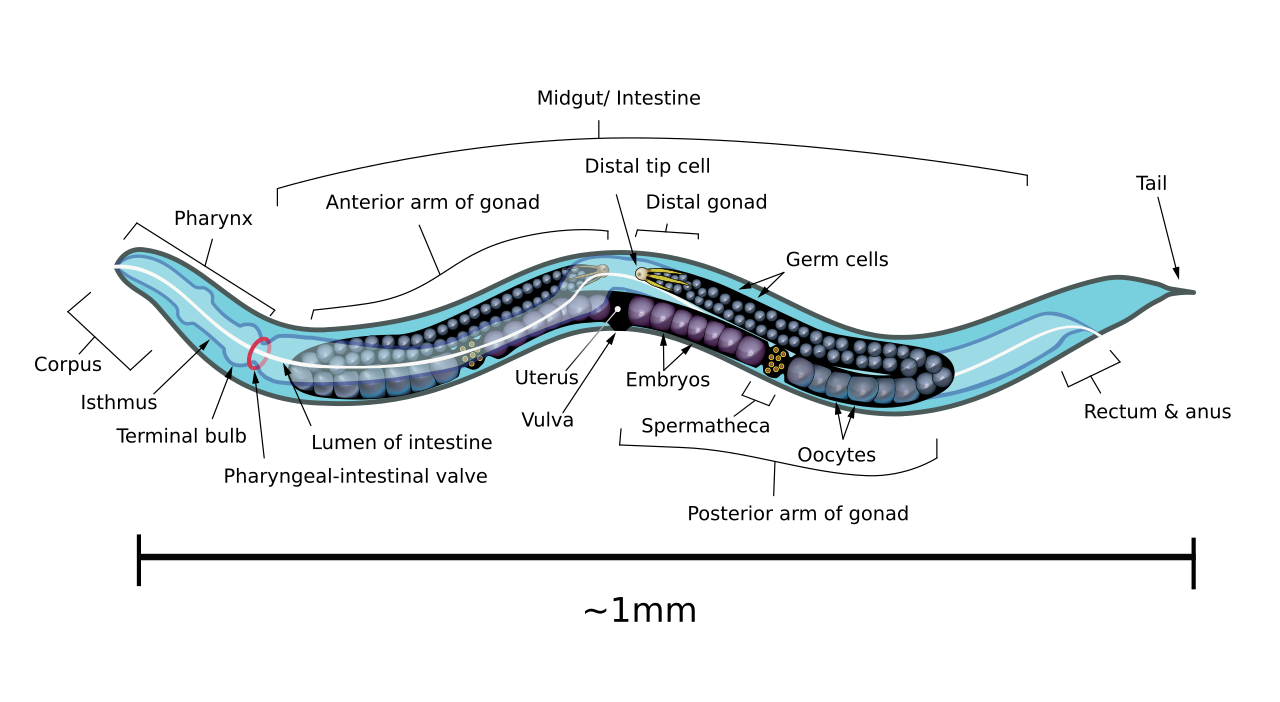
Image 13A lateral (left side) anatomical diagram of an adult-stage nematode hermaphrodite Caenorhabditis elegans ( full size) with emphasis on the digestive and reproductive systems. C. elegans is a free-living, transparent nematode (roundworm) which measures about 1 millimetre (0.039 in) in length. The hermaphrodite form, as seen here, is the most common, although a male form is also found. When self-inseminated, the species will lay about 300 eggs, but when the hermaphrodite is inseminated by a male, the number of progeny can exceed 1,000.
-
Image 14A female Calliope Hummingbird ( Stellula calliope), the smallest bird found in Canada and the United States, feeding insects to chicks. Found mostly in western North America (although vagrants have been found in New York and Connecticut), it is migratory and winters in southwestern Mexico.
-
Image 15Liguus virgineus, also known as the candy cane snail, is a species of snail in the family Orthalicidae. It is native to the Caribbean island of Hispaniola, in the nations of Haiti and the Dominican Republic. There have also been at least three reports of living specimens being found in the Florida Keys of the United States. The snail lives on trees and feeds on moss, fungi and microscopic algae covering the bark.
-
-
Image 17A cross section of a post- clitellum segment of an annelid (ringed worm); almost all segments of an annelid contain the same set of organs and parts, a pattern called metamerism. Annelids have no lungs, but rather exchange carbon dioxide and oxygen directly through the moist skin when blood reaches the extremely fine capillaries of the body walls; a dry worm cannot breathe and will die of suffocation. The worm's red blood, which does not consist of platelets or red cells but mostly of a liquid containing suspended hemoglobin, makes a circuit up and down the animal in its closed circulatory systems.
-
Image 18Brittle stars, serpent stars, or ophiuroids (from Latin ophiurus 'brittle star'; from Ancient Greek ὄφις (óphis) 'serpent' and οὐρά (ourá) 'tail'; referring to the serpent-like arms of the brittle star) are echinoderms in the class Ophiuroidea, closely related to starfish. They crawl across the sea floor using their flexible arms for locomotion. The ophiuroids generally have five long, slender, whip-like arms which may reach up to 60 cm (24 in) in length on the largest specimens. ( Full article...)
-
Image 19A soybean cyst nematode ( Heterodera glycines), together with an egg, as viewed through a low-temperature scanning electron microscope at 1000x magnification. This nematode infects the roots of soybeans, and the female nematode eventually becomes a cyst. Infection causes various symptoms that may include chlorosis of the leaves and stems, root necrosis, loss in seed yield and suppression of root and shoot growth.
-
Image 20Credit: Twilight Zone Expedition Team 2007, NOAA-OE
Selected article - Entries here consist of Good and Featured articles, which meet a core set of high editorial standards.
Cetacea is an infraorder that comprises the 94 species of whales, dolphins, and porpoises. It is divided into toothed whales (Odontoceti) and baleen whales (Mysticeti), which diverged from each other in the Eocene some 50 million years ago (mya). Cetaceans are descended from land-dwelling hoofed mammals, and the now extinct archaeocetes represent the several transitional phases from terrestrial to completely aquatic. Historically, cetaceans were thought to have descended from the wolf-like mesonychians, but cladistic analyses confirm their placement with even-toed ungulates in the order Cetartiodactyla.
Whale populations were drastically reduced in the 20th century from intensive whaling, which led to a moratorium on hunting by the International Whaling Commission in 1982. Smaller cetaceans are at risk of accidentally getting caught by fishing vessels using, namely, seine fishing, drift netting, or gill netting operations. (Full article...)
- ... that super weaners may be "milk thieves" or "double mother-sucklers"?
The following are images from various animal-related articles on Wikipedia.
-
-
Image 2The Spiralia develop with spiral cleavage in the embryo, as here in a sea snail. (from Animal)
-
Image 3Myxozoans such as Myxobolus cerebralis are single-celled parasites, never more than 20 μm across. (from Animal)
-
-
Image 5Jean-Baptiste de Lamarck led the creation of a modern classification of invertebrates, breaking up Linnaeus's "Vermes" into nine phyla by 1809. (from Animal)
-
-
Image 7The red pigment in a flamingo's plumage comes from its diet of shrimps, which get it from microscopic algae. (from Animal coloration)
-
Image 8Examples of fauna in Olleros de Tera ( Spain) (from Fauna)
-
Image 9Animal anatomical engraving from Handbuch der Anatomie der Tiere für Künstler. (from Zoology)
-
Image 10In Roseate Spoonbills 1905–1909, Abbott Handerson Thayer tried to show that even the bright pink of these conspicuous birds had a cryptic function. (from Animal coloration)
-
Image 11A venomous coral snake uses bright colours to warn off potential predators. (from Animal coloration)
-
Image 12Bright coloration of orange elephant ear sponge, Agelas clathrodes signals its bitter taste to predators (from Animal coloration)
-
Image 13A clade representation of seven dog breeds in relation to wolves. (from Zoology)
-
Image 14Artistic vision: Still Life with Lobster and Oysters by Alexander Coosemans, c. 1660 (from Animal)
-
Image 15Idealised nephrozoan body plan. With an elongated body and a direction of movement the animal has head and tail ends. Sense organs and mouth form the basis of the head. Opposed circular and longitudinal muscles enable peristaltic motion. (from Animal)
-
Image 16The hawk-cuckoo resembles a predatory shikra, giving the cuckoo time to lay eggs in a songbird's nest unnoticed (from Animal coloration)
-
Image 17Simplified schematic of an island's fauna – all its animal species, highlighted in boxes (from Fauna)
-
Image 18Fish and frog melanophores are cells that can change colour by dispersing or aggregating pigment-containing bodies. (from Animal coloration)
-
Image 19Conrad Gessner (1516–1565). His Historiae animalium is considered the beginning of modern zoology. (from Zoology)
-
Image 20Linnaeus's table of the animal kingdom from the first edition of Systema Naturae (1735) (from Zoology)
-
Image 21Papuan, Australian and New Zealand fauna. This image was likely first published in the first edition (1876–1899) of the Nordisk familjebok. (from Fauna)
-
Image 22A praying mantis in deimatic or threat pose displays conspicuous patches of colour to startle potential predators. This is not warning coloration as the insect is palatable. (from Animal coloration)
-
Image 23Robert Hooke's Micrographia (from Animal coloration)
-
Image 24Non-bilaterians include sponges (centre) and corals (background). (from Animal)
-
Image 25Animals are unique in having the ball of cells of the early embryo (1) develop into a hollow ball or blastula (2). (from Animal)
-
Image 26Sides of beef in a slaughterhouse (from Animal)
-
Image 27A camouflaged orange oak leaf butterfly, Kallima inachus (centre) has protective resemblance. (from Animal coloration)
-
Image 28Kelp gull chicks peck at red spot on mother's beak to stimulate the regurgitating reflex. (from Zoology)
-
Image 29The black and yellow warning colours of the cinnabar moth caterpillar, Tyria jacobaeae, are avoided by some birds. (from Animal coloration)
-
-
-
Image 32Predators, such as this ultramarine flycatcher ( Ficedula superciliaris), feed on other animals. (from Animal)
-
Image 33Sexual reproduction is nearly universal in animals, such as these dragonflies. (from Animal)
-
Image 34A brilliantly-coloured oriental sweetlips fish ( Plectorhinchus vittatus) waits while two boldly-patterned cleaner wrasse ( Labroides dimidiatus) pick parasites from its skin. The spotted tail and fin pattern of the sweetlips signals sexual maturity; the behaviour and pattern of the cleaner fish signal their availability for cleaning service, rather than as prey. (from Animal coloration)
-
Image 35Male Goldie's bird-of-paradise displays to a female. (from Animal coloration)
-
Image 36A gun dog retrieving a duck during a hunt (from Animal)
-
Image 37Side of zebrafish shows how chromatophores (dark spots) respond to 24 hours in dark (above) or light (below). (from Animal coloration)
-
Image 38The microscopic cave snail Zospeum tholussum, found at depths of 743 to 1,392 m (2,438 to 4,567 ft) in the Lukina Jama–Trojama cave system of Croatia, is completely blind with a translucent shell (from Fauna)
-
Image 39Warning coloration of the skunk in Edward Bagnall Poulton's The Colours of Animals, 1890 (from Animal coloration)
-
Image 40This frog changes its skin colour to control its temperature. (from Animal coloration)
-
Image 41The bilaterian gut develops in two ways. In many protostomes, the blastopore develops into the mouth, while in deuterostomes it becomes the anus. (from Animal)
-
Image 42The brilliant iridescent colours of the peacock's tail feathers are created by Structural coloration. (from Animal coloration)
-
Image 43The blue whale is the largest animal that has ever lived; it can be up to 33.6 metres (110 ft) long. (from Animal)
-
Image 44Hydrothermal vent mussels and shrimps (from Animal)
-
Image 45Butterfly wing at different magnifications reveals microstructured chitin acting as diffraction grating. (from Animal coloration)
-
Image 46The olm's blood makes it appear pink. (from Animal coloration)
-
Image 47Squid chromatophores appear as black, brown, reddish and pink areas in this micrograph. (from Animal coloration)
The following table lists estimated numbers of described extant species for the animal groups with the largest numbers of species,[1] along with their principal habitats (terrestrial, fresh water,[2] and marine),[3] and free-living or parasitic ways of life.[4] Species estimates shown here are based on numbers described scientifically; much larger estimates have been calculated based on various means of prediction, and these can vary wildly. For instance, around 25,000–27,000 species of nematodes have been described, while published estimates of the total number of nematode species include 10,000–20,000; 500,000; 10 million; and 100 million.[5] Using patterns within the taxonomic hierarchy, the total number of animal species—including those not yet described—was calculated to be about 7.77 million in 2011.[6][7][a]
| Phylum
|
Example
|
No. of
Species
|
Land
|
Sea
|
Fresh
water
|
Free-
living
|
Parasitic
|
| Annelids
|
|
17,000[1]
|
Yes (soil)[3]
|
Yes[3]
|
1,750[2]
|
Yes
|
400[4]
|
| Arthropods
|
|
1,257,000[1]
|
1,000,000
(insects)[9]
|
>40,000
(Malac-
ostraca)[10]
|
94,000[2]
|
Yes[3]
|
>45,000[b][4]
|
| Bryozoa
|
|
6,000[1]
|
|
Yes[3]
|
60–80[2]
|
Yes
|
|
| Chordates
|
|
65,000[1]
45,000[11]
|
23,000[11]
|
13,000[11]
|
18,000[2]
9,000[11]
|
Yes
|
40
(catfish)[12][4]
|
| Cnidaria
|
|
16,000[1]
|
|
Yes[3]
|
Yes (few)[3]
|
Yes[3]
|
>1,350
(Myxozoa)[4]
|
| Echinoderms
|
|
7,500[1]
|
|
7,500[1]
|
|
Yes[3]
|
|
| Molluscs
|
|
85,000[1]
107,000[13]
|
35,000[13]
|
60,000[13]
|
5,000[2]
12,000[13]
|
Yes[3]
|
>5,600[4]
|
| Nematodes
|
|
25,000[1]
|
Yes (soil)[3]
|
4,000[5]
|
2,000[2]
|
11,000[5]
|
14,000[5]
|
| Platyhelminthes
|
|
29,500[1]
|
Yes[14]
|
Yes[3]
|
1,300[2]
|
Yes[3]
3,000–6,500[15]
|
>40,000[4]
4,000–25,000[15]
|
| Rotifers
|
|
2,000[1]
|
|
>400[16]
|
2,000[2]
|
Yes
|
|
| Sponges
|
|
10,800[1]
|
|
Yes[3]
|
200-300[2]
|
Yes
|
Yes[17]
|
Total number of described extant species as of 2013: 1,525,728 [1] |
Select [►] to view subcategories
Animals Animals by century of formal description Animals by conservation status Behavior by type of animal Set index articles on animals
WikiProject family tree
- (By taxa)
- WikiProject Arthropods
-
- Ant task force
- WikiProject Beetles
- WikiProject Lepidoptera
- WikiProject Phasmatodea
- WikiProject Bivalves
- WikiProject Cephalopods
- WikiProject Gastropods
- WikiProject Amphibians and Reptiles
- WikiProject Dinosaurs
- WikiProject Turtles
- Domestic pigeon task force
- WikiProject Poultry
- WikiProject Aquarium Fishes
- WikiProject Sharks
- WikiProject Cats
- WikiProject Cetaceans
- WikiProject Dogs
- WikiProject Primates
- WikiProject Rodents
- WikiProject Bats
- WikiProject Animal anatomy
- WikiProject Animal rights
- WikiProject Cryptozoology
- WikiProject Neuroscience
- WikiProject Organismal Biomechanics
- WikiProject Zoo
|
|
|
Here are some Open Tasks : |
The following Wikimedia Foundation sister projects provide more on this subject:
- ^ The application of DNA barcoding to taxonomy further complicates this; a 2016 barcoding analysis estimated a total count of nearly 100,000 insect species for Canada alone, and extrapolated that the global insect fauna must be in excess of 10 million species, of which nearly 2 million are in a single fly family known as gall midges (Cecidomyiidae).[8]
- ^ Not including parasitoids.[4]
- ^ a b c d e f g h i j k l m n Zhang, Zhi-Qiang (2013-08-30). "Animal biodiversity: An update of classification and diversity in 2013". Zootaxa. 3703 (1): 5. doi:10.11646/zootaxa.3703.1.3. Archived from the original on 24 April 2019. Retrieved 2 March 2018.
- ^ a b c d e f g h i j Balian, E. V.; Lévêque, C.; Segers, H.; Martens, K. (2008). Freshwater Animal Diversity Assessment. Springer. p. 628. ISBN 978-1-4020-8259-7.
- ^ a b c d e f g h i j k l m n Hogenboom, Melissa. "There are only 35 kinds of animal and most are really weird". BBC Earth. Archived from the original on 10 August 2018. Retrieved 2 March 2018.
- ^ a b c d e f g h Poulin, Robert (2007). Evolutionary Ecology of Parasites. Princeton University Press. p. 6. ISBN 978-0-691-12085-0.
- ^ a b c d Felder, Darryl L.; Camp, David K. (2009). Gulf of Mexico Origin, Waters, and Biota: Biodiversity. Texas A&M University Press. p. 1111. ISBN 978-1-60344-269-5.
- ^ "How many species on Earth? About 8.7 million, new estimate says". 24 August 2011. Archived from the original on 1 July 2018. Retrieved 2 March 2018.
- ^ Mora, Camilo; Tittensor, Derek P.; Adl, Sina; Simpson, Alastair G.B.; Worm, Boris (2011-08-23). Mace, Georgina M. (ed.). "How Many Species Are There on Earth and in the Ocean?". PLOS Biology. 9 (8) e1001127. doi:10.1371/journal.pbio.1001127. PMC 3160336. PMID 21886479.
- ^ Hebert, Paul D.N.; Ratnasingham, Sujeevan; Zakharov, Evgeny V.; Telfer, Angela C.; Levesque-Beaudin, Valerie; Milton, Megan A.; Pedersen, Stephanie; Jannetta, Paul; deWaard, Jeremy R. (1 August 2016). "Counting animal species with DNA barcodes: Canadian insects". Philosophical Transactions of the Royal Society B: Biological Sciences. 371 (1702) 20150333. doi:10.1098/rstb.2015.0333. PMC 4971185. PMID 27481785.
- ^ Stork, Nigel E. (January 2018). "How Many Species of Insects and Other Terrestrial Arthropods Are There on Earth?". Annual Review of Entomology. 63 (1): 31–45. doi:10.1146/annurev-ento-020117-043348. PMID 28938083. S2CID 23755007. Stork notes that 1m insects have been named, making much larger predicted estimates.
- ^ Poore, Hugh F. (2002). "Introduction". Crustacea: Malacostraca. Zoological catalogue of Australia. Vol. 19.2A. CSIRO Publishing. pp. 1–7. ISBN 978-0-643-06901-5.
- ^ a b c d Reaka-Kudla, Marjorie L.; Wilson, Don E.; Wilson, Edward O. (1996). Biodiversity II: Understanding and Protecting Our Biological Resources. Joseph Henry Press. p. 90. ISBN 978-0-309-52075-1.
- ^ Burton, Derek; Burton, Margaret (2017). Essential Fish Biology: Diversity, Structure and Function. Oxford University Press. pp. 281–282. ISBN 978-0-19-878555-2.
Trichomycteridae ... includes obligate parasitic fish. Thus 17 genera from 2 subfamilies, Vandelliinae; 4 genera, 9spp. and Stegophilinae; 13 genera, 31 spp. are parasites on gills (Vandelliinae) or skin (stegophilines) of fish.
- ^ a b c d Nicol, David (June 1969). "The Number of Living Species of Molluscs". Systematic Zoology. 18 (2): 251–254. doi:10.2307/2412618. JSTOR 2412618.
- ^ Sluys, R. (1999). "Global diversity of land planarians (Platyhelminthes, Tricladida, Terricola): a new indicator-taxon in biodiversity and conservation studies". Biodiversity and Conservation. 8 (12): 1663–1681. doi:10.1023/A:1008994925673. S2CID 38784755.
- ^ a b Pandian, T. J. (2020). Reproduction and Development in Platyhelminthes. CRC Press. pp. 13–14. ISBN 978-1-000-05490-3.
- ^ Fontaneto, Diego. "Marine Rotifers | An Unexplored World of Richness" (PDF). JMBA Global Marine Environment. pp. 4–5. Archived (PDF) from the original on 2 March 2018. Retrieved 2 March 2018.
- ^ Morand, Serge; Krasnov, Boris R.; Littlewood, D. Timothy J. (2015). Parasite Diversity and Diversification. Cambridge University Press. p. 44. ISBN 978-1-107-03765-6. Archived from the original on 12 December 2018. Retrieved 2 March 2018.
Discover Wikipedia using portals
-
List of all portals
-
-
-
-
-
-
-
-
-
-
Random portal
-
WikiProject Portals
-
|