Edward G. Robinson
Edward G. Robinson | |
|---|---|
Robinson in the 1930s | |
| Born | Emanuel Goldenberg December 12, 1893 Bucharest, Kingdom of Romania |
| Died | January 26, 1973 (aged 79) Los Angeles, California, U.S. |
Resting place | Beth El Cemetery, Ridgewood, Queens |
| Occupation | Actor |
| Years active | 1913–1973 |
| Spouses | Gladys Lloyd
(m. 1927; div. 1956)Jane Adler (m. 1958) |
| Children | Edward G. Robinson Jr. |
| Awards | |
Edward Goldenberg Robinson (born Emanuel Goldenberg; December 12, 1893 – January 26, 1973) was an American actor who was popular during Hollywood's Golden Age. After making his stage debut in 1913, he rose to stardom with his performance as the title character in Little Caesar (1931) and became well known for his portrayals of gangsters. He starred in a variety of films, including the biopics Dr. Ehrlich's Magic Bullet and A Dispatch from Reuters (both 1940) and the film noirs Double Indemnity and The Woman in the Window (both 1944).
During the 1930s and 1940s, Robinson was an outspoken public critic of fascism and Nazism, which were growing in strength in Europe in the years which led up to World War II. His activism included contributing over $250,000 to more than 850 organizations that were involved in war relief, along with contributions to cultural, educational, and religious groups. His postwar films include The Stranger (1946) and Key Largo (1948), and he won the Cannes Film Festival Award for Best Actor for House of Strangers (1949).
During the 1950s, Robinson was called to testify in front of the House Un-American Activities Committee during the Red Scare, but he was cleared of any deliberate Communist involvement. He did not name names but renounced a number of leftist organizations so as not to be probed further. As a result of being investigated, he found himself on Hollywood's graylist, people who were on the Hollywood blacklist maintained by the major studios, but could find work at minor film studios on what was called Poverty Row. He returned to the A-list when Cecil B. DeMille cast him as Dathan (the adversary of Moses) in The Ten Commandments (1956).
During his 60-year career, Robinson appeared in 30 Broadway plays,[1] and more than 100 films.[2] In 1956, he was nominated for the Tony Award for Best Actor in a Play for Middle of the Night.[3] He played his final role in the science-fiction story Soylent Green (1973).[4] Multiple film critics and media outlets have cited him as one of the best actors never to have received an Academy Award nomination.[5][6] He received an Academy Honorary Award for his work in the film industry, which was awarded two months after he died in 1973. In 1999, he was ranked number 24 in the American Film Institute's list of the 25 greatest male stars of Classic American cinema.
Early years and education
Robinson was born Emanuel Goldenberg (Yiddish: עמנואל גאָלדענבערג) on December 12, 1893, in a Yiddish-speaking Romanian Jewish family in Bucharest, the fifth and penultimate son of Sarah (née Guttman) and Yeshaya Moyshe Goldenberg (later called Morris in the U.S.), a builder and tinsmith.[7] He had five brothers: Zach, Jack, Oscar, Willie, and Max.[8] The family lived in one of several attached buildings surrounding a court at 671 Strada Cantemier in Bucharest.[9] Emanuel, known as "Manny", was close to his maternal grandmother, who lived with them and often told him stories from the Hebrew Bible.[10] He was enrolled at a Jewish school, where he studied the Torah and learned Hebrew and German.[11] Once, his father took him to a see a film, a silent Western, but both thought motion pictures were just "a passing fad." At a Bucharest café they saw a Romanian play based on Jules Verne's Around the World in Eighty Days: "I loved that, and I thought the actors were making up the words."[11]
According to the New York Times, one of his brothers was attacked by an anti-semitic gang during a "schoolboy pogrom".[2] In the wake of that violence, the family decided to emigrate to the United States.[2] Robinson arrived in New York City on February 21, 1904.[12] "At Ellis Island I was born again," he wrote. "Life for me began when I was 10 years old."[2] He grew up on the Lower East Side,[13]: 91 and had his bar mitzvah at the First Roumanian-American Congregation.[14] He attended Townsend Harris High School and then the City College of New York, planning to become a criminal attorney.[15] An interest in acting and performing in front of people led to his winning an American Academy of Dramatic Arts scholarship,[15] after which he changed his name to Edward G. Robinson (the G. standing for his original surname).[15] He had heard the surname "Robinson" in a play and liked "the ring and strength of it", and for the given name he chose "Edward" after King Edward VII.[16]
He served in the United States Navy during World War I, but was not sent overseas.[17]
Career
Theatre and film debut
Robinson made his professional stage debut playing a character named Sato in a production of Paid in Full, which opened in April 1913 in Binghamton, New York.[18][19] He then joined a Cincinnati stock company called The Orpheum Players for 22 weeks and played various roles in many plays, including two different characters in Alias Jimmy Valentine. "I was becoming adept at doubling—that is, playing two parts in one play, in suitable disguises. I did it all season," he later wrote.[20] Robinson's next stage appearance was as the guide Nasir in a touring production of Kismet that took him to Ottawa and Montreal before closing in November 1914.[21] In 1915, Robinson made his Broadway debut at the Hudson Theatre in Archibald and Edgar Selwyn's production of the play Under Fire, written by Roi Cooper Megrue.[22] He played four roles in Under Fire: "They were all bit parts, but I portrayed a French spy, a Belgian peasant, a Prussian soldier and a Cockney private. I became known as the league of nations."[23] Under Fire ran for six months and the Selwyns hired Robinson for the role of a prisoner in their production of another play written by Megrue, Under Sentence.[24] After Under Sentence, he played a wide range of characters, including a Filipino in Azelle M. Aldrich and Joseph Noll's The Pawn (1917), a German soldier in Drafted (1917), a Swede in Henning Berger's The Deluge (1917), and a French-Canadian in Harry James Smith's The Little Teacher (1918).[25][26] The Little Teacher was a success, but he left the production to enlist as a sailor in the United States Navy.[27] He went to Pelham Bay Naval Training Station and also applied to enter naval intelligence.[28] During this time, Robinson thought films were "scarcely an art form" and believed "the living theater was the only theater and all the rest was nonsense."[29]
When World War I ended, Robinson went back to the stage and toured with the Garrick Players of Washington, D.C.[30] He returned to Broadway in 1919 with a role in First is Last, "the first and only time" he played an Anglo-Saxon on stage.[31] In 1920, he was cast in productions of Maxim Gorky's Night Lodging and Booth Tarkington's Poldekin.[32] In November, Arthur Hopkins gave him a role in a play titled Samson and Delilah, starring Jacob Ben-Ami.[33] He disliked his performance in the silent film Fields of Glory and producer Sam Goldwyn cut it out.[34] In the summer of 1921, he performed in five plays at the Elitch Theatre in Denver, Colorado.[35] He liked his role as Mendel in The Idle Inn (1921) and also played in the 1922 revival of The Deluge.[36] Following a return to Denver's Elitch Theatre, Robinson accepted a role in Alfred Savoir's Banco, with Alfred Lunt in the title role.[37] Film director John S. Robertson offered Robinson the supporting role of Domingo Escobar in the silent film The Bright Shawl (1923), which was based on a Joseph Hergesheimer novel of the same title. Robinson traveled to Havana, Cuba, for the filming and was paid the equivalent of a stage actor's 20-week salary.[38] He later remembered, "In any case, The Bright Shawl was not nearly as heartrending an experience as Fields of Glory. Still, the manufacture of a movie seemed silly and unrewarding to me."[39] In 1923, he appeared in four Broadway productions: Henrik Ibsen's Peer Gynt, starring his friend Joseph Schildkraut; Elmer Rice's avant-garde The Adding Machine; Ferenc Molnár's Launzi, with Pauline Lord in the title role; and A Royal Fandango, starring Ethel Barrymore.[40]
Broadway success and first sound films
In 1924, Robinson played the role of Ed Munn in a stage adaptation of the Olive Higgins Prouty novel Stella Dallas, starring the eminent actress Mrs. Leslie Carter in the title role.[41] That same year, he had a role in the successful Broadway production of Edwin Justus Mayer's The Firebrand, a play about Benvenuto Cellini and the Medicis; Robinson played the part of Ottaviano, the cousin of Frank Morgan's character, Alessandro de' Medici, Duke of Florence.[42] From November 1925 to January 1926,[43] Robinson played two George Bernard Shaw characters: Caesar in the Theatre Guild revival of Androcles and the Lion and Giuseppe in its curtain raiser, The Man of Destiny.[44] He played a Jew in the Guild's production of Franz Werfel's The Goat Song (1926).[45] The Guild cast him as a stage director in Nikolai Evreinov's The Chief Thing (1926),[46] a play he described as "highly theatrical and stirring."[47] In August, Robinson appeared with actress Gladys Lloyd (his future wife) in the play Henry Behave.[48] In October, he portrayed Mexican general Porfirio Díaz in the Guild production of Juarez and Maximilian,[49] a Werfel play about the Second Mexican Empire. In November, he played a New England lawyer in Sidney Howard's Ned McCobb's Daughter.[50]
From January to February 1927, Robinson enacted the role of Smerdiakov in the Guild's adaptation of Fyodor Dostoevsky's novel The Brothers Karamazov.[51] His next and final role for the Guild was Ponza in Luigi Pirandello's Right You Are If You Think You Are (1927).[52] In the summer, Robinson went to Atlantic City to play a cigar store owner in a production of Jo Swerling's The Kibitzer, the first play billed "with Edward G. Robinson."[53] When The Kibitzer closed, he returned to Broadway and took the role of a gangster in Bartlett Cormack's The Racket, which ran for 119 performances between November 1927 and March 1928.[54] Although he disliked the character, he later remembered, "Boy, did that play change my life. It was a smash!"[53] The Racket was also staged at the Curran in San Francisco and the Biltmore in Los Angeles, where film studio executives saw Robinson and offered him contracts, which he turned down.[55] In late 1928, he wore a red wig for his next Broadway role, a "maniacal masochist" in a stage adaptation of Hugh Walpole's A Man with Red Hair.[55] Robinson accepted a $50,000 offer from film producer Walter Wanger to play a role opposite Claudette Colbert in the 1929 sound film The Hole in the Wall, filmed at Paramount's Kaufman Astoria Studios.[56] It was his first sound film and he found he had to "develop a whole new bag of tricks", which included speaking in a lower voice, acting without exaggerated expressions, and filming a story out of continuity. Robinson later said:
I must admit I thought Hole in the Wall was going to be the stinker of all times, and I certainly did not accept the invitation to go the preview. Claudette went, and she sent me a wire: "We weren't too bad, baby. We weren't too bad. Love, Claudette."
I take her word for it. I've never seen the film.[57]
Robinson helped Swerling rewrite The Kibitzer and Swerling shared the playwriting credit with him. A success, the rewritten play ran on Broadway for 120 performances from February to June 1929.[58] Robinson later remarked, "It was also a vehicle for me. Why not? I was the coauthor, and I gave myself all the best of it. […] Every once in a while an actor finds a play that serves him well."[59] Swerling and the play's producer, Patterson McNutt, sold the film rights to Paramount Pictures without Robinson's consent. He sued them but lost.[60] He had a featured role in the Universal film Night Ride (1930). A. H. Woods offered Robinson star billing in a play with "junky" dialogue, which he rejected. MGM producer Irving Thalberg sent him the "beautifully written" script for the film A Lady to Love (1930).[61] He went to California and played a 50-year-old Italian opposite top-billed Vilma Bánky as his wife. The film, directed by Victor Sjöström, was a success with audiences, but Robinson declined a three-year contract with MGM.[62] At Universal, Robinson got second billing in Outside the Law and also replaced Jean Hersholt as Charlie Yong in East Is West (both 1930).[63] He followed these films with eight performances as the title character in Edmond Fleg's play Mr. Samuel (originally titled Le marchand de Paris) in November 1930.[64] Hal Wallis saw Robinson in Mr. Samuel and went backstage to inform him that Warners-First National Pictures wanted to make a deal with him.[65] After signing a contract with the studio, Robinson played the male lead in his first film for Warners, The Widow from Chicago (1931) with Alice White.[66]
Little Caesar and stardom at Warners
At this point, Robinson was becoming an established film actor. What began his rise to stardom was an acclaimed portrayal of the gangster Caesar Enrico "Rico" Bandello in Little Caesar (1931) at Warner Bros. The New York Times praised his "wonderfully effective performance" and also wrote, "Little Caesar becomes at Mr. Robinson's hands a figure out of Greek epic tragedy".[67] Hal Wallis had originally offered him the bit part of Otero, but Robinson thought he was not right for that role and did not want to play bit parts. He told Wallis, "If you're going to have me in Little Caesar as Otero, you will completely imbalance the picture. The only part I will consider playing is Little Caesar."[68] Warners immediately cast him in another gangster film, Smart Money (1931), his only movie with James Cagney. In Smart Money, he played a barber whose weaknesses are gambling and blondes; he later said, "For the record, I am the most penny ante of gamblers and I prefer brunettes."[69] He was reunited with Mervyn LeRoy, director of Little Caesar, in Five Star Final (1931), where he played a journalist named Randall.[70] Five Star Final was nominated for the Academy Award for Best Picture and became one of Robinson's favorites: "I loved Randall because he wasn't a gangster. […] He made sense, and thus I'm able to say that Five Star Final is one of my favorite films."[71]
Robinson's next two films were not among his favorites. He described The Hatchet Man (1932) as "one of my horrible memories" and Two Seconds (1932) as "a mishmash memory".[71] He "adored" Tiger Shark (1932), a melodrama directed by Howard Hawks, because Hawks "let [him] chew the scenery" as a tuna fisherman.[71] Warners then starred him in a "highly fictionalized" biopic he "rather liked", Silver Dollar (1932), where Robinson portrayed prospector Horace Tabor.[71] Mary Astor was his love interest in The Little Giant (1933), a comedy about a beer baron who tries to enter high society.[72] Astor was one of Robinson's favorite leading ladies: "She had then all the attributes that make for greatness in an actress: beauty, poise, experience, talent, and, above all, she did her homework. She has been vastly underrated, and it's a great pity."[73] He disliked the script for his next film, I Loved a Woman (1933), and managed to have it rewritten. Robinson thought Kay Francis, his co-star, "had that indefinable presence that somehow enabled her to be convincing as well as beautiful."[74] He "loathed" Dark Hazard (1934) but enjoyed making The Man with Two Faces (1934) because he was reunited with Astor and had the opportunity to "use a putty nose, a set of whiskers, false eyebrows, and a French accent."[75]
Warners loaned Robinson to Columbia for the John Ford-directed comedy The Whole Town's Talking (1935), which was based on a novel written by W. R. Burnett, the author of Little Caesar. He played two characters in the film: a notorious murderer and a clerk who resembles him. Robinson called Ford "the consummate professional" and "a totally remarkable director".[76] He also said it "was a delight to work with and to know" Jean Arthur, his leading lady in The Whole Town's Talking.[77] Sam Goldwyn borrowed him for the historical Western film Barbary Coast (1935), directed by Hawks and co-starring Miriam Hopkins. Robinson later wrote that working with Hopkins was "a horror": "I tried to work with her. She made no effort whatever to work with me."[77] Although she was always late and uncooperative, Hopkins agreed to act without her shoes whenever she had a scene with Robinson, who disliked the idea of standing on a box to look taller.[78] Tired of Hopkins' unprofessionalism, Robinson eventually confronted her and told her off in front of the cast and crew. After that, Robinson and Hopkins had to play a slap scene and she told him, "Eddie, let's do this right. You smack me now so we won't have to do it over and over again. Do you hear me, Eddie? Smack me hard." The slap was so loud everyone heard it and applauded.[79]
Back at Warner Bros., Robinson agreed to play a detective in Bullets or Ballots (1936) only after small changes were made to the screenplay.[80] Warners then sent him to Britain for the role of a salesman in the comedy Thunder in the City (1937). The British producers allowed Robinson to change the script and he asked Robert E. Sherwood to rewrite it. Sherwood turned it into a satire, but the film was not successful.[81] Robinson starred as the title character's promoter in the boxing drama Kid Galahad (1937), with Bette Davis as his leading lady and Humphrey Bogart in a supporting role. Davis' acting style did not impress him when they made the film: "Miss Davis was, when I played with her, not a very gifted amateur and employed any number of jarring mannerisms that she used to form an image. In her early period Miss Davis played the image, and not herself, and certainly not the character provided by the author."[82] Robinson turned down several scripts at Warners before MGM borrowed him for the title role in The Last Gangster (1937), featuring James Stewart and "the compelling" Rose Stradner.[83] He returned to Warners and approved of his next two assignments: the "very funny" comedy A Slight Case of Murder (1938), for which he received good notices from critics, and The Amazing Dr. Clitterhouse (1938), in which he played the title role, which had been originated on stage by Sir Cedric Hardwicke.[84] Robinson accepted an offer from Columbia to star in I Am the Law (1938) as a professor who becomes a prosecutor. He later described the film as "a potboiler, but at least I was on the right side of the law for once and survived; up to now, it seemed to me, I had died in every picture."[85]
World War II
At the time World War II broke out in Europe, Robinson played an FBI agent in Confessions of a Nazi Spy (1939), the first American film that portrayed Nazism as a threat to the United States. MGM borrowed him for the lead role in the financially successful drama Blackmail (1939).[86] Then, to avoid being typecast, Robinson portrayed the biomedical scientist and Nobel laureate Paul Ehrlich in the biopic Dr. Ehrlich's Magic Bullet (1940). He later said, "Among all the plays and films in which I've appeared, I'm proudest of my role in Dr. Ehrlich's Magic Bullet. […] It was, I think, one of the most distinguished performances I've ever given."[87] Robinson also portrayed entrepreneur Paul Julius Reuter in A Dispatch from Reuters (1940),[88] his second-favorite film.[89] Both films were biographies of prominent Jewish public figures. In between, Robinson played a gangster who goes to a monastery in the comedy Brother Orchid (1940), featuring Humphrey Bogart and Ann Sothern. According to Robinson, he and Bogart "got along splendidly" and "respected each other."[89]
Robinson portrayed the villainous Wolf Larsen in the 1941 film adaptation of the Jack London novel The Sea Wolf, co-starring John Garfield and Ida Lupino. He thought Garfield "was one of the best young actors I ever encountered".[89] Robinson followed The Sea Wolf with a top-billed role opposite Marlene Dietrich and George Raft in Manpower (1941). In his autobiography, he remembered Dietrich's professionalism: "Playing with her, I learned that we shared a common passion: work. More than that: Be on time, know the lines, toe the marks, say the words, be ready for anything."[90] Although he described Manpower as mostly "inane", Robinson considered that he and Dietrich were a "stunning combination" and that adding Raft as the third lead was "showmanship casting."[91] He found Raft to be "touchy, difficult, thoroughly impossible to play with"; Robinson wanted to leave the film when Raft punched him, but Hal Wallis convinced him to stay.[92] He went to MGM for Unholy Partners (1942), a film he thought was "best forgotten", and returned to Warners for the comedy Larceny, Inc. (1942).[93] He volunteered for military service in June 1942 but was disqualified as he was aged 48;[94] he was an active and vocal critic of fascism and Nazism during the war.[95]
Post-Warner Bros.
Robinson was one of several stars in the 20th Century-Fox anthology film Tales of Manhattan (1942), where he played a role in one of the five stories.[96] He opined that his next four films were "at the very best, trivial": the Universal anthology film Flesh and Fantasy (1943), the Columbia war drama Destroyer (1943), the Fox war drama Tampico (1944), and the Columbia war comedy Mr. Winkle Goes to War (1944).[97] At Paramount, he co-starred with Fred MacMurray and Barbara Stanwyck in one of his favorite films, Billy Wilder's Double Indemnity (1944), where his riveting soliloquy on insurance actuarial tables (written by Raymond Chandler) is considered one of the most memorable moments of his career. He played the third leading role in Double Indemnity: "I debated accepting it; Emanuel Goldenberg told me that at my age it was time to begin thinking of character roles, to slide into middle and old age with the same grace as that marvelous actor Lewis Stone."[98] He then went to RKO to play the top-billed role of a college professor who befriends Joan Bennett in Fritz Lang's The Woman in the Window (1944), featuring Dan Duryea in a supporting role. Robinson remembered Lang as "one of the greats in his declining period."[99] Robinson, Bennett, and Duryea were reunited in another Lang film, Scarlet Street (1945), where Robinson played a married painter in love with Bennett. He did not like Scarlet Street: "[I] hastened to finish it, so monotonous was the story and the character I played."[99]
At MGM, Robinson played a Norwegian farmer in the drama Our Vines Have Tender Grapes (1945), and then he went to RKO for another top-billed role in Orson Welles' The Stranger (1946), a thriller co-starring Loretta Young and Welles. About The Stranger, he said, "Orson has genius, but in this film it seemed to have run out. It was bloodless, and so was I."[100] Robinson followed it with another thriller, The Red House (1947), "a moody piece" he co-produced with Sol Lesser.[101] He was "inordinately proud of" his next film, All My Sons (1948), an adaptation of Arthur Miller's play of the same title.[102] Robinson received second billing as the gangster Johnny Rocco in John Huston's Key Largo (1948), the last of five films that he made with Humphrey Bogart, and the only one in which Robinson played a supporting role to Bogart's character in the film. It is also the only film with Bogart where Bogart's character killed Robinson's character in a gunfight, instead of the opposite. Robinson later wrote, "Second billing or no, I got the star treatment because [Bogart] insisted upon it—not in words but in action. When asked to come on the set, he would ask: 'Is Mr. Robinson ready?' He'd come to my trailer dressing room to get me."[103] Around the same time, he played top-billed starring roles in Night Has a Thousand Eyes (1948), which he described as "unadulterated hokum that I did for the money", and House of Strangers (1949), which he "loved".[104] Robinson had a cameo appearance in It's a Great Feeling (1949) and went to England to play the father in the British drama My Daughter Joy (1950), retitled Operation X in the United States.[105]
Graylisting and The Ten Commandments
Robinson found it hard to get work after his graylisting and referred to this period as "the 'B' picture phase of my career as a movie star".[106] He got top billing in modest-budget films: Actors and Sin (1952), co-starring Eddie Albert and Marsha Hunt; Vice Squad (1953), with brief appearances by second-billed co-star Paulette Goddard; Big Leaguer (1953), co-starring Vera-Ellen; The Glass Web (1953), co-starring John Forsythe and Marcia Henderson; and Black Tuesday (1954), featuring Peter Graves and Jean Parker.[106] In 1953, Robinson made his television debut with a live performance in the Lux Video Theatre episode "Witness for the Prosecution", which aired on September 17.[107] He also starred in the Climax! episode "Epitaph for a Spy", a television version of Eric Ambler's novel of the same title.[108] He accepted third billing and played Barbara Stanwyck's husband in The Violent Men (1955), co-starring Glenn Ford. He had a role as an attorney in the well-received Tight Spot (1955), but top billing went to Ginger Rogers. Although Robinson received top billing in A Bullet for Joey (1955), George Raft played the leading role in that film. He starred in Illegal (1955), featuring Nina Foch and Hugh Marlowe, and co-starred with top-billed Alan Ladd in Hell on Frisco Bay (1956). He played the top-billed role in the psychological thriller Nightmare (1956) but later described these films as "the series of program movies that I did for the money and something to do, my own self-esteem decreasing by the hour."[106]
Robinson career's rehabilitation received a boost when the anti-communist film director Cecil B. DeMille cast him as Dathan, the Hebrew overseer who becomes the governor of Goshen, in his 1956 version of The Ten Commandments, the most expensive film up to that time. DeMille signed Robinson for the role in September 1954.[109] He received fourth star billing after Charlton Heston, Yul Brynner, and Anne Baxter. In his autobiography, Robinson remembered:
The top directors and producers wouldn't have me and while I'm grateful to those who did in the period and bow low to them for their guts, what I needed was recognition again by a top figure in the industry. I've already mentioned the name of that top figure—Cecil B. DeMille.
No more conservative or patriarchal figure existed in Hollywood, no one more opposed to communism or any permutation or combinations thereof. And no fairer one, no man with a greater sense of decency and justice. I'm told that when the part of Dathan was discussed in his new Ten Commandments, somebody suggested that I would be ideal but that under the circumstances I was, of course, unacceptable. Mr. DeMille wanted to know why, coldly reviewed the matter, felt I had been done an injustice, and told his people to offer me the part.
Cecil B. DeMille returned me to films. Cecil B. DeMille restored my self-respect.[110]
Heston said Robinson was "extraordinary" in the "difficult" role of Dathan, a composite of all the Israelites who rebel against Moses in the Book of Exodus.[111] Jesse L. Lasky Jr., one of the screenwriters of The Ten Commandments, also praised Robinson's acting: "At the end of a long film, to sway this multitude by one speech, to turn them, from an inspired host marching to freedom with God and Prophet into carousing, faithless sinners, required a magic performance. […] Eddie accomplished the impossible with the reading of that speech."[112] Robinson later told Lasky, "You gave me the greatest exit a 'heavy' ever had. No actor would break friendship with a writer who created a tempest, then an earthquake, then opened a fissure and had me fall through into hell. Even in Little Caesar I never had an exit as good as that!"[112] In 1957, Robinson was honored by the Maryland State Council of the American Jewish Congress with a special award for his performance in The Ten Commandments.[113]
Later career
Before The Ten Commandments was released, Robinson returned to the Broadway stage for the first time in 26 years. He starred as the middle-aged manufacturer who falls in love with a younger woman, played by Gena Rowlands, in Paddy Chayefsky's romantic play Middle of the Night.[114] Produced and directed by Joshua Logan, the Broadway production ran for 477 performances between February 1956 and May 1957.[115] Robinson's role in Middle of the Night earned him a 1956 Tony Award nomination for Best Actor in a Play.[3] In 1958, he starred in the Playhouse 90 episode "Shadows Tremble", playing the part of a retired manufacturer who seeks acceptance in a small town.[116] Robinson had a second-billed part as Frank Sinatra's brother in Frank Capra's comedy film A Hole in the Head (1959).[117] In 1959, he appeared as the chairman of the board of a textile firm in Goodyear Theatre episode "A Good Name",[118] and worked with his son Edward G. Robinson Jr. in "Heritage", an episode of Dick Powell's Zane Grey Theatre.[119]
Robinson went to Europe for Seven Thieves (1960). He had support roles in My Geisha (1962), Two Weeks in Another Town (1962), Sammy Going South (1963), The Prize (1963), Robin and the 7 Hoods (1964), and Good Neighbor Sam (1964). When Spencer Tracy fell ill, Robinson took over the role of Carl Shurz in John Ford's Cheyenne Autumn (1964).[120] He played a supporting role in The Outrage (1964), an American remake of Rashomon.
He was second-billed, under Steve McQueen, with his name above the title, in The Cincinnati Kid (1965). McQueen had idolized Robinson while growing up, and opted for him when Spencer Tracy insisted on top billing for the same role. Robinson played the role of Lancey Howard, "the reigning champ of the stud poker tables": "That man on the screen, more than in any other picture I ever made, was Edward G. Robinson with great patches of Emanuel Goldenberg showing through. He was all cold and discerning and unflappable on the exterior; he was aging and full of self-doubt on the inside."[121] Robinson was top-billed in The Blonde from Peking. He also appeared in Grand Slam (1967), starring Janet Leigh and Klaus Kinski.
Robinson was originally cast in the role of Dr. Zaius in Planet of the Apes (1968) and he even went so far as to film a screen test with Charlton Heston. However, Robinson dropped out of the project before its production began due to heart problems and concerns over the long hours that he would have needed to spend under the heavy ape makeup. He was replaced by Maurice Evans.[122]
His later appearances included The Biggest Bundle of Them All (1968) starring Robert Wagner and Raquel Welch, Never a Dull Moment (1968) with Dick Van Dyke, It's Your Move (1968), Mackenna's Gold (1969) starring Gregory Peck and Omar Sharif, and the Night Gallery episode "The Messiah on Mott Street" (1971).
Heston, as president of the Screen Actors Guild, presented Robinson with its annual award in 1969, "in recognition of his pioneering work in organizing the union, his service during World War II, and his 'outstanding achievement in fostering the finest ideals of the acting profession.'"[13]: 124
The last scene that Robinson filmed was a euthanasia sequence, with his friend and co-star Charlton Heston, in the science fiction film Soylent Green (1973); he died 84 days later.
Robinson was never nominated for an Academy Award. In a 1972 article for The Los Angeles Times, he said, "It never really bothered me. Unlike some actors, I think the Oscars are a wonderful thing. I would have liked winning one, but maybe I'm not the type."[123] In his autobiography he wrote, "For me to say I wouldn't accept it would certainly be a case of refusing something never offered; for me to say I would, would be to ask for something I've never been tendered."[124]
In 1973, the Academy of Motion Picture Arts and Sciences voted Robinson an honorary Oscar in recognition that he had "achieved greatness as a player, a patron of the arts and a dedicated citizen ... in sum, a Renaissance man".[2] Daniel Taradash, president of the Academy, sent Leonard Spigelgass an unmarked Oscar and told him to tell Robinson of the honor. Spigelgass went to the hospital and informed Robinson about the award: "He waved his hand in denial and refutation. Then I showed him the Oscar and said, 'Eddie, have I ever lied to you?' He shook his head and held the Oscar tightly to him and wept softly."[125] He died two months before the award ceremony took place, so the award was accepted by his widow, Jane Robinson.[2] Hollywood columnist Dorothy Manners observed, "And the long-delayed tribute to Edward G. Robinson (amazingly enough, this very fine actor had never even received a nomination from the Academy during his lifetime) was a beautiful moment."[126]
Radio
From 1937 to 1942, Robinson starred as Steve Wilson, editor of the Illustrated Press, in the newspaper drama Big Town.[127] He also portrayed hardboiled detective Sam Spade for a Lux Radio Theatre adaptation of The Maltese Falcon. During the 1940s he performed on CBS Radio's "Cadena de las Américas" network broadcasts to South America in collaboration with Nelson Rockefeller's cultural diplomacy program at the U.S. State Department's Office of the Coordinator of Inter-American Affairs.[128]
Political activism
During the 1930s, Robinson was an outspoken public critic of fascism and Nazism, donating more than $250,000 to 850 political and charitable organizations between 1939 and 1949. He was host to the Committee of 56, which gathered at his home on December 9, 1938, signing a "Declaration of Democratic Independence," which called for a boycott of all German-made products.[95] After the Nazi invasion of the Soviet Union, while he was not a supporter of Communism, he appeared at Soviet war relief rallies in order to give moral aid to America's new ally, which he said could join "together in their hatred of Hitlerism".[13]: 107
Although he attempted to enlist in the military when the United States formally entered World War II, he was unable to do so because of his age;[94] instead, the Office of War Information appointed him as a Special Representative based in London.[13]: 106 From there, taking advantage of his multilingual skills, he delivered radio addresses in over six languages to European countries that had fallen under Nazi domination.[13]: 106 His talent as a radio speaker in the U.S. had previously been recognized by the American Legion, which had given him an award for his "outstanding contribution to Americanism through his stirring patriotic appeals".[13]: 106 Robinson was also an active member of the Hollywood Democratic Committee, serving on its executive board in 1944, during which time he became an "enthusiastic" campaigner for Roosevelt's reelection that same year.[13]: 107 During the 1940s, Robinson also contributed to the cultural diplomacy initiatives of Roosevelt's Office of the Coordinator of Inter-American Affairs in support of Pan-Americanism through his broadcasts to South America on the CBS "Cadena de las Américas" radio network.[128]
In early July 1944, less than a month after the Invasion of Normandy by Allied forces, Robinson traveled to Normandy to entertain the troops, becoming the first movie star to go there for the USO.[13]: 106 [129] He personally donated US$100,000 (equal to $1,828,922 today) to the USO.[13]: 107 After returning to the U.S., he continued his active involvement in the war effort by going to shipyards and defense plants in order to inspire workers, and appearing at rallies to help sell war bonds.[13]: 107 After the war ended, Robinson publicly spoke out in support of democratic rights for all Americans, especially in demanding equality for Black workers in the workplace. He endorsed the Fair Employment Practices Commission's call to end workplace discrimination.[13]: 109 Black leaders praised him as "one of the great friends of the Negro and a great advocator of Democracy".[13]: 109 Robinson also campaigned for the civil rights of African Americans, helping many to overcome segregation and discrimination.[130]
During the years when Robinson spoke out against fascism and Nazism, he was not a supporter of Communism, but he did not criticize the Soviet Union, which he saw as an ally against Hitler. However, according to the film historian Steven J. Ross "activists who attacked Hitler without simultaneously attacking Stalin were vilified by conservative critics as either Communists, Communist dupes, or, at best, as naïve liberal dupes."[13]: 128 In addition, Robinson learned that 11 out of the more than 850 charities and groups that he had helped over the previous decade were listed as Communist front organizations by the FBI.[131] As a result, he was called to testify in front of the House Un-American Activities Committee (HUAC) in 1950 and 1952, and he was also threatened with blacklisting.[132]
As shown in the full House Un-American Activities Committee transcript for April 30, 1952,[133] Robinson repudiated some of the organizations that he had belonged to in the 1930s and 1940s.[132][134] and stated that he felt he had been duped or made use of unawares "by the sinister forces who were members, and probably in important positions in these [front] organizations."[13]: 121 When asked whom he personally knew who might have "duped" him, he replied, "Well, you had Albert Maltz, and you have Dalton Trumbo, and you have ... John Howard Lawson. I knew Frank Tuttle. I didn't know [Edward] Dmytryk at all. There are the Buchmans, that I know, Sidney Buchman and all that sort of thing. It never entered my mind that any of these people were Communists."[133] Despite accusing these persons of being duplicitous towards him about their political aims, Robinson never directly accused anyone of being a Communist. His own name was cleared, but in the aftermath, his career noticeably suffered; he was offered smaller roles infrequently. In October 1952, he wrote an article titled "How the Reds made a Sucker Out of Me", and it was published in the American Legion Magazine.[135] The chair of the committee, Francis E. Walter, told Robinson at the end of his testimonies that the Committee "never had any evidence presented to indicate that you were anything more than a very choice sucker."[13]: 122
Personal life
In 1917, Robinson fell in love with actress Pauline Lord when he worked with her in the play The Deluge. He remembered, "She was the first woman I ever proposed to. 'Oh, Eddie,' she said, 'you could knock me over with a feather.' Which I had to assume meant 'No!' It did little for my self-esteem."[136]
In the mid-1920s, Robinson met stage actress Gladys Lloyd at an after-theater party. He later said, "What I felt when I first saw her has to be described in the phrasing that was not then cliché: I thought her a vision of loveliness. Tall, beautiful, aristocratic, contained, groomed, witty, and with natural charm Gladys was."[137] They were married in 1927. They appeared together in two Broadway plays, Henry Behave (1926) and Mr. Samuel (1930),[138] and Gladys also played small roles in Robinson's films Smart Money, Five Star Final, The Hatchet Man, and Two Seconds.[139] The couple had a son, Edward G. Robinson Jr. (1933–1974), known as Manny, and a daughter from Gladys Robinson's first marriage.[140] The couple divorced in 1956.
In 1958, Robinson married Jane Bodenheimer, a dress designer professionally known as Jane Adler. They lived in Palm Springs, California.[141]
In contrast to the gangsters he portrayed in film, Robinson was a soft-spoken and cultured man.[2] In addition to English and Romanian, he spoke Hebrew, Yiddish, German, French, Italian, and Spanish.[142][143] He was a passionate art collector, eventually building up a significant private collection. In 1956, however, he was forced to sell his collection to pay for his divorce settlement with Gladys Robinson; his finances had also suffered due to underemployment in the early 1950s.[13]: 120 He sold the collection for $3 million to the Greek shipping magnate Stavros Niarchos.[144]
Death
Robinson died of bladder cancer at Cedars Sinai Hospital in Los Angeles[145] on January 26, 1973, just weeks after finishing Soylent Green, and months before he was to be given an honorary Academy Award later that year. He was 79. Services were conducted at Temple Israel in Los Angeles where Charlton Heston delivered the eulogy.[2] More than 1,500 friends of Robinson attended, with another 500 people outside.[13] His body was flown to New York where it was entombed in a crypt in his family's mausoleum at Beth-El Cemetery in Queens.[146] His pallbearers were Jack L. Warner, Hal B. Wallis, Mervyn Leroy, George Burns, Sam Jaffe, Frank Sinatra, Jack Karp and Alan Simpson.[2]
Awards and honors
- Best Actor of 1940 for Dr. Ehrlich's Magic Bullet in the National Intercollegiate Film Critics' Association poll[147]
- 1941 American Legion's Citation of Honor for "outstanding contribution to Americanism" via his radio program, Big Town[148]
- 1941 Best Film Player on the Air in Motion Picture Daily's radio popularity poll[149]
- 1941 National Safety Council Annual Special Award Plaque for Big Town and in recognition of "outstanding contribution to the cause of safe driving"[150]
- The National Board of Review's Committee on Exceptional Photoplays included Robinson's role in Tales of Manhattan in a list of "screen performances worthy of special praise"[151]
- Louisville Courier Journal's No. 1 Male Actor of 1944 for Double Indemnity[152]
- 1956 Tony Award for Best Actor in a Play nomination for Middle of the Night[3]
- 1957 special award from the American Jewish Congress for his performance in The Ten Commandments[154]
- 1960 Motion Picture Star on the Hollywood Walk of Fame[155]
- 1971 TV Scout Award nomination for Best Actor for The Old Man Who Cried Wolf (1970)[156]
- 1973 Academy Honorary Award (posthumous)
Thank you, Chuck. My husband knew he was to be honored tonight and he prepared his thanks. May I read what he wrote: "It couldn't have come at a better time in a man's life. Had it come earlier it would have aroused deep feelings in me; still, not so deep as now. I am very grateful to my rich, warm, creative, talented, intimate colleagues who have been my life's associates. How much richer can you be?" Thank you for Eddie.
— Jane Robinson, at the 45th Academy Awards[157]
In popular culture
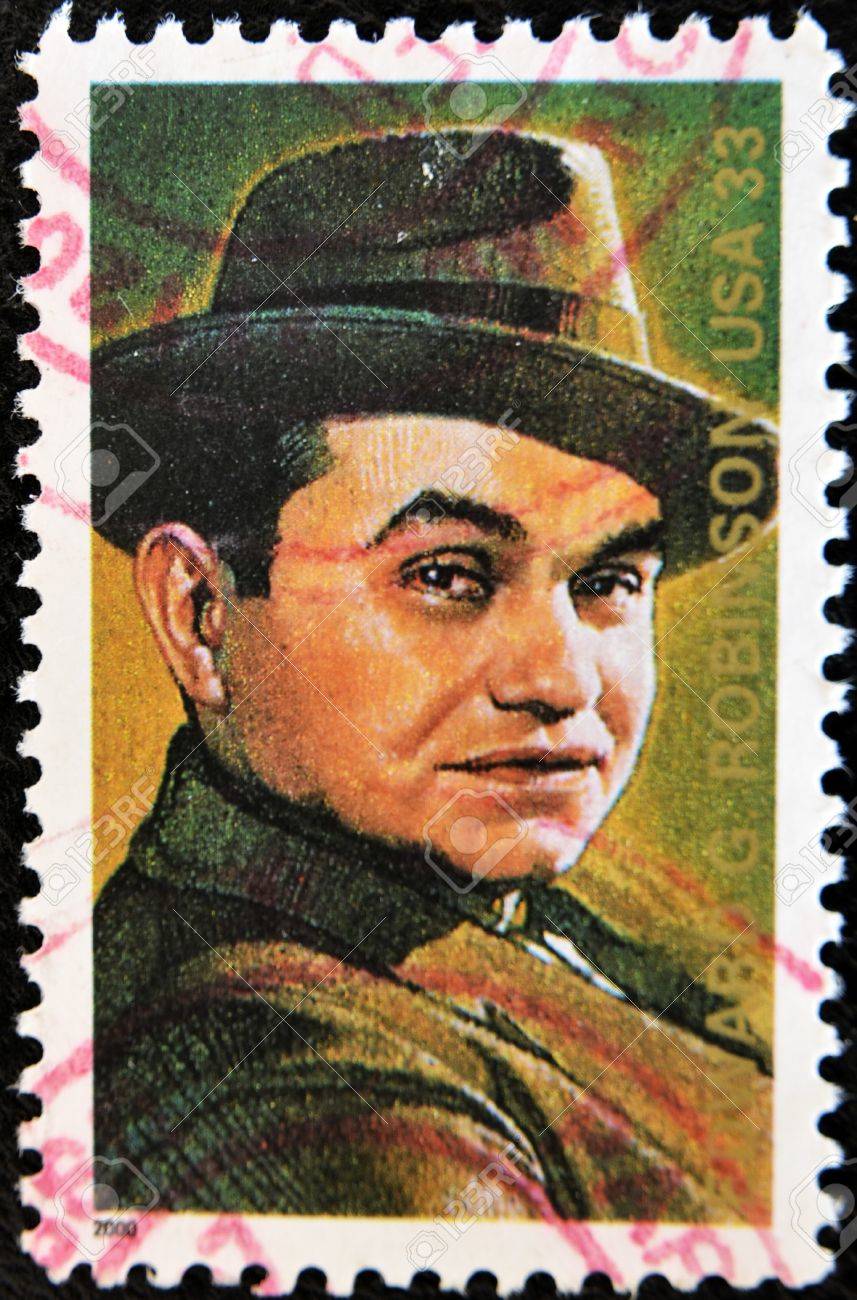
In October 2000, Robinson's image was imprinted on a U.S. postage stamp, the sixth in its Legends of Hollywood series.[13]: 125 [158]
Robinson has been the inspiration for a number of animated television characters, usually caricatures of his most distinctive 'snarling gangster' guise. An early version of the gangster character Rocky, featured in the Bugs Bunny cartoon Racketeer Rabbit, shared his likeness. This version of the character also appears briefly in Justice League, in the episode "Comfort and Joy", as an alien with Robinson's face and non-human body, who hovers past the screen as a background character.
Similar caricatures also appeared in The Coo-Coo Nut Grove, Thugs with Dirty Mugs and Hush My Mouse. Another character based on Robinson's tough-guy image was The Frog (Chauncey "Flat Face" Frog) from the cartoon series Courageous Cat and Minute Mouse. The voice of B.B. Eyes in The Dick Tracy Show was based on Robinson, with Mel Blanc and Jerry Hausner sharing voicing duties. The Wacky Races animated series character 'Clyde' from the Ant Hill Mob was based on Robinson's Little Caesar persona.
Voice actor Hank Azaria has noted that the voice of Simpsons character police chief Clancy Wiggum is an impression of Robinson.[159]
Robinson was portrayed by actor Michael Stuhlbarg in the 2015 biographical drama film Trumbo.[160]
Selected filmography
Radio appearances
| Year | Program | Episode/source |
|---|---|---|
| 1940 | Screen Guild Theatre | Blind Alley[163] |
| 1946 | Suspense | The Man Who Wanted to Be Edward G. Robinson aka The Man Who Thought He Was Edward G. Robinson[164][165] |
| 1946 | This Is Hollywood | The Stranger[166] |
| 1950 | Screen Directors Playhouse | The Sea Wolf[166] |
See also
References
- ^ "Edward G. Robinson – Broadway Cast & Staff | IBDB". IBDB. Retrieved April 10, 2020.
- ^ a b c d e f g h i Whitman, Alden (January 27, 1973). "Edward G. Robinson, 79, Dies; His 'Little Caesar' Set a Style; Man of Great Kindness Edward G. Robinson Is Dead at 79 Made Speeches to Friends Appeared in 100 Films". The New York Times.
- ^ a b c "NOMINATIONS (Edward G. Robinson)". Tony Awards. Retrieved February 26, 2026.
- ^ Obituary Variety, January 31, 1973, p. 71.
- ^ Robey, Tim (February 1, 2016). "20 great actors who've never been nominated for an Oscar". The Daily Telegraph. Archived from the original on January 11, 2022. Retrieved October 17, 2022.
- ^ Singer, Leigh (February 19, 2009). "Oscars: the best actors never to have been nominated". The Guardian. UK. Retrieved September 17, 2022.
- ^ Parish, James Robert; Marill, Alvin (1972). The Cinema of Edward G. Robinson. South Brunswick, New Jersey: A. S. Barnes. p. 16. ISBN 0-498-07875-2.
- ^ Robinson & Spigelgass 1973, p. 17.
- ^ Robinson & Spigelgass 1973, p. 13.
- ^ Robinson & Spigelgass 1973, pp. 8, 13–14.
- ^ a b Robinson & Spigelgass 1973, p. 16.
- ^ "1904 passenger list entry for Manole Goldenberg". Ancestry.com.
- ^ a b c d e f g h i j k l m n o p q r Ross, Steven J. (2011). Hollywood Left and Right. How Movie Stars Shaped American Politics. Oxford University Press. p. 125. ISBN 978-0-19-518172-2. Retrieved March 20, 2012.
- ^ Epstein (2007), p. 249
- ^ a b c Pendergast, Tom. Ed. St. James Encyclopedia of Popular Culture, Vol. 4, pp. 229–230
- ^ Robinson & Spigelgass 1973, p. 8.
- ^ Beck, Robert (September 2, 2008). Edward G. Robinson Encyclopedia. McFarland. ISBN 9780786438648. Retrieved January 14, 2016.
- ^ Robinson & Spigelgass 1973, p. 345.
- ^ Luther, Roger (January 11, 2009). "The Stone Opera House: Historic Binghamton Theater Faces "Demolition by Neglect"". Treasures of the Tier. Retrieved August 21, 2025.
- ^ Robinson & Spigelgass 1973, pp. 49–50.
- ^ Robinson & Spigelgass 1973, pp. 52–53.
- ^ Robinson & Spigelgass 1973, pp. 55–56.
- ^ Scott, Vernon (June 21, 1963). "Tough 'Little Caesar' Now Just a Softie". The Vancouver Sun. UPI. p. 17. Retrieved January 5, 2026.
- ^ Robinson & Spigelgass 1973, p. 59.
- ^ Robinson & Spigelgass 1973, pp. 60–62.
- ^ Hirsch, Foster (1975). Edward G. Robinson. Pyramid Publications. p. 18. ISBN 9780515036428.
- ^ Robinson & Spigelgass 1973, p. 62.
- ^ Robinson & Spigelgass 1973, p. 63.
- ^ Robinson & Spigelgass 1973, p. 64.
- ^ Robinson & Spigelgass 1973, pp. 65–66.
- ^ Robinson & Spigelgass 1973, pp. 67–68.
- ^ Robinson & Spigelgass 1973, pp. 68–70.
- ^ Robinson & Spigelgass 1973, p. 70.
- ^ Robinson & Spigelgass 1973, pp. 72–73.
- ^ Robinson & Spigelgass 1973, p. 73.
- ^ Robinson & Spigelgass 1973, p. 74.
- ^ Robinson & Spigelgass 1973, p. 75.
- ^ Robinson & Spigelgass 1973, pp. 76–77.
- ^ Robinson & Spigelgass 1973, p. 77.
- ^ Robinson & Spigelgass 1973, pp. 82–84.
- ^ Robinson & Spigelgass 1973, pp. 86–88.
- ^ Robinson & Spigelgass 1973, pp. 89–90.
- ^ "Androcles and the Lion - Broadway Play - 1925 Revival". Internet Broadway Database. Retrieved February 14, 2026.
- ^ Robinson & Spigelgass 1973, p. 94.
- ^ Robinson & Spigelgass 1973, pp. 95–96.
- ^ "The Chief Thing - Broadway Play - Original". Internet Broadway Database. Retrieved February 14, 2026.
- ^ Robinson & Spigelgass 1973, p. 100.
- ^ Robinson & Spigelgass 1973, pp. 102–103.
- ^ "Juarez and Maximilian - Broadway Play - Original". Internet Movie Database. Retrieved February 14, 2026.
- ^ Robinson & Spigelgass 1973, p. 105.
- ^ "The Brothers Karamazov - Broadway Play - Original". Internet Broadway Database. Retrieved February 14, 2026.
- ^ Robinson & Spigelgass 1973, pp. 108–109.
- ^ a b Robinson & Spigelgass 1973, p. 111.
- ^ "The Racket - Broadway Play - Original". Internet Broadway Database. Retrieved February 14, 2026.
- ^ a b Robinson & Spigelgass 1973, p. 112.
- ^ Robinson & Spigelgass 1973, p. 114.
- ^ Robinson & Spigelgass 1973, pp. 114–115.
- ^ "Kibitzer - Broadway Play - Original". Internet Broadway Database. Retrieved February 15, 2026.
- ^ Robinson & Spigelgass 1973, p. 115.
- ^ Robinson & Spigelgass 1973, p. 116.
- ^ Robinson & Spigelgass 1973, p. 117.
- ^ Robinson & Spigelgass 1973, pp. 118, 121–122.
- ^ Robinson & Spigelgass 1973, p. 119.
- ^ "Mr. Samuel - Broadway Play - Original". Internet Broadway Database. Retrieved February 15, 2026.
- ^ Robinson & Spigelgass 1973, p. 122.
- ^ Robinson & Spigelgass 1973, p. 128.
- ^ "NEW GANG FILM AT STRAND.; "Little Caesar" Notable for Acting of Edward G. Robinson". The New York Times. January 10, 1931. Retrieved December 26, 2025.
- ^ Robinson & Spigelgass 1973, p. 131.
- ^ Robinson & Spigelgass 1973, p. 9.
- ^ Robinson & Spigelgass 1973, p. 141.
- ^ a b c d Robinson & Spigelgass 1973, p. 142.
- ^ Robinson & Spigelgass 1973, p. 144.
- ^ Robinson & Spigelgass 1973, p. 152.
- ^ Robinson & Spigelgass 1973, pp. 160–161.
- ^ Robinson & Spigelgass 1973, pp. 164, 169.
- ^ Robinson & Spigelgass 1973, pp. 170–171.
- ^ a b Robinson & Spigelgass 1973, p. 176.
- ^ Robinson & Spigelgass 1973, p. 180.
- ^ Robinson & Spigelgass 1973, p. 181.
- ^ Robinson & Spigelgass 1973, p. 182.
- ^ Robinson & Spigelgass 1973, pp. 187–189.
- ^ Robinson & Spigelgass 1973, p. 203.
- ^ Robinson & Spigelgass 1973, p. 207.
- ^ Robinson & Spigelgass 1973, pp. 215, 218.
- ^ Robinson & Spigelgass 1973, p. 220.
- ^ Robinson & Spigelgass 1973, pp. 233–234.
- ^ Robinson & Spigelgass 1973, p. 234.
- ^ Schatz, Thomas. Boom and Bust: American Cinema in the 1940s. University of California Press, November 23, 1999, p. 99.
- ^ a b c Robinson & Spigelgass 1973, p. 241.
- ^ Robinson & Spigelgass 1973, p. 242.
- ^ Robinson & Spigelgass 1973, p. 244.
- ^ Robinson & Spigelgass 1973, p. 245.
- ^ Robinson & Spigelgass 1973, p. 246.
- ^ a b Wise, James: Stars in Khaki: Movie Actors in the Army and Air Services. Naval Institute Press, 2000. ISBN 1-55750-958-1. p. 228.
- ^ a b Ross, pp. 99–102
- ^ Robinson & Spigelgass 1973, p. 249.
- ^ Robinson & Spigelgass 1973, p. 260.
- ^ Robinson & Spigelgass 1973, p. 261.
- ^ a b Robinson & Spigelgass 1973, p. 264.
- ^ Robinson & Spigelgass 1973, p. 267.
- ^ Robinson & Spigelgass 1973, p. 274.
- ^ Robinson & Spigelgass 1973, p. 279.
- ^ Robinson & Spigelgass 1973, p. 280.
- ^ Robinson & Spigelgass 1973, p. 281.
- ^ Robinson & Spigelgass 1973, pp. 283–284.
- ^ a b c Robinson & Spigelgass 1973, p. 299.
- ^ Graham, Sheilah (September 9, 1953). "Hollywood". Pittsburgh Post-Gazette. p. 6. Retrieved February 21, 2026.
- ^ "Television: High Spots and Programs". Pittsburgh Post-Gazette. December 9, 1954. Retrieved February 21, 2026.
- ^ Hopper, Hedda (September 23, 1954). "Robinson To Star In DeMille Film". Toledo Blade. Retrieved March 2, 2025.
- ^ Robinson & Spigelgass 1973, pp. 299–300.
- ^ Heston, Charlton (1995). In the Arena: An Autobiography. Simon & Schuster. p. 145. ISBN 0-684-80394-1.
- ^ a b Lasky, Jesse L. Jr. (1975). Whatever Happened to Hollywood?. Funk & Wagnalls. p. 305. ISBN 0-308-10172-3.
- ^ "DeMille Honored For Bible Movie". Spokane Daily Chronicle. Spokane, Washington. Associated Press. March 19, 1957. Retrieved September 12, 2015.
- ^ Kleiner, Dick (March 21, 1956). "ROBINSON ISN'T ALWAYS IN GANGSTER-TYPE ROLE". Sarasota Journal. NEA. p. 15. Retrieved February 20, 2026.
- ^ "Middle of the Night - Broadway Play - Original". Internet Broadway Database. Retrieved February 20, 2026.
- ^ "Edward G. Robinson Stars In Playhouse 90 Drama". The Victoria Advocate. October 19, 1958. p. 4. Retrieved February 27, 2026.
- ^ Robinson & Spigelgass 1973, p. 320.
- ^ "TV Scout Preview". St. Petersburg Times. March 2, 1959. p. 8-C. Retrieved February 27, 2026.
- ^ "TV Previews". Lawrence Daily Journal-World. April 2, 1959. p. 12. Retrieved February 27, 2026.
- ^ Thompson, Howard (December 28, 1963). "Edward G. Robinson Replaces Ailing Spencer Tracy in Movie; Jane, Meet Charlotte Rodgers to Add Song Added Attractions Revivals". New York Times. Retrieved February 26, 2026.
- ^ Robinson & Spigelgass 1973, pp. 209–210.
- ^ Heston, Charlton (1995). In the Arena: An Autobiography. Simon & Schuster. p. 394. ISBN 0-684-80394-1.
- ^ Prelutsky, Burt (August 13, 1972). "Edward G. Robinson Nicer Than Roles". The Tuscaloosa News. The Los Angeles Times. p. 8B. Retrieved February 26, 2026.
- ^ Robinson & Spigelgass 1973, p. 99.
- ^ Robinson & Spigelgass 1973, pp. 337–338.
- ^ Manners, Dorothy (April 4, 1973). "Off the Grapevine". Toledo Blade. p. P-3. Retrieved February 26, 2026.
- ^ Dunning, John (1998). "Big Town". On the Air: The Encyclopedia of Old-Time Radio (Revised ed.). New York, NY: Oxford University Press. pp. 88–89. ISBN 978-0-19-507678-3. Retrieved October 1, 2019.
- ^ a b Dissonant Divas in Chicana Music: The Limits of La Onda Deborah R. Vargas. University of Minnesota Press, Minneapolis, 2012 p. 152-153 ISBN 978-0-8166-7316-2 Edward G. Robbinson, OCIAA, CBS radio, Pan-americanism and Cadena de las Americas on google.books.com
- ^ D-Day to Germany: Cameraman Jack Lieb comments on original footage of 1944-45 (Video). Chronos. December 10, 2016. Robinson with the troops in France at 28:43 – via YouTube.
- ^ Lotchin, Roger W. (2000). The Way We Really Were: The Golden State in the Second Great War. University of Illinois Press. ISBN 9780252068195.
- ^ Miller, Frank. Leading Men, Chronicle Books and TCM (2006) p. 185
- ^ a b Sabin, Arthur J. In Calmer Times: The Supreme Court and Red Monday, p. 35. Philadelphia: University of Pennsylvania Press, 1999
- ^ a b Communist infiltration of Hollywood motion-picture industry: Hearing before the Committee on Un-American activities, House of Representatives, Eighty-second Congress, first session (Report). April 30, 1952. p. 2421.
- ^ Bud and Ruth Schultz, It Did Happen Here: Recollections of Political Repression in America, p. 113. Berkeley: University of California Press, 1989.
- ^ Ross, Stephen J. (Autumn 2011). "Little Caesar and the McCarthyist Mob -reprinted from Hollywood Left and Right: How Movie Stars Shaped American Politics". USC Trojan Family Magazine. University of Southern California. Archived from the original on May 27, 2013.
- ^ Robinson & Spigelgass 1973, pp. 60–61.
- ^ Robinson & Spigelgass 1973, pp. 92–93.
- ^ Robinson & Spigelgass 1973, pp. 102–103, 119–120.
- ^ Robinson & Spigelgass 1973, p. 138.
- ^ "Edward G. Robinson, Jr. Is Dead; Late Screen Star's Son Was 40". The New York Times. February 27, 1974. Retrieved July 21, 2007.
- ^ Meeks, Eric G. (2012). The Best Guide Ever to Palm Springs Celebrity Homes. Horatio Limburger Oglethorpe. p. 91. ISBN 978-1479328598.
- ^ Silhouettes of Stars, Players, and Directors of Warner Bros. Pictures, Inc. New York City: Warner Bros. Pictures, Inc. 1937. p. 158.
- ^ Robinson & Spigelgass 1973, pp. 23, 33.
- ^ Shaun Considine, Mad as Hell: The Life and Work of Paddy Chayevskt, ch. 11 'Contention on Broadway'
- ^ Gansberg, p. 246, 252–253.
- ^ Beck, Robert (2002). The Edward G. Robinson Encyclopedia. McFarland. p. 131.
- ^ "Collegians Give Ideas On Films For Past Year: Bette Davis And Eddie Robinson Get Nod For Best Performances Of 1940". The Deseret News. INS. January 11, 1941. p. 6.
- ^ "In Recognition—". Boxoffice. 38 (10): 37. January 25, 1941.
- ^ "BOB HOPE, CROSBY, SKELTON, CROOKS, SMITH AND BRICE TOP RADIO POLL". Motion Picture Herald. 145 (12): 25. December 20, 1941.
- ^ "AWARDS TO CBS-JANUARY, 1941-APRIL, 1942". Broadcasting. 22 (18): 7. May 4, 1942.
- ^ Alicoate, Jack, ed. (1943). The Film Daily Year Book of Motion Pictures. The Film Daily. p. 99.
- ^ "Paramount won first place in 27 out of 37* best-star polls". Motion Picture Herald. 158 (5): 23. February 3, 1945.
- ^ "LAMBS GAMBOL TO BE TELECAST FOR FIRST TIME: Televiewers in 4 Cities to See Top Performers In Famous Entertainment Event --Annual Lambs Award to be Presented". NBC Color Television News. April 9, 1956.
- ^ "Jewish Award For DeMille". The Spokesman-Review. March 20, 1957. Retrieved May 8, 2014.
- ^ "Edward G. Robinson". Hollywood Walk of Fame. Retrieved February 19, 2026.
- ^ "Scott, Susannah York Win TV Scout Awards; 'Jane Eyre' Sweeps". The Prescott Courier. NEA. May 11, 1971. p. 4. Retrieved February 18, 2026.
- ^ "To Edward G. Robinson who achieved greatness as a player, a patron of the arts and a dedicated citizen...in sum, a Renaissance man. From his friends in the industry he loves. (accepted by his wife, Jane Robinson)". Academy Awards Acceptance Speech Database. Retrieved February 19, 2026.
- ^ Edward G. Robinson stamp, 2000
- ^ Joe Rhodes (October 21, 2000). "Flash! 24 Simpsons Stars Reveal Themselves". TV Guide.
- ^ Vancheri, Barbara (November 25, 2015). "Michael Stuhlbarg plays Edward G. Robinson in 'Trumbo'". Pittsburgh Post-Gazette. Retrieved September 16, 2023.
- ^ Arms and the Woman at the AFI Catalog of Feature Films
- ^ Die Sehnsucht Jeder Frau at the AFI Catalog of Feature Films
- ^ "Sunday Caller". Harrisburg Telegraph. February 24, 1940. p. 17. Retrieved July 20, 2015 – via Newspapers.com.
- ^ "The Man Who Wanted to Be Edward G. Robinson". Harrisburg Telegraph. October 12, 1946. p. 17. Retrieved October 1, 2015 – via Newspapers.com.
- ^ "Suspense .. Episodic log".
- ^ a b "Those Were the Days". Nostalgia Digest. Vol. 42, no. 3. Summer 2016. p. 39.
Further reading
- Gansberg, Alan L. (2004). Little Caesar: A Biography of Edward G. Robinson. Scarecrow Press. ISBN 978-0-8108-4950-1.
- Epstein, Lawrence Jeffrey (2007). Edge of a Dream: The Story of Jewish Immigrants on New York's Lower East Side, 1880–1920. John Wiley & Sons. ISBN 978-0-7879-8622-3.
- Robinson, Edward G.; Spigelgass, Leonard (1973). All My Yesterdays; an Autobiography. Hawthorn Books. LCCN 73005443.