1st Canadian Parliament
| 1st Canadian Parliament | |||
|---|---|---|---|
| Majority parliament | |||
| Sep. 24, 1867 – Jul. 8, 1872 | |||
| Parliament leaders | |||
| Prime minister | Rt. Hon. Sir John A. Macdonald Jul. 1, 1867 – Nov. 5, 1873 | ||
| Cabinet | 1st Canadian Ministry | ||
| Party caucuses | |||
| Government | Conservative Party & Liberal-Conservative | ||
| Opposition | Liberal Party | ||
| Crossbench | Anti-Confederation Party | ||
| House of Commons | |||
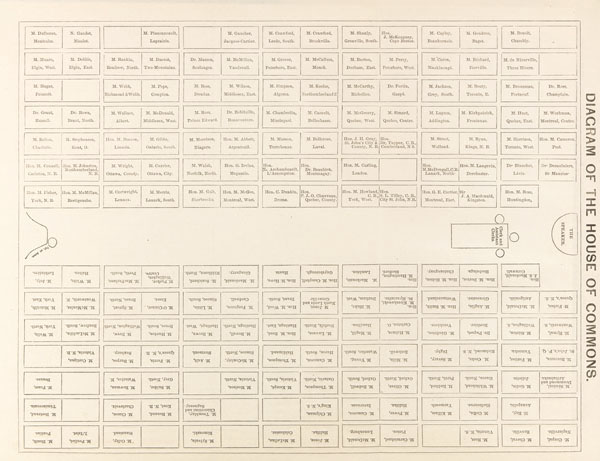
Seating arrangements of the House of Commons | |||
| Speaker of the Commons | Hon. James Cockburn November 6, 1867 – March 25, 1874 | ||
| Members | 180 MP seats List of members | ||
| Senate | |||
Seating arrangements of the Senate | |||
| Speaker of the Senate | The Hon. Joseph-Édouard Cauchon November 5, 1867 – June 30, 1872 | ||
| Government Senate leader | Alexander Campbell July 1, 1867 – November 5, 1873 | ||
| Opposition Senate leader | Luc Letellier de St-Just July 1, 1867 – November 5, 1873 | ||
| Senators | 72 senator seats List of senators | ||
| Sovereign | |||
| Monarch | Victoria 1 July 1867 – 22 Jan. 1901 | ||
| Governor general | The Viscount Monck 1 July 1867 – 14 Nov. 1868 | ||
| Lord Lisgar 2 Feb. 1869 – 25 June 1872 | |||
| The Earl of Dufferin 25 June 1872 – 25 Nov. 1878 | |||
| Sessions | |||
| 1st session November 6, 1867 – May 22, 1868 | |||
| 2nd session April 15, 1869 – June 22, 1869 | |||
| 3rd session February 15, 1870 – May 12, 1870 | |||
| 4th session February 15, 1871 – April 14, 1871 | |||
| 5th session April 11, 1872 – June 14, 1872 | |||
| |||
The 1st Canadian Parliament was summoned in November 1867, following the election of the members of the House of Commons in the 1867 federal election. It lasted until dissolution in 1872, prior to the 1872 election (four years and 252 days). It met in five different sessions from 1867 to 1872, and was prorogued between the sessions.
The House of Commons was controlled by a majority coalition between the Conservative Party and the Liberal-Conservative Party under Prime Minister Sir John A. Macdonald and the 1st Canadian Ministry. The Official Opposition was the Liberal Party, but there was not yet a Leader of the Official Opposition during the 1st Parliament.
James Cockburn, M.P., was the Speaker of the House of Commons for the term of the Parliament. Senator Joseph-Édouard Cauchon was the Speaker of the Senate for the term of the Parliament.
Creation of the Parliament of Canada
Confederation
Canada was created on July 1, 1867, when the British North America Act, 1867 (now the Constitution Act, 1867) was brought into force by royal proclamation of Queen Victoria. That was the culmination of Canadian Confederation, which united the Province of Canada, Nova Scotia and New Brunswick into a new federation, with the Province of Canada split into two new provinces, Ontario and Quebec.[1][2]
The act created a new federal parliament, the Parliament of Canada. It was composed of the monarch, represented by the Governor General of Canada, the appointed Senate, and the elected House of Commons.[3] The Parliament operates on a similar basis as the British Parliament, with the government of Canada headed by the Prime Minister of Canada, who holds office based on controlling a majority in the House of Commons.[4]
Based on the political situation leading up to July 1, 1867, it was generally expected that John A. Macdonald, one of the co-premiers of the Province of Canada, would be the first prime minister of Canada. This was confirmed by Governor General Viscount Monck, who appointed Macdonald as prime minister in May 1867. Macdonald then appointed the cabinet ministers for the new federal government, which took office on July 1, in the run-up to the first elections for the House of Commons, which occurred in August and September, 1867.[1][5]
House of Commons
The seats in the House of Commons were allocated to the four provinces, based on population: Ontario had 82 seats, Quebec had 65, Nova Scotia had 19, and New Brunswick had 15.[6] Most of the electoral districts, also called ridings, were single-member districts, but there were some multi-member districts. Voting was done by open ballots, with members elected on a first-past-the-post system.
In the first general elections in 1867, Macdonald's supporters, an informal coalition of Conservatives and Liberal-Conservatives, won a majority of the seats in the House of Commons, confirming him and the cabinet in office.[7] The Parliament was then summoned for November 7, 1867.
Senate
The Senate is an appointed body, not elected. Seats are allocated on regional representation, not provincial equality.
The Senate in 1867 was composed of three divisions: the Ontario, Quebec and the Maritime divisions. Each division had twenty-four seats, for a total of seventy-two seats in all. The seats of the Maritime division were allocated equally between New Brunswick and Nova Scotia, with twelve senators from each of those provinces.
The proclamation of Confederation on May 22 had named the 72 men (24 each for Quebec and Ontario, 12 each for New Brunswick and Nova Scotia) who would sit in the Senate.
The province of Quebec has 24 Senate divisions which are constitutionally mandated. In all other provinces, a Senate division is strictly an optional designation of the senator's own choosing, and has no real constitutional or legal standing. A senator who does not choose a special senate division is designated a senator for the province at large.
Addition of Manitoba, British Columbia, and the North-West Territories
Canada expanded westward during the term of the first Parliament, with the addition of the provinces of Manitoba and British Columbia. That resulted in the expansion of both the House of Commons and the Senate.
On July 15, 1870, Canada acquired Rupert's Land and the North-Western Territory. That same date, Parliament created the province of Manitoba, a small province centred on Winnipeg. Manitoba was the fifth Canadian province and was allotted two seats in the Senate and four in the House of Commons. With the increase, the number of seats in the Senate rose to 74. The seats were not filled until December 13, 1871, when Governor General Lord Lisgar, on the advice of Prime Minister Macdonald, filled those two seats.
On July 20, 1871, British Columbia became the sixth Canadian province and was allotted three seats in the Senate, bringing the combined number of seats in the Senate to 77. On December 13, 1871, Lord Lisgar, again on the advice of Macdonald, appointed three persons to fill those seats.
Also on July 15, 1870, the federal Parliament created a federal territory, the North-West Territories which included all of Rupert's Land and the North-Western Territory (other than Manitoba). The North-West Territories did not receive any representation in the House of Commons or the Senate until 1886.
Throne speeches of the first Parliament
Each new session of the Canadian Parliament opens with the Throne Speech from the Governor General. Although delivered by the governor general, the throne speech is drafted by the government and sets out the legislative agenda of the government for the upcoming session.[8]
1867: First Session
Governor General Monck opened the first Parliament with the throne speech on November 7, 1867.[9]
Monck commented on the enactment of the British North America Act, 1867, stating that while passed by the Imperial Parliament, it had been the product of careful negotiations between the British government and the delegates of the British North American provinces. While the British government saw the creation of the new country as advantageous to the Empire, the provincial delegates had been given every freedom in the design of the new constitution. He trusted that the new country would soon extend from the Atlantic to the Pacific.
He stated that it now fell to the representatives of the people of Canada to create the institutions and laws necessary to put into practice the principles set out in the constitution. He stated that some of the objectives for the government in the upcoming session would be:
- financial matters, such as currency, customs, excise, and federal revenue generally;
- the adoption of a uniform postal system;
- management and maintenance of federal public works and properties;
- militia organization and defence;
- administration of Indian affairs;
- uniform laws respecting patents of invention and discovery;
- naturalization of aliens;
- criminal law;
- laws relating to bankruptcy and insolvency.
Monck also stated a proposal would be introduced for the immediate construction of the Intercolonial Railway, as required by the constitution, and assisted by the financial guarantee given by the British government. Measures would also be introduced for the protection of fisheries and marine interests, as well as uniform laws regarding federal elections.
He also specifically advised the members of the House of Commons that the financial needs for operation of the government since July 1 had been undertaken on the authority of the ministers, who would account to the House of Commons for their expenditures during that period.
1869: Second Session
The second session of the Parliament opened on April 15, 1869. The throne speech was given by the new Governor General, Sir John Young.[10]
The governor general commented that the federal government, the Hudson's Bay Company and the Colonial Secretary had been engaged in negotiations for the HBC to surrender Rupert's Land and the North-Western Territory to Canada, and that the transfer seemed likely. He also announced that the governor of Newfoundland had communicated with him on the possibility of admitting Newfoundland into Confederation. He mentioned that with the assistance of the British government, measures had been undertaken to resolve Nova Scotia's objections to aspects of the new federal system.
He announced that bills would be introduced in the session for the following purposes:
- the assimilation of provincial criminal laws into federal criminal law;
- uniform federal elections law;
- uniform bankruptcy and insolvency law;
- uniform laws relating to patents of invention and discovery.
He also mentioned that the charters of several banks would be up for renewal, which would be a very important measure for the sound commerce of the country.
1870: Third Session
The third session opened on February 15, 1870, with a throne speech by the governor general, Sir John Young.[11]
After complimentary opening remarks about the economy, the governor general commented on the political unrest in the North-West Territories, which he attributed to misapprehensions about the intentions of the Canadian government in acquiring the territory. He stated that the government had responded with conciliation measures, which he hoped would lead to a peaceful and equitable settlement of the difficulties and the incorporation of the North-West Territories into Canada. He advised that since the existing act for the temporary government of the North-West Territories was due to expire, a new measure would be introduced in the session.
The governor general then mentioned several other proposed bills for the session, to deal with:
- banking regulation, to balance the financial security of Canadians with the business structures of the banks;
- a uniform electoral franchise and federal election laws;
- regulation of the local coasting trade, failing which an Imperial statute would apply;
- creation of a federal court of appeal, which would also have some original jurisdiction;
- a uniform census law, to meet the constitutional requirement for a census in 1871, which would be important for the readjustment of seats in the House of Commons. He hoped that similar rules could be adopted for censuses in Newfoundland and Prince Edward Island, to assist in uniform data tables.
The governor general noted with satisfaction the strong turn-out by the militia, ready to repeal the threat of Fenian raids. He also commented on the attempts made by the provinces to encourage immigration and the improvement of public works.
He closed by referring to his visits to all the provinces, including his role in welcoming Prince Arthur on his visit to Canada. He was happy to report to the Imperial government the general satisfaction that Canadians in all parts of the country had with their ability to create their own institutions, governed by their own laws.
4th Session
On Wednesday February 15, 1871. The 4th session of the 1st parliament of the Dominion of Canada opened with a speech from the throne by the governor general, John Young (The Lord Lisgar).
In the speech, he highlights the menace of invasion from the United States. He also celebrates the creation of the province of Manitoba and looks forward to the same from British Columbia. On that topic, he speaks on the importance of the interoceanic railway to be created. He encourages more immigration to these new territories. He recommends the swift standardization of currency to not fall into the divisiveness seen in Europe. He says the census will occur on April 3, 1971. He briefly touches on some future bills pertaining to Parliamentary Elections, Weights and Measures, Insurance Companies, Savings Banks, and for the Consolidation and amendment of the Inspection Laws.[12]
5th Session
On Thursday April 11, 1872. The 5th session of the 1st parliament of the Dominion of Canada opened with a speech from the throne by the governor general, John Young (The Lord Lisgar).
In the speech, he highlights the threat of invasion of Manitoba from the United States. He remarks on a conference held in Ottawa in September 1871 on the subject of immigration. He recognizes the adoption of British Columbia into the union and the continuation of the railway project. He encourages the development of canals and a direct water communication between the Gulf of St. Lawrence and the Bay of Fundy. He notes that the census has taken place. He briefly mentions future bills pertaining to Judges of Superior Courts-to the regulation and management of the Public Lands and Mines of the Dominion in Manitoba and the North West Territories, aid for the amendment of the laws relating to the Public Health.[13]
Party standings at opening of Parliament, 1867
Although there were changes to the House of Commons and the Senate during the term of the 1st Parliament, due to by-elections and new appointments to the Senate, Prime Minister Macdonald and the 1st Canadian ministry retained their majority throughout.
House of Commons
| Seats in the House of Commons by party and province | ||||||
|---|---|---|---|---|---|---|
| Party | New Brunswick | Nova Scotia | Ontario | Quebec | Totals | |
| Conservative | 1 | 1 | 33 | 36 | 71 | |
| Liberal-Conservative | 2 | 0 | 16 | 11 | 29 | |
| Liberal | 12 | 0 | 33 | 17 | 62 | |
| Anti-Confederation | 0 | 18 | 0 | 0 | 18 | |
| Vacant | 0 | 0 | 0 | 1 | 1 | |
| Totals: | 15 | 19 | 82 | 65 | 181 | |
Senate
| Seats in the Senate by party and Senate division | |||||
|---|---|---|---|---|---|
| Party | Ontario | Quebec | Maritime | Totals | |
| Conservative | 13 | 15 | 10 | 38 | |
| Liberal-Conservative | 1 | 1 | 4 | 6 | |
| Liberal | 10 | 8 | 8 | 26 | |
| Vacant | 0 | 0 | 2 | 2 | |
| Totals: | 24 | 24 | 24 | 72 | |
Maritime Senate seats by province
| Seats in the Maritime division by province | |||||
|---|---|---|---|---|---|
| Party | New Brunswick | Nova Scotia | Totals | ||
| Conservative | 5 | 5 | 10 | ||
| Liberal-Conservative | 1 | 3 | 4 | ||
| Liberal | 4 | 4 | 8 | ||
| Vacant | 2 | 0 | 2 | ||
| Totals: | 24 | 24 | 24 | ||
House of Commons
Following is a full list of members of the House of Commons in the first Parliament, organised by province,
John A. Macdonald was the Prime Minister of Canada throughout the term of the 1st Parliament, and appointed the members of the federal Cabinet.[5]
James Cockburn, MP for Northumberland West in Ontario, was the speaker for the term of the 1st Parliament.[14]
Although the Liberal Party formed the Official Opposition, the party did not yet have a leader, so there was no Leader of the Official Opposition.[15]
Key:
- Party leaders are italicized.
- Cabinet ministers are in boldface.
- The Prime Minister is both.
Electoral districts denoted by an asterisk (*) indicates that district was represented by two members.
Members elected in 1867
New Brunswick
| Electoral district | Name | Party | First elected | No. of terms | |
|---|---|---|---|---|---|
| Albert | John Wallace | Liberal | 1867 | 1st term | |
| Carleton | Charles Connell | Liberal | 1867 | 1st term | |
| Charlotte | John Bolton | Liberal | 1867 | 1st term | |
| City and County of Saint John | John Hamilton Gray | Conservative | 1867 | 1st term | |
| City of Saint John | Samuel Leonard Tilley | Liberal-Conservative | 1867 | 1st term | |
| Gloucester | Timothy Warren Anglin | Liberal | 1867 | 1st term | |
| Kent | Auguste Renaud | Liberal | 1867 | 1st term | |
| King's | George Ryan | Liberal | 1867 | 1st term | |
| Northumberland | John Mercer Johnson (to September 8, 1868) (death) | Liberal | 1867 | 1st term | |
| Queen's | John Ferris | Liberal | 1867 | 1st term | |
| Restigouche | John McMillan (to February 15, 1868) (appointed Inspector of Post Offices) | Liberal | 1867 | 1st term | |
| Sunbury | Charles Burpee | Liberal | 1867 | 1st term | |
| Victoria | John Costigan | Liberal-Conservative | 1867 | 1st term | |
| Westmorland | Albert James Smith | Liberal | 1867 | 1st term | |
| York | Charles Fisher (to October 3, 1868) (appointed to the Supreme Court of New Brunswick) | Liberal | 1867 | 1st term |
Nova Scotia
Note:
1 – The Anti-Confederate Party dissolved after failing to secure Nova Scotia's secession from Confederation. In 1869 its members joined other parties, or in one case sat as an independent.
Ontario
Note:
6 – One Ontario MP, Alexander Morris, recontested his seat in a byelection. He was reelected in Lanark South on November 29, 1869, after being appointed Minister of Inland Revenue.
Quebec
Four Quebec members recontested their seats in byelections, and were re-elected:
2 – John Rose was reelected in Huntingdon on November 28, 1867, after being named Minister of Finance.
3 – Barthélemy Pouliot was unseated on petition, but was reelected in L'Islet on July 14, 1869.
4 – Christopher Dunkin was reelected in Brome on November 29, 1869, after being named Minister of Agriculture.
5 – John Henry Pope was reelected in Compton on November 11, 1871, after being named Minister of Agriculture following Dunkin's resignation from Parliament.
New provinces
Manitoba
Manitoba joined Confederation in 1870. Elections to choose Manitoba's representatives were held on March 2 and March 3, 1871.
| Electoral district | Name | Party | First elected | No. of terms | |
|---|---|---|---|---|---|
| Lisgar | John Christian Schultz (from March 2, 1871) | Conservative | 1871 | 1st term | |
| Marquette* (both candidates declared elected due to a tie) |
James S. Lynch (from March 2, 1871) | Liberal | 1871 | 1st term | |
| Angus McKay (from March 2, 1871) | Conservative | 1871 | 1st term | ||
| Selkirk | Donald Alexander Smith (from March 2, 1871) | Independent Conservative | 1871 | 1st term | |
| Provencher | Pierre Delorme (from March 3, 1871) | Conservative | 1871 | 1st term |
British Columbia
British Columbia joined Confederation in 1871. Elections to choose the province's representatives were held in November and December of that year.
| Electoral district | Name | Party | First elected | No. of terms | |
|---|---|---|---|---|---|
| Cariboo District | Joshua Spencer Thompson (from December 19, 1871) | Liberal-Conservative | 1871 | 1st term | |
| New Westminster District | Hugh Nelson (from December 13, 1871) | Liberal-Conservative | 1871 | 1st term | |
| Vancouver | Robert Wallace (from December 15, 1871) | Conservative | 1871 | 1st term | |
| Victoria* | Amor De Cosmos (from November 24, 1871) | Liberal | 1871 | 1st term | |
| Henry Nathan, Jr. (from November 24, 1871) | Liberal | 1871 | 1st term | ||
| Yale District | Charles Frederick Houghton (from December 19, 1871) | Liberal | 1871 | 1st term |
By-elections, 1867 to 1871
New Brunswick
| Date | Riding | Incumbent | Party | Elected | Party | Reason for by-election | ||
|---|---|---|---|---|---|---|---|---|
| March 13, 1868 | Restigouche | John McMillan | Liberal | William Murray Caldwell | Liberal | McMillan appointed Inspector of Post Offices in New Brunswick, February 15, 1868 | ||
| October 28, 1868 | York | Charles Fisher | Liberal | John Pickard | Independent Liberal | Fisher appointed to New Brunswick Supreme Court, October 3, 1868 | ||
| December 24, 1868 | Northumberland | John Mercer Johnson | Liberal | Richard Hutchison | Liberal | Johnson's death, November 8, 1868 | ||
| November 29, 1870 | Restigouche | William Murray Caldwell | Liberal | George Moffat, Sr. | Conservative | Caldwell appointed inspector of post offices in New Brunswick, September 29, 1870 | ||
Nova Scotia
Ontario
| Date | Riding | Incumbent | Party | Elected | Party | Reason for by-election | ||
|---|---|---|---|---|---|---|---|---|
| April 13, 1868 | Lincoln | James Rea Benson | Liberal-Conservative | Thomas Rodman Merritt | Liberal | Benson called to the Senate, March 14, 1868 | ||
| August 14, 1868 | York West | William Pearce Howland | Liberal-Conservative | Amos Wright | Liberal | Howland appointed Lieutenant-Governor of Ontario, July 15, 1868 | ||
| July 12, 1869 | Wellington Centre | Thomas Sutherland Parker | Liberal | James Ross | Liberal | Parker's death, October 24, 1868 | ||
| November 13, 1869 | Renfrew North | John Rankin | Liberal-Conservative | Francis Hincks | Conservative | Rankin resigned to provide a seat for Hincks, October 12, 1869 | ||
| November 29, 1869 | Renfrew South | Daniel McLachlin | Liberal | John Lorn McDougall | Liberal | McLachlin resigned June 3, 1869, taking retirement | ||
| November 29, 1869 | Lanark South | Alexander Morris | Conservative | Alexander Morris | Conservative | Ministerial by-election upon Morris's appointment as Minister of Inland Revenue, November 15, 1869 | ||
| April 27, 1870 | Frontenac | Thomas Kirkpatrick | Conservative | George Airey Kirkpatrick | Conservative | Kirkpatrick's death, March 26, 1870 | ||
| March 20, 1871 | Hastings East | Robert Read | Conservative | John White | Conservative | Read called to the Senate, February 24, 1871 | ||
| June 30, 1871 | Algoma | Wemyss Mackenzie Simpson | Conservative | Frederick William Cumberland | Conservative | Simpson appointed Indian Commissioner for Rupert's Land, April 26, 1871 | ||
Quebec
| Date | Riding | Incumbent | Party | Elected | Party | Reason for by-election | ||
|---|---|---|---|---|---|---|---|---|
| November 28, 1867 | Huntingdon | Sir John Rose | Liberal-Conservative | Sir John Rose | Liberal-Conservative | Ministerial by-election upon Rose's appointment as Minister of Finance, November 18, 1867 | ||
| December 11, 1867 | Montmorency | Joseph-Édouard Cauchon | Conservative | Jean Langlois | Conservative | Cauchon called to the Senate, November 2, 1867 | ||
| April 20, 1868 | Montreal West | Thomas D'Arcy McGee | Liberal-Conservative | Michael Patrick Ryan | Liberal-Conservative | McGee assassinated, April 7, 1868 | ||
| October 17, 1868 | Three Rivers | Louis-Charles Boucher de Niverville | Conservative | William McDougall | Conservative | Boucher de Niverville appointed sheriff for the district of Trois-Rivières, September 30, 1868 | ||
| October 30, 1868 | Saint Maurice | Louis-Léon Lesieur Desaulniers | Conservative | Élie Lacerte | Conservative | Desaulniers appointed inspector of prisons and asylums in Quebec, September 29, 1868 | ||
| February 17, 1869 | Kamouraska | Vacant | Charles Alphonse Pantaléon Pelletier | Liberal | No election held in 1867 due to riots | |||
| July 14, 1869 | L'Islet | Barthélemy Pouliot | Conservative | Barthélemy Pouliot | Conservative | Previous election annulled, June 9, 1869 | ||
| October 30, 1869 | Huntingdon | Sir John Rose | Liberal-Conservative | Julius Scriver | Liberal | Rose resigned September 29, 1869 and moved to London where he acted as the government's representative to the UK. | ||
| November 29, 1869 | Brome | Christopher Dunkin | Conservative | Christopher Dunkin | Conservative | Ministerial by-election upon Dunkin's appointment as Minister of Agriculture, November 15, 1869 | ||
| July 5, 1870 | Missisquoi | Brown Chamberlin | Conservative | George Barnard Baker | Liberal-Conservative | Chamberlin resigned on appointment as Queen's Printer, June 6, 1870 | ||
| July 18, 1870 | Quebec East | Pierre-Gabriel Huot | Liberal | Adolphe Guillet dit Tourangeau | Conservative | Huot resigned on appointment as postmaster at Quebec, June 14, 1870 | ||
| August 15, 1870 | Bellechasse | Louis-Napoléon Casault | Conservative | Télesphore Fournier | Liberal | Casault resigned on appointment to the Superior Court of Quebec, May 26, 1870 | ||
| September 1, 1870 | St. Hyacinthe | Alexandre-Édouard Kierzkowski | Liberal | Louis Delorme | Liberal | Kierzkowski's death, August 4, 1870 | ||
| November 18, 1870 | Richelieu | Thomas McCarthy | Conservative | Georges Isidore Barthe | Independent Conservative | McCarthy's death, September 23, 1870 | ||
| September 15, 1871 | Montcalm | Joseph Dufresne | Conservative | Firmin Dugas | Conservative | Dufresne was appointed Sheriff of Saint-Jean County, July 13, 1871 | ||
| November 11, 1871 | Compton | John Henry Pope | Conservative | John Henry Pope | Conservative | Ministerial by-election upon appointment as Minister of Agriculture, October 25, 1871 | ||
| November 17, 1871 | Brome | Christopher Dunkin | Conservative | Edward Carter | Conservative | Dunkin resigned on appointment to the Superior Court of Quebec, October 24, 1871 | ||
Senate
Senators summoned to the 1st Parliament
Following is a full list of members of the Senate in the first Parliament, organised by senatorial division. Senator Joseph-Édouard Cauchon was the speaker of the Senate during the 1st Parliament, except for nine days in 1869 and two days in 1872.[16] Names of senators who were members of the federal Cabinet are italicised.[5]
Ontario Division
Quebec Division
Maritime Division
Notes
- ^ a b c d e f g h i j k l m n o p q r s t u v w x y z aa ab ac ad ae af ag ah ai aj ak al am an ao ap aq ar as at au av Died in office.
- ^ Resigned on appointment as Lieutenant Governor of Ontario.
- ^ Disqualified. Failed to attend Senate for two consecutive sessions of Parliament.
- ^ Resigned on appointment to the District Court of Algoma.
- ^ a b c d e f Resigned from Senate.
- ^ a b Resigned on appointment as Lieutenant Governor of Quebec.
- ^ a b c d Resigned on appointment to Superior Court of Quebec.
- ^ Resigned on bankruptcy.
- ^ a b Resigned on appointment as Lieutenant Governor of New Brunswick.
- ^ a b Resigned on appointment to the Supreme Court of Nova Scotia.
- ^ Resigned from Senate to stand for election to the House of Commons.
Senators appointed during the 1st Parliament
| [17] | Name | Party | Province (Division) | Date appointed | Appointed by | On the Advice of | Left office | Reason |
|---|---|---|---|---|---|---|---|---|
| Joseph-Édouard Cauchon | Independent Conservative | Quebec (Stadacona) | November 2, 1867 | Viscount Monck | Macdonald | June 30, 1872 | Resignation | |
| Jean-Charles Chapais | Conservative | Quebec (De la Durantaye) | January 30, 1868 | Viscount Monck | Macdonald | |||
| James Rea Benson | Liberal-Conservative | Ontario | March 14, 1868 | Viscount Monck | Macdonald | |||
| James Dever | Liberal | New Brunswick | March 14, 1868 | Viscount Monck | Macdonald | |||
| John Glasier | Liberal | New Brunswick | March 14, 1868 | Viscount Monck | Macdonald | |||
| Archibald McLelan | Liberal-Conservative | Nova Scotia | June 21, 1869 | Baron Lisgar | Macdonald | |||
| Alexander Macfarlane | Conservative | Nova Scotia | October 10, 1870 | Baron Lisgar | Macdonald | |||
| Jeremiah Northup | Liberal | Nova Scotia | October 10, 1870 | Baron Lisgar | Macdonald | |||
| Ebenezer Perry | Conservative | Ontario | February 2, 1871 | Baron Lisgar | Macdonald | |||
| Frank Smith | Conservative | Ontario | February 2, 1871 | Baron Lisgar | Macdonald | |||
| Ezra Churchill | Liberal-Conservative | Nova Scotia | February 3, 2871 | Baron Lisgar | Macdonald | |||
| Louis Panet | Conservative | Quebec (La Salle) | February 10, 1871 | Baron Lisgar | Macdonald | |||
| Robert Read | Conservative | Ontario | February 24, 1871 | Baron Lisgar | Macdonald | |||
| Robert William Weir Carrall | Conservative | British Columbia | December 13, 1871 | Baron Lisgar | Macdonald | |||
| Clement Francis Cornwall | Conservative | British Columbia | December 13, 1871 | Baron Lisgar | Macdonald | |||
| Alexandre-René Chaussegros de Léry | Conservative | Quebec (Lauzon) | December 13, 1871 | Baron Lisgar | Macdonald | |||
| Marc-Amable Girard | Conservative | Manitoba | December 13, 1871 | Baron Lisgar | Macdonald | |||
| William John Macdonald | Conservative | British Columbia | December 13, 1871 | Baron Lisgar | Macdonald | |||
| John Sutherland | Independent Conservative | Manitoba | December 13, 1871 | Baron Lisgar | Macdonald | |||
| Henry Adolphus Newman Kaulback | Conservative | Nova Scotia | March 27, 1872 | Baron Lisgar | Macdonald |
- Senators in bold were cabinet ministers during the 1st Parliament
Parliamentary term and sessions
| Parliament & Session | General Election Dates | Return of the Writs | Opening Date | Last Sitting Day | Prorogation | Dissolution |
|---|---|---|---|---|---|---|
| 1st Parliament | August 7 to September 20, 1867 | September 24, 1867 | — | - | - | July 8, 1872 |
| 1st Session | — | — | November 6, 1867 | May 22, 1868 | May 22, 1868 | — |
| 2nd Session | — | — | April 15, 1869 | June 22, 1869 | June 22, 1869 | — |
| 3rd Session | — | — | February 15, 1870 | May 12, 1870 | May 12, 1870 | — |
| 4th Session | — | — | February 15, 1871 | April 14, 1871 | April 14, 1871 | — |
| 5th Session | — | — | April 11, 1872 | June 14, 1872 | June 14, 1872 | — |
| Source: House of Commons Procedure and Practice[18] | ||||||
Pre-Confederation predecessors
See also
References
- ^ a b Donald Creighton, The Road to Confederation (Macmillan Publishing, 1964; reprinted ed., University Press, 2012), pp. 430–435; online version.
- ^ Constitution Act, 1867.
- ^ Constitution Act, 1867, s. 17.
- ^ Eric Janse and Jeffrey LeBlanc (eds.), House of Commons Procedure and Practice (4th ed., 2025), chapter 2: Parliaments and Ministries.
- ^ a b c Government of Canada. "First Ministry, July 1, 1867 – November 5, 1873". Guide to Canadian Ministries since Confederation. Privy Council Office.
- ^ Constitution Act, 1867,s. 37 as originally enacted, note 20.
- ^ Janse and LeBlanc (eds.), House of Commons Procedure and Practice, Appendix 12: General Election Results Since 1867.
- ^ Janse and LeBlanc (eds.), House of Commons Procedure and Practice, chapter 8: The Parliamentary Cycle, para. 8.8: Speech from the Throne and Subsequent Proceedings in the House.
- ^ "Throne Speech", November 7, 1867, reported in the Journals of the Senate of Canada, 1st Parliament, 1st session, vol. 1, pp. 59–60.
- ^ "Throne Speech", April 15, 1869, reported in the Journals of the Senate of Canada, 1st Parliament, 2nd session, vol. 2, pp. 15–17.
- ^ ":Throne Speech", February 15, 1879, reported in the Journals of the Senate of Canada, 1st Parliament, 3rd session, vol. 3, pp. 11–13.
- ^ "Documents. Throne Speech" (PDF). parl.ca. Retrieved 31 May 2023.
- ^ "Documents. Throne Speech" (PDF). parl.ca. Retrieved 31 May 2023.
- ^ Library of Parliament: ParlInfo: Speakers of the House of Commons.
- ^ Library of Parliament: ParlInfo: Leaders of the Official Opposition.
- ^ Library of Parliament: ParlInfo: Speakers of the Senate.
- ^ "Senators: 1st Parliament of Canada". Parliament of Canada. Retrieved February 9, 2012.
- ^ Janse and LeBlanc (eds.), House of Commons Procedure and Practice, Appendix 13: Parliaments Since 1867 and Number of Sitting Days.
Works cited
- Government of Canada. "1st Parliament". Members of the House of Commons: 1867 to Date: By Parliament. Library of Parliament. Archived from the original on 2006-12-20. Retrieved 2006-11-30.
- Government of Canada. "1st Parliament". Senators: 1867 to Date: By Parliament. Library of Parliament. Retrieved February 9, 2012.
- Government of Canada. "The Canadian Ministry in order of precedence (Current)". Canadian Ministry (Cabinet). Library of Parliament. Archived from the original on April 9, 2010. Retrieved December 1, 2006.
Further reading
- Hodgins, William Egerton, ed. (2014) [1st Pub. 1896]. Correspondence, reports of the ministers of justice and orders in council upon the subject of Dominion and provincial legislation, 1867–1895. CIHM/ICMH Microfiche series / CIHM/ICMH collection de microfiches; no. 14543. Ottawa: Canada. Department of Justice; Government Print Bureau. hdl:2027/aeu.ark:/13960/t3zs37z6q. ISBN 978-0-665-14543-8.