Cyperus diandrus
| Cyperus diandrus | |
|---|---|
| North shore of Lake Ontario, Canada in August | |
| Scientific classification | |
| Kingdom: | Plantae |
| Clade: | Tracheophytes |
| Clade: | Angiosperms |
| Clade: | Monocots |
| Clade: | Commelinids |
| Order: | Poales |
| Family: | Cyperaceae |
| Genus: | Cyperus |
| Species: | C. diandrus
|
| Binomial name | |
| Cyperus diandrus | |
| Synonyms[3] | |
|
Homotypic synonyms
Heterotypic synonyms
| |
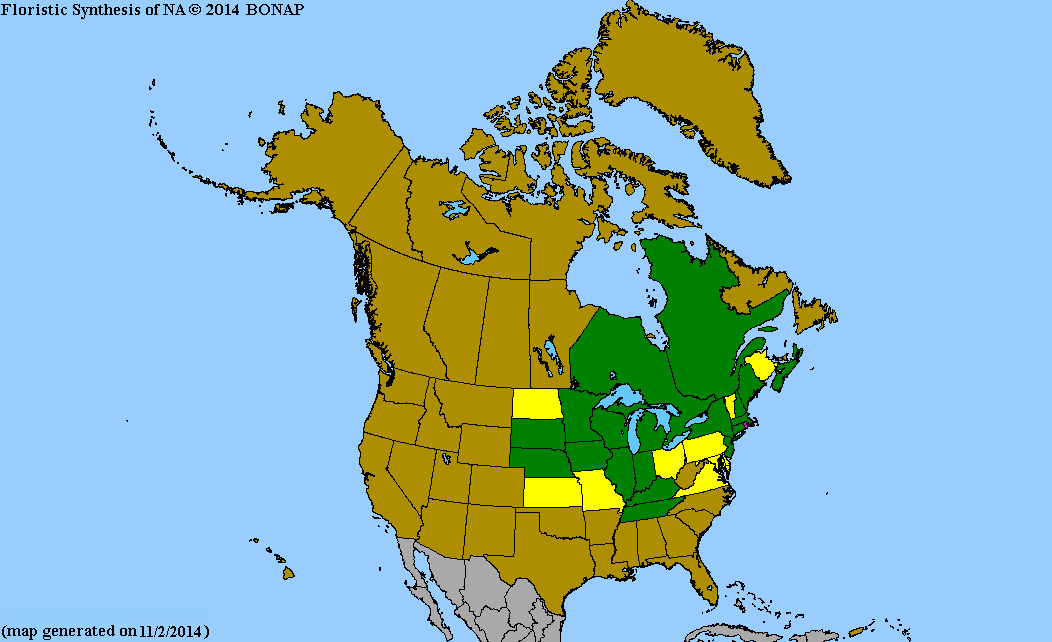
Cyperus diandrus, also known as umbrella flatsedge, is a species of flowering plant in the sedge family Cyperaceae. It is native to northeastern North America, ranging from the Maritime provinces of southeastern Canada southward to Virginia, reaching as far west as Nebraska. It is often confused with Cyperus bipartitus, both of which have chestnut-brown scales protecting the flowers. Its season runs from July to October but little else is known about its ecology.
Cyperus diandrus was named and described by John Torrey in 1818. The common name refers to the umbrella-like shape of its flower cluster, known to botanists as an umbel. The specific epithet diandrus suggests that each flower has "two stamens" (pollen-bearing organs), which is also true of various other species of flatsedges. In Canada, it is referred to as low umbrella flatsedge (French: souchet diandre). In other locales, it is simply known as low flatsedge.
Description
Cyperus diandrus is an annual sedge with fibrous roots. It has a cespitose (tufted) growth habit, with multiple stems at the base of the plant. A stem rarely exceeds 25 cm (9.8 in) in height. Above the stem, the inflorescence bears clusters of spikelets, each with numerous florets. There are up to 4 leaf-like bracts at the base of the inflorescence. The main cluster of spikelets at the top of the stem is stalkless, accompanied by 0–4 additional clusters on stalks up to 6 cm long. Each cluster supports 6–12 flattened spikelets. The terminal spikelet is usually erect. A spikelet consists of 8–28 florets, each covered by a scale (a type of bract in sedges and grasses). Each floret has two (occasionally three) anthers and a branched style with two stigmas. A perianth is absent. The anthers and stigmas emerge from the axil of the floral scale. The fruit is an achene.[4][5]
Cyperus diandrus is sometimes confused with Cyperus bipartitus, both of which have pigmented floral scales ranging in color from reddish-brown to purplish-brown. The two species may be distinguished by the pigmented pattern on the surface of the scales. Cyperus diandrus has a thin band of pigment along the scale's margin, with a conspicuous pale area on the face of the scale. Cyperus bipartitus is more heavily pigmented such that a pale area is lacking.[5][6][7] Occasionally the scales will be entirely pale greenish-white, in which case the plant may resemble Cyperus flavescens. Since the color of the scales may be misleading, the styles should also be examined. Cyperus diandrus has persistent styles that project 2–4 mm beyond the tip of the scale, whereas Cyperus bipartitus has deciduous styles that project less than 2 mm.[8][9] The relatively long styles of Cyperus diandrus give its spikelets a woolly appearance.[10]
Taxonomy
Cyperus diandrus was first described by the American botanist John Torrey in 1818.[2][11] Torrey published a more elaborate description of the species (in both Latin and English) in 1819.[12] Its type specimen was collected by the American naturalist John Eatton Le Conte on the border of salt marshes near New York City. The specific epithet diandrus means "with two stamens",[13] a characteristic shared by various species of Cyperus. In 1843, Torrey referred to the species as the "diandrous galingale".[14] In Canada, it is called "low umbrella flatsedge" (French: souchet diandre).[15] In other locales, it is simply known as "low flatsedge" (or "low cyperus").[16][17][18]
Cyperus diandrus is closely allied with Cyperus bipartitus. The latter was first described as Cyperus flavescens var. castaneus by the German-American botanist Frederick Traugott Pursh in 1813.[19] In 1836, Torrey published the name Cyperus diandrus var. castaneus based on Pursh's variety.[20] Torrey intentionally described a variety (not a species) but he emphasized that it "is very distinct from Cyperus diandrus".[10] In 1843, Torrey compared the two taxa in detail.[21] Combined with other details,[8][22] Torrey's descriptions of Cyperus diandrus and Cyperus diandrus var. castaneus may be organized as follows:
| Cyperus diandrus | Cyperus bipartitus (syn. Cyperus diandrus var. castaneus) | |
|---|---|---|
| Spikelets | Flatly compressed | Less so |
| Scale shape | Oblong, with obtuse tips | Longer and narrower, very closely imbricated (overlapping) |
| Scale pigment | Thin band of pigment along the margin, with a conspicuous pale area on the face of the scale | More heavily pigmented such that a pale area is lacking |
| Scale texture | Membranaceous (thin, pliable) | Coriaceous (leathery), with a firmer texture |
| Style length | Much exserted beyond the scales (2–4 mm), the exposed portion about as long as the scale; total length three or four times the length of the achene | Scarcely exserted beyond the scales (<2 mm); total length about twice the length of the achene |
| Style form | 2-cleft nearly to the base; more-or-less straight | Less deeply cleft; usually making a short double curvature toward the base |
| Achenes | Oblong-obovate, slightly scabrous, dull | Orbicular-obovate, minutely wrinkled transversely |
Distribution and habitat
Since Cyperus diandrus is often confused with other species, range maps should be interpreted with care. For example, in 1960, many Illinois specimens labeled as Cyperus diandrus were found to be misidentified.[8] The species was subsequently found to occur in just eight Illinois counties.
Cyperus diandrus is native to northeastern North America, ranging from Nova Scotia southward to Virginia, and as far west as Nebraska.[23] It was introduced in Germany.[3] In 2002, Flora of North America reported Cyperus diandrus in the following provinces and states:[4]
- Canada: New Brunswick, Nova Scotia, Ontario, Quebec
- United States: Connecticut, Delaware, Illinois, Indiana, Iowa, Maine, Maryland, Massachusetts, Michigan, Minnesota, Missouri, Nebraska, New Hampshire, New Jersey, New York, Pennsylvania, Rhode Island, Vermont, Virginia
In the United States, it is especially common in New England, New York, New Jersey, and the Midwestern United States.[24] It was introduced in the U.S. state of Washington.[25] Throughout its range, it grows on shorelines in sandy, peaty and slightly brackish habitats, usually not in disturbed areas. Its season runs from July to October.[22]
Conservation
As of February 2026, the NatureServe global conservation status of Cyperus diandrus is secure (G5).[1] It is uncommon (S3) in Illinois, Iowa, New York, and Quebec; imperiled (S2) in North Dakota, Ohio, and Pennsylvania; critically imperiled (S1) in Delaware, Missouri, New Brunswick, Nova Scotia, Vermont, and Virginia; and possibly extirpated (SH) in Kansas. It is endangered in Pennsylvania and Vermont.[26][27]
See also
References
- ^ a b NatureServe (30 January 2026). "Cyperus diandrus". NatureServe Explorer. Arlington, Virginia. Retrieved 3 February 2026.
- ^ a b "Cyperus diandrus Torr.". International Plant Names Index (IPNI). Royal Botanic Gardens, Kew; Harvard University Herbaria & Libraries; Australian National Botanic Gardens. Retrieved 26 February 2026.
- ^ a b "Cyperus diandrus Torr.". Plants of the World Online. Royal Botanic Gardens, Kew. Retrieved 3 February 2026.
- ^ a b Tucker, Gordon C.; Marcks, Brian G.; Carter, J. Richard (2002). "Cyperus diandrus". In Flora of North America Editorial Committee (ed.). Flora of North America North of Mexico (FNA). Vol. 23. New York and Oxford: Oxford University Press. Retrieved 3 February 2026 – via eFloras.org, Missouri Botanical Garden, St. Louis, MO & Harvard University Herbaria, Cambridge, MA.
- ^ a b "Cyperus diandrus (Umbrella Flatsedge)". Minnesota Wildflowers. Retrieved 4 February 2026.
- ^ "Comparison of Cyperus bipartitus and Cyperus diandrus spikelets". Minnesota Wildflowers. Retrieved 3 February 2026.
- ^ "Cyperus diandrus — umbrella flatsedge". Go Botany. Native Plant Trust. Retrieved 3 February 2026.
- ^ a b c Mohlenbrock (1960), pp. 284–287.
- ^ Reznicek, A. A.; Voss, E. G.; Walters, B. S. (February 2011). "Cyperus". Michigan Flora Online. University of Michigan. Retrieved 2 February 2026.
- ^ a b Torrey (1836), pp. 251–2.
- ^ Eaton (1818), p. 226.
- ^ Torrey (1819), p. 90.
- ^ Gledhill (2008), p. 139.
- ^ Torrey (1843), p. 338.
- ^ "Cyperus diandrus Torrey". Database of Vascular Plants of Canada. Retrieved 22 February 2026.
- ^ "Rare and Uncommon Native Vascular Plants of Vermont" (PDF). Vermont Natural Heritage Inventory, Vermont Fish & Wildlife Department. Retrieved 22 February 2026.
- ^ "Cyperus diandrus Torr.". Online Virtual Flora of Wisconsin. Consortium of Wisconsin Herbaria. Retrieved 22 February 2026.
- ^ Dole (1937), p. 70.
- ^ "Cyperus flavescens var. castaneus Pursh". International Plant Names Index (IPNI). Royal Botanic Gardens, Kew; Harvard University Herbaria & Libraries; Australian National Botanic Gardens. Retrieved 14 February 2026.
- ^ "Cyperus diandrus var. castaneus (Pursh) Torr.". International Plant Names Index (IPNI). Royal Botanic Gardens, Kew; Harvard University Herbaria & Libraries; Australian National Botanic Gardens. Retrieved 9 February 2026.
- ^ Torrey (1843), pp. 338–339.
- ^ a b "Cyperus diandrus Torrey". Flora of the Southeastern United States. Retrieved 3 February 2026.
- ^ Kartesz, John T. (2014). "Cyperus diandrus". State-level distribution map from the North American Plant Atlas (NAPA). Biota of North America Program (BONAP). Retrieved 3 February 2026.
- ^ Kartesz, John T. (2014). "Cyperus diandrus". County-level distribution map from the North American Plant Atlas (NAPA). Biota of North America Program (BONAP). Retrieved 18 February 2026.
- ^ "Cyperus diandrus (umbrella flatsedge)". Burke Herbarium. Retrieved 10 February 2026.
- ^ "Threatened and Endangered Species Desk Reference (Publication 546, Revision #5)" (PDF). Pennsylvania Department of Transportation. January 2020. Retrieved 8 March 2026.
- ^ "Rare and Uncommon Native Vascular Plants of Vermont" (PDF). Vermont Natural Heritage Inventory. 10 June 2024. Retrieved 7 March 2026.


Bibliography
- Dole, E. J., ed. (1937). The Flora of Vermont (3rd ed.). Burlington, Vermont: Free Press Printing Co.
- Eaton, Amos (1818). A Manual of Botany for the Northern and Middle States (2nd ed.). Albany: Websters and Skinners. Retrieved 26 February 2026.
- Gledhill, David (2008). The Names of Plants (4th ed.). Cambridge University Press. ISBN 978-0-521-86645-3. Retrieved 21 February 2026.
- Mohlenbrock, Robert H. (April 1960). "The Cyperaceae of Illinois. I. Cyperus". The American Midland Naturalist. 63 (2): 270–306. doi:10.2307/2422793.
- Torrey, John (1819). A catalogue of plants, growing spontaneously within thirty miles of the City of New-York. Albany: Lyceum of Natural History of New York. Retrieved 3 February 2026.
- Torrey, John (1836). "Monograph of the North American Cyperaceae". Annals of the Lyceum of Natural History of New York. 3: 239–448. Retrieved 12 January 2026.
- Torrey, John (1843). Flora of the State of New York. Vol. 2. Albany: Carroll and Cook. Retrieved 12 February 2026.
External links
- "Cyperus diandrus Torr.". World Flora Online. Retrieved 11 February 2026.
- "Cyperus diandrus". Lady Bird Johnson Wildflower Center. The University of Texas at Austin. Retrieved 3 February 2026.
- "Cyperus diandrus". New York Flora Atlas. Retrieved 10 February 2026.
- "Cyperus diandrus Torrey". Digital Atlas of the Virginia Flora. Retrieved 10 February 2026.
- "Cyperus diandrus". Indiana Plant Atlas. Retrieved 10 February 2026.
- "Umbrella Flatsedge Cyperus diandrus" (PDF). Pennsylvania Natural Heritage Program. Retrieved 10 February 2026.
- "Cyperus niger var. castaneus Kük.". International Plant Names Index (IPNI). Royal Botanic Gardens, Kew; Harvard University Herbaria & Libraries; Australian National Botanic Gardens. Retrieved 15 February 2026.