Cyperus bipartitus
| Cyperus bipartitus | |
|---|---|
| Thames River, Ontario | |
| Scientific classification | |
| Kingdom: | Plantae |
| Clade: | Tracheophytes |
| Clade: | Angiosperms |
| Clade: | Monocots |
| Clade: | Commelinids |
| Order: | Poales |
| Family: | Cyperaceae |
| Genus: | Cyperus |
| Species: | C. bipartitus
|
| Binomial name | |
| Cyperus bipartitus | |
| Synonyms[4] | |
|
Homotypic synonyms
Heterotypic synonyms
| |
Cyperus bipartitus, also known as slender flatsedge, river cyperus, or shining flatsedge, is a species of flowering plant in the sedge family Cyperaceae. It is native to the Americas, from southeastern Canada to northern Argentina. In the United States, its season runs from July to October but little else is known about its ecology. It is often confused with Cyperus diandrus, both of which have chestnut-brown scales protecting the flowers. It may also be confused with Cyperus gracilis, another species known as "slender flatsedge". The name "shining flatsedge" refers to the shiny appearance of its heavily pigmented floral scales.
The taxon known as Cyperus bipartitus was described as a variety of Cyperus diandrus by John Torrey in 1836. Torrey noted the variety was commonly found in New England, western New York State, and Pennsylvania, and went on to describe a taxon that "is very distinct from Cyperus diandrus". For most of the 19th century, botanists considered Cyperus bipartitus to be a variety of Cyperus diandrus.
Description
Cyperus bipartitus is an annual sedge with fibrous roots. It has a cespitose (tufted) growth habit, with multiple stems at the base of the plant. A stem rarely exceeds 25 cm (9.8 in) in height. Above the stem, the inflorescence bears clusters of spikelets, each with numerous florets. There are 2–3 leaf-like bracts at the base of the inflorescence. The main cluster of spikelets at the top of the stem is stalkless, accompanied by 0–4 additional clusters on stalks up to 3 cm long. Each cluster supports 3–10 flattened spikelets. The terminal spikelet is usually erect. A spikelet consists of 10–26 florets, each covered by a scale (a type of bract in sedges and grasses). Each floret has two (occasionally three) anthers and a branched style with two stigmas. A perianth is absent. The anthers and stigmas emerge from the axil of the floral scale. The fruit is an achene, a black disc about a millimeter wide.[5][6][7]
Cyperus bipartitus is often confused with Cyperus diandrus, both of which have pigmented floral scales ranging in color from reddish-brown to purplish-brown. The two species may be distinguished by the pigmented pattern on the surface of the scales. Cyperus diandrus has a thin band of pigment along the scale's margin, with a conspicuous pale area on the face of the scale. Cyperus bipartitus is more heavily pigmented such that a pale area is lacking.[7][8][9] Occasionally the scales will be entirely pale greenish-white, in which case the plant may resemble Cyperus flavescens. Since the color of the scales may be misleading, the styles should also be examined. Cyperus diandrus has persistent styles that project 2–4 mm beyond the tip of the scale, whereas Cyperus bipartitus has deciduous styles that project less than 2 mm.[10][11]
Taxonomy
Cyperus bipartitus was named and described by the American botanist John Torrey in 1836.[3] Torrey's description was based on a specimen collected in New Orleans, Louisiana.[12][13] Cyperus bipartitus Torr. has many synonyms but two are most important: Cyperus diandrus var. castaneus (Pursh) Torr. and Cyperus rivularis Kunth.
The taxon known as Cyperus bipartitus was first described as Cyperus flavescens var. castaneus by the German-American botanist Frederick Traugott Pursh in 1813.[14] Pursh's description was based on specimens from New York, Vermont, and Massachusetts.[15] The epithet castaneus, which means "chestnut-brown", refers to the color of the floral scales. In 1824, the American botanist Jacob Bigelow raised Pursh's variety to the rank of species.[16] At the time, Bigelow was unaware that the name Cyperus castaneus had been previously published in 1797,[17] and so Cyperus castaneus (Pursh) Bigelow is an illegitimate name. In 1836, Torrey published the name Cyperus diandrus var. castaneus based on Pursh's variety.[18] In addition to Pursh and Bigelow, Torrey cited Cyperus bicolor, an illegitimate name published by William P. C. Barton in 1818.[19] Torrey noted the variety was commonly found in New England, western New York State, and Pennsylvania, and went on to describe a taxon that "is very distinct from Cyperus diandrus".[20] He elaborated on the differences between the two taxa in his Flora of the State of New York published in 1843.[21]
Torrey simultaneously published the names Cyperus diandrus var. castaneus and Cyperus bipartitus in his monograph of 1836 but he made no connection between the two, nor was the latter included in his Flora of the State of New York in 1843. These facts suggest that the taxon we now call Cyperus bipartitus was known to Torrey (and his contemporaries) as Cyperus diandrus var. castaneus.
In 1837, the German botanist Carl Sigismund Kunth named and described Cyperus rivularis based on a specimen collected in the U.S. state of Georgia.[22] Kunth compared Cyperus rivularis to Cyperus flavescens but he did not mention Cyperus diandrus.[23] Over the next 150 years, many botanists would consider Cyperus diandrus var. castaneus (Pursh) Torr. to be a synonym of Cyperus rivularis Kunth.[10][24][25] The controversy ended in 1983 when the name Cyperus rivularis Kunth was firmly placed in synonymy with Cyperus bipartitus Torr.[26] The latter became widely accepted after its publication in the influential Flora of North America in 2002.[5] As of February 2026, most authorities consider both Cyperus diandrus var. castaneus (Pursh) Torr. and Cyperus rivularis Kunth to be synonyms of Cyperus bipartitus Torr.[4][27]
Distribution and habitat
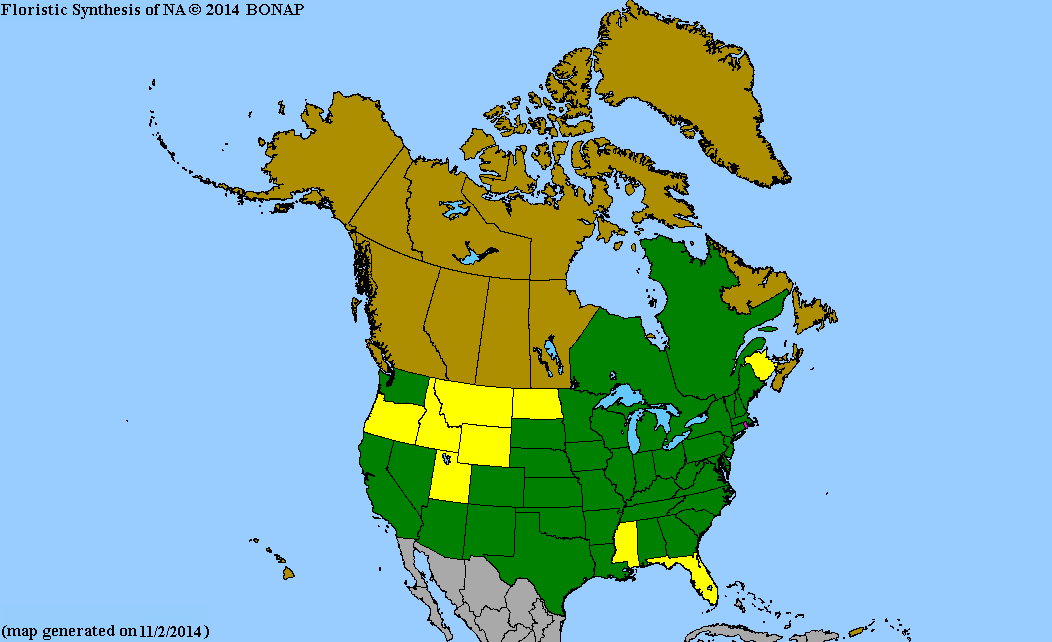
Cyperus bipartitus is native to the Americas, from southeastern Canada to northern Argentina.[4] It is found in wet environments such as lakes, sandbars, and ditches at elevations to 1,500 metres (4,900 ft).[5] In the United States, its season runs from July to October,[28] but in Mexico, its season extends into January.[29]
North of Mexico, Cyperus bipartitus is most common in the Great Lakes region.[30][31] It is relatively uncommon in the southeastern United States, being essentially absent from Louisiana eastward along the Gulf Coastal Plain across the Florida panhandle to the Atlantic Coastal Plain of South Carolina.[28] The type specimens of both Cyperus bipartitus Torr. and Cyperus rivularis Kunth came from the southeastern U.S., which partially explains the confusion surrounding the taxonomy of this species. Despite this, one or the other of these names has been in constant use since at least 1894.[25]
See also
References
- ^ Lansdown, R.V. (2016). "Pycreus bipartitus". The IUCN Red List of Threatened Species. Retrieved 2 February 2026.
- ^ NatureServe (30 January 2026). "Cyperus bipartitus". NatureServe Explorer. Arlington, Virginia. Retrieved 2 February 2026.
- ^ a b "Cyperus bipartitus Torr.". International Plant Names Index (IPNI). Royal Botanic Gardens, Kew; Harvard University Herbaria & Libraries; Australian National Botanic Gardens. Retrieved 2 February 2026.
- ^ a b c "Cyperus bipartitus Torr.". Plants of the World Online. Royal Botanic Gardens, Kew. Retrieved 2 February 2026.
- ^ a b c Tucker, Gordon C.; Marcks, Brian G.; Carter, J. Richard (2002). "Cyperus bipartitus". In Flora of North America Editorial Committee (ed.). Flora of North America North of Mexico (FNA). Vol. 23. New York and Oxford: Oxford University Press. Retrieved 2 February 2026 – via eFloras.org, Missouri Botanical Garden, St. Louis, MO & Harvard University Herbaria, Cambridge, MA.
- ^ Tucker, Gordon C. (2012). "Cyperus bipartitus". Jepson eFlora. University of California, Berkeley. Retrieved 2 February 2026.
- ^ a b "Cyperus bipartitus (Shining Flatsedge)". Minnesota Wildflowers. Retrieved 3 February 2026.
- ^ "Comparison of Cyperus bipartitus and Cyperus diandrus spikelets". Minnesota Wildflowers. Retrieved 3 February 2026.
- ^ "Cyperus bipartitus — shining flatsedge". Go Botany. Native Plant Trust. Retrieved 2 February 2026.
- ^ a b Mohlenbrock (1960), pp. 284–287.
- ^ Reznicek, A. A.; Voss, E. G.; Walters, B. S. (February 2011). "Cyperus". Michigan Flora Online. University of Michigan. Retrieved 2 February 2026.
- ^ Torrey (1836), p. 257.
- ^ "Cyperus bipartitus Torr.". Global Biodiversity Information Facility. Retrieved 27 February 2026.
- ^ "Cyperus flavescens var. castaneus Pursh". International Plant Names Index (IPNI). Royal Botanic Gardens, Kew; Harvard University Herbaria & Libraries; Australian National Botanic Gardens. Retrieved 7 February 2026.
- ^ "Cyperus flavescens var. castaneus Pursh". Global Biodiversity Information Facility. Retrieved 27 February 2026.
- ^ "Cyperus castaneus (Pursh) Bigelow". International Plant Names Index (IPNI). Royal Botanic Gardens, Kew; Harvard University Herbaria & Libraries; Australian National Botanic Gardens. Retrieved 27 February 2026.
- ^ "Cyperus castaneus Willd.". International Plant Names Index (IPNI). Royal Botanic Gardens, Kew; Harvard University Herbaria & Libraries; Australian National Botanic Gardens. Retrieved 27 February 2026.
- ^ "Cyperus diandrus var. castaneus (Pursh) Torr.". International Plant Names Index (IPNI). Royal Botanic Gardens, Kew; Harvard University Herbaria & Libraries; Australian National Botanic Gardens. Retrieved 7 February 2026.
- ^ "Cyperus bicolor W.P.C.Barton". International Plant Names Index (IPNI). Royal Botanic Gardens, Kew; Harvard University Herbaria & Libraries; Australian National Botanic Gardens. Retrieved 27 February 2026.
- ^ Torrey (1836), pp. 251–2.
- ^ Torrey (1843), pp. 338–339.
- ^ "Cyperus rivularis Kunth". International Plant Names Index (IPNI). Royal Botanic Gardens, Kew; Harvard University Herbaria & Libraries; Australian National Botanic Gardens. Retrieved 6 February 2026.
- ^ Kunth (1837), p. 6.
- ^ Dole (1937), p. 70.
- ^ a b Britton (1894), p. 28.
- ^ Tucker (1983), p. 66.
- ^ "Cyperus bipartitus Torr.". WFO Plant List. Retrieved 2 February 2026.
- ^ a b "Cyperus bipartitus Torrey". Flora of the Southeastern United States. Retrieved 2 February 2026.
- ^ Tucker (1994), p. 79.
- ^ Kartesz, John T. (2014). "Cyperus bipartitus". State-level distribution map from the North American Plant Atlas (NAPA). Biota of North America Program (BONAP). Retrieved 2 February 2026.
- ^ Kartesz, John T. (2014). "Cyperus bipartitus". County-level distribution map from the North American Plant Atlas (NAPA). Biota of North America Program (BONAP). Retrieved 2 February 2026.


Bibliography
- Britton, N. L. (January 1894). "New or Noteworthy North American Phanerogams-VIII". Bulletin of the Torrey Botanical Club. 21 (1): 27–34. doi:10.2307/2478032.
- Dole, E. J., ed. (1937). The Flora of Vermont (3rd ed.). Burlington, Vermont: Free Press Printing Co.
- Kunth, Carl Sigismund (1837). Enum. Pl. [Kunth] Vol. 2. Stuttgart and Tübingen: J. G. Cottae. Retrieved 3 March 2026.
- Mohlenbrock, Robert H. (April 1960). "The Cyperaceae of Illinois. I. Cyperus". The American Midland Naturalist. 63 (2): 270–306. doi:10.2307/2422793.
- Torrey, John (1836). "Monograph of the North American Cyperaceae". Annals of the Lyceum of Natural History of New York. 3: 239–448. Retrieved 12 January 2026.
- Torrey, John (1843). Flora of the State of New York. Vol. 2. Albany: Carroll and Cook. Retrieved 12 February 2026.
- Tucker, Gordon C. (1983). "The Taxonomy of Cyperus (Cyperaceae) in Costa Rica and Panama". Systematic Botany Monographs. 2: 1–85. doi:10.2307/25027589. JSTOR 25027589.
- Tucker, Gordon C. (1994). "Revision of the Mexican Species of Cyperus (Cyperaceae)". Systematic Botany Monographs. 43: 1–213. doi:10.2307/25027842. JSTOR 25027842.
External links
- "Cyperus bipartitus Torr.". World Flora Online. Retrieved 11 February 2026.
- "Cyperus bipartitus". Lady Bird Johnson Wildflower Center. The University of Texas at Austin. Retrieved 2 February 2026.
- "Cyperus bipartitus Torrey slender flatsedge". Calflora. Retrieved 12 January 2014.
- "Cyperus bipartitus Torr.". eFloraMEX. Retrieved 4 February 2026.
- Kükenthal, Georg (1936). Engler, A. (ed.). Cyperaceae-Scirpoideae-Cypereae. Das Pflanzenreich IV, 20(Heft 101). Leipzig: Verlag von Wilhelm Engelmann. Retrieved 9 February 2026.
- Photo gallery