C/2026 A1 (MAPS)
Comet MAPS as seen by the James Webb Space Telescope on 7 February 2026 | |
| Discovery[1][2] | |
|---|---|
| Discovered by | MAP Observation Program
|
| Discovery site | AMACS1, Chile (W94) |
| Discovery date | 13 January 2026 |
| Designations | |
| 6AC4721, CK26A010 | |
| Orbital characteristics[6] | |
| Epoch | 8 February 2026 (JD 2461079.5) |
| Observation arc | 63 days |
| Earliest precovery date | 18 December 2025[3] |
| Number of observations | 894[7] |
| Orbit type | Kreutz sungrazer |
| Aphelion | 309±2 AU |
| Perihelion | 0.005734 AU (1.233 R☉)[a] |
| Semi-major axis | 155±1 AU |
| Eccentricity | 0.99996 |
| Orbital period | 1921±18 years 1711 years (inbound)[4] |
| Max. orbital speed | 557 km/s |
| Inclination | 144.49° |
| 7.86° | |
| Argument of periapsis | 86.3° |
| Mean anomaly | 359.97° |
| Next perihelion | 4 April 2026 ≈14:23 UT[5] |
| TJupiter | –0.043 |
| Earth MOID | 0.556 AU |
| Jupiter MOID | 2.987 AU |
| Physical characteristics[6] | |
Mean radius | 0.2 km (0.12 mi)[8] |
| Comet total magnitude (M1) | 14.8±1 |
| 9.7 (20 March 2026)[9] | |
C/2026 A1 (MAPS), formerly known by its temporary designation as 6AC4721, is a Kreutz sungrazer comet discovered on 13 January 2026 from the AMACS1 Observatory in the Atacama Desert. This comet was discovered through the MAPS program, which was led by Alain Maury, Georges Attard, Daniel Parrott and Florian Signoret.[b] On 4 April 2026, it will pass about 162,000 km (101,000 mi) from the surface of the Sun.[a] When near the Sun, the forward scattering of light could make the comet significantly brighter,[12] but hard to see against the glare of the Sun.[c] How bright the comet will get is largely unknown as it depends on the comet's survival upon perihelion approach.
Observational history
C/2026 A1 (MAPS) was discovered from the AMACS1 Observatory at San Pedro de Atacama, using a 0.28 m (11 in) f/2.2 Schmidt telescope with a CCD camera.[1] It was discovered at a distance of 2.056 AU (307.6 million km; 191.1 million mi) from the Sun, making it the furthest Kreutz sungrazer ever discovered,[13] surpassing the record previously held by Comet Ikeya–Seki,[d] allowing a lead time of observations for approximately 81 days before perihelion.[15]
The comet was 17.8 magnitude at the moment of discovery and was located in the constellation Columba.[1]
Earliest precovery date is December 2025, when it was about magnitude 20.[3] Its discovery was officially announced on 20 January 2026.[1][2] It is expected to become visible in 8 to 10-inch telescopes by late March, a few days before perihelion.[16][17] By mid March it had brightened to an apparent magnitude of about 10.[9] It will cross the celestial equator on 30 March 2026.[18] Due to its relatively low declination in the sky relative to the Sun, it will become more favorable to view from the Southern hemisphere than in the north.[16]
As seen from Earth, the comet will come to solar conjunction on 4 April 2026 around 13:21 (behind the Sun) and 15:37 UT (in front of the Sun).[19] For both, it will be 0.04 degrees from the center of the Sun (the Sun has a width of 0.5 degrees).[19] It is expected to enter SOHO–LASCO's field-of-view by 2 April 2026.[20]
Orbit
C/2026 A1 is a Kreutz group comet. It was initially thought to belong to the Pe subgroup, a subgroup of the Kreutz Sungrazers closely associated with subgroup I, which all fragmented from the Great Comet of 1106.[21] This specific subgroup include some bright members like the Great Comet of 1843 and C/1963 R1 (Pereyra).[22][e] However, its extraordinarily long orbital period suggested it's only a coincidence and it may possibly be a member of a yet-unknown distinct subgroup instead.[23]
It will pass through the solar corona and reach perihelion on 4 April 2026 around 14:23 UT when it will be 0.005734 AU (1.233 R☉) from the center of the Sun[5] or about 162,000 km from the surface of the Sun.[a] There is no chance of a solar impact as the 5-sigma uncertainty is only ±3000 km,[6][f] giving a minimum possible approach of about 159000 km. It will then make closest approach to Earth around 6 April 2026 00:00 UT when it will be 0.961 AU (143.8 million km) from Earth.[24]
With an observation arc of 63 days, the comet's inbound orbital period (calculated at epoch 1800, which is before entering the planetary region of the Solar System) suggests it last reached perihelion around 1700 years ago,[4] suggesting that it may be a second-generation fragment from the Great Comet of 371 BC itself,[23] specifically the comet of 363 AD that was witnessed by Ammianus Marcellinus.[25]
Physical characteristics
In January 2026, initial estimates of the upper limit for the size of its nucleus placed it at less than 2.4 km (1.5 mi) in diameter.[16][26] A study published in March 2026 using the data from the James Webb Space Telescope (JWST) concluded that the comet is roughly 400 m (1,300 ft) in diameter,[8] about the size of C/2011 W3 (Lovejoy),[27] however its authors noted that the comparison has to be treated with caution as C/2026 A1 is the only Kreutz comet that we have direct measurements of its nucleus out of the more than 5,000 members of the family we had known so far.[8]
See also
- 115P/Maury, the first comet discovered by one of Comet MAPS' discoverers, Alain J. Maury
- List of Kreutz sungrazers
- C/2011 W3 (Lovejoy), the Great Comet of 2011
- C/2024 S1 (ATLAS)
- C/2025 R3 (PanSTARRS), another naked eye comet for April 2026
Notes
- ^ a b c The comet will pass 0.005734 AU (1.233 R☉) from the center of the Sun[5] which is (0.233 solar radii * 695700 km) = 162,000 km (101,000 mi) from the surface of the Sun.
- ^ C/2026 A1 is the third comet discovered by the program after C/2025 L2 (MAPS)[10] and C/2025 O2 (MAPS)[11]
- ^ Observing a comet when it is very close to the Sun can be dangerous.
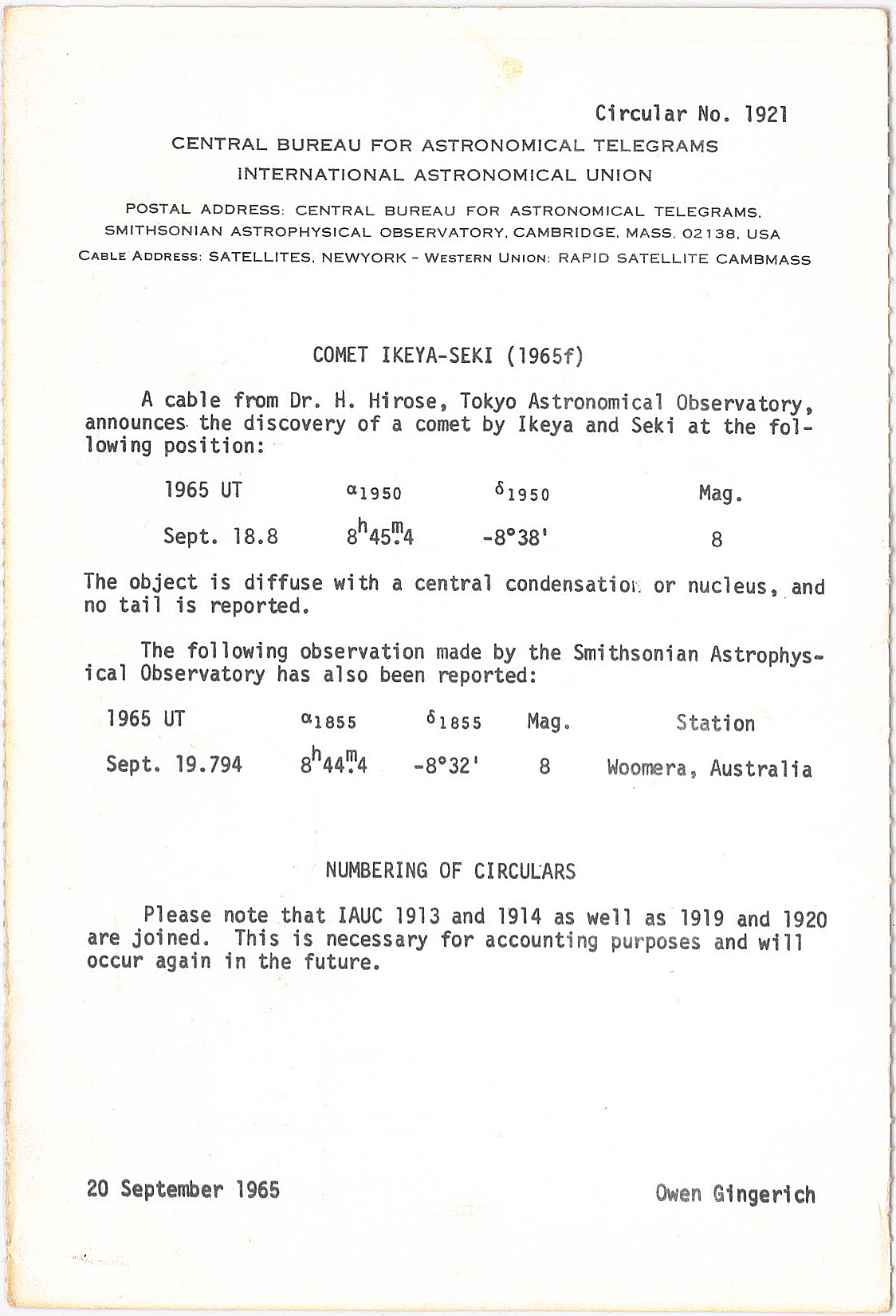
- ^ Comet Ikeya–Seki was first discovered at a distance of 1.11 AU (166 million km) from the Sun on 18 September 1965,[14] which gave astronomers approximately 33 days to observe the comet inbound.[15]
- ^ The Great Comet of 1843 passed 132000 km from the surface of the Sun and C/1963 R1 (Pereyra) passed 56000 km from the surface of the Sun. With a short observation arc of 8 days, the Kreutz Great Southern Comet of 1887 is believed to have passed about 27000 km from the surface of the Sun. Sun-plunger (with a sun-striking trajectory and non-Kreutz member) C/2007 M5 (SOHO), if it did not get vaporized by the extreme solar radiation and tidal forces, would have tried to impact the Sun at 0.0011 AU (160 thousand km; 100 thousand mi) from the Sun's center.
- ^ JPL #7 at the JPL SBDB shows a 1-sigma uncertainty of 3.7E-6 AU which is a 1-sigma uncertainty of 555 km or a 5-sigma uncertainty of 3000 km (3.7E-6 * AU * 5).
References
- ^ a b c d A. Maury; S. Deen; M. Masek; et al. (20 January 2026). D. W. Green (ed.). "Comet C/2026 A1 (MAPS)" (TXT). Central Bureau for Astronomical Telegrams. 5658.
- ^ a b D. Parrott; G. Attard; A. Maury; F. Signoret; et al. (20 January 2026). "Comet C/2026 A1 (MAPS)". Minor Planet Electronic Circulars. 2026-B129. Bibcode:2026MPEC....B..129P. doi:10.48377/MPEC/2026-B129.
- ^ a b E. Baldwin-Fiebrich; E. Norman (16 January 2026). "Potentially bright 'sungrazing' comet discovered". Astronomy Now. Retrieved 17 January 2026.
- ^ a b Horizons output. "Barycentric Osculating Orbital Elements for C/2026 A1 (MAPS)". Archived from the original on 2 March 2026. Retrieved 18 March 2026. (Solution using the Solar System's barycenter (Sun+Jupiter). Select Ephemeris Type:Elements and Center:@0)
Inbound period (PR) = 6.25E+05 / 365.25 days = 1711 years - ^ a b c "Horizons Batch for C/2026 A1 (MAPS) on 2026-Apr-04" (Perihelion occurs when rdot flips from negative to positive). JPL Horizons. Archived from the original on 3 March 2026. Retrieved 18 March 2026. (JPL #7 / Soln.date: 2026-Mar-17)
- ^ a b c "C/2026 A1 (MAPS) – JPL Small-Body Database Lookup". ssd.jpl.nasa.gov. Jet Propulsion Laboratory. Archived from the original on 25 February 2026. Retrieved 18 March 2026.
- ^ "C/2026 A1 (MAPS) Orbit". Minor Planet Center. Retrieved 18 March 2026.
- ^ a b c Q. Zhang; M. M. Knight; Q. Z. Ye; et al. (2026). "Preliminary Nucleus Size Estimate for Kreutz Sungrazer C/2026 A1 (MAPS)". Research Notes of the American Astronomical Society. 10 (3). doi:10.3847/2515-5172/ae5220.
- ^ a b "COBS Observation list: C/2026 A1". Comet Observation Database. Črni Vrh Observatory. Retrieved 2 March 2026.
- ^ "C/2025 L2 (MAPS) – JPL Small-Body Database Lookup". ssd.jpl.nasa.gov. Jet Propulsion Laboratory. Retrieved 10 March 2026.
- ^ "C/2025 O2 (MAPS) – JPL Small-Body Database Lookup". ssd.jpl.nasa.gov. Jet Propulsion Laboratory. Retrieved 10 March 2026.
- ^ D. Dickinson (11 February 2026). "New Sungrazer Comet A1 MAPS Could Be Bright in Early April If It Survives Perihelion". Universe Today. Retrieved 13 February 2026.
- ^ Jure Atanackov [@JAtanackov] (15 January 2026). "The newly discovered Kreutz comet, provisionally designated 6AC4721, is outstanding in at least one aspect: this is by far the earliest (before the perihelion) a Kreutz comet has ever been discovered. In other words, a Kreutz comet has never before been discovered with so much lead time - 3 months!" (Tweet) – via X (formerly Twitter).
- ^ K. Ikeya; T. Seki; H. Hirose (20 September 1965). O. Gingerich (ed.). "Comet Ikeya–Seki (1965f)". IAU Circular. 1921 (1).
- ^ a b J. Rao (5 February 2026). "Will a bright comet adorn our early spring sky? Why astronomers are getting excited about Comet C/2026 A1 (MAPS)". Space.com. Retrieved 13 February 2026.
- ^ a b c B. King (4 February 2026). "New Kreutz Comet C/2026 A1 may Dazzle". Sky & Telescope. Retrieved 5 February 2026.
- ^ J. Carter (8 March 2026). "A Possible Daylight Comet Is Coming — Or The Sun May Destroy It". Forbes. Retrieved 10 March 2026.
- ^ "Crossing the celestial equator at declination 0". JPL Horizons. Retrieved 13 February 2026.
- ^ a b "Sun-Observer-Target angle for C/2026 A1 (MAPS) on 2026-Apr-04". JPL Horizons. Retrieved 18 March 2026. (JPL #7 / Soln.date: 2026-Mar-17)
- ^ J. Rao (10 March 2026). "'Easter comet' could be visible in daytime skies this April — if it survives a fiery dive past the sun". Space.com. Retrieved 11 March 2026.
- ^ Z. Sekanina (2021). "New Model for the Kreutz Sungrazer System: Contact-Binary Parent and Upgraded Classification of Discrete Fragment Populations". arXiv:2109.01297 [astro-ph.EP].
- ^ E. Irizarry. "The best comets of 2026: Here's what to watch for". EarthSky.org. Retrieved 18 January 2026.
- ^ a b Z. Sekanina (2026). "New Kreutz Sungrazer C/2026 A1 (MAPS): Third Time's the Charm?". arXiv:2602.17626 [astro-ph.EP].
- ^ "Earth approach on 5-6 April 2026". JPL Horizons. Archived from the original on 7 March 2026. Retrieved 18 March 2026. (JPL #7 / Soln.date: 2026-Mar-17)
- ^ Z. Sekanina (2022). "Unprecedented Daylight Display of Kreutz Sungrazers in AD 363?". arXiv:2202.01164 [astro-ph.EP].
- ^ E. Irizarry (24 January 2026). "New sungrazing comet might get bright. See maps here!". EarthSky.org. Retrieved 5 February 2026.
- ^ B. Gundlach; J. Blum; Y. V. Skorov; H. U. Keller (2012). "A Note on the Survival of the sungrazing comet C/2011 W3 (Lovejoy) within the Roche limit". arXiv:1203.1808 [astro-ph.EP].
External links
- C/2026 A1 at the JPL Small-Body Database
- C/2026 A1 an NEOCP report from Project Pluto (13 January 2026).
- C/2026 A1 at Gideon van Buitenen's website.
- C/2026 A1 at Seiichi Yoshida's website.
- C/2026 A1 at COBS (Comet Observation database)
- HDR Astrophotography: Comet tails simulations by Nicolas Lefaudeux