Trillium underwoodii
| Trillium underwoodii | |
|---|---|
| Scientific classification | |
| Kingdom: | Plantae |
| Clade: | Tracheophytes |
| Clade: | Angiosperms |
| Clade: | Monocots |
| Order: | Liliales |
| Family: | Melanthiaceae |
| Genus: | Trillium |
| Species: | T. underwoodii
|
| Binomial name | |
| Trillium underwoodii | |
| Synonyms[1] | |
| |
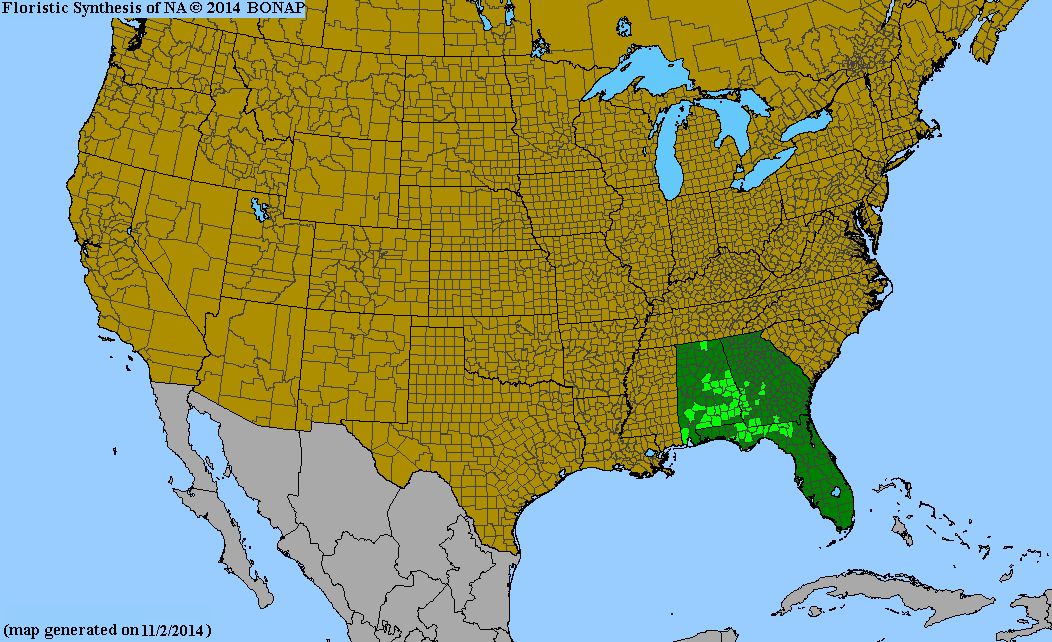
Trillium underwoodii, commonly known as the longbract wakerobin, is a species of flowering plant in the family Melanthiaceae. It is native to the southeastern United States, where it occurs in Alabama, Florida, and Georgia.[1][2] It is a perennial herb that spreads by underground rhizomes.[3]
Description
Trillium underwoodii is a perennial herb up to 20 cm tall, spreading by means of underground rhizomes.[3] The leaves are mottled with light, medium, and dark green blotches.[3][4] Flowers are foul-smelling or musk-scented, usually deep maroon or purplish red but occasionally yellow.[3][4] Small described the sepals as lanceolate and the berry as ovoid.[4]
Taxonomy
The species was first described by John K. Small in 1897.[4] In his original treatment, Small distinguished T. underwoodii from Trillium sessile, noting differences in overall size and habit as well as in floral characters such as the stamens and styles.[4] A 2019 molecular phylogenetic study found little genetic distinction between Trillium underwoodii and Trillium decipiens, suggesting that their status as separate species may require re-evaluation.[5]
Conservation
According to a 2019 assessment by the Trillium Working Group, Trillium underwoodii is considered a species of least concern globally, with a NatureServe conservation status of G4 ("apparently secure").[6]
The species occurs across southern Alabama, southwestern Georgia, and northern Florida.[6] Although population data are limited, some subpopulations are reported to be large.[6] Potential threats include habitat degradation from logging and urbanization, herbivory by overabundant white-tailed deer, disturbance from feral pigs, and competition from invasive plant species such as Japanese stiltgrass, bush honeysuckle, English ivy, Chinese privet, and trifoliate orange.[6] However, no widespread population declines have been documented.[6]
References
- ^ a b Kew World Checklist of Selected Plant Families
- ^ Biota of North America Program 2014 county distribution map
- ^ a b c d Case Jr., Frederick W. (2002). "Trillium underwoodii". In Flora of North America Editorial Committee (ed.). Flora of North America North of Mexico (FNA). Vol. 26. New York and Oxford: Oxford University Press – via eFloras.org, Missouri Botanical Garden, St. Louis, MO & Harvard University Herbaria, Cambridge, MA.
- ^ a b c d e Small, John K. (1897). "Studies in the Botany of the Southeastern United States. IX. I. The Sessile-Flowered Trillia of the Southern States". Bulletin of the Torrey Botanical Club. 24 (4): 169–178. JSTOR 2478330.
- ^ "Trillium underwoodii". NatureServe Explorer. Retrieved 17 March 2026.
- ^ a b c d e Meredith, C.R.; Trillium Working Group (2019). The Conservation Status of Trillium in North America (PDF) (Report).
- Case, Frederick W. and Case, Roberta B. (1997) Trilliums. ISBN 0-88192-374-5
External links
- Citizen science observations for Trillium underwoodii at iNaturalist
- Floridata
- Native Florida Wildflowers
- Atlas of Florida Vascular Plants
- Evolution Plants
- Stritch, Larry. "Longbract Trillium (Trillium underwoodii)". United States Forest Service. Retrieved 22 September 2021.
- "Trillium underwoodii". NatureServe Explorer. NatureServe, Arlington, Virginia. Retrieved 16 November 2021.