Trillium discolor
| Trillium discolor | |
|---|---|
| 1831 Illustration[1] | |
| Scientific classification | |
| Kingdom: | Plantae |
| Clade: | Embryophytes |
| Clade: | Tracheophytes |
| Clade: | Spermatophytes |
| Clade: | Angiosperms |
| Clade: | Monocots |
| Order: | Liliales |
| Family: | Melanthiaceae |
| Genus: | Trillium |
| Species: | T. discolor
|
| Binomial name | |
| Trillium discolor | |
| Synonyms[3] | |
| |
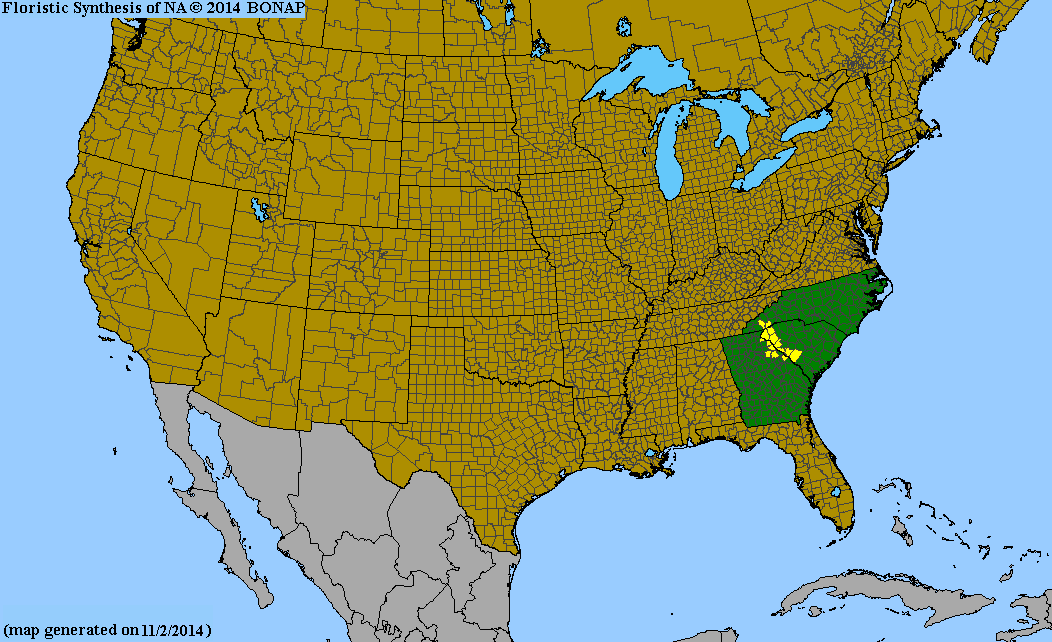
Trillium discolor, the mottled wakerobin,[4] pale yellow trillium, or small yellow toadshade,[5] is a species of flowering plant in the family Melanthiaceae. It is native to areas of the Savannah River drainage system of Georgia, North Carolina and South Carolina[6] such as Steven's Creek Heritage Preserve and Lake Keowee. It is found along moist stream banks in upland woods, on acidic to basic soils.[7]
Description
Trillium discolor is a perennial herbaceous plant that blooms mid April to early May. It has a flower with pale yellow petals that stand upright at the junction of the three leaf-like bracts.[5]
Conservation
Trillium discolor is ranked as globally vulnerable (G3) due to its restricted geographic range and ongoing population decline.[2]
The species is endemic to the Savannah River drainage of Georgia, North Carolina, and South Carolina, with an estimated range of approximately 5,000–20,000 km² and 81–300 known occurrences.[2] Long-term population trends suggest a decline of approximately 10–30%, partly due to historical habitat alteration such as dam construction and ongoing land-use changes.[2]
Major threats include habitat loss from commercial and residential development, silvicultural practices, and hydrological changes, as well as competition from invasive plant species such as Ligustrum sinense and disturbance from feral hogs.[2] Herbivory by white-tailed deer may also negatively impact populations, particularly smaller occurrences.[2]
More broadly, many species of Trillium are particularly vulnerable to disturbance due to their slow life history, delayed reproductive maturity, and limited seed dispersal.[8] These traits, combined with habitat fragmentation and localized endemism in the southeastern United States, contribute to elevated conservation concern for narrowly distributed species such as T. discolor.[8]
References
- ^ by Samuel Curtis and William Jackson Hooker, published in Curtis's Botanical Magazine, volume 58, Plate 3097
- ^ a b c d e f "Trillium discolor". NatureServe Explorer. NatureServe. Retrieved 16 November 2021.
- ^ "Trillium discolor". World Checklist of Selected Plant Families (WCSP). Royal Botanic Gardens, Kew. Archived from the original on November 18, 2021.
- ^ NRCS. "Trillium discolor". PLANTS Database. United States Department of Agriculture (USDA). Retrieved 15 December 2015.
- ^ a b Case Jr., Frederick W. (2002). "Trillium discolor". In Flora of North America Editorial Committee (ed.). Flora of North America North of Mexico (FNA). Vol. 26. New York and Oxford: Oxford University Press – via eFloras.org, Missouri Botanical Garden, St. Louis, MO & Harvard University Herbaria, Cambridge, MA.
- ^ Kartesz, John T. (2014). "Trillium discolor". County-level distribution map from the North American Plant Atlas (NAPA). Biota of North America Program (BONAP). Retrieved 7 October 2019.
- ^ Stritch, Larry. "Mottled Wakerobin (Trillium discolor)". United States Forest Service. Retrieved 7 October 2019.
- ^ a b Meredith, Clayton; Frances, Anne; Highland, Amy (2022). The Conservation Status of Trillium in North America (Report). Mt. Cuba Center and New Mexico BioPark Society.
Bibliography
- Case, Frederick W.; Case, Roberta B. (1997). Trilliums. Portland, Oregon: Timber Press. ISBN 978-0-88192-374-2.
- Freeman, J. D. (1975). "Revision of Trillium subgenus Phyllantherum (Liliaceae)". Brittonia. 27 (1): 1–62. Bibcode:1975Britt..27....1F. doi:10.2307/2805646. JSTOR 2805646. S2CID 20824379.