Thomas Storer (American mathematician)
Thomas Storer | |
|---|---|
Storer with a student in 1985 | |
| Born | 1938 |
| Died | November 9, 2006 (aged 67–68) |
| Citizenship | Navajo Nation and U.S. |
| Alma mater | |
| Scientific career | |
| Fields | Mathematics, combinatorics |
| Institutions | University of Michigan |
| Thesis | A Family of Generalized Difference Sets (1964) |
| Doctoral advisor | Albert Leon Whiteman |
| Doctoral students | Peyton Young |
Thomas Frederick Storer (1938 – November 9, 2006) was a Navajo American mathematician who studied combinatorics and cyclotomy. He was a professor at the University of Michigan, and was one of the first Native Americans to become a PhD mathematician. In addition to his mathematical research, teaching, and mentoring, Storer also did notable work on string figures.
Education and career
Storer, a citizen of the Navajo Nation, was born in 1938.[1] He attended the University of California, Los Angeles for his bachelors degree, with the help of a football scholarship.[2][3] He went on to the University of Southern California for his graduate work, receiving an MA in 1962, and a PhD in 1964.[2][4] His thesis was titled A Family of Generalized Difference Sets, and was advised by Albert Whiteman.[4] Storer was one of the first Native Americans to complete a PhD in mathematics; Native Hawaiian Edwin Mookini completed his PhD in the same year, at the same institution.[1][5][6]
In 1965, after a short period in residence in Princeton, New Jersey at the Institute for Advanced Study,[7] Storer went to the University of Michigan, where he remained for the rest of his career.[8] He was promoted to full professor in 1979, and retired to emeritus status in 2001.[3][9]
At the University of Michigan, Storer was known as a teacher and mentor. In 1985, he received the Amoco Foundation Good Teaching Award.[9] Storer was an advocate for Native American causes on the University of Michigan campus, and learned the language spoken by the Ojibwe people in Michigan.[3][9] Ten doctoral students completed their PhDs with Storer as their thesis advisor, including Peyton Young (co-advised with Jack Edmonds).[4]
String figures
Storer also wrote several works on string figures, the designs formed by manipulating string around one's fingers. His bibliography on the topic went through three editions.[3] He also wrote a monograph on string figures, which appeared as a two-volume special issue of the Bulletin of String Figures Association.[1]
-
Schema representing the Osage Diamonds string figure in Storer's notation
-
Seifert surface associated with the Osage Diamonds string figure
In his monograph, he devised a notation system for compactly and precisely describing string figures.[1] The International String Figure Association began recommending that contributors use either the older notation of Haddon and Rivers, or else a modified, more verbose version of Storer's notation.[10]
For example, Storer's monograph encodes the sequence of steps for making the Osage 2-Diamonds string figure (pictured) as follows:[11]: 84


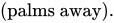
Here, the fingers are encoded with the numerals 1 through 5, with 1 representing the thumb and 5 representing the little finger. The notation describes a sequence of movements of a loop held by one finger (a "functor", written before a set of parentheses), relative to a loop held by another finger (an "object", written inside parentheses). The symbol denotes releasing a loop of string, while the vertical line denotes moving hands apart so that the string is not slack.[1][11]: 1–28


Personal life
Storer was married to Karen Storer for a period of over 30 years. He had two daughters.[3][9] Storer died on November 9, 2006.[2][9]
Selected publications
- Storer, Thomas (1967). Cyclotomy and difference sets. Lectures in Advanced Mathematics. Vol. 2. Markham Publishing Co. MR 0217033. Zbl 0157.03301.
- Storer, Thomas (2000). String Figure Bibliography (PDF) (3rd ed.). ISFA Press. ISBN 0-9651467-5-8. Earlier editions: 1st ed. (1985), Bulletin of SFA, vol. 12; 2nd ed. (1996), ISFA Press, ISBN 0965146715.
- Storer, T. (1988). "String Figures". Bulletin of String Figures Association. 16 (Supplemental Issue in Two Parts). Nippon Ayatori Kyokai: 410 pages.
See also
References
- ^ a b c d e Vandendriessche, Eric (2015). "Thomas Storer and the Concept of Heart-Sequence". String Figures as Mathematics? An Anthropological Approach to String Figure-making in Oral Tradition Societies. Studies in History and Philosophy of Science. Vol. 36. Springer. doi:10.1007/978-3-319-11994-6. ISBN 978-3-319-11993-9.
- ^ a b c "Thomas F. Storer Ph.D. (obituary)". Ann Arbor News. November 12, 2006. Retrieved July 20, 2025 – via Legacy.com.
- ^ a b c d e Sherman, Mark (2007). "Someone who Loved the String: a tribute to Tom Storer". Bulletin of the International String Figure Association. 14: 1–37.
- ^ a b c Thomas Frederick Storer at the Mathematics Genealogy Project
- ^ "Doctorates in Mathematics". Indigenous Mathematicians. Retrieved July 21, 2025.
- ^ Yong, Kamuela E. (2022). "Indigenous Peoples Exist Within Mathematics" (PDF). A Word From... Notices of the American Mathematical Society. 69 (4). Retrieved July 30, 2025.
- ^ "Thomas F. Storer". Institute for Advanced Study. Retrieved July 22, 2025.
- ^ "Tom Storer Retires" (PDF). Department of Mathematics. ContinuUM. University of Michigan. 2002. Retrieved July 21, 2025.
- ^ a b c d e "Thomas Storer (obituary)". The University Record. University of Michigan. January 8, 2007.
- ^ Hoenigman, Darja (2020). "Talking about strings: The language of string figure-making in a Sepik society in Papua New Guinea". Language Documentation & Conservation. 14: 598–641.
- ^ a b Storer, T. (1988). "String Figures". Bulletin of String Figures Association. 16 (Supplemental Issue in Two Parts). Nippon Ayatori Kyokai: 410 pages.