Robert Westley Hall-Dare
Robert Westley Hall-Dare | |
|---|---|
| Member of Parliament for South Essex | |
| In office 1832–1836 | |
| Preceded by | New constituency |
| Succeeded by | George Palmer |
| Personal details | |
| Born | 3 March 1789 Demerara, The Guianas |
| Died | 20 May 1836 (aged 47) London, United Kingdom |
| Party | Conservative |
| Profession | Politician |
Robert Westley Hall-Dare (3 March 1789 – 20 May 1836) was a British Conservative politician who was Member of Parliament for South Essex from 1832, as a Tory, until his death in 1836. He was succeeded by George Palmer.
Early life
He was born Robert Westley Hall in Demerara in modern-day Guyana on 3 March 1789 to parents Robert Westley Hall and Maria Elizabeth De Codin. His parents owned the 'Maria's Pleasure' sugar plantation on Wakenaam Island in the Essequibo River,[1] which passed to Robert on his father's death. Hall was educated at Harrow from 1802 to 1809.[2] He was a Captain in the 23rd Welsh Fusiliers, serving in the West Indies and the Peninsular War.[2]
He married Elizabeth Grafton on 8 November 1815. He changed his name by Royal sign-manual to Robert Westley Hall-Dare on 25 April 1823, taking the name Dare from his wife, daughter and heiress of Marmaduke Grafton Dare.[2]
One of his granddaughters was Mabel Virginia Anna Hall-Dare (Mabel Bent), who in 1877 married the explorer James Theodore Bent.
Political career
Hall-Dare was High Sheriff of Essex in 1821.[2] His merits for public service were spotted by his friend William Jerdan, editor of The Literary Gazette.[3] Hall-Dare was elected MP for South Essex in 1832. In terms of politics, he was described as "opposed to free trade in corn and in everything else; in favour of a repeal of the assessed, and other taxes pressing on the springs of industry, and the imposition in their stead of a tax upon property; and also in favour of an extension of the currency", and a Peelite.[2] He supported the Corn Laws in Parliament, as well as better observance of the Sabbath.[4][5]
The British Museum has a satirical print (c. 1818) showing Hall-Dare slicing a round pudding representing lands in the county of Essex, labelled 'Ilford to Romford'.[6]
Death
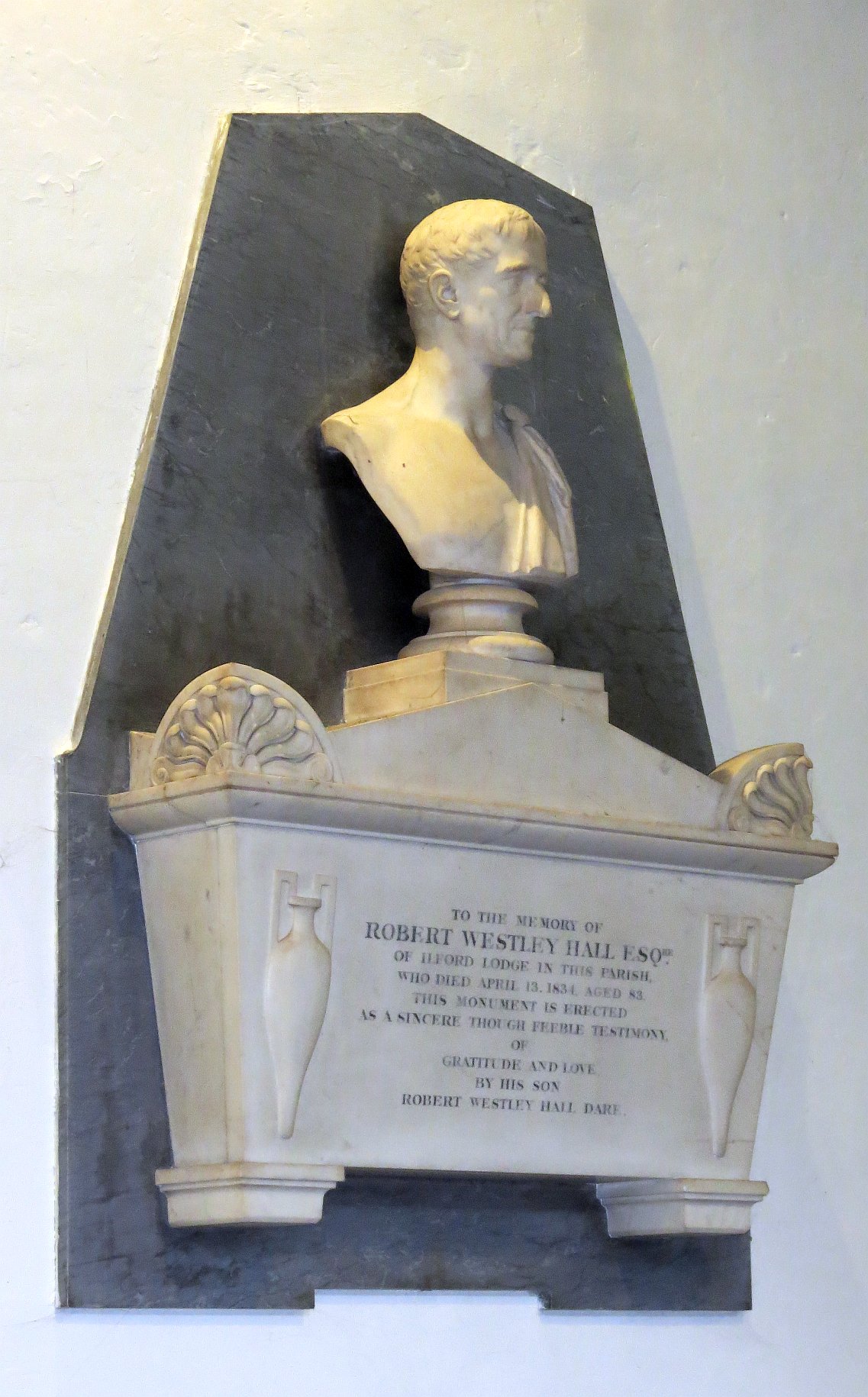
Hall-Dare died at the age of 47 in his house in London, 4 Portman Square.[2] He had nine children. He left his estate in British Guyana to his eldest son, also called Robert Westley Hall-Dare.[2] His mortal remains rest in the family vault in St Mary's Church, Theydon Bois, Essex.[7] Two years before his own death he commissioned a memorial bust for his father, Robert Westley Hall, from the sculptor Patrick Macdowell in St Margaret's Church, Barking, Essex.[8]
References
- ^ "Summary of Individual | Legacies of British Slave-ownership". Archived from the original on 22 November 2016. Retrieved 25 January 2026.
- ^ a b c d e f g "Summary of Individual | Legacies of British Slavery".
- ^ “[A] politico-literary labour of love was undertaken to promote the cause of a friend whom I dearly prized, and with whom for many a year I enjoyed that choice happiness which results from cordial sympathies and esteem. I allude to the late Robert Westley Hall Dare; who appeared, to my partial but discerning eyes, to be rusting away a life which might be serviceable to his country, in the too-secluded repose of a private gentleman.” William Jerden, The autobiography of William Jerdan, with his literary, political and social reminiscences and correspondence during the last fifty years (1852, London, Vol.3, pp.66-67).
- ^ "MINUTES". Parliamentary Debates (Hansard). 26 May 1834.
- ^ "Preamble". Parliamentary Debates (Hansard). 28 March 1833. Retrieved 6 April 2022.
- ^ For an image of the cartoon (British Museum, London inventory ref: 1948,0214.811), see https://www.britishmuseum.org/collection/object/P_1948-0214-811
- ^ https://www.theydonparishes.org/theydon-bois/
- ^ "Robert Westley monument in St Margaret's Church in Barking". Archived from the original on 17 October 2022.