Rancilio Silvia
Rancilio Silvia V3 (2011) with distinctive 10mm commercial steam wand (tilted on its ball joint), chrome conical grouphead cover and steam knob, and branded portafilter handle | |
| Type | Espresso machine |
|---|---|
| Inception | 1997 |
| Manufacturer | Rancilio (Parabiago, Italy) founded 1927 |
| Available | Yes |
| Models made |
|
| Website | https://www.ranciliogroup.com/rancilio/silvia/ |
| External images | |
|---|---|
| Visual comparison of Rancilio Silvia versions V1, V2, and V3 (Avi Schneor)[1] | |
| Photograph of V3 (left) and V1/V2 (right) steam wand/valve assemblies [2] |
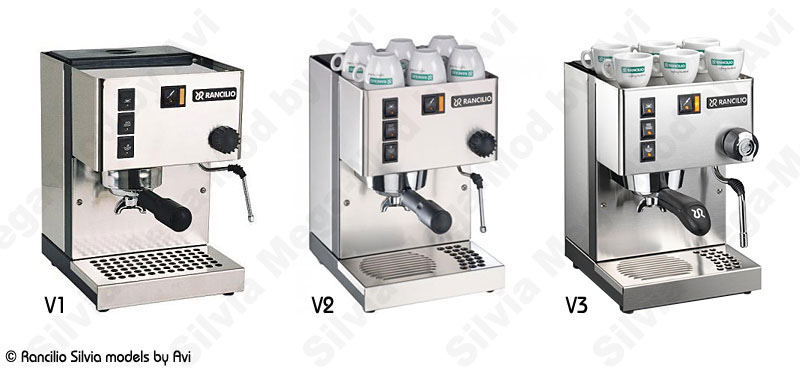

The Rancilio Silvia (officially "Miss Silvia") is a semi-automatic espresso machine manufactured by Rancilio since 1997.
James Hoffmann suggests that the Silvia marks the beginning of the "prosumer category" in espresso, representing "miniature commercial machines for the home," and characterizes the Silvia as "the closest to a commercial machine" available among consumer espresso machines.[3] Mark Frauenfelder concurs, noting that the Silvia "shares many characteristics of commercial equipment — robustness and repairability being chief among them."[4] He describes the Silvia as "the most well-documented espresso maker in history, thanks to its legion of hacker fans," and devotes an entire chapter, "Tickling Miss Silvia," to the machine.[4] Hoffmann agrees, observing that the Silvia is "probably the most modified domestic espresso machine in the world."[5] The Silvia is regarded as "an icon in the home coffee market,"[6] "a classic" in the espresso community, and "perhaps the most famous domestic espresso machine on the market," to the point of being recognised as a potential "coffee cliché."[7]
History
The Silvia was first introduced by Rancilio in late 1997, not as a product but as a thank-you gift for the company's commercial importers and vendors; it was only later made available for sale to consumers.[4][8][9][10]
Rancilio had previously entered the home espresso market in 1989 with the release of its Miss Rancilio line, lead by the Audrey espresso machine with its distinctively curved white plastic casing.[11] The Audrey was equipped with a 300cc brass boiler and an 1100W heating element, a 3-way solenoid valve, an ULKA vibratory pump, and a single commercial 58mm brass brew group.[12]
The Silvia placed these components into a much heavier steel chassis, finished with a rectangular brushed stainless steel case and drip tray cover, and a cylindrical brushed steel collar covering the brass grouphead. (The Silvia may thus be understood as an example of old wine in a new bottle.) As a result, the Silvia weighs 14 kilograms (31 lb), more than 50% more than its ancestor Audrey's 9 kilograms (20 lb).[13][1] Hoffmann describes the Silvia as "built like an absolute tank," and exceptionally stable in countertop operation.[14] Matte black rocker switches replaced the translucent orange, fully illuminated switches on prior Miss Rancilio machines, completing the Silvia's visual design.
As the Silvia evolved, online communities began to assign informal version control numbers to denote changes in features relative to production date. (There is no evidence that Rancilio uses or acknowledges these version numbers; they have, however, been employed in peer-reviewed scientific literature.[15]) The initial release of the Silvia subsequently became known as V1.[1]
Versions
The general references for the following version history the Silvia are Avi Schneor's introduction to his SchneorDesign Rancilio Silvia Mega-Mod project[1] and the KaffeeWiki guide to Rancilio Silvia's differences in production series.[13]
The production date for each Silvia machine is typically printed as a four-digit code in the bottom-right corner of the manufacturer's sticker concealed beneath the drip tray, or, on some early models, on the bottom of the machine body. The first two digits of this code are the production month, and the second two digits are the production year, such that "0506" would denote a Silvia manufactured in May 2006.[16]
V1 (1997-July 2006)
Even within what is generally referred to as the first version of the Silvia, Rancilio did make some alterations. Early V1 machines have a Rancilio logo printed in black on the front of the case; later models have a thick plastic badge attached to the case in the same location.
In May 2000, a change was made to the design of the Silvia's boiler, which incidentally accommodates user installation of a PID controller to manage boiler temperature; machines made in April 2000 and earlier have an earlier version of the boiler.[16] In 2002, the boiler design was revised once more, replacing the threaded, replaceable stainless steel heating element with a copper element soldered to the upper half of the boiler.
V2 (August 2006-early 2008)
In August 2006, Rancilio introduced significant changes to the Silvia. The boiler design was revised again, replacing the cast brass connections for steam and water pipes with threaded connections.
Rancilio also changed the design of the overpressure valve (OPV) which regulates pressure between the pump and the grouphead. The V1 OPV could only be adjusted to reduce brew pressure by adding washers between the single 20mm nut and the OPV body. The V2 OPV had two 20mm nuts, which could be more easily adjusted to raise and lower brew pressure. The now defunct (but archived) website PIDSilvia described methods both for adding a pressure gauge to the Silvia (among many other useful guides)[17] and for measuring the effective brew pressure without such a manometer, by comparing the flow rate from the OPV through the overflow tube to the pressure/flow curve for the machine's ULKA vibratory pump.[18]
Instead of the cylindrical brushed steel grouphead cover of the V1, the V2 grouphead was insulated with a conical plastic collar covered in a silver chrome film. Rancilio also replaced the uniformly perforated drip tray cover of the V1 with a new design, which placed a circular array of angled slots under the grouphead, and two curved columns of holes under the steam wand.[16]
V2 retained the V1 ribbed black plastic portafilter handle and steam knob, and the 6mm diameter steam wand with hexagonal tip, attached to the machine by a simple swivel joint.[16][19]
In mid-2007, Rancilio changed the Silvia from a 110 °C (230 °F) brew thermostat to a 100 °C (212 °F) brew thermostat. (While this is not considered a separate version, the change did make a significant improvement in the Silvia's thermal management and brew quality.)
V3 (2008-2013)
In mid-2008, Rancilio made another significant improvement to the Silvia design, completing the basis for all subsequent models. (Some Silvias made in early 2008 are still V2.)[20] The machine was upgraded with a thicker 10mm diameter commercial-grade steam wand with a single-hole tip, attached to the machine by an articulating ball joint that allowed the steam wand to tilt in all directions as well as swivel.[19][2]
The V3 steam wand greatly increased the Silvia's ability to heat and texture milk (or non-dairy milk) to produce the microfoam necessary for proper latte art. In his 2020 survey of "The Best Espresso Machine Under £500," James Hoffmann characterized the Silvia's steam power as "a beast... the closest to steaming with a commercial steam wand" available in a consumer espresso machine, and both "incredibly quick and incredibly powerful" in producing microfoam and bringing the milk up to temperature.[21] In his testing, the Silvia was able to steam 150 grams of refrigerated milk to microfoam at 60 °C (140 °F) in just 21 seconds, half the time required by the contemporary Gaggia Classic Pro (2019) in the same test (42 seconds).[22]
To complement the new steam wand, Rancilio also added a new partially chrome steam valve knob. Both parts were made available in an aftermarket 'Pro Kit' sold by Rancilio, allowing service centers and capable end users to upgrade V2 and V1 Silvias.
V4 (2013-2016)
An internal update, revising the boiler design to make the copper heating element removable and replaceable, similar to the V1 Silvia. V4 is otherwise identical to V3.
V5 (2016-2020)
A moderate update, adding insulation to the boiler and revising the power switch, adding a second round LED to indicate both machine power and heating element activity, replacing the vertical bar light alongside the power switch on prior models dating back to the Audrey.
Rancilio also introduced the first official distinction in the Silvia line: between the Silvia M, otherwise identical to V3 and V4, and the Silvia E, which adds a standby mode that deactivates the boiler's heating element after 30 minutes without user interaction, for compliance with European Union energy regulations.
V6 (2020-present)
A minor update: the steam wand was slightly streamlined, eliminating the small lip in V3 and later models, making the wand easier to wipe down.
Rancilio also offered a new color option, "Silva Black," for an additional fee, with a matte case to match the new black grouphead cover. V6 is otherwise identical to V3, V4, and V5.
Silvia Pro (2020-present)
In the Silvia's third decade, Rancilio introduced a new, larger version of the machine. The Silvia Pro is a dual boiler machine, with the same 300cc brew boiler as the regular Silvia alongside a dedicated 1000cc steam boiler, allowing users to steam milk while simultaneously pulling a shot of espresso. Instead of the mechanical thermostats on the Silvia, both boilers on the Silvia Pro are PID controller. The Pro also adds a shot-time display, and a timer to wake up and shut down the machine. As a result of these additions, especially the added steam boiler, the Silvia Pro has a larger footprint than the Silvia, is notably taller, and about 50% heavier.[1][5]
Silvia Pro X (2021-present)
The following year, Rancilio introduced a more expensive version of the Silvia Pro, adding a brew pressure gauge, a variable "soft infusion" feature to control brew pressure during extraction, a new portafilter handle (based on the Rancilio RS-1), and a range of color options: matte blank, matte white, matte pink, and the traditional Silvia brushed stainless steel.[1]
References
- ^ a b c d e f Avi Schneor. "Rancilio Silvia Mega-Mod Part 1: Introduction". Retrieved 23 February 2026.
- ^ a b "Rancilio V3 Steam Wand Upgrade". 1 March 2020. Retrieved 24 February 2026.
- ^ James Hoffmann (18 September 2020). "The Best Espresso Machine Under £500 (Chapter 10)" (video). Event occurs at 19:06. Retrieved 18 February 2026.
The Silvia is the closest to a commercial machine of the group here [including the Lelit Anna and Gaggia Classic Pro]. It's right at the beginning of that 'prosumer' category, where you get miniature commercial machines for the home.
- ^ a b c Mark Frauenfelder (2010). "4. Tickling Miss Silvia". Made by Hand: searching for meaning in a throwaway world. New York, NY: Portfolio/Penguin Group. pp. 73–92. p. 85:
It [the Silvia] was introduced in 1997, not as a commercial product but as a thank-you gift to importers and vendors of Rancilio's expensive restaurant-grade espresso machines. Unsurprising, then, that the machine shares many characteristics of commercial equipment — robustness and repairability being chief among them.
- ^ a b James Hoffmann (1 June 2021). "The Best Espresso Machine Under £1,500". Retrieved 18 February 2026.
...probably the most modified domestic espresso machine in the world. I suspect there's more PID kits running on Rancilio Silvias than anything else.
- ^ "First Look: Rancilio Silvia Pro". CoffeeGeek. 7 July 2021.
- ^ Christensen, Asser. "RANCILIO SILVIA [V6] REVIEW: COFFEE CLICHÉ OR CLASSY CLASSIC? The Rancilio Silvia is a classic among espresso machines. But is it still worth buying in this era?". The Coffee Chronicler. Retrieved 4 September 2024.
- ^ Frauenfelder, Mark (7 July 2010). ""Tickling Miss Silvia": Mark Frauenfelder Hacks Coffee's God-Shot". Gizmodo. Retrieved 2019-04-29.
- ^ "CoffeeGeek - Rancilio Silvia Espresso Machine". coffeegeek.com. Retrieved 2019-04-29.
- ^ "What makes the Rancilio Silvia so awesome?". Yuppiechef Magazine. 2013-10-24. Retrieved 2019-04-29.
- ^ "First Look: Rancilio Rocky Grinder". Coffee Geek. 7 June 2003.
The Rocky was introduced to the world in 1989, the same year the Rancilio Audrey home espresso machine came about.
- ^ Bramah, Edward (1989). Coffee makers: 300 years of art & design. Quiller Press. p. 148.
20. The 'Miss Rancilio' [Audrey]. The casing has been cut away to reveal the interior.
- ^ a b "Rancilio Miss Silvia" (in German). Retrieved 18 February 2018.
Unterschiede in den Produktionsserien (Modelljahre)
- ^ James Hoffmann (18 September 2020). "The Best Espresso Machine Under £500 (Chapter 3)" (video). Event occurs at 4:07. Retrieved 18 February 2026.
- ^ Xiuju Wang; Loong-Tak Lim; Siming Tan; Yucheng Fu (2019). "Investigation of the factors that affect the volume and stability of espresso crema". Food Research International. 116 (February): 668–675. doi:10.1016/j.foodres.2018.08.095.
(Rancilio Silvia, V4, Rancilio Group, Italy)
- ^ a b c d "Identify the manufacture year of Rancilio Silvia" (PDF). Auber Instruments. Retrieved 22 February 2026.
Old boiler with M4 thread sensor mounting hole. [...] Machine made in April 2000 does not have the hole. Machine made in May, 2000 has.
- ^ "How To Guides". PIDSilvia. Archived from the original on 27 November 2014. Retrieved 23 February 2026.
- ^ "Ulka Water Pump Pressure". PIDSilvia. Archived from the original on 14 January 2016. Retrieved 23 February 2026.
- ^ a b "Rancilio Silvia Steam Valve Complete from V3 '08 (Part #: 10705169)". EspressoCare. Retrieved 24 February 2026.
It can also be used on pre-2008 machines as a complete replacement. Both older and newer style knobs fit this valve. If you're not certain which version you have, the 2008 knob is silver in the center, so it's a good indicator as long as no one replaced only the knob on an earlier version. The best confirmation is to measure the diameter of the steam wand tube (not the tip): PRE-2008 = 6mm; 2008-Since = 10mm.
- ^ "r/RancilioSilvia -- Should I upgrade to a v3 steam wand?". Retrieved 23 February 2026.
I picked up a V2 (march 2008 build)...
- ^ James Hoffmann (18 September 2020). "The Best Espresso Machine Under £500 (Chapter 10)" (video). Event occurs at 16:12. Retrieved 18 February 2026.
- ^ James Hoffmann (18 September 2020). "The Best Espresso Machine Under £500 (Chapter 9)" (video). Event occurs at 15:18. Retrieved 18 February 2026.