Pushpa Dixit
Mahamahopadhyaya Dr. Pushpa Dixit | |
|---|---|
पुष्पा दीक्षित | |
Dixit in 2024 | |
| Born | 12 June 1943 |
| Other names | Mataji |
| Citizenship | Indian |
| Occupation | Retired Professor |
| Known for | Paushpi Prakriya |
| Spouse | Prof. Shiv Prasad Dixit |
| Parent(s) | Pandit Sundarlal Shukla & Mrs. Janaki Devi Shukla |
| Academic background | |
| Education | M.A. in Sanskrit (received three gold medals), Ph.D. |
| Website | pushpadikshit.in |
Pushpa Dixit (Sanskrit: पुष्पा दीक्षित, IAST: Puṣpā Dīkṣita [puʂpɑː d̪iːkʂɪt̪ə]) is an Indian scholar, author, and poet who is a proponent of Pāṇinīan Vyākaraṇam, the study of Sanskrit grammar and linguistics on the principles of the ancient grammarian Pāṇini. Referred to as Mātāji (respected mother), Dixit developed a new teaching methodology known as the Paushpi Prakriyā.
Early life and education
Pushpa was born on 12 June 1943 in the city of Jabalpur, Madhya Pradesh, India. Her father, Sundarlal Shukla, was an Ayurvedic physician and scholar. Her mother was Janaki Devi Shukla. During her childhood, she followed in the footsteps of her father, who was a scholar of Vyakarana, and later studied it under Vishwanath Tripathi, a leading grammarian and the principal of Krishna Bodhashram Sanskrit College in Jabalpur. She also received her Sanskrit education from three more gurus, including Ramprasad Tripathi.[1] She married early to Shiv Prasad Dixit.[2][3][4]
Dixit completed her postgraduate degree in Sanskrit with three gold medals from Rani Durgavati Vishwavidyalaya.[5][1] Dixit pursued her higher education at the same university, where she earned her Ph.D. degree.[6]
Academic career
She served as the head of the Sanskrit department at Government Girls Postgraduate College in Bilaspur.[2] She remained at service for almost 39 years.
Dixit participated in national-level Sanskrit poetry conferences and was selected as one of the 15 national Sanskrit poets to recite poetry at the 13th World Sanskrit Conference held at the University of Edinburgh, Scotland.[7]
To promote the study of Pānini's grammar, Dixit organizes workshops, both online and offline through her institution, Pāṇini Shodh Sansthān, in Bilaspur, Chhattisgarh,[8][9] free of cost.[10][11] Accommodation and meals at these workshops are provided by the Kosal Sanskrit Committee.[12][13]
In Bilaspur, Dixit has developed a new mathematical method to clarify the principles of the Ashtadhyayi, aiming to enable students to grasp the concepts of Paninian grammar in a shorter time frame.[14] The Paushpi Prakriyā focuses on understanding the essence of Pāṇini’s Aṣṭādhyāyī,[15] simplifying the complex rules into a structured learning path.[16][17][18][5]
Paushpi Prakriyā
Dixit believed that the prevailing methodologies, primarily based on texts like the Siddhānta Kaumudi and the Kāśikā, were inefficient for contemporary learners, prompting her to create a system that could condense years of study into a much shorter period. Thus, she worked for decades to develop a mathematical method that clarifies the procedural science of the Aṣṭādhyāyī, which helps learners acquire a comprehensive understanding in four months. This method has not been previously articulated since Pāṇini. By restructuring the traditional sequence of verbal forms, she reorganized the Pāṇinian Dhātupāṭha while retaining all roots, aligning them with the procedural method.[19]
Dixit's approach has been praised for significantly reducing the learning time of Sanskrit grammar, which traditionally took years to accomplish. Thousands of students have passed through her institution.[20][21][22][10][23][24][25][26]
Publications
Along with the Paushpi Prakriya, she has published numerous works:[27][28]
- अष्टाध्यायी सहजबोध (Ashtadhyayi Sahajabodha) - A Scientific Commentary of Pāṇinī's Aṣṭādhyāyī" is a Hindi series of which six volumes are published.[2]
- सार्वधातुक खण्ड (sārva-dhātuka khaṇḍa) (1999)
- आर्धधातुकप्रकरणम् (ārdha-dhātuka prakaraṇam) (2001)
- कृदन्तप्रकरणम् (kṛdanta-prakaraṇam) (2004)
- तद्धितप्रकरणम् (taddhita-prakaraṇam) (2006)
- सुबन्तप्रक्रिया, स्त्रीप्रत्यय और द्विरुक्ति (subanta-prakriyā, strīpratyaya aura dvirukti) (2011)
- कारकप्रकरणम् तथा समासप्रक्रिया (kāraka-prakaraṇam tathā samāsa prakriyā) (2016)
- पौष्पी नव्यसिद्धान्तकौमुदी (Pauṣpi Navyasiddhāntakaumudī) is a Sanskrit series of which two volumes are published.
- सुबन्तप्रक्रिया-स्त्रीप्रत्यया-द्विरुक्तिश्च (subanta-prakriyā-strīpratyayā-dviruktiśca) (2018)
- सार्वधातुकतिङ्कृत्प्रत्ययाः (sārva-dhātuka-tiṅkṛt-pratyayāḥ)
- आर्धधातुक प्रत्ययों की इडागम व्यवस्था (Ārdhadhātuka Pratyayon kī Iḍāgama Vyavasthā)
- शीघ्रबोधव्याकरणम् (Śīghra-bodha-vyākaraṇam) (2007)[29]
- धात्वधिकरीयं सामान्यमङ्गकार्यम् (Dhātvadhikarīyaṁ Sāmānyam-aṅga-kāryam) (2014)
- तिङन्तकोषः – त्रयो भागाः (Tiṅanta-Koṣaḥ – three parts) (2014)[30]
- कृदन्तकोषः – द्वौ भागौ (Kridanta-Koṣaḥ – two parts) (2014)
- पाणिनीयं वैदिकव्याकरणम् (Pāṇinīyaṃ Vaidika-vyākaraṇam) (2019)
- भगवतः पाणिनेः सप्तविभागाष्टाध्यायी (Bhagavataḥ Pāṇineḥ Saptavibhāga-Aṣṭādhyāyī)
- पाणिनीयाष्टाध्यायीसूत्रपाठः प्रकरणनिर्देशसमन्वितः (Pāṇinīya Aṣṭādhyāyīsūtrapāṭhaḥ Prakaraṇanirdeśasamanvitaḥ)
Books published by Samskrita Bharati
Source:[31]
- पाणिनीयाष्टाध्यायीसूत्रपाठः प्रकरणनिर्देशसमन्वितः (Pāṇinīya Aṣṭādhyāyīsūtrapāṭhaḥ Prakaraṇanirdeśasamanvitaḥ) (2010)
- तिङ्कृत्कोषः – द्वौ भागौ (Tiṅkṛt Koṣaḥ) (2011) - in two parts
- सार्वधातुकखण्डः (sārva-dhātuka khaṇḍaḥ)
- आर्धधातुकखण्डः (ārdha-dhātuka khaṇḍaḥ)
- णिजन्तकोषः (Ṇijantakoṣaḥ) (2012)[32]
- सन्नन्तकोषः (Sannantakoṣaḥ) (2012)[33]
- यङन्तकोषः नामधातुकोषश्च (Yaṅantakoṣaḥ nāmadhātukoṣaśca) (2012)
- यङ्लुगन्तकोषः (Yaṅlugantakoṣaḥ) (2012)[34]
- लकारसरणिः – चत्वारो भागाः (Lakāra-saraṇiḥ) (2012) - in four parts
- लट्, लोट, लङ्, विधिलिङ्, इत्येते सार्वधातुकलकाराः (Laṭ, loṭa, laṅ, vidhiliṅ, ityete sārvadhātukalakārāḥ)
- लृट्, लृङ्, लुट्, आशीर्लिङ्, इत्येते चत्वारो लकाराः (Lṛṭ, lṛṅ, luṭ, āśīrliṅ, ityete catvāro lakārāḥ)
- लिट् लकारः (Liṭ lakāraḥ)
- लुङ् लकारः (luṅ lakāraḥ)
- इडागमः (Idāgamaḥ) (2010)
- पाणिनीयधातुपाठः - सार्थः (Pāṇinīya Dhātupāṭhaḥ - with meaning) (2019)
- प्रक्रियानुसारी पाणिनीयधातुपाठः – (Prakriyānusārī Pāṇinīya-Dhātupāṭhaḥ) (2011)
- पाणिनीयमूलधातुपाठः – प्रक्रियानुसारी (Pāṇinīya-Mūla-Dhātupāṭhaḥ – Prakriyānusārī) (2020)
- सनाद्यन्तधातुपाठः (Sanādyanta-Dhātupāṭhaḥ) (2020)
- सस्वरः पाणिनीयधातुपाठः – द्वौ भागौ (Sasvaraḥ Pāṇinīya Dhātupāṭhaḥ) (2012) – in two parts (editor)
- सार्वधातुकप्रत्ययोपयोगी (sārva-dhātuka-Pratyayopayogī)
- आर्धधातुकप्रत्ययोपयोगी (ārdha-dhātuka-Pratyayopayogī)
Poetry
Source:[6]
- अग्निशिखा (Agnishikhā) (1984)
- शाम्भवी (Śāmbhavī)[35] - (गीतिकाव्य)[note 1]
- अपराजितवधूमहाकाव्यम् (Aparājitavadhu Mahākāvyam) - Editor and translator
- प्रबुद्धभारतम् (Prabuddhabhāratam) - Editor and translator
- सौन्दर्यलहरी (Saundaryalaharī) - commentary on the translation of Bacchulal Awasthi.
- तिङन्तसिद्धिः (Tiṅantasiddhiḥ) - 46-hour DVD prepared by Samskrita Bharati
- अष्टाध्यायी की अध्ययन पद्धति (Aṣṭādhyāyī kī Adhyayana Paddhati) - 72 Episodes Series prepared by UGC to broadcast on Gyan Darshan
- तिङन्तप्रक्रिया (Tiṅantaprakriyā) - 78 Episodes Series prepared by UGC to broadcast on Gyan Darshan
- वैदिक व्याकरणम् (vaidika vyākaraṇam) - 8 episodes created for the E-PG Pathshala[note 2]of the project of Shri Lal Bahadur Shastri National Sanskrit University.[36]
- काशी पाण्डित्य परियोजना (Kāśī Pāṇḍitya Pariyojanā) – 09 DVDs prepared by Acharya Vasistha Tripathi for Philosophy and 08 DVDs prepared by Acharya Ramyatna Shukla for Vyakarana.
Recognition and awards
- Certificate of Honour[note 3] – On 14 August 2004, the contemporary President of India, Dr. A. P. J. Abdul Kalam, awarded her this certificate for proficiency in Sanskrit literature and scholarship in the scriptures.[37]
- अभिनन्दनपत्रम् (Letter of Commendation) – Presented by Central Sanskrit University, Jaipur Campus on the occasion of Sanskrit Week on 11 August 2011.[38]
- Vachaspati Title – On 26 November 2010, she was conferred the title of Vachaspati (D.Litt) from Lal Bahadur Shastri National Sanskrit University for extra-ordinary knowledge of Indian Vidya.[39]
- Mahamahopadhyaya Title – On 24 March 2011, Uttarakhand Sanskrit University, Haridwar, conferred the honorary title of Mahamahopadhyaya on its 3rd convocation ceremony for extra-ordinary knowledge of Indian Vidya.[40]
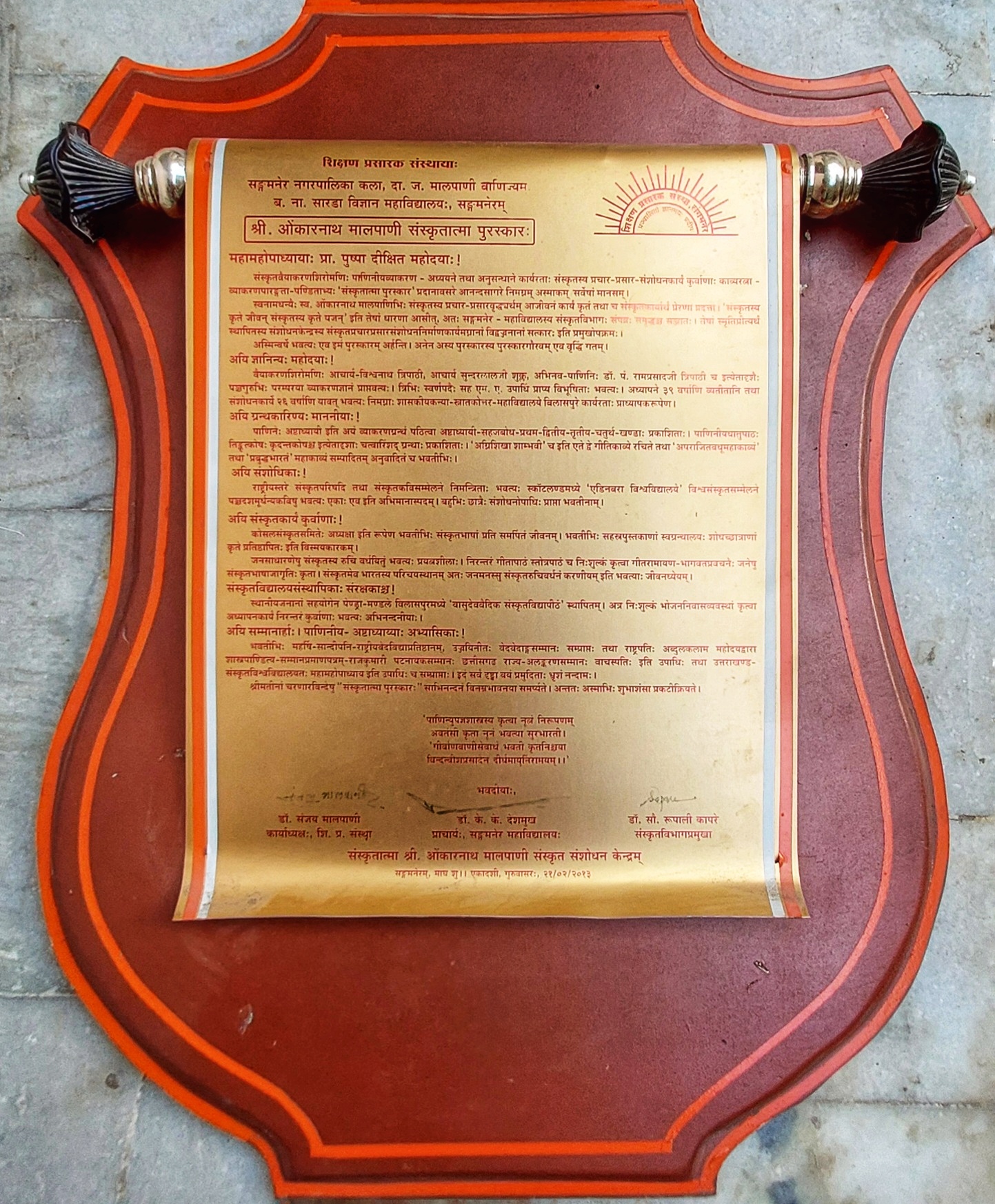
- श्रीः ओंकारनाथमालपाणीसंस्कृतात्मापुरस्कारः (Śrīḥ Oṁkāranātha Mālapāṇī Saṃskṛtātma Award) – On 21 February 2013, Sangamner College awarded her this for her achievements in Sanskrit.[1]
Notes
- ^ A song that has qualities such as intense emotional experience, melody, expressiveness, etc., is called gītikāvya.
- ^ e-PG Pathshala is an initiative of the MHRD under its National Mission on Education through ICT (NME-ICT) being executed by the UGC.
- ^ The Certificate of Honour scheme was introduced in 1958 to recognize scholars of Sanskrit, Arabic, and Persian, and was extended to include Pali/Prakrit in 1996. Awarded annually on the eve of Independence Day, it honors scholars over 60 for their significant contributions. Each awardee receives a monetary grant of Rs. 50,000 per year for life, along with a sanad and a shawl presented by the President. The scheme includes 15 awards for Sanskrit, 3 each for Arabic and Persian, and 1 for Pali/Prakrit.
References
- ^ a b c श्रीः ओंकारनाथमालपाणीसंस्कृतात्मापुरस्कारः [Śrīḥ oṁkāranāthamālapāṇīsaṁskṛtātmāpuraskāraḥ] (jpg) (in Sanskrit). Archived from the original on 26 January 2025 – via Official Website Gallery.
वैयाकरणशिरोमणिः आचार्य-विश्वनाथ त्रिपाठी, आचार्य सुन्दरलालजी शुक्ल, अभिनव-पाणिनिः डॉ. पं. रामप्रसादजी त्रिपाठी च इत्येतादृशैः पञ्चगुरुभिः परम्परया व्याकरणज्ञानं प्राप्तवत्यः ।
[Traditionally, the knowledge of grammar has been obtained through five gurus, including the eminent grammarian Acharya Vishwanath Tripathi, Acharya Sundarlalji Shukla, and the modern Panini, Dr. Pandit Ramprasadji Tripathi.] - ^ a b c Dixit, Pushpa (1999). अष्टाध्यायी सहजबोध: पाणिनीय अष्टाध्यायी की सर्वथा नवीन वैज्ञानिक व्याख्या [Aṣṭādhyāyī Sahajabodha : A Scientific Commentary of Pāṇinī's Aṣṭādhyāyī]. पाणिनीय शोधसंस्थान ग्रन्थमाला (in Hindi) (1st ed.). Delhi: Pratibhā Prakāśana. pp. xxiii–xxxii. ISBN 81-7702-005-6.
- ^ कुमारी, मैत्रेयी. आधुनिक संस्कृत साहित्य. विद्यानिधि प्रकाशन. दिल्ली. 2017
- ^ पाठक, जगन्नाथ (2000). उपाध्याय, बलदेव (ed.). आधुनिक संस्कृत साहित्य का इतिहास [History of Modern Sanskrit Literature] (in Hindi) (1st ed.). Lucknow: उत्तर प्रदेश संस्कृत संस्थान. pp. 343–344.
- ^ a b डॉ. देशराज (July 2023). "ब्रूहि कोऽस्मिन् युगे कालिदासायते (डॉ. पुष्पा दीक्षित)" [Tell me, in this age, who is like Kalidasa? (Dr. Pushpa Dixit)] (PDF). आधुनिक संस्कृत साहित्य [Contemporary Sanskrit Literature] (in Hindi) (1st ed.). Delhi: IGNOU. pp. 136–148. BSKC-109. Archived (PDF) from the original on 16 April 2024.
- ^ a b Jha, Ajay (October 2021). "आधुनिक संस्कृत विदुषी एवं कवयित्री पुष्पा दीक्षित" [Modern Sanskrit scholar and poetess Pushpa Dixit]. Sahityasetu (65). Archived from the original on 15 January 2025.
- ^ Brockington, John. "Report on the Thirteenth World Sanskrit Conference". The Internet Archive. Retrieved 16 January 2025.
- ^ Shukla, CK (3 January 2025). "डॉ. पालेश्वर प्रसाद शर्मा की पुण्य तिथि : डॉ. पुष्पा दीक्षित बोलीं- उनकी रचनाओं को पढ़कर छत्तीसगढ़ को जान सकते हैं" [Dr. Paleshwar Prasad Sharma's death anniversary: Dr. Pushpa Dixit said - One can learn about Chhattisgarh by reading his works]. हरिभूमि (in Hindi). Archived from the original on 15 January 2025. Retrieved 15 January 2025.
- ^ "संस्कृत भारत की आत्मा, इसके बिना संस्कृति अधूरी: डॉ. दुबे" [Sanskrit is the soul of India; without it, culture is incomplete: Dr. Dubey.]. Dainik Bhaskar (in Hindi). 16 June 2019. Archived from the original on 1 July 2019. Retrieved 18 January 2025.
- ^ a b "संस्कृत वेदों का चिंतन है, इससे कई भाषाओं का जन्म हुआ : पुष्पा दीक्षित" [Sanskrit is the contemplation of the Vedas; many languages have originated from it: Pushpa Dixit.]. ETV Bharat News (in Hindi). 3 March 2020. Archived from the original on 15 January 2025. Retrieved 15 January 2025.
- ^ "संस्कृत व्याकरण शिविर में पंजीयन 30 तक - Jodhpur News". Dainik Bhaskar (in Hindi). 17 November 2024. Archived from the original on 18 November 2024. Retrieved 15 January 2025.
- ^ "बिलासपुर में संस्कृत सिखाकर गुरु दक्षिणा दे रहे अमेरिका के वरुण | बिलासपुर में संस्कृत सिखाकर गुरु दक्षिणा दे रहे अमेरिका के वरुण - Bilaspur (Chhattisgarh) News". dainikbhaskar. 15 January 2025. Archived from the original on 15 January 2025. Retrieved 15 January 2025.
- ^ "बिलासपुर में संस्कृत सीखकर अमेरिका में करेगी प्रचार" [After learning Sanskrit in Bilaspur, she will promote it in America.]. Nai Dunia (in Hindi). 27 May 2015. Retrieved 18 January 2025.
- ^ Sharma, Kamlesh (4 January 2025). "डा.पालेश्वरप्रसाद शर्मा की रचनाओं को पढ़कर छत्तीसगढ़ को जान सकते हैं - आचार्या डा.पुष्पा दीक्षित" [One can learn about Chhattisgarh by reading the works of Dr. Paleshwar Prasad Sharma - Acharya Dr. Pushpa Dixit.]. K News Group (in Hindi). Archived from the original on 15 January 2025. Retrieved 15 January 2025.
- ^ Atharva Forum (19 June 2021). महर्षि पाणिनि और उनका शब्दविज्ञान - Dr Pushpa Dixit & Sunil Joshi | #atharvaforum. Retrieved 15 January 2025 – via YouTube.
- ^ त्रिपाठी, नीलेश (7 March 2020). "डॉ. पुष्पा दीक्षित: 78 की उम्र में भी जारी है संस्कृत बचाने की मुहिम, गणितीय विधि में तैयार किया संस्कृत का फार्मूला" [Dr. Pushpa Dixit: At the age of 78, she continues the mission to preserve Sanskrit and has developed a formula for Sanskrit using mathematical methods.]. News18 हिंदी (in Hindi). Archived from the original on 1 May 2024. Retrieved 15 January 2025.
- ^ शर्मा, मधु (29 January 2018). "VIDEO: विदेश तक संस्कृत की अलख जगा रहीं पुष्पा दीक्षित" [Pushpa Dixit is awakening the awareness of Sanskrit even abroad.]. Nai Dunia (in Hindi). Archived from the original on 7 November 2019. Retrieved 15 January 2025.
- ^ "World Sanskrit Day 2023 :बिलासपुर के इस संस्थान में संस्कृत सीखने आ रहे विदेशी". ETV Bharat News (in Hindi). 31 August 2023. Archived from the original on 15 January 2025. Retrieved 15 January 2025.
- ^ "परिचय" [Introduction]. महामहोपाध्यायाचार्या डॉ पुष्पा दीक्षित (in Hindi). Archived from the original on 15 January 2025. Retrieved 16 January 2025.
- ^ दास, कोसलेंद्र (17 March 2012). "दक्षिणमुखी : पूरी दुनिया के लिए है संस्कृत : पुष्पा दीक्षित" [Sanskrit is for the Whole World: Pushpa Dixit]. दक्षिणमुखी. Archived from the original on 16 January 2025. Retrieved 16 January 2025.
- ^ "Dr. Pushpa Dikshit's method VS more traditional ways". Google Groups. 5 March 2017. Archived from the original on 18 January 2025. Retrieved 18 January 2025.
- ^ Tripathi, Radhavallabh; Rashtriya Sanskrit Sansthan, eds. (2012). षष्ट्यब्दसंस्कृतम् [Sixty years of Sanskrit studies,1950-2010] (PDF). Vol. 1 (1st ed.). New Delhi: Central Sanskrit University. p. 260. ISBN 978-81-246-0628-5. OCLC 779774068. Archived (PDF) from the original on 21 October 2023.
- ^ Fenal Shah (29 April 2015). Dr Pushpa Dixit 2 on ETV. Retrieved 15 January 2025 – via YouTube.
- ^ Pushpa Dikshit (5 September 2018). Dr. Pushpa Dikshit - A TV Interview (News Nation). Retrieved 15 January 2025 – via YouTube.
- ^ त्रिपाठी, राधावल्लभ. संस्कृत साहित्य: बीसवीं शताब्दी. राष्ट्रिय संस्कृत संस्थान. दिल्ली. 1999
- ^ "Dr. Pushpa Dikshit". Dr. Pushpa Dikshit. Archived from the original on 26 November 2022. Retrieved 15 January 2025.
- ^ "Bio". Google Docs. Archived (PDF) from the original on 16 January 2025. Retrieved 16 January 2025.
- ^ "मिसाल: 40 साल से संस्कृत की सेवा करने वाली पुष्पा के छात्र विदेश में मुफ्त शिक्षा दे रहे हैं" [Example: Students of Pushpa, who has been serving Sanskrit for 40 years, are providing free education abroad.]. ETV Bharat News (in Hindi). 3 March 2020. Archived from the original on 15 January 2025. Retrieved 15 January 2025.
- ^ दीक्षित, पुष्पा (2007). शीघबोधव्याकरणम् : संस्कृत व्याकरण का प्रारम्भिक प्रक्रियाग्रन्थ. पाणिनीय शोध संस्थान ग्रन्थमाला [Śīghabodhavyākaraṇam: A Preliminary Process of Sanskrit Grammar]. पाणिनीय शोधसंस्थान ग्रन्थमाला (in Hindi). दिल्ली: प्रतिभा प्रकाशन. ISBN 978-81-7702-135-6.
- ^ दीक्षित, पुष्पा (2014). कविरसायनमित्यपरनामा तिङन्तकोषः [The Tiṅanta Lexicon otherwise named Kavirasāyana] (in Sanskrit) (1st ed.). दिल्ली, भारत: प्रतिभा प्रकाशन. ISBN 978-81-7702-290-2. OCLC 893550858.
- ^ "Bookstore Samskrita Bharati". www.samskritabharati.in. Retrieved 17 January 2025.
- ^ दीक्षित, पुष्पा (2012). णिजन्तकोषः. महादेवशास्त्रिग्रन्थामाला (in Sanskrit) (1st ed.). नई दिल्ली: संस्कृतभारती. ISBN 978-93-81160-46-6.
- ^ दीक्षित, पुष्पा (2012). सन्नन्तकोषः. महादेवशास्त्रिग्रन्थामाला (in Sanskrit) (1st ed.). नई दिल्ली: संस्कृतभारती. ISBN 978-93-81160-47-3.
- ^ Dīkṣita, Puṣpā (2012). यङ्लुगन्तकोषः. महादेवशास्त्रिग्रन्थामाला (in Sanskrit) (1st ed.). नई दिल्ली: संस्कृतभारती. ISBN 978-93-81160-45-9.
- ^ तिवारी, कौशल (26 May 2020). "वागर्थ आधुनिक संस्कृत: शाम्भवी". वागर्थ आधुनिक संस्कृत. Retrieved 16 January 2025.
- ^ Dixit, Pushpa. "Subject: Sanskrit (M.A)". e-PG Pathshala. P-08. M-26. Archived from the original on 18 January 2025. Retrieved 18 January 2025.
- ^ "List of Recipients of President's Certificate of Honour - 2004". Central Sanskrit University. Archived from the original on 14 January 2025. Retrieved 18 January 2025.
- ^ Annual Report 2011-12 (PDF) (Report). Central Sanskrit University. p. 107. Archived (PDF) from the original on 19 January 2025. Retrieved 26 January 2025.
- ^ "संस्कृत भाषा प्राचीन होते हुए भी नवीन है" [Although the Sanskrit language is ancient, it is also modern.]. Navbharat Times (in Hindi). Archived from the original on 16 January 2025. Retrieved 16 January 2025.
छत्तीसगढ़ की प्रो. पुष्पा दीक्षित को वाचस्पति की मानद उपाधि दी गई।
[... Professor Pushpa Dikshit from Chhattisgarh was awarded the honorary title of Vachaspati.] - ^ "Sanskrit is language that can bind humanity: Alva". The Tribune. Dehradun. 24 March 2011. Archived from the original on 22 September 2022. Retrieved 16 January 2025.