Psilocybe fimetaria
| Psilocybe fimetaria | |
|---|---|
| Scientific classification | |
| Kingdom: | Fungi |
| Division: | Basidiomycota |
| Class: | Agaricomycetes |
| Order: | Agaricales |
| Family: | Hymenogastraceae |
| Genus: | Psilocybe |
| Species: | P. fimetaria
|
| Binomial name | |
| Psilocybe fimetaria (P.D. Orton) Watling (1967)
| |
| Synonyms[1] | |
| |
| Psilocybe fimetaria | |
|---|---|
| Mycological characteristics | |
| Gills on hymenium | |
| Cap is convex or umbonate | |
| Hymenium is adnexed or free | |
| Stipe has a cortina | |
| Spore print is blackish-brown to purple | |
| Ecology is saprotrophic | |
| Edibility is psychoactive | |
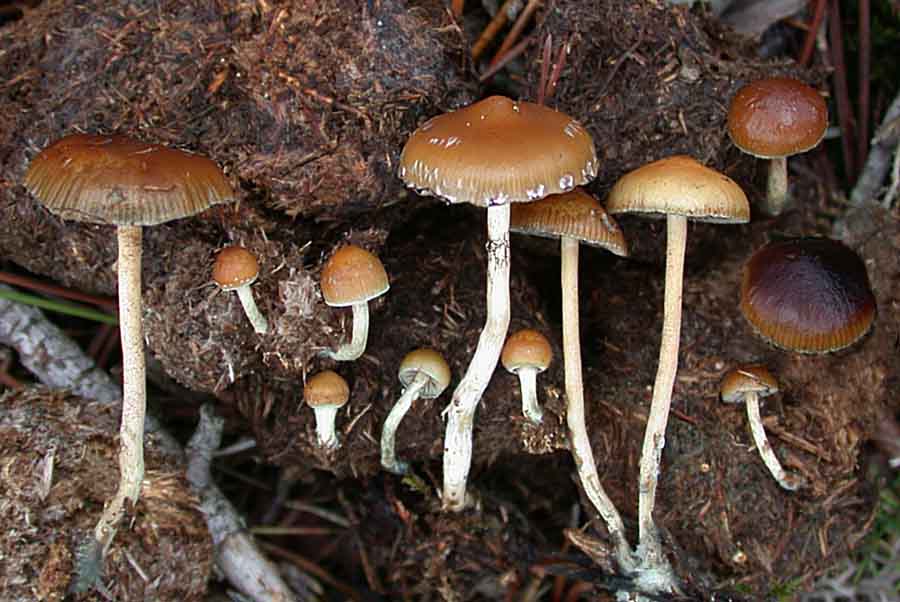
Psilocybe fimetaria is a dung-loving mushroom, usually found on horse dung. [2][3] Along with Psilocybe fuscofulva, it is one of two Psilocybe mushroom species that has been found to contain no detectable levels of the psychoactive tryptamines psilocin, psilocybin, or others. In the case of P. fimetaria, this may be due to some individual specimens having a very low concentration, or the species actually being a pair of morphologically similar species.[4][5]
Etymology
- From the Latin word 'fĭmus', meaning dung, excretement or manure, and the standard Latin suffix '-arius', meaning engaged-in or structured. [6][7]
Description
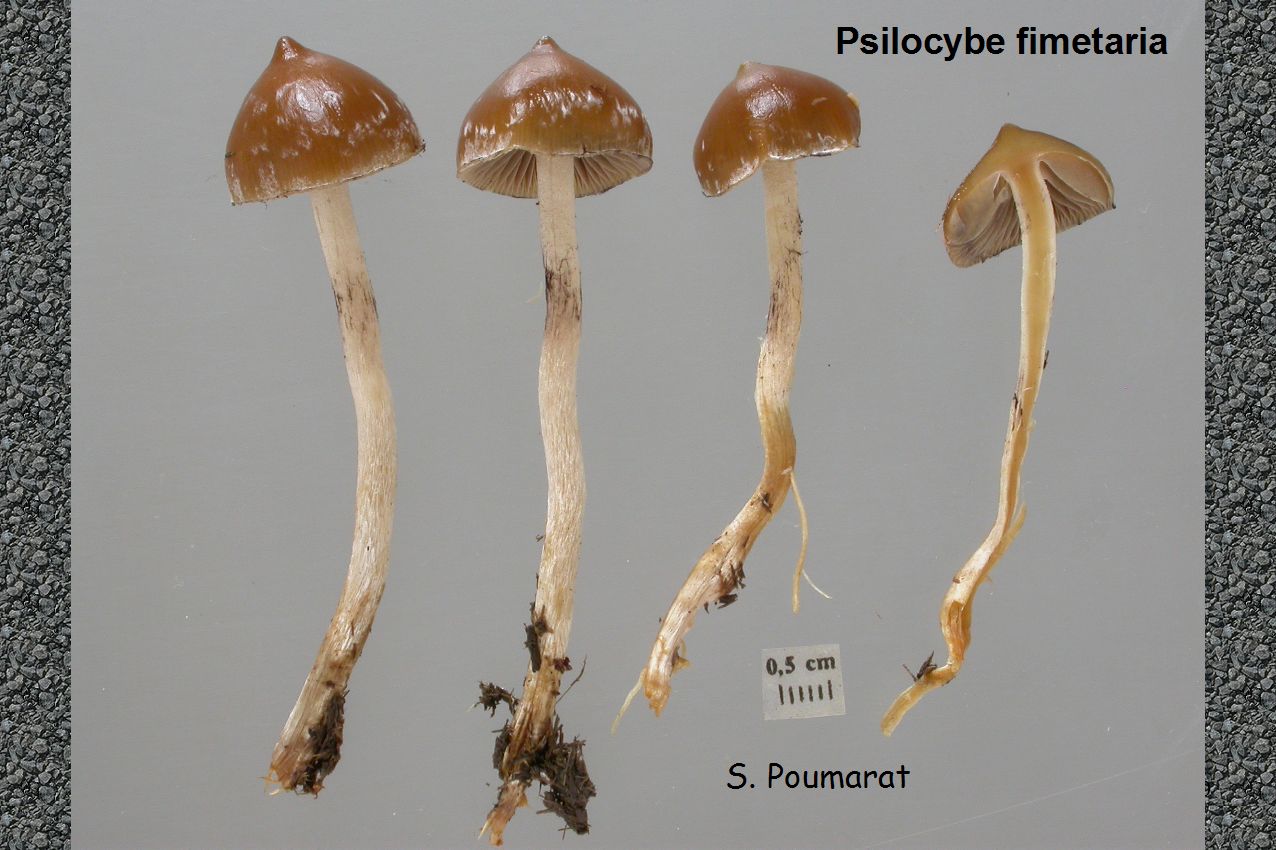
- Cap: 0.5 — 3.5 cm in diameter, papillate to convex, becoming umbonate to broadly convex in age. Surface even to translucent-striate near the margin, viscid when moist from a thick separable gelatinous pellicle. Often velar remnants on surface, typically around the margin. Pale reddish brown to ochraceous, hygrophanous, fading in drying to yellowish olive to ochraceous buff. Flesh whitish to honey colored.
- Gills: Adnexed, free or sinuate. Close, interleaving and ventricose. Whitish clay at first, eventually dark reddish brown with olivaceous hue, white fimbriate.
- Spore Print: Dark purple-brown, (9.5)12.5 — 15(16) x 6.5 — 9.5 μm, ovoid in front view, ellipsoid in side view, thick walled with a broad germ pore.
- Stipe: 2 – 9 cm long by (0.5)2 – 4 mm thick. Cylindrical, flexuous, equal but sometimes slightly swollen at the base. Whitish at first, soon discolouring yellow to yellowish brown from handling, reddish brown or honey brown in age, sometimes with distinctive blue tones at the base. Surface covered with whitish fibrils towards the apex, with an apical evanescent fibrillose annulus that develops from a thickly cortinate partial veil.
- Odor: Farinaceous
- Taste: Farinaceous
- Microscopic features: Basidia 4-spored. Pleurocystidia absent. Cheilocystidia (15)20 — 30(35) by (4)6 — 8(9) μm, ventricose-fusiform or lageniform with a narrow neck, often flexuous, 4 — 15 by 0.5 — 1.5 μm, occasionally branched.
Habitat and distribution
P. fimetaria is found growing solitary or in small groups on horse or cow dung, in grassy areas, in Autumn from September to November. [3][2] The species is generally uncommon and infrequently recorded, but it can occasionally occur in large numbers in localized areas. [2] Psilocybe semilanceata may be an indicator species for P. fimetaria, as they both favour similar grasses, soil types and climatic conditions.
It has been recorded in Great Britain, Iceland and much of mainland Europe. [2][3] Despite what much of the literature states, there have not been confirmed recordings of P. fimetaria in Asia or the Americas (Canada, the Pacific Northwest and Chile). [3][8][9] However, Paul Stamets suggests that the actual range in which these mushrooms fruit is likely much wider than what has been documented so far. [5]
Similar species
Psilocybe fimetaria may be visually confused with the similarly hemispherically capped species Deconica coprophila and Psilocybe liniformans or Psilocybe semilanceata as they often grow in the same habitat and share macroscopic similarities. [5]
P. fimetaria is phylogenetically closely related to P. liniformans but can be differentiated by the latter’s separable gelatinous gill edge, which is a peelable gelatinous threads running along the bottom edge of the gills. [5][10] Additionally, P. fimetaria has a distinct veil on its cap. [10] D. coprophila can also appear similar but can be distinguished by its adnate or subdecurrent gill attachment, less dense gill spacing, and its cap being a deeper red color. [10] Furthermore, confusion with P. semilanceata is possible, as P. fimetaria can sometimes be conic-shaped, though generally not as sharply conical as the distinctive shape of P. semilanceata. [5] Additionally, P. semilanceata prefers cow and sheep pastures but does not directly grow on dung, unlike P. fimetaria. [5]
Gallery
-
P. fimetaria at various stages of development
-
Two P. fimetaria on dung amongst heather
-
Single P.fimetaria with sharp papilla
-
Two P. fimetaria with Panaeolus papilionaceus behind
-
P. fimetaria spores 1000x
References
- ^ "GSD Species Synonymy: Psilocybe fimetaria (P.D. Orton) Watling". Species Fungorum. CAB International. Retrieved 2014-11-30.
- ^ a b c d Buczacki, Stefan; Shields, Chris; Ovenden, Denys (2012). Collins Fungi Guide: The most complete field guide to the mushrooms & toadstools of Britain & Ireland. London: HarperCollins Publ. ISBN 978-0-00-746648-1.
- ^ a b c d Stamets, Paul (2023). Psilocybin Mushrooms of the World: An Identification Guide. Andrew Weil. New York: Potter/Ten Speed/Harmony/Rodale. ISBN 978-1-60774-199-2.
- ^ Gotvaldová, Klára; Borovička, Jan; Hájková, Kateřina; Cihlářová, Petra; Rockefeller, Alan; Kuchař, Martin (2022). "Extensive Collection of Psychotropic Mushrooms with Determination of Their Tryptamine Alkaloids". International Journal of Molecular Sciences. 23 (22) 14068. doi:10.3390/ijms232214068. PMC 9693126. PMID 36430546.
- ^ a b c d e f Stamets, Paul (2025). Psilocybin Mushrooms in Their Natural Habitats A Guide to the History, Identification, and Use of Psychoactive Fungi. New York: Ten Speed. pp. 160–161. ISBN 9781984863034.
- ^ Olivetti, Olivetti Media Communication-Enrico. "ONLINE LATIN DICTIONARY - Latin - English". online-latin-dictionary.com. Retrieved 2026-01-23.
- ^ "-arius", Wiktionary, the free dictionary, 2026-01-09, retrieved 2026-01-25
- ^ "Psilocybe fimetaria (P.D.Orton) Watling". www.gbif.org. Retrieved 2026-01-23.
- ^ "Psilocybe fimetaria". iNaturalist. Retrieved 2026-01-23.
- ^ a b c Knudsen, Henning; Vesterholt, Jan (2008). Funga Nordica: agaricoid, boletoid and cyphelloid genera. Copenhagen: Nordsvamp. ISBN 978-87-983961-3-0.