Portal:Stars
IntroductionA star is a luminous spheroid of plasma held together by self-gravity. The nearest star to Earth is the Sun. Many other stars are visible to the naked eye at night; their immense distances from Earth make them appear as fixed points of light. The most prominent stars have been categorised into constellations and asterisms, and many of the brightest stars have proper names. Astronomers have assembled star catalogues that identify the known stars and provide standardized stellar designations. The observable universe contains an estimated 1022 to 1024 stars. Only about 4,000 of these stars are visible to the naked eye—all within the Milky Way galaxy. A star's life begins with the gravitational collapse of a gaseous nebula of material largely comprising hydrogen, helium, and traces of heavier elements. Its total mass mainly determines its evolution and eventual fate. A star shines for most of its active life due to the thermonuclear fusion of hydrogen into helium in its core. This process releases energy that traverses the star's interior and radiates into outer space. At the end of a star's lifetime, fusion ceases and its core becomes a stellar remnant: a white dwarf, a neutron star, or—if it is sufficiently massive—a black hole. Stellar nucleosynthesis in stars or their remnants creates almost all naturally occurring chemical elements heavier than lithium. Stellar mass loss or supernova explosions return chemically enriched material to the interstellar medium. These elements are then recycled into new stars. Astronomers can determine stellar properties—including mass, age, metallicity (chemical composition), variability, distance, and motion through space—by carrying out observations of a star's apparent brightness, spectrum, and changes in its position in the sky over time. Stars can form orbital systems with other astronomical objects, as in planetary systems and star systems with two or more stars. When two such stars orbit closely, their gravitational interaction can significantly impact their evolution. Stars often form part of much larger gravitationally bound structures, such as star clusters and galaxies. (Full article...) Selected star -Photo credit: NASA's STEREO
The Sun is the star at the center of the Solar System. The Sun has a diameter of about 1,392,000 kilometers (865,000 mi) (about 109 Earths), and by itself accounts for about 99.86% of the Solar System's mass; the remainder consists of the planets (including Earth), asteroids, meteoroids, comets, and dust in orbit. About three-quarters of the Sun's mass consists of hydrogen, while most of the rest is helium. Less than 2% consists of other elements, including iron, oxygen, carbon, neon, and others. The Sun's color is white, although from the surface of the Earth it may appear yellow because of atmospheric scattering. Its stellar classification, based on spectral class, is G2V, and is informally designated a yellow star, because the majority of its radiation is in the yellow-green portion of the visible spectrum. In this spectral class label, G2 indicates its surface temperature of approximately 5,778 K (5,505 °C), and V (Roman five) indicates that the Sun, like most stars, is a main sequence star, and thus generates its energy by nuclear fusion of hydrogen nuclei into helium. Selected article -Photo credit: JAXA/NASA
A solar flare is a large explosion in the Sun's atmosphere that can release as much as 6 × 1025 joules of energy. The term is also used to refer to similar phenomena in other stars, where the term stellar flare applies. Solar flares affect all layers of the solar atmosphere (photosphere, corona, and chromosphere), heating plasma to tens of millions of kelvins and accelerating electrons, protons, and heavier ions to near the speed of light. They produce radiation across the electromagnetic spectrum at all wavelengths, from radio waves to gamma rays. Most flares occur in active regions around sunspots, where intense magnetic fields penetrate the photosphere to link the corona to the solar interior. Flares are powered by the sudden (timescales of minutes to tens of minutes) release of magnetic energy stored in the corona. If a solar flare is exceptionally powerful, it can cause coronal mass ejections. X-rays and UV radiation emitted by solar flares can affect Earth's ionosphere and disrupt long-range radio communications. Direct radio emission at decimetric wavelengths may disturb operation of radars and other devices operating at these frequencies. Solar flares were first observed on the Sun by Richard Christopher Carrington and independently by Richard Hodgson in 1859 as localized visible brightenings of small areas within a sunspot group. Stellar flares have also been observed on a variety of other stars. The frequency of occurrence of solar flares varies, from several per day when the Sun is particularly "active" to less than one each week when the Sun is "quiet". Large flares are less frequent than smaller ones. Solar activity varies with an 11-year cycle (the solar cycle). At the peak of the cycle there are typically more sunspots on the Sun, and hence more solar flares. Selected image -Photo credit: NASA
The Crab Nebula (catalogue designations M1, NGC 1952, Taurus A) is a supernova remnant and pulsar wind nebula in the constellation of Taurus. The nebula was observed by John Bevis in 1731; it corresponds to a bright supernova recorded by Chinese and Arab astronomers in 1054. At X-ray and gamma-ray energies above 30 KeV, the Crab is generally the strongest persistent source in the sky, with measured flux extending to above 1012 eV. Located at a distance of about 6,500 light-years (2 kpc) from Earth, the nebula has a diameter of 11 ly (3.4 pc) and expands at a rate of about 1,500 kilometers per second. At the center of the nebula lies the Crab Pulsar, a rotating neutron star, which emits pulses of radiation from gamma rays to radio waves with a spin rate of 30.2 times per second. The nebula acts as a source of radiation for studying celestial bodies that occult it. Did you know?
SubcategoriesTo display all subcategories click on the ►
Stars Stars by luminosity class Stars by metallicity Stars by spectral type Stars by type Stars with proper names Lists of stars Star types Astronomical catalogues of stars Star atlases Coats of arms with stars Flags with stars Star symbols Stars in the Andromeda Galaxy Star clusters Fiction about stars Stellar groupings Hypothetical stars Star images Stellar astronomy Stellar dynamics Sun Star systems Wikipedia categories named after stars Star stubs Sun Atmospheric radiation Solar calendars Coats of arms with sunrays Coats of arms with suns Sun in culture Day Horizontal coordinate system Missions to the Sun Solar observatories Solar phenomena Solar alignment Solar eclipses Solar energy Structure of the Sun Sun tanning Sundials Sun stubs Galaxies Astronomical catalogues of galaxies Galaxies by year of discovery Galaxies by century of discovery Fiction about galaxies Galaxy clusters Galaxy filaments Galaxy superclusters Lists of galaxies Morphological types of galaxy Active galaxies Barred galaxies Dark galaxies Dwarf galaxies Elliptical galaxies Field galaxies Hypothetical galaxies Galaxy images Interacting galaxies Irregular galaxies Lenticular galaxies Low surface brightness galaxies Overlapping galaxies Peculiar galaxies Polar-ring galaxies Protogalaxies Ring galaxies Spiral galaxies Supermassive black holes Galaxy stubs Wikipedia categories named after galaxies Black holes Fiction about black holes Intermediate-mass black holes Physical horizons Stellar black holes Supermassive black holes Tidal disruption events White holes Supernovae Fiction about supernovae Historical supernovae Hypernovae Superbubbles Discoverers of supernovae Supernova remnants Selected biography -Photo credit: NASA
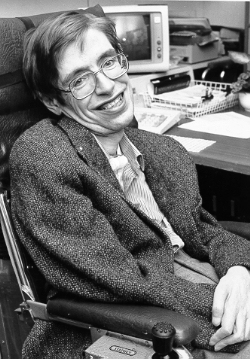
Stephen William Hawking (8 January 1942 – 14 March 2018) was an English theoretical astrophysicist, cosmologist, and author who was director of research at the Centre for Theoretical Cosmology at the University of Cambridge. Between 1979 and 2009, he was the Lucasian Professor of Mathematics at Cambridge, widely viewed as one of the most prestigious academic posts in the world. Hawking was born in Oxford into a family of physicians. In 1959, at the age of 17, he began his university education at University College, Oxford, where he received a first-class BA degree in physics. In 1962, he began his graduate work at Trinity Hall, Cambridge, where, in 1966, he obtained his PhD in applied mathematics and theoretical physics, specialising in general relativity and cosmology. In 1963, at age 21, Hawking was diagnosed with an early-onset slow-progressing form of motor neurone disease that gradually, over decades, paralysed him. After the loss of his speech, he communicated through a speech-generating device, initially through use of a handheld switch, and eventually by using a single cheek muscle. Hawking's scientific works included a collaboration with Roger Penrose on gravitational singularity theorems in the framework of general relativity, and the theoretical prediction that black holes emit radiation, often called Hawking radiation. Initially, Hawking radiation was controversial. By the late 1970s, and following the publication of further research, the discovery was widely accepted as a major breakthrough in theoretical physics. Hawking was the first to set out a theory of cosmology explained by a union of the general theory of relativity and quantum mechanics. Hawking was a vigorous supporter of the many-worlds interpretation of quantum mechanics. He also introduced the notion of a micro black hole. Hawking achieved commercial success with several works of popular science in which he discussed his theories and cosmology in general. His book A Brief History of Time appeared on the Sunday Times bestseller list for a record-breaking 237 weeks. Hawking was a Fellow of the Royal Society, a lifetime member of the Pontifical Academy of Sciences, and a recipient of the Presidential Medal of Freedom, the highest civilian award in the United States. In 2002, Hawking was ranked number 25 in the BBC's poll of the 100 Greatest Britons. He died in 2018 at the age of 76, having lived more than 50 years following his diagnosis of motor neurone disease. (Full article...) TopicsWikiProjects
More science WikiProjects...
Things to do
Related portals
More science portals...
Associated WikimediaThe following Wikimedia Foundation sister projects provide more on this subject:
Discover Wikipedia using portals
|