Poompuhar (film)
| Poompuhar | |
|---|---|
Theatrical release poster | |
| Directed by | P. Neelakantan |
| Screenplay by | M. Karunanidhi |
| Story by | Ilango Adigal |
| Starring | S. S. Rajendran C. R. Vijayakumari Rajasree K. B. Sundarambal |
| Music by | R. Sudarsanam |
Production company | Mekala Pictures |
| Distributed by | SSR Pictures |
Release date |
|
| Country | India |
| Language | Tamil |
Poompuhar is a 1964 Indian Tamil-language epic film directed by P. Neelakantan and written by M. Karunanidhi. It is the second film based on the epic Cilappatikaram after Kannagi (1942). The film stars S. S. Rajendran, C. R. Vijayakumari, Rajasree and K. B. Sundarambal. It was released on 18 September 1964.
Plot
More than 2,000 years ago, southern India was divided into three major Tamil kingdoms—the Chola, Pandya, and Chera dynasties—which ruled most of present-day Tamil Nadu and Kerala. Kannagi was born in the city of Puhar, a port city of the Chola kingdom. She was married to a wealthy merchant named Kovalan, and the couple lived a happy and prosperous life.
During this time, a grand ceremony was held to appoint Madhavi as the princess of dancers in the Chola kingdom. Kovalan was invited to the ceremony as one of the dignitaries. After her appointment, the king granted Madhavi the right to choose a man of her choice from among the dignitaries. Impressing everyone with her beauty and artistic talent, Madhavi chose Kovalan. Kovalan, captivated by her charm and skills, reciprocated her affection.
This incident shattered the happy married life of Kannagi and Kovalan. Kovalan became deeply involved with Madhavi and spent all his wealth on her. When Kannagi discovered their relationship, she was heartbroken. In her vulnerable state, she was abused by some youngsters. Kovalan’s father advised her to remarry, but Kannagi, known for her chastity and devotion, chose to wait patiently for Kovalan’s return.
Because of her profession, Madhavi was required to entertain visiting dignitaries, which Kovalan could not accept. Frequent disputes arose between them, eventually leading Kovalan to end his relationship with Madhavi and reunite with Kannagi. Kannagi forgave him, and they resumed their life together in harmony.
However, they were now poor, as Kovalan had squandered all his wealth. Their only remaining possessions were Kannagi’s ruby-encrusted golden anklets, which were highly valuable. Ashamed to remain in Puhar, they decided to leave the Chola kingdom and travel to the Pandya kingdom, intending to sell the anklets and start a new life.
They departed secretly, with only Madhavi knowing of their escape. Along the way, Madhavi met them and revealed that she was pregnant with Kovalan’s child. Kannagi urged Kovalan to return to Madhavi, but he refused. Ultimately, Kovalan and Kannagi continued their journey to the Pandya kingdom, while Madhavi returned to her home.
In time, Madhavi gave birth to a daughter named Manimekalai. After learning about her parents’ tragic past, Manimekalai became dissatisfied with worldly life. She rejected a marriage proposal from the Chola prince and later embraced Buddhism after hearing the teachings of a Buddhist monk. The prince continued to pursue her, and in one tragic incident, he was killed by Manimekalai. As punishment, she was banished from the kingdom.
Kovalan later learned about Madhavi and Manimekalai but repented his past actions and chose not to meet them. Kovalan and Kannagi lived for some time without selling the anklets, but eventually, poverty forced them to do so. Kovalan decided to sell one anklet while Kannagi kept the other and set out for Madurapura (present-day Madurai), the capital of the Pandya kingdom.
At the same time, one of the Pandya queen’s anklets was stolen. The king announced a reward for its recovery. Kovalan approached the royal goldsmith to sell Kannagi’s anklet, unaware that the goldsmith himself had stolen the queen’s anklets. The deceitful goldsmith rushed to the palace and falsely accused Kovalan of stealing the queen’s anklet.
Without proper investigation, the king ordered Kovalan’s immediate execution. When Kannagi arrived in Madurapura and learned of her husband’s unjust death, she was devastated. The king and queen rejoiced, believing the stolen anklet had been recovered.
Enraged, Kannagi stormed into the royal court and threw her anklet to the ground, breaking it open. It was revealed to contain rubies, unlike the queen’s anklet, which was filled with pearls. Shocked by the truth, the queen collapsed. Kannagi cursed the king for his injustice and pronounced a curse upon Madurapura.
A great fire erupted, destroying the city and killing the king, queen, and its inhabitants. After fulfilling her curse, Kannagi ascended to heaven. Thereafter, the people of Tamil Nadu and Sri Lanka revered her as a goddess of chastity and justice, worshipping her as Pattini or Kannagi Amman.
Cast
- C. R. Vijayakumari as Kannagi[1]
- S. S. Rajendran as Kovalan[2]
- Rajasree as Madhavi[2]
- K. B. Sundarambal as Gavundhi Adigal[3]
- Nagesh as Ganasabai
- Manorama as Vasanthamalai
- O. A. K. Thevar as King Nedunjeliyan I[2]
- G. Sakunthala as Kopperundevi
- Senthamarai as Minister of Pandyan kingdom
Soundtrack
Music was composed by R. Sudarsanam.[4]
| No. | Title | Lyrics | Singers | Length |
|---|---|---|---|---|
| 1. | "Ennai Mudhal Mudhallaga" | Radha Manikam | T. M. Soundararajan, S. Janaki | 3:37 |
| 2. | "Ponnaal Idhupole" | Udumalai Narayana Kavi | S. Janaki | 3:28 |
| 3. | "Vazhkkai Ennum Odam" | M. Karunanidhi | K. B. Sundarambal | 3:19 |
| 4. | "Thappitthu Vandhanamma" | Mayavanathan | K. B. Sundarambal | 2:36 |
| 5. | "Andru Kollum" | Mayavanathan | K. B. Sundarambal | 2:16 |
| 6. | "Iraiva Iraiva" | Alangudi Somu | P. Susheela | 3:55 |
| 7. | "Kaaviri Penne" | Mayavanathan | P. Susheela, T. M. Soundararajan | 3:29 |
| 8. | "Pottirunthum" | Alangudi Somu | P. Susheela | 3:13 |
| 9. | "Thamizh Engal Uyiranathu" | Mayavanathan | P. Susheela | 4:30 |
| 10. | "Thunbamellam" | Mayavanathan | K. B. Sundarambal | 3:22 |
| 11. | "Thottavudan Malaronru" | Mayavanathan | K. B. Sundarambal | 0:38 |
| Total length: | 34:23 | |||
Release and reception
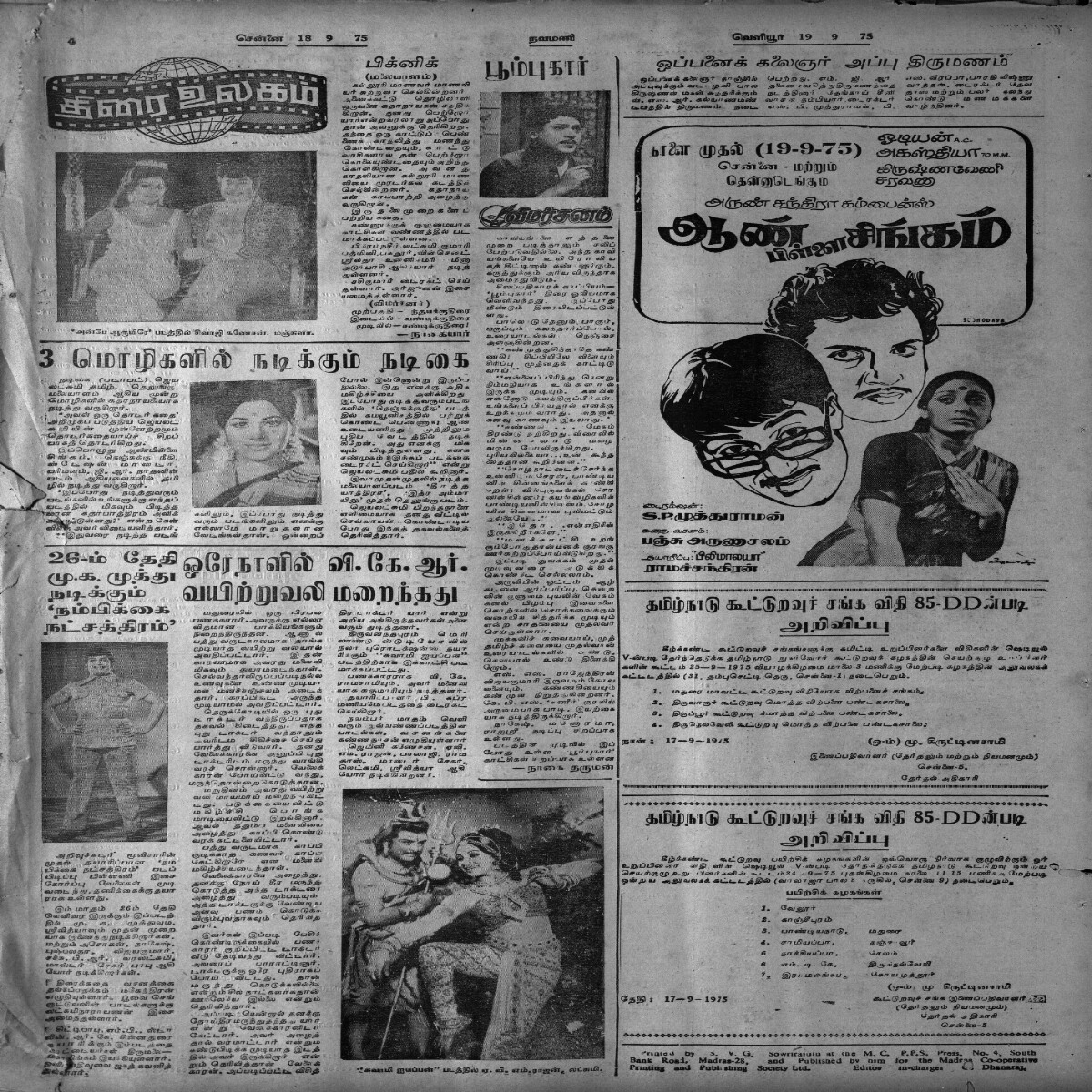
Poompuhar was released on 18 September 1964 and distributed by SSR Pictures in Madras.[5] The Indian Express called it an "ambitious motion picture in the grand tradition of screen spectacle. It combines lavish and gigantic sets, good acting [..] and pleasing music by Sudharshanam".[2] T. M. Ramachandran of Sport and Pastime wrote the story is "well-known, the film sustains the interest of the audience on account of imaginative treatment and deft touches by director P. Neelakantan" while praising the artistes and their performances.[1] Kalki published a two page review of the film done by two persons; Na. Thyagarasan, secretary of Madhavi Mandram felt Poompuhar completely ruined the story and characters which were originally conceived by Ilango Adigal and those changes done only damage to the story but praised the acting while Senthoora Pandian felt though the film begins like The Ten Commandments by Cecil B. DeMille, it falls short of being epic due to the maker's conveying of message while also expressing giving naturalistic treatment for an epic plot and portraying Kannagi as atheist.[6][7] In 1975, Naagai Dharuman of Navamani praised Karunanidhi's dialogues, acting and scenes of present day Poompuhar.[8]
References
- ^ a b Ramachandran, T. M. (17 October 1964). "Vijayakumari Steals the Show". Sport and Pastime. Vol. 18. p. 50. Retrieved 14 February 2019 – via Internet Archive.
{{cite magazine}}: CS1 maint: deprecated archival service (link) - ^ a b c d "Poompuhar". The Indian Express. 26 September 1964. p. 3. Archived from the original on 9 July 2024. Retrieved 13 February 2021 – via Google News Archive.
- ^ Vamanan (31 August 2018). "Rare scenes: When party lines blurred for Karuna". The Times of India. Retrieved 13 February 2021.
{{cite news}}: CS1 maint: deprecated archival service (link) - ^ "Poompuhar". Raaga.com. Archived from the original on 30 July 2012. Retrieved 7 August 2011.
- ^ "Poompuhar". The Indian Express. 18 September 1964. p. 10. Retrieved 6 July 2022 – via Google News Archive.
- ^ "பூம்புகார்". Kalki (in Tamil). 18 October 1964. p. 29. Retrieved 8 November 2025.
{{cite magazine}}: CS1 maint: deprecated archival service (link) - ^ "பூம்புகார்". Kalki (in Tamil). 18 October 1964. p. 30. Retrieved 8 November 2025.
{{cite magazine}}: CS1 maint: deprecated archival service (link) - ^ தருமன், நாகை (18 September 1975). "பூம்புகார்". Navamani (in Tamil). p. 4. Retrieved 11 November 2025 – via Endangered Archives Programme.