Peperomia sneidernii
| Peperomia sneidernii | |
|---|---|
| Scientific classification | |
| Kingdom: | Plantae |
| Clade: | Tracheophytes |
| Clade: | Angiosperms |
| Clade: | Magnoliids |
| Order: | Piperales |
| Family: | Piperaceae |
| Genus: | Peperomia |
| Species: | P. sneidernii
|
| Binomial name | |
| Peperomia sneidernii | |
Peperomia sneidernii is a species of epiphyte in the genus Peperomia that is endemic in Colombia.[1][2] It grows on wet tropical biomes.[1] Its conservation status is Threatened.[3]
Description
The first specimens where collected in Caldas, Colombia.[4]
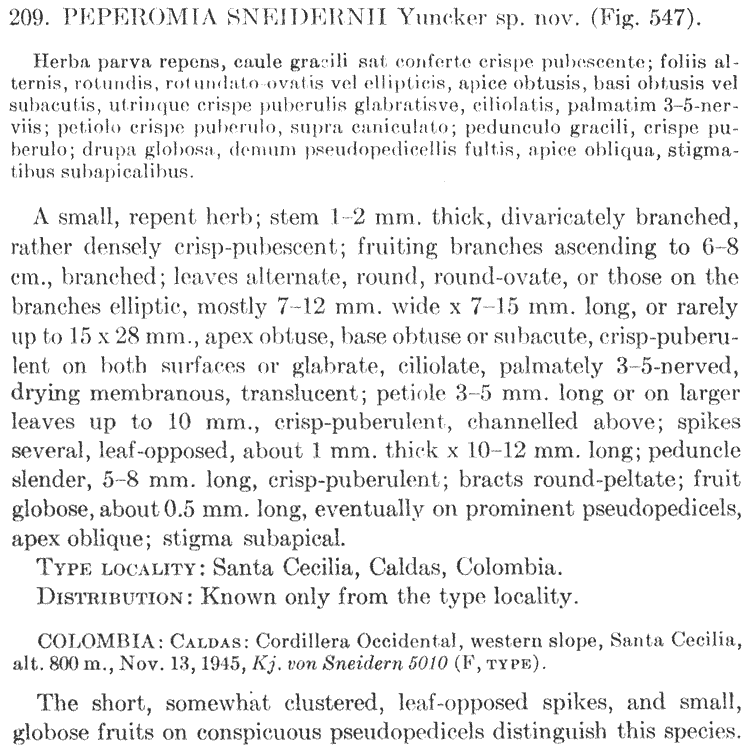
Peperomia sneiderniiis a small repent herb. The stems are 1-2 mm thick, divaricately branched, rather densely crisp-pubescent. The fruiting branches ascend up to 6-8 cm. The leaves alternate, round, or those on the branchse elliptic, mostly 7-12 mm wide and 7-15 mm long and even rarely up to 15 x 28 mm. Its tip and base is obtuse, crisp-pubescent on both surfaces, ciolate, palmately 3-5 nerved, drying membranous, translucent. The petioles are 3-5 mm long or on larger leaves up to 10 mm, crisp-puberulent, channelled above. There are several spikes that are opposed to the leaf that is about 1 mm thick and 10-12 mm long. The peduncles are slender, 5-8 mm long, and crisp-puberulent. The bracts are round. The fruit is globose that is 0.5 mm long, eventually on proiment pseudopedicels, the tip is oblique. The stigma is at the tip.[4]
The short, clustered, leaf-opposed spikes, and small globose fruits on pseudopedicels distinguish this species.[4]
Taxonomy and naming
It was described in 1950 by Truman G. Yuncker in The Piperaceae of northern South America 2, from specimens collected by Kjell von Sneidern.[5] It got its name from botanist who collected the first specimen, who was Kjell von Sneidern.[4]
Distribution and habitat
It is endemic in Colombia.[2] It grows on a epiphyte environment and is a herb.[1][4] In Colombia, its elevation range is 800 meters.[1] It grows on wet tropical biomes.[1]
Conservation
This species is assessed as Threatened, in a preliminary report.[3]
References
- ^ a b c d e "Peperomia sneidernii Yunck". Plants of the World Online. Royal Botanic Gardens, Kew. Retrieved 11 March 2026.
- ^ a b "Peperomia sneidernii Yunck". Global Biodiversity Information Facility. Retrieved 11 March 2026.
- ^ a b Bachman, Steven P.; Brown, Matilda J. M.; Leão, Tarciso C. C.; Lughadha, Eimear Nic; Walker, Barnaby E. (2024). "Extinction risk predictions for the world's flowering plants to support their conservation". New Phytologist. 242 (2): 797–808. doi:10.1111/nph.19592. PMID 38437880.
- ^ a b c d e Yuncker, Truman George. "The Piperaceae of northern South America 2: 625–626, f. 547. 1950". Piperac. N. South Amer. 2: 625–626.
- ^ "Peperomia sneidernii Yunck". Tropicos. Retrieved 11 March 2026.