Peperomia serratirhachis
| Peperomia serratirhachis | |
|---|---|
| Scientific classification | |
| Kingdom: | Plantae |
| Clade: | Tracheophytes |
| Clade: | Angiosperms |
| Clade: | Magnoliids |
| Order: | Piperales |
| Family: | Piperaceae |
| Genus: | Peperomia |
| Species: | P. serratirhachis
|
| Binomial name | |
| Peperomia serratirhachis | |
Peperomia serratirhachis is a species of epiphyte in the genus Peperomia that is endemic in Brazil.[1][2] Its conservation status is Threatened.[3]
Description
The first specimens where collected in La Paz, Bolivia.[4]
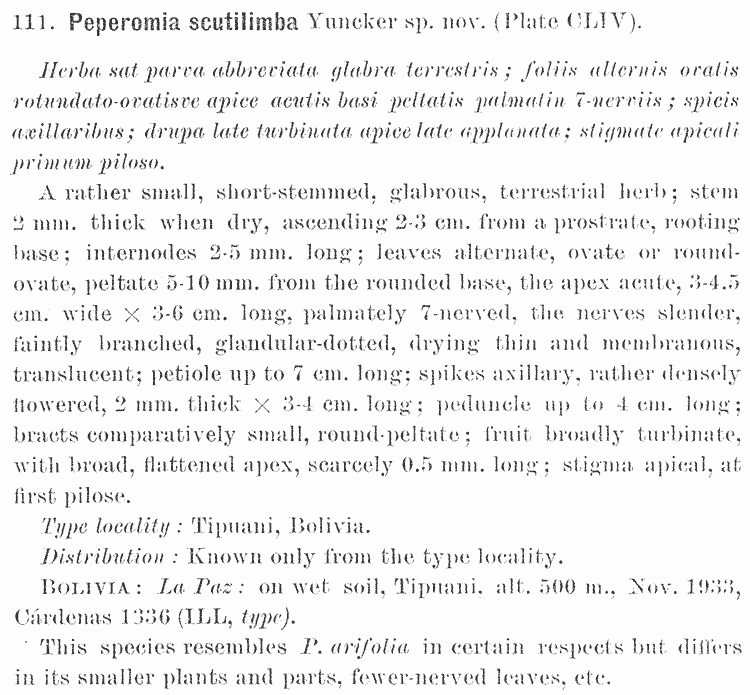
Peperomia serratirhachis is an erect or suberect, branching, pellucid herb that is 5-8 cm high, glabrous with the exception of scattered flaccid setose hairs on the leaves and occasionally at the nodes. The leaves are ovate, with an obtuse tip and cordate base that is 15 mm wide and as long. The leaves are 5-nerved, the midrib and lateral nerves are strongly branched upward, drying very thin, transparent. Its petioles are 5 mm long. The spikes are leaf-opposed and at the tip that are 1 mm thick and 2 cm long . Its peduncles are 5 mm long. The rachis are flattened. The braces are small and round while having tooth-like projections of the rachis. The drupes are around 0.8 mm long, ellipsoidal, verrucose, with a short, conic style and apical stigma, sessile, or at the most subpedicelate.[4]
The branching, upright, subglabrous plants, ovate leaves, flattened and toothed rachis, and the scarely stalked fruits distinguish this species. It resembles P. pellucida somewhat but differs in a number of characteristics. From P. hispidula var. sellowiana it differs in its scarely pedicellate fruits and toothed rachis.[4]
Taxonomy and naming
It was described in 1966 by Truman G. Yuncker in Boletim do Instituto de Botânica 3, from specimens collected by Moysés Kuhlmann.[5] The name refers to the toothed character of the rachis.[4]
Distribution and habitat
It is endemic in Brazil.[2] It grows on a epiphyte environment and is a herb.[1][4]
Conservation
This species is assessed as Threatened, in a preliminary report.[3]
References
- ^ a b "Peperomia serratirhachis Yunck". Plants of the World Online. Royal Botanic Gardens, Kew. Retrieved 11 March 2026.
- ^ a b "Peperomia serratirhachis Yunck". Global Biodiversity Information Facility. Retrieved 11 March 2026.
- ^ a b Bachman, Steven P.; Brown, Matilda J. M.; Leão, Tarciso C. C.; Lughadha, Eimear Nic; Walker, Barnaby E. (2024). "Extinction risk predictions for the world's flowering plants to support their conservation". New Phytologist. 242 (2): 797–808. doi:10.1111/nph.19592. PMID 38437880.
- ^ a b c d e Yuncker, Truman George. "Lilloa 27: 275, t. 154. 1955". Lilloa. 27: 154.
- ^ "Peperomia serratirhachis Yunck". Tropicos. Retrieved 11 March 2026.