Peperomia scutilimba
| Peperomia scutilimba | |
|---|---|
| Scientific classification | |
| Kingdom: | Plantae |
| Clade: | Tracheophytes |
| Clade: | Angiosperms |
| Clade: | Magnoliids |
| Order: | Piperales |
| Family: | Piperaceae |
| Genus: | Peperomia |
| Species: | P. scutilimba
|
| Binomial name | |
| Peperomia scutilimba | |
Peperomia scutilimba is a species of epiphyte in the genus Peperomia that is endemic in Peru.[1][2] Its conservation status is Threatened.[3]
Description
The first specimens where collected in La Paz, Bolivia.[4]
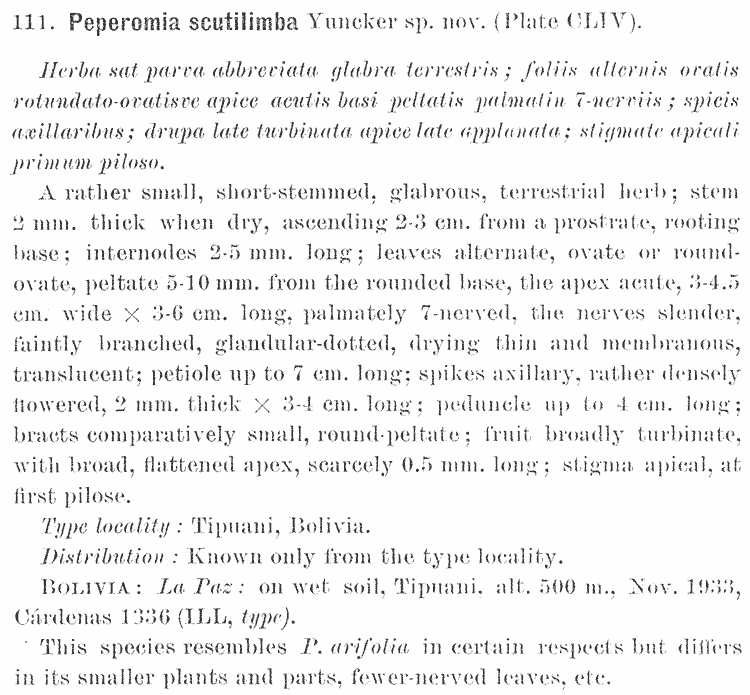
Peperomia scutilimba is a rather small, short-stemmed, glabrous, and terrestrial herb. The stems are 2 mm thick when dry that ascends up to 2–3 cm from the prostrate. The internodes are 2–5 mm long. The leaves alternate, round that are 5–10 mm from the rounded base. The tip is acute that is 3–4.5 cm wide and 3–6 cm long. The tip of the leaf is palmately 7-nerved, the nerves are slender, faintly branched, gladular-dotted, drying thin and membranous, and transulecent. The petioles are up to 7 cm long. The spikes are axillary, rather densely flowered, that are 2 mm thick and 3–4 cm long. The peduncles are up to 4 cm long. The bracts are small and round. The fruits are broadly turbinate and 0.5 mm long with a broad and flattened apex. The stigma is at the tip, specifically at the first pilose.[4]
This species resembles P. arifolia in certain aspects but it differs in its smaller plants and parts, fewer-nerved leaves, etc.[4]
Taxonomy and naming
It was described in 1955 by Truman G. Yuncker in American Journal of Botany 39, from specimens collected by Christopher Sandeman.[5]
Distribution and Habitat
It is endemic in Bolivia.[2] It grows on a epiphyte environment and is a herb.[1][4]
Conservation
This species is assessed as Threatened, in a preliminary report.[3]
References
- ^ a b "Peperomia scutilimba Yunck". Plants of the World Online. Royal Botanic Gardens, Kew. Retrieved 11 March 2026.
- ^ a b "Peperomia scutilimba Yunck". Global Biodiversity Information Facility. Retrieved 11 March 2026.
- ^ a b Bachman, Steven P.; Brown, Matilda J. M.; Leão, Tarciso C. C.; Lughadha, Eimear Nic; Walker, Barnaby E. (2024). "Extinction risk predictions for the world's flowering plants to support their conservation". New Phytologist. 242 (2): 797–808. doi:10.1111/nph.19592. PMID 38437880.
- ^ a b c d Yuncker, Truman George. "Lilloa 27: 275, t. 154. 1955". Lilloa. 27: 154.
- ^ "Peperomia scutilimba Yunck". Tropicos. Retrieved 11 March 2026.