Peperomia sandemanii
| Peperomia sandemanii | |
|---|---|
| Scientific classification | |
| Kingdom: | Plantae |
| Clade: | Tracheophytes |
| Clade: | Angiosperms |
| Clade: | Magnoliids |
| Order: | Piperales |
| Family: | Piperaceae |
| Genus: | Peperomia |
| Species: | P. sandemanii
|
| Binomial name | |
| Peperomia sandemanii | |
Peperomia sandemanii is a species of epiphyte in the genus Peperomia that is endemic in Peru.[1][2] Its conservation status is Threatened.[3]
Description
The first specimens where collected in Huacapistana, Peru.[4]
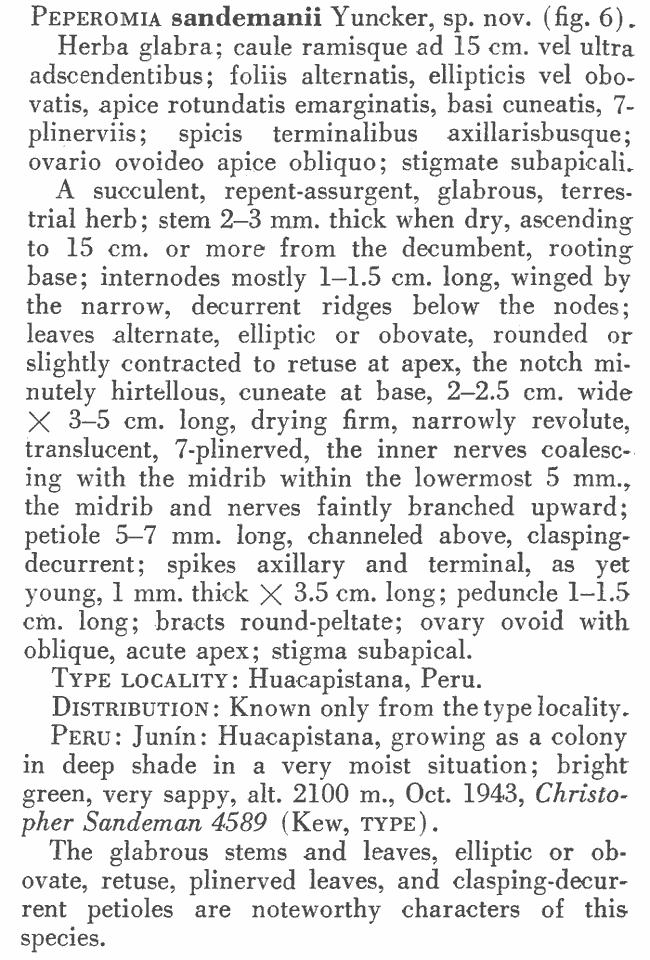
Peperomia scutilimba is a succulent, repent-assurgent, glabrous, and terrestrial herb. Its stems are 2–3 mm thick when dry that ascends up to 15 cm or more from the rooting base. Its internodes are mostly 1-1.5 cm long, winged by the decurrent ridges below the nodes. The leaves alternate, elliptic or obovoate, rounded or slightly contracted to retuse at apex. The notch is minutely hirtellous, cuneate at base, 2-2.5 cm wide and 3–5 cm long. Drying firm, narrowly revoluate, translucent, 7-plinerved, the inner nerves coalescing with the midrib within the lowermost 5 mm, the midrib and nerves are branched upward. The petioles are 5–7 mm long, channelled above, clasping-decurrent. The axillary spikes are at the tip, 1 mm thick and 3.5 cm long. The peduncles are 1-1.5 cm long. The bracts are round. The ovary is ovoid with oblique, acute tip. The stigma is subapical.[4]
The glabrous stems and leaves, elliptic, retuse, plinerved nerves, and clasping-decurrent petioles are the distinguishing characteristics of this species.[4]
Taxonomy and naming
It was described in 1950 by Truman G. Yuncker in American Journal of Botany 39, from specimens collected by Christopher Sandeman.[5] It got its name from the person who collected the first specimens, who was Christopher Sandeman.[4]
Distribution and habitat
It is endemic in Bolivia.[2] It grows on a epiphyte environment and is a herb.[1][4]
Conservation
This species is assessed as Threatened, in a preliminary report.[3]
References
- ^ a b "Peperomia sandemanii Yunck". Plants of the World Online. Royal Botanic Gardens, Kew. Retrieved 11 March 2026.
- ^ a b "Peperomia sandemanii Yunck". Global Biodiversity Information Facility. Retrieved 11 March 2026.
- ^ a b Bachman, Steven P.; Brown, Matilda J. M.; Leão, Tarciso C. C.; Lughadha, Eimear Nic; Walker, Barnaby E. (2024). "Extinction risk predictions for the world's flowering plants to support their conservation". New Phytologist. 242 (2): 797–808. doi:10.1111/nph.19592. PMID 38437880.
- ^ a b c d e Yuncker, Truman George. "American Journal of Botany 39(9): 636. 1952". Amer. J. Bot. 39: 636.
- ^ "Peperomia sandemanii Yunck". Tropicos. Retrieved 11 March 2026.