Peperomia purpurinodis
| Peperomia purpurinodis | |
|---|---|
| Scientific classification | |
| Kingdom: | Plantae |
| Clade: | Tracheophytes |
| Clade: | Angiosperms |
| Clade: | Magnoliids |
| Order: | Piperales |
| Family: | Piperaceae |
| Genus: | Peperomia |
| Species: | P. purpurinodis
|
| Binomial name | |
| Peperomia purpurinodis | |
Peperomia purpurinodis is a species of subshrub in the genus Peperomia that is endemic in Fiji.[1][2] It grows on wet tropical biomes.[1] Its conservation status is Threatened.[3]
Description
The type specimen were collected near Namosi, Fiji.[4]
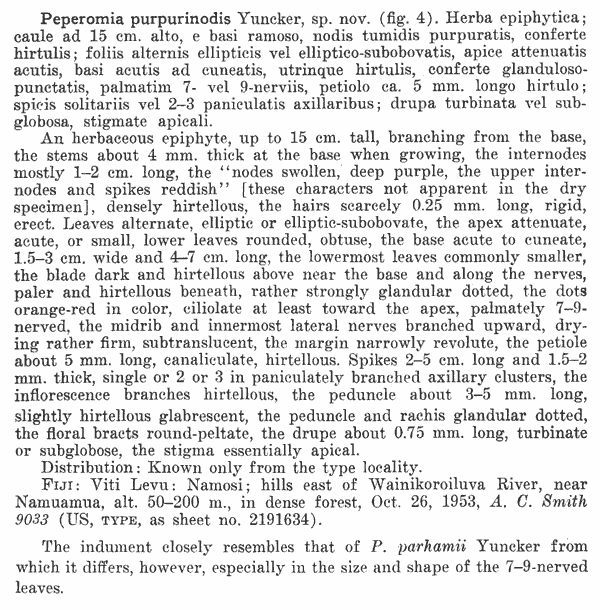
Peperomia purpurinodis is a small, herbaceous epiphyte, growing up to 15 cm tall and branching from the base. Its stems have swollen nodes that are a deep purple color, a distinctive feature noted in living plants. The stems and nodes are densely covered in very short (0.25 mm), stiff, erect hairs. The alternate leaves are elliptic to elliptic-subobovate, measuring 4–7 cm long and 1.5–3 cm wide. The leaf tip is attenuate and acute (though lower leaves may be more rounded), and the base is acute to wedge-shaped. Both leaf surfaces are hirtellous, and the blade is notably dotted with prominent orange-red glandular dots. The margins are ciliolate, at least toward the tip. The leaves are palmately 7–9-nerved and dry to a rather firm, subtransparent texture with a narrowly revolute margin. The petiole is about 5 mm long and hirtellous. The spikes are 2–5 cm long, either solitary or arranged in small, paniculate clusters of 2 or 3 in the leaf axils. The peduncle is 3–5 mm long and slightly hirtellous, and both the peduncle and the rachis are dotted with glands. The floral bracts are round-peltate, and the drupes are about 0.75 mm long, turbinate to subglobose, with an apical stigma.[4]
This species is set apart by its small stature, distinctly swollen purple nodes, and leaves that are palmately 7–9-nerved and covered in prominent orange-red glandular dots. While its dense, short indument resembles that of P. parhamii, it differs markedly in the size, shape, and higher nerve count of its leaves.[4]
Taxonomy and naming
It was described in 1956 by Truman G. Yuncker in Bulletin of the Torrey Botanical Club 83, from specimens collected by Albert Charles Smith.[5] It got its name from description of the species.[4]
Distribution and habitat
It is endemic in Fiji.[2] It grows on an epiphytic subshrub environment and is a herb.[1][4] It grows on wet tropical biomes.[1]
Conservation
This species is assessed as Threatened, in a preliminary report.[3]
References
- ^ a b c d "Peperomia purpurinodis Yunck". Plants of the World Online. Royal Botanic Gardens, Kew. Retrieved 12 March 2026.
- ^ a b "Peperomia purpurinodis Yunck". Global Biodiversity Information Facility. Retrieved 12 March 2026.
- ^ a b Bachman, Steven P.; Brown, Matilda J. M.; Leão, Tarciso C. C.; Lughadha, Eimear Nic; Walker, Barnaby E. (2024). "Extinction risk predictions for the world's flowering plants to support their conservation". New Phytologist. 242 (2): 797–808. doi:10.1111/nph.19592. PMID 38437880.
- ^ a b c d e Yuncker, Truman George. "Bulletin of the Torrey Botanical Club 83: 303, f. 2. 1956". Bull. Torrey Bot. Club. 83: 303.
- ^ "Peperomia purpurinodis Yunck". Tropicos. Retrieved 13 March 2026.