Peperomia deficiens
| Peperomia deficiens | |
|---|---|
| Scientific classification | |
| Kingdom: | Plantae |
| Clade: | Tracheophytes |
| Clade: | Angiosperms |
| Clade: | Magnoliids |
| Order: | Piperales |
| Family: | Piperaceae |
| Genus: | Peperomia |
| Species: | P. deficiens
|
| Binomial name | |
| Peperomia deficiens | |
Peperomia deficiens is a species of epiphyte in the genus Peperomia that is endemic in Peru.[1][2] It grows on wet tropical biomes.[1] Its conservation status is Threatened.[3]
Description
The type specimen were collected near Alto Río Huallaga, Peru, at an altitude of 360–900 meters (1,180–2,950 ft).[4]
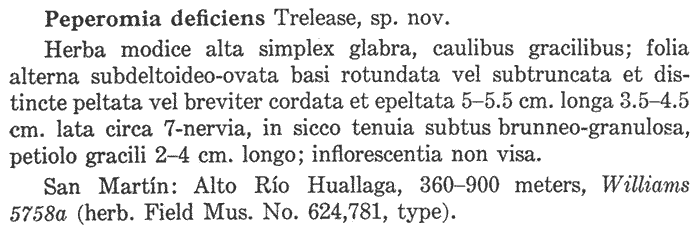
Peperomia deficiens is a moderately tall, unbranched, glabrous herb with slender stems. The alternate leaves are somewhat deltoid-ovate, with a rounded to subtruncate base. They are distinctly peltate or, in some cases, shortly cordate and epeltate, measuring 5–5.5 cm (2.0–2.2 in) long and 3.5–4.5 cm (1.4–1.8 in) wide. The leaves are about 7-nerved, thin when dry, and have a brownish granular texture on the underside. The slender petiole is 2–4 cm (0.8–1.6 in) long. The inflorescence was not seen on the type specimen.[4]
Taxonomy and naming
It was described in 1936 by William Trelease in Publications of the Field Museum of Natural History, Botanical Series 13, from specimens collected by Llewelyn Williams.[5] It got its epithet from the Latin wikt:deficiens, referring to the absence of inflorescences on the type collection. [4]
Distribution and habitat
It is endemic in Peru.[2] It grows on a epiphyte environment and is a herb.[1][4] It grows on wet tropical biomes.[1]
Conservation
This species is assessed as Threatened, in a preliminary report.[3]
References
- ^ a b c d "Peperomia deficiens Trel". Plants of the World Online. Royal Botanic Gardens, Kew. Retrieved 14 March 2026.
- ^ a b "Peperomia deficiens Trel". Global Biodiversity Information Facility. Retrieved 14 March 2026.
- ^ a b Bachman, Steven P.; Brown, Matilda J. M.; Leão, Tarciso C. C.; Lughadha, Eimear Nic; Walker, Barnaby E. (2024). "Extinction risk predictions for the world's flowering plants to support their conservation". New Phytologist. 242 (2): 797–808. doi:10.1111/nph.19592. PMID 38437880.
- ^ a b c d Trelease, William. "Publications of the Field Museum of Natural History, Botanical Series 13(357): 38. 1936". Publ. Field Mus. Nat. Hist., Bot. Ser. 13(357): 38.
- ^ "Peperomia deficiens Trel". Tropicos. Retrieved 14 March 2026.