Peperomia davidsoniae
| Peperomia davidsoniae | |
|---|---|
| Scientific classification | |
| Kingdom: | Plantae |
| Clade: | Tracheophytes |
| Clade: | Angiosperms |
| Clade: | Magnoliids |
| Order: | Piperales |
| Family: | Piperaceae |
| Genus: | Peperomia |
| Species: | P. davidsoniae
|
| Binomial name | |
| Peperomia davidsoniae | |
Peperomia davidsoniae or Peperomia davidsonii is a species of subshrub in the genus Peperomia that is endemic in Panama.[1][2] It grows on wet tropical biomes.[1] Its conservation status is Threatened.[3]
Description
The first specimens where collected in Chiriquí, Panama.[4]
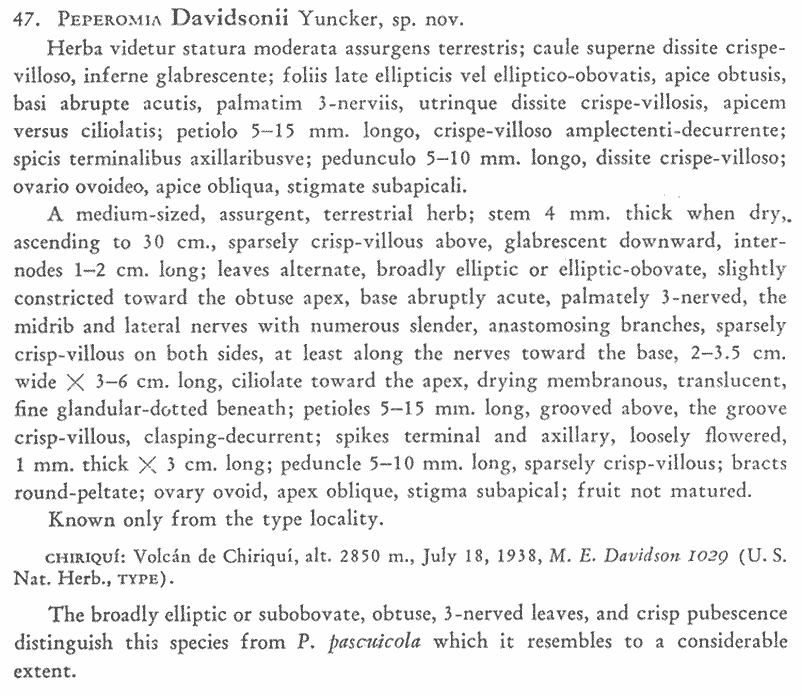
Peperomia davidsoniae is a medium-sized, ascending terrestrial herb with a stem 4 mm thick when dry, ascending to 30 cm, sparsely covered with crisped hairs above and becoming hairless downward, with internodes 1–2 cm long. The alternate leaves are broadly elliptic or elliptic-obovate, slightly constricted toward the obtuse apex, with base abruptly acute, measuring 2–3.5 cm wide by 3–6 cm long. They are palmately 3-nerved, with the midrib and lateral nerves bearing numerous slender, interconnecting branches, sparsely crisp-hairy on both sides at least along the nerves toward the base, and fringed with fine hairs toward the apex. The leaves dry membranous and translucent, with fine glandular dots beneath. The petioles are 5–15 mm long, grooved above with the groove crisp-hairy, clasping and decurrent. The terminal and axillary spikes are loosely flowered, 1 mm thick by 3 cm long, on peduncles 5–10 mm long that are sparsely crisp-hairy. The bracts are round-peltate. The ovary is ovoid with oblique apex and subapical stigma. Fruit was not matured at the time of description.[4]
It resembles P. pascuicola to a considerable extent, but differs in these leaf shape and pubescence characteristics. The numerous slender, anastomosing branches from the main nerves, the clasping-decurrent petioles with grooved, crisp-hairy surfaces, and the subapical stigma position are additional diagnostic features.[4]
Taxonomy and naming
It was described in 1950 by Truman G. Yuncker in Annals of the Missouri Botanical Garden 37, from specimens collected by Mary Ellen Davidson.[5] It got its name from person who collected the type specimen, M. E. Davidson. [4]
Distribution and habitat
It is endemic to Panama.[2] It grows on a subshrub environment and is a herb.[1][4] It grows on wet tropical biomes.[1]
Conservation
This species is assessed as Threatened, in a preliminary report.[3]
References
- ^ a b c d "Peperomia davidsoniae Yunck". Plants of the World Online. Royal Botanic Gardens, Kew. Retrieved 12 March 2026.
- ^ a b "Peperomia davidsoniae Yunck". Global Biodiversity Information Facility. Retrieved 12 March 2026.
- ^ a b Bachman, Steven P.; Brown, Matilda J. M.; Leão, Tarciso C. C.; Lughadha, Eimear Nic; Walker, Barnaby E. (2024). "Extinction risk predictions for the world's flowering plants to support their conservation". New Phytologist. 242 (2): 797–808. doi:10.1111/nph.19592. PMID 38437880.
- ^ a b c d e Yuncker, Truman George. "Annals of the Missouri Botanical Garden 37(1): 102. 1950". Ann. Missouri Bot. Gard. 37: 102.
- ^ "Peperomia davidsoniae Yunck". Tropicos. Retrieved 12 March 2026.