Peperomia cushiana
| Peperomia cushiana | |
|---|---|
| Scientific classification | |
| Kingdom: | Plantae |
| Clade: | Tracheophytes |
| Clade: | Angiosperms |
| Clade: | Magnoliids |
| Order: | Piperales |
| Family: | Piperaceae |
| Genus: | Peperomia |
| Species: | P. cushiana
|
| Binomial name | |
| Peperomia cushiana | |
Peperomia cushiana is a species of epiphyte in the genus Peperomia that is endemic in Peru.[1][2] It grows on wet tropical biomes.[1] Its conservation status is Threatened.[3]
Description
The type specimen were collected near Cushi, Peru at an altitude of 1500 meters.[4]
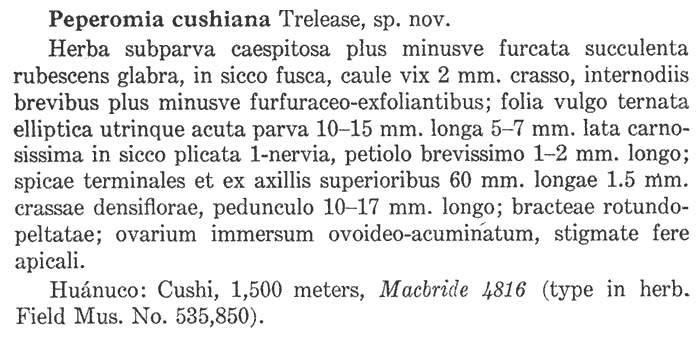
Peperomia cushiana is a somewhat small, tufted, more or less forked, succulent herb that turns reddish and is glabrous, drying to a brown color. The stem is barely 2 mm thick with short internodes that are more or less exfoliating in a scurfy manner. The leaves are typically in whorls of 3. They are elliptical, pointed at both ends, and small (10–15 mm long, 5–7 mm wide), very fleshy, and 1-nerved, becoming plicate when dry. The very short petiole is 1–2 mm long. The spikes are terminal and from the upper axils, 60 mm long and 1.5 mm thick, densely flowered, and borne on a peduncle 10–17 mm long. The immersed ovary is ovoid-acuminate with a nearly apical stigma.[4]
Taxonomy and naming
It was described in 1936 by William Trelease in Publications of the Field Museum of Natural History, Botanical Series 13, from specimens collected by James Francis Macbride.[5] It got its epithet from the type locality. [4]
Distribution and habitat
It is endemic in Peru.[2] It grows on a epiphyte environment and is a herb.[1][4] It grows on wet tropical biomes.[1]
Conservation
This species is assessed as Threatened, in a preliminary report.[3]
References
- ^ a b c d "Peperomia cushiana Trel". Plants of the World Online. Royal Botanic Gardens, Kew. Retrieved 14 March 2026.
- ^ a b "Peperomia cushiana Trel". Global Biodiversity Information Facility. Retrieved 14 March 2026.
- ^ a b Bachman, Steven P.; Brown, Matilda J. M.; Leão, Tarciso C. C.; Lughadha, Eimear Nic; Walker, Barnaby E. (2024). "Extinction risk predictions for the world's flowering plants to support their conservation". New Phytologist. 242 (2): 797–808. doi:10.1111/nph.19592. PMID 38437880.
- ^ a b c d Trelease, William. "Publications of the Field Museum of Natural History, Botanical Series 13(357): 36. 1936". Publ. Field Mus. Nat. Hist., Bot. Ser. 13(357): 36.
- ^ "Peperomia cushiana Trel". Tropicos. Retrieved 14 March 2026.