Peperomia bermudezana
| Peperomia bermudezana | |
|---|---|
| Scientific classification | |
| Kingdom: | Plantae |
| Clade: | Tracheophytes |
| Clade: | Angiosperms |
| Clade: | Magnoliids |
| Order: | Piperales |
| Family: | Piperaceae |
| Genus: | Peperomia |
| Species: | P. bermudezana
|
| Binomial name | |
| Peperomia bermudezana | |
Peperomia bermudezana is a species of epiphyte in the genus Peperomia that is endemic to Peru.[1][2] It grows in wet tropical biomes.[1] Its conservation status is Threatened.[3]
Description
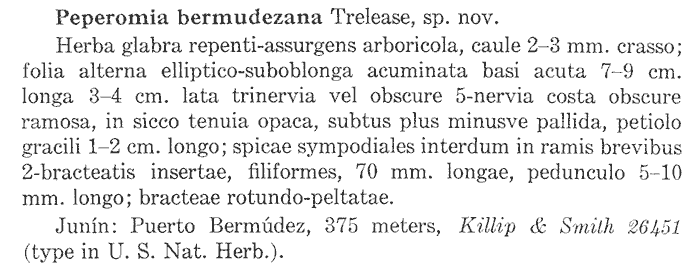
The type specimen was collected near Puerto Bermúdez, Peru at an altitude of 375 meters.[4]
Peperomia bermudezana is a smooth, creeping and ascending herb that grows on trees. Its stems are 2 to 3 mm thick. The leaves are arranged alternately and are elliptical to somewhat oblong in shape, with a pointed tip and a sharp, acute base. Each leaf blade measures 7 to 9 cm in length and 3 to 4 cm in width. They feature three distinct nerves, or sometimes five obscure ones, with the midrib showing faint branching. When dried, the leaves are thin and dull, with the underside appearing more or less pale. The slender petioles are 1 to 2 cm long. The flower spikes are sympodial, meaning they develop from a series of lateral branches, and are sometimes inserted on short, two-bracted branches. These spikes are thread-like, reaching 70 mm in length, and are borne on a peduncle 5 to 10 mm long. The floral bracts are rounded and peltate, shield-shaped with the stalk attached at the center.[4]
Taxonomy and naming
It was described in 1936 by the American botanist William Trelease in Publications of the Field Museum of Natural History, Botanical Series 13.[5] The species is named after its type locality, Puerto Bermúdez in Peru.[4]
Distribution and habitat
This species is endemic to Peru.[2] It grows as an epiphytic herb in wet tropical biomes.[1][4]
Conservation
This species is assessed as Threatened, in a preliminary report.[3]
References
- ^ a b c "Peperomia bermudezana Trel". Plants of the World Online. Royal Botanic Gardens, Kew. Retrieved 13 March 2026.
- ^ a b "Peperomia bermudezana Trel". Global Biodiversity Information Facility. Retrieved 13 March 2026.
- ^ a b Bachman, Steven P.; Brown, Matilda J. M.; Leão, Tarciso C. C.; Lughadha, Eimear Nic; Walker, Barnaby E. (2024). "Extinction risk predictions for the world's flowering plants to support their conservation". New Phytologist. 242 (2): 797–808. doi:10.1111/nph.19592. PMID 38437880.
- ^ a b c d Trelease, William. "Peperomia bermudezana". Publications of the Field Museum of Natural History, Botanical Series. 13(2): 25.
- ^ "Peperomia bermudezana Trel". Tropicos. Retrieved 13 March 2026.