Peperomia aerea
| Peperomia aerea | |
|---|---|
| Scientific classification | |
| Kingdom: | Plantae |
| Clade: | Tracheophytes |
| Clade: | Angiosperms |
| Clade: | Magnoliids |
| Order: | Piperales |
| Family: | Piperaceae |
| Genus: | Peperomia |
| Species: | P. aerea
|
| Binomial name | |
| Peperomia aerea | |
Peperomia aerea is a species of epiphyte in the genus Peperomia that is endemic in Peru.[1][2] It grows on wet tropical biomes.[1] Its conservation status is Threatened.[3]
Description
The type specimen were collected near Chanchamayo Valley, Peru at an altitude of 1,800 meters (5,900 ft).[4]
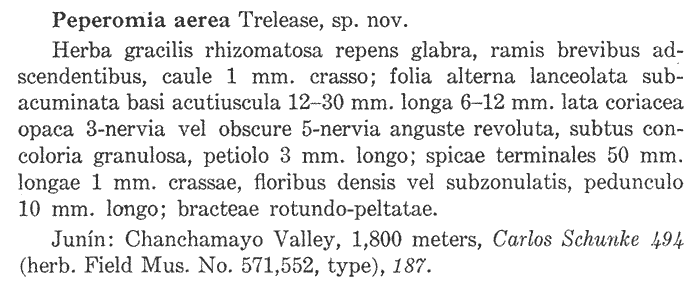
Peperomia aerea is a delicate, creeping herb with a rhizomatous root system. Its slender stems are about 1 mm thick, with short, ascending branches. The leaves are alternate, lance-shaped, and somewhat pointed, measuring 12–30 mm (0.47–1.18 in) long and 6–12 mm (0.24–0.47 in) wide. These coriaceous (leathery) leaves have a dull, opaque appearance and are narrowly rolled back at the edges. They feature three distinct nerves, or sometimes five obscure ones, and are granular with a color similar to the stem on their underside. The petioles are short, only about 3 mm long. The flowering spikes are terminal and reach up to 50 mm (2 in) in length with a thickness of 1 mm, densely packed with small flowers that may form slight bands. These spikes are borne on a peduncle about 10 mm long. The floral bracts are rounded and peltate, meaning they are shield-shaped with the stalk attached to the center.[4]
Taxonomy and naming
It was described in 1936 by William Trelease in Publications of the Field Museum of Natural History, Botanical Series 13, from specimens collected by Carlos Schunke.[5] It got its name from description of the species.[4]
Distribution and habitat
It is endemic in Peru.[2] It grows on a epiphyte environment and is a herb.[1][4] It grows on wet tropical biomes.[1]
Conservation
This species is assessed as Threatened, in a preliminary report.[3]
References
- ^ a b c d "Peperomia aerea Trel". Plants of the World Online. Royal Botanic Gardens, Kew. Retrieved 12 March 2026.
- ^ a b "Peperomia aerea Trel". Global Biodiversity Information Facility. Retrieved 12 March 2026.
- ^ a b Bachman, Steven P.; Brown, Matilda J. M.; Leão, Tarciso C. C.; Lughadha, Eimear Nic; Walker, Barnaby E. (2024). "Extinction risk predictions for the world's flowering plants to support their conservation". New Phytologist. 242 (2): 797–808. doi:10.1111/nph.19592. PMID 38437880.
- ^ a b c d Trelease, William. ":Publications of the Field Museum of Natural History, Botanical Series 13(357): 19. 1936". Publ. Field Mus. Nat. Hist., Bot. Ser. 13(357): 19.
- ^ "Peperomia aerea Trel". Tropicos. Retrieved 13 March 2026.