Pallache family
Interior of Synagogue of El Transito | |
| Origin | |
|---|---|
| Meaning | Palace(s) |
| Region of origin | Iberian Peninsula |
| Other names | |
| Variant forms | de Palacio(s) (Spanish), de Palácio(s) (Portuguese), Pallais (French), Palacci (Italian), Palatsi (Greek), etc., all ultimately from Collis Palatium |
Pallache, also de Palacio(s), Palache, Palaçi, Palachi, Palatsi, Palacci, Palaggi, al-Fallashi, and many other variations, is a prominent Sephardic Jewish family from the Iberian Peninsula, who spread mostly through the Mediterranean after the Alhambra Decree in 1492, and related events.[1][note 1]
The Pallaches established themselves in cities in Morocco, the Netherlands, Turkey, Egypt, and other countries from the 1500s to the 1900s. The family includes Chief Rabbis, rabbis, founders of synagogues and batei midrash, scientists, entrepreneurs, writers, and others. Best known are Moroccan envoys and brothers Samuel Pallache (c. 1550–1616) and Joseph Pallache, at least three grand rabbis of Izmir – Gaon.[6] Haim Palachi (1788–1868), his sons Abraham Palacci (1809–1899) and Rahamim Nissim Palacci (1814–1907), grand rabbi of Amsterdam Isaac Juda Palache (1858–1927), American mineralogist Charles Palache (1869–1954), and Dutch linguist Juda Lion Palache (1886–1944).
History
Inquisitions and expulsions
According to historians Mercedes García-Arenal and Gerard Wiegers, the Pallaches "were a family of Hispanic Jews who settled in Fez after the Jews were expelled from Spain in 1492."[1] In 1492, Isabella and Ferdinand issued the Alhambra Decree, ordering the expulsion of practicing Jews from their kingdoms.[7] Jews who had converted to Christianity were safe from expulsion. Some 200,000 Jews converted; between 40,000 and 100,000 fled.[8]
In 1496, King Manuel I of Portugal decreed that all Jews must convert to Catholicism or leave the country. Jews who converted to Christianity were known as New Christians. This initial edict of expulsion turned into an edict of forced conversion by 1497. In 1506, the Lisbon Massacre erupted. In 1535, Portugal launched its own inquisition. Portuguese Jews fled to the Ottoman Empire (notably Thessaloniki and Istanbul and to Morocco. Some went to Amsterdam, France, Brazil, Curaçao, and the Antilles. As Portugal was under control of the Philippine Dynasty of the House of Habsburg (1581–1640), the Portuguese Inquisition blended with the Spanish.
The combined Spanish-Portuguese inquisitions caused one of the largest diasporas in Jewish history.
Iberia
According to Professor Mercedes García-Arenal,[9] the Pallaches were "a Sephardi family perhaps descended from the Bene Palyāj mentioned by the twelfth-century chronicler Abraham ibn Daud as 'the greatest of the families of Córdoba'".[2]
According to Professor Reginald Aldworth Daly, the Pallaches were "persecuted Sephardim Jews of Portugal who were exiled to Holland".[10]
According to Professor Giovanna Fiume,[11] "The Pallache family also emigrated to the Netherlands, perhaps from Portugal or Spain, or, second, another hypothesizes, they emigrated [directly] from their native Spain to Fez."[12]
José Maria Abecassis cites historian Abraham ibn Daud of Toledo (c. 1110–1180), who wrote:
According to the historian Abraham Ben Daud (Sepher Ha-Qabbalah, 69) the Pallache family was already famous in Cordoba in the 10th century. After expulsion from Spain in 1492, they went to Morocco, where later they branched out to Holland, Turkey, Palestine, and Gibraltar. Other spellings: Palatio, Pallacío, Payachia. Members of this family provided eminent services to Morocco in the 17th century. They distinguished themselves as ambassadors or envoys of the Sultans in Europe, especially in Holland. They established diplomatic relations and created important trade with their country. The Palaçano lived in Portugal before the Expulsion.[13]
Morocco
The Jewish presence in Morocco goes back to Carthage, fared moderately, and often prospered under Muslim rule (e.g., the Marinid dynasty). From Morocco, they filtered into Al-Andalus (Islamic Spain, 711–1492) but began to return during the Spanish Reconquista, which mounted in the 10th century. The Spanish-Portuguese expulsions and inquisitions sent Jews back to Morocco on a larger scale. Resultant overcrowding in Moroccan cities led to tension, fires, and famines in Jewish quarters.
Moïse Al Palas (also Moses al-Palas[2]) (???–1535), born in Marrakesh, was a rabbi who moved to Tetuán and lived for a time in Salonica, then in the Ottoman Empire. Before dying in Venice, he published Va-Yakhel Moshe (1597) and Ho'il Moshe (1597), and an autobiography.[2][14][15]
Isaac Pallache was a rabbi in Fez, Morocco, first mentioned in takkanot (Jewish community statutes) in 1588. His sons were Samuel Pallache (c. 1550–1616) and Joseph Pallache. Isaac was married to a sister of Fez's grand rabbi, Judah Uziel; his nephew Isaac Uziel became a rabbi of the Neve Shalom community in Amsterdam.[5]
Netherlands
Jews began to settle in the Netherlands at the end of the 16th century. Thanks to its independence from Spanish control in 1581, the Dutch Republic attracted Sephardic Jews in the Netherlands as a refuge from a common enemy, Spain.
After an unsuccessful attempt to return to Spain in the mid-1600s, Samuel and Joseph Pallache settled a new branch of the Pallache family in the Netherlands by 1608. There, they represented their benefactor, Zidan al-Nasir of Morocco, as well as the Dutch government, in complex negotiations with Morocco, the Netherlands, Spain, France, England, the Ottoman Empire, and other European states – often on behalf of more than one sponsoring state and (as stateless Jews) on their own behalf.[5]
The sons of both brothers continued in their fathers's footsteps, some remaining in the Netherlands (e.g., David Pallache), others returning to Morocco (e.g., Moses Pallache).
In the Netherlands, the surname solidified as "Palache" (a spelling variation which started in the 16th century), and the family continues as Palache in the Netherlands to the present. Prominent members have included grand rabbi Isaac Juda Palache (1858–1927) and his son, Professor Juda Lion Palache (1887–1944).
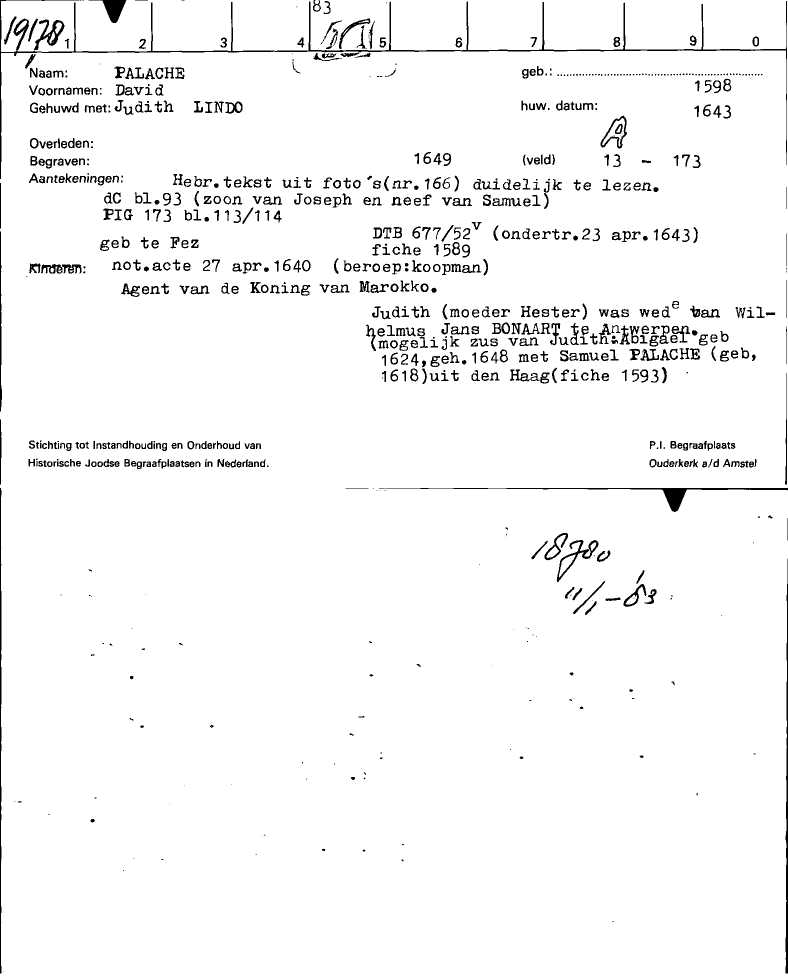
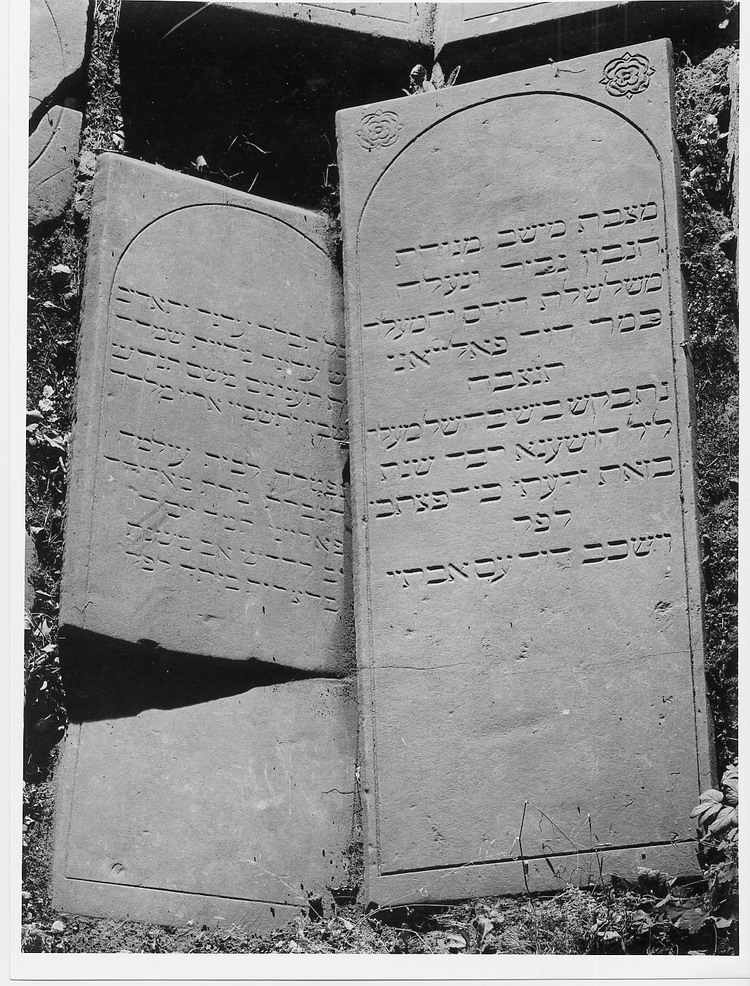
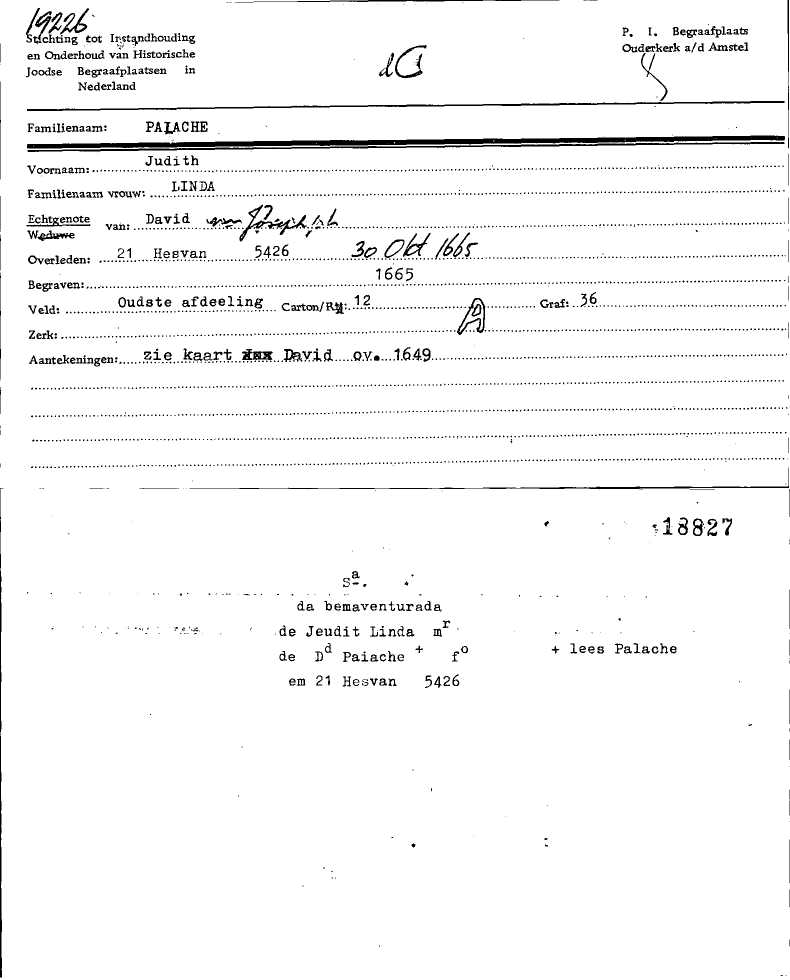
The Pallache brothers and their sons did not marry members of the Portuguese Sephardic community in the Netherlands. "It seems significant that no male member of the Pallache family ever married a woman from the Portuguese community... it is surely significant that neither Samuel nor any of his heirs were ever to marry into the great trading families of 'the Portuguese nation'."[5] In September 2016, however, two 1643 marriage certificates were discovered for David Pallache (1598–1650[16][17][18]) and Judith Lindo (??? – October 30, 1665[19][20]) of Antwerp, daughter of Ester Lindo[21][22] In 1646, Samuel Pallache (1616–???), son of Isaac Joseph Pallache and nephew of David Joseph Pallache, married Abigail (born 1622), sister of Judith Lindo.[23][24][25]
Turkey
The first reported Pallache in Turkey (then, the Ottoman Empire) dates to 1695, when Isaac Pallache of Leghorn (Livorno, Italy) wrote a letter to the Dutch consul in Smyrna (1695)[5][15]
The Pallache appear in Izmir (then, "Smyrna") no later than the time of rabbi Jacob Pallache, who married the daughter of a grand rabbi Joseph ben Hayyim Hazan.[26] Jacob's son became grand rabbi Haim Palachi (1788–1868), two of whose sons, Abraham (1809–1899) and Isaac, or Rahamim Nissim (1814–1907), also became grand rabbis there.
According to the Encyclopedia of Jews in the Islamic World:
The Pallache... produced several leading rabbinical scholars in the Ottoman city of Izmir (Smyrna) during the nineteenth and early twentieth centuries. Two of them, Hayyim ben Jacob and his sone Abraham, served as chief rabbi (hakham bashi) and became the focus of a fierce dispute that engulfed the town's Jewish community, while a third, Soloman ben Abraham, contributed to its decline.[3]
In 1863, a London-based Jewish newspaper noted "the chief rabbi of Smyrna, Palacci, a venerable, octogenarian, seems to command universal respect".[27] In 1868, Die Deborah (part of The American Israelite) reported a gather of four rabbis who unanimously supported the wish of the late Abraham Palacci that his son (son not named) be appointed in his place.[28] In 1872, the Bulletin de l'Alliance Israélite Universelle reported on a "real famine" for which relief was sent to Chief Rabbi Palacci to distribute.[29] In early 1873, the name of Haim Nissim Palacci appears as treasurer in Smyrna of the Alliance Israélite Universelle.[30] In mid-1873, the Universal Israelitish Alliance of Paris and the Anglo-Jewish Association of London agreed to establish a school for Jewish boys and girls in Smyrna under the guidance of Dr. Palacci, Chief Rabbi of Smyrna.[31] In 1891, a newspaper reported the a "good likeness" of chief rabbi Abraham Palacci was on its way from Smyrna to Istanbul as part of books sent there.[32] In 1893, a newspaper reported that the importance of a grand rabbi Palacci (which one, unspecified), aided by his son Nissim Palacci.[33]
The Pallache continued in Turkey past the 1922 great fire of Smyrna; some left during Allied evacuation during World War II and were murdered during the Holocaust.[34]
Egypt
No later than the close of the 19th century, a branch of the Pallache family had settled in Egypt, with some remaining in Cairo into the 1950s.
Which members of the family had what foreign citizenship is as yet undetermined, e.g., Spanish under the Decree-Law of 29 December 1948.[35] Neither "Palacci" nor variations on the surname appear in either the Egyptian or Greek lists.
Palacci department store
In 1897, Palacci brothers Vita, Henri, and family established the Palacci[36] (Arabic: Balaatshi) department store.[15][37] In 1904, the company's name was Palacci Menasce et Fils.[38] Shortly thereafter, it had become Palacci Fils, Haim et Cie,[39] located on Muski street near the old Opera House.[37] By 1907, Vita Palacci had become head of the store.[40] Also in 1907, newspapers mentions "Mr. Vita Pallacci, the distinguished chief of the house of Palacci Pils, Halm and Co., which is well known in Europe and America" as president of the "Ahemia Society".[41][42] By 1909, the Palacci had partnered with A. Hayam,[37] and the store employed 20 office clerks and more than 100–120 sales staff.[37][43] In 1910, "Albert Palacci & Co." appears as a Cairo firm interested in trading in silk.[44] At an unclear date, "Palacci, Menasce & Co." are recorded as having stores in Cairo, Tanta, and Mansoura.[45]
In 1916, "Palacci, Fils, Haym, and Co." were listed among "persons who have been granted licenses to trade in Egypt, with the British Empire, and with Allies of Great Britain".[46] The same year, "Palacci Fil, Haim & Co." filed a suit against "Mohamed Moh. Sélim".[47]
When Vita died in 1917, his oldest son Albert Vita Palacci succeeded as manager.[48][49] The store had offices overseas in Paris (1922) to purchase draperies and hardware, while its Cairo offices exported household essentials and perfumes.[50] By the mid-1920s, Palacci had branches on Fuad Street and in Heliopolis.[37]
In 1925, the Palacci partook in a "Gran Corso Carnivalesque" in Cairo, organized by the International Union of Commercial Establishment Employees of Cairo, along with 24 other department stores.[51][37]
By November 1926, it added a new location in Heliopolis.[52][53] By 1927, it had begun to advertise seasonally[54] or special occasions like weddings,[55] school supplies,[56] carpets,[57] brass beds,[58] shirts, ties, and false collars.[57] In 1928, it dropped Heliopolis as its second location[59] but restored a more French version "Palacci Haym & Cie" as well as the second store in Heliopolis[60] (alternate version "Palacci Haim & Cie.") in the first quarter of 1929,[61] reverting again to "Palacci Haym & Co."[62]
In 1933, the family of Mahmoud Abel Bak El Bitar had a lawsuit against "Pallaci, Haym & Co."[63] By 1935, the Palacci department store had experienced financial difficulties.[64]
In August 1937, the original department store of les "Grand Magasins" Palacci, Haym & Co. on Mouski Street burned; the family did not rebuild.[64][65]
The 1948 Cairo bombings, which included the Ades and Gattegno stores, did not deter the family; both Albert Vita Palacci and Dr. Victor Palacci appear in a 1955 Who's Who for Egypt,[66] while Henry Menahem Palacci in Cairo appears in the mid-1950s (along with an Albert Palacci in Belgium).[67] By the time Nasser had nationalized all Jewish-owned assets in Egypt (1958), most Palacci had left Cairo in diaspora–yet "Palacci Fils, Hayem et Cie." remained listed as a business in Cairo as late as 1959.[68]
Ahemia Society
As community leaders, the Palacci supported Jewish causes inside and outside Egypt. In 1907, Vita Palacci was serving as president of la société de bienfaisence a "Hachemia" (from Hebrew Hakham: הכם ḥaḵam, "wise"?):
In 1901, a Jewish mutual aid society was founded in Cairo called the "Hachemia." This institution, which is a charitable organization for Turkish [Ottoman] Jews residing in Egypt, is making positive advances. Since the last fiscal year, Hachemia has provided medical care to a thousand visiting patients at the rate of one piaster (0.25 French francs) per visit, not including patients cared for and covered by Hachemia in several hospitals in Cairo and Alexandria... Last year, Baron Edmond de Rothschild, during his last visit to Cairo, donated 3,000 francs. In 1901, Baroness de Rothschild made a gift in the same amount. The committee leadership of Hachemia is composed of prominent people of Cairo. Mr. Vita Palacci, the distinguished head of the major commercial house Palacci Sons, Haim and Co., well known in Egypt and in Sudan, is the current and committed president of Hachemia. Among the other members of the leadership are: Dr. Beneroya, the editor of the newspaper "La Vara"; Mr. Talvi, an engineer at the Ministry of Public Works, etc.; Dr. Amster, doctor administering health services; and Dr. Isaac J. Levy of Alexandria, doctor at the Jewish Community Menascé Hospital, of Anti-Tuberculosis League, and the Alexandria Municipality. The latter two are honorary members theoretically, actively, and practically.[69]
During 1916–1917, "Palacci Fils, Haym & Co." was one of numerous donors in Egypt to the "Yeshibat Erez Israel (Rabbinical Institution) for the Refugee Rabbis from the Holy Land". This group collected 120,427.5 PT (piasters), routed to its treasurer, E. Anzurat. Donors were from Alexandria, Cairo, "suburbs," England, Australia, Canada, S. Africa, India, France, and the U.s.. The local collector in Cairo was Rabbi Haim Mendelof. The Palacci donated 500 PT, as did Maurice Calamari, I.M. Cattaui & Fils, Le Fils de M. Cicurel, Jaques & Elie Green.[70]
Cairo residences
The Pallache family settled around the main home of Vita Palacci, a villa ("Palacci-Naggar-Ades Building") at No. 23 Ahmed Basha Street (Ahmad Pasha Street) in Garden City, Cairo.[71][72][73][74] Two of Vita Palacci's grandchildren, Eddy and Colette, have written memoirs of their childhoods in Cairo (and Paris), which document Sephardic Jewish life in Cairo in the 1930s.[64][65][72]
Alexandria
Pallache also settled in Alexandria. "Mordahai Palacci-Miram was likewise a Sephardi but from Constantinople, when he married Rosa Alterman, an Ashkenazi of German origin. Several of their children were born in Constantinople... but to escape an outbreak of plague came to Alexandria..." A "Ventura Palacci-Miram" is also mentioned.[75]
Congo venture: La Coupole
In the mid-1940s, Henri Palacci founded "La Coupole" store in Leopoldville, (now Kinshasa) Belgian Congo.
Other countries
The Pallache had established themselves in Jamaica by the 19th century in the sugar trade. In 1825, the London Gazette posted notice of a partnership that included Mordecai Palache and Alexander Palache "of Kingston, in the Island of Jamaica."[76] A "Charles, son of Mordechai Palache" is recorded in 1847.[77] A prominent Palace at this time was the Honorable John Thomson Palache.[78][79][80]
By 1855, a "Vita Palacci" appears in Argentina.[81]
In 1911, Camille Palacci, daughter of the late Aaron Palacci, married Benjamin Bigio in Manchester, U.K.[82]
21st century
Continued expulsions and diaspora have dispersed the Pallache family to many countries in the Americas, Europe, and farther afield.
By the 20th century, the Pallache established itself within the U.S. The family of American mineralogist Charles Palache came to California from Jamaica.[10][83] His descendants include Judith Palache Gregory, a writer, counselor, educator, and permaculturalist.
Numerous Palacci came to the United States in diaspora from Turkey and Egypt, including Colette Rossant.
Synagogues
Netherlands
Samuel Pallache may have helped found the first synagogue in Amsterdam.[15][84] As early as 1769, David Franco Mendes records a first minyan in Amsterdam with sixteen worshippers, including Samuel and Joseph Pallache.[85][86] Other sources go further to claim that this first minyan occurred in Palache's home, as they were envoys from Morocco[87][88] and occurred around 1590[89] or Yom Kippur 1596.[90][91] However, Professors García-Arenal and Gerard Wiegers[92] point out that the Pallache brothers arrived in Amsterdam in the 1600s decade.[5]
Turkey
Around 1840, the Pallache home in Smyrna became today's Beth Hillel Synagogue and seat of a yeshiva or beit madras. The synagogue lies in the Kemeraltı marketplace district in Izmir and is named after Haim or Abraham Palacci. Professor Stanford J. Shaw stated it was Haim who founded the Beth Hillel Palacci[93] or his son Abraham. According to Jewish Izmir Heritage, "In the 19th century, Rabbi Avraham Palache founded in his home a synagogue named Beit Hillel, after the philanthropist from Bucharest who supported the publication of Rabbi Palache's books. However, the name 'Avraham Palache Synagogue' was also used by the community."[94] This synagogue forms a cluster of eight extant (from a recorded peak of 34 in the 19th century), all adjacent... [making] Izmir is the only city in the world in which an unusual cluster of synagogues bearing a typical medieval Spanish architectural style is preserved ...[and] creating an historical architectural complex unique in the world."[95] The Zalman Shazar Center also refers to Beit Hillel synagogue as "Avraham Palaggi's synagogue" but then states that "the synagogue was founded by Palaggi Family in 1840" and that Rav Avraham Palaggi "used" it. "The building had been used as a synagogue and a Beit Midrash. The synagogue has not been used since 1960's."[96]
Egypt
The Palaccis were one of many families that helped maintain the Sephardic Sha'ar Hashamayim Synagogue (Cairo) on Adly Street in downtown Cairo.[97]
Yeshivas
Turkey
Journey into Jewish Heritage states that Haim Palacci founded the Beit Hillel Yeshiva in Izmir in the middle of the 19th century.[98] Current sources are unclear, but it is likely the same as the Beit Midrash mentioned above.[96]
Israel
A seminary was named in Haim Palachi's honor in Bnei Brak, Israel.[3]
Documented spellings of surname
As the Pallache settled in new cities with new languages, spellings of the surname changed. Sometimes, the families themselves voluntarily changed their surnames while at other times changes occurred via officialdom. In the 20th century, Turkish officials forced all nationals to adopt surnames under the 1934 Surname Law.
Variations on the Pallache name appear on both Spanish and Portuguese lists of Sephardic names. For instance, "Palacci" is listed as Spanish Sephardic,[99] while "Pallache" is listed as Portuguese Sephardic.[100]
Samuel Pallache's name appeared in several forms–including variations that he himself used.[101] A German Vierteljarhschrift mentions both "Duarte de Palacios" and "Duarte Palache" when referring to the same person, thus making direct equation between the names "de Palacios" and "Palache."[102]
Family tree
16th–17th centuries in Morocco and the Netherlands
- Moïse Al Palas (???–1535)[14][15]
- Isaac Pallache(???–1560[15]), rabbi of Fez[103]
- Isaac Uziel (???-1622), rabbi, nephew of Isaac Palacche
- Samuel Pallache (ca. 1550–1616), envoy and dragoman of Morocco[15][103]
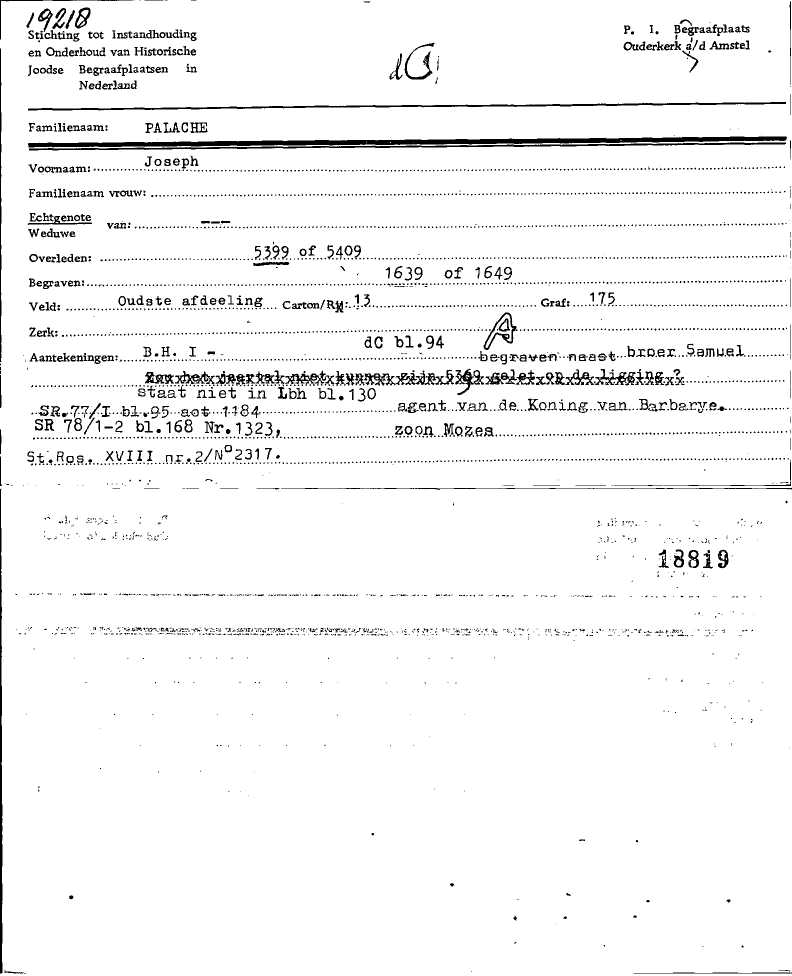
- Joseph Pallache (ca.1552-1638/1639/1649), envoy and dragoman of Morocco[15][103][104][105]
- Isaac Palache, envoy of Morocco to the Ottoman Sultan, later broker in Amsterdam, later served sultan of Morocco (1647)[5][103]
- Yehoshua Pallache (Joshua), co-envoy of Morocco to Poland, tax collector of Salé, Morocco[103]
- Manasseh ben Samuel, helped gain the 1656 return of Jews to England from Oliver Cromwell[15]
- David Pallache (1598–1650?), envoy of Morocco to King Louis XIII of France, envoy and dragoman of Morocco , and business partner of Michael de Spinoza (father of Baruch Spinoza)[106][103][107][108]
- Moses Pallache(???–1650[15]), advisor to four sultans of Morocco: Muley Zaydan, Muley Abd al-Malik , Muley al-Walid, and Muley Muhammad al-Shakh al-Saghir[103]
- Abraham Palacci, 17th century merchant to Safi, Morocco[103]
17th–20th centuries in the Netherlands
- Judah Pallache
- Isaac Juda Palache (1858–1927), grand rabbi of Amsterdam, bet din from 1885[15][103][109]
- Juda Lion Palache (1886–1944), professor of Oriental languages at the University of Amsterdam[15][103][110]
- Isaac Juda Palache (1858–1927), grand rabbi of Amsterdam, bet din from 1885[15][103][109]
17th–20th centuries in the Ottoman empire
- Isaac Pallache of Leghorn (Livorno, Italy) and later Izmir[5][15][103]
- Samuel Palacci, died 1732[111]
- Jacob Pallache (ca. 1755–1828), 18th century rabbi
- Isaac Palacci, brother of Haim[111]
- Salomon Palache[103]
- Hayyim Pallache (Palagi) (1788–1869), hakham bachi (1858), grand rabbi and kabbalist,[15][103] member of Communal Council in Istanbul, died February 9, 1869[111]
- Abraham Palacci (1809–1899), grand rabbi,[15][103] funded for Beit Hilel yeshiva 1840, chief rabbi 1869, died 1899[111]
- Isaac Palacci, son of Haim[111] a.k.a. Rahamim Nissim Palacci (1813–1907), grand rabbi and author[111]
- Joseph Palacci (1819–1896), rabbi and author[103][111]
- Benjamin Palacci 1890, later rabbi in Izmir[111]
- Hilel Palacci, member of Izmir communal council 1929–1933[111]
- Jacob Palacci, director of choir Choeur des Maftirim in Istanbul 19th–20th century[111]
- Nissim Palacci, helped Jewish Hospital Istanbul early 20th century, member of Galata community committee 1928–1931, member Haskeuy community committee 1935–1939[111]
19th–20th centuries in Egypt
- Vita Palacci (ca. 1865–1917[48]), left Izmir for Cairo, co-founded Palacci department store[38][39]
- Henri Palacci, brother of Vita, left Izmir for Cairo, traded in chemical products in Egypt and Sudan[15]
- Menahem Palacci, cofounded Palacci department store in Cairo, helped Jews in Egypt become Egyptian citizens in 1922[15]
17th–20th centuries elsewhere
- Jacob Pallache, 17th century rabbi of Marrakesh and later Egypt[5]
- Abraham Pallache, 18th century rabbi in the Ottoman Empire[103]
- Abraham Pallache, 19th century rabbi in Morocco[103]
- Samuel Pallache, 18th century rabbi in the Netherlands[103]
- Moshe Samuel Palache (???-1859), rabbi in Jerusalem[103]
- Palache of Jamaica and USA[103][116]
- James Palache (1834–1906)
- Whitney Palache (1866–1949)[83]
- James Palache (died 1918)[117]
- John Garber Palache
- Charles Palache (1869–1954)[10]
- Alice Palache Jones (1907–1989)
- Mary Palache Gregory
- Judith Palache Gregory (1932–2017)
- Whitney Palache (1866–1949)[83]
- James Palache (1834–1906)
- Palatchi whose branches moved from Turkey to Spain or Latin America:
- Spain: Alberto Palatchi
- Argentina: Gabriel Palatchi Henri Palacci/Palatchi (1898–???), deported from Istanbul to France in 1942[34]
- Isaac Palacci/Palatchi (1900–???), deported from Istanbul to France in 1942[34][34]
Holocaust victims
- Sarah Palatchi (1904 – 1944), born Sarah Kabili in Turkey, deported to Drancy internment camp in France, murdered in Auschwitz.[118][119]
- Mordecai Palatchi/Palacci (1903–1942), born in Turkey and deported to Drancy internment camp
- David Palachi (1905 – 1943), born in Algeria, deported to Nice, sent in 1943 to Auschwitz and murdered.[120][121]
- Jean Palatchi (1926 – ???), deported to Drancy internment camp; survived the Holocaust.[122][123]
- Bella Palatsi (1896 – 942), born in Greece, deported to Drancy, sent in 1942 to Auschwitz and murdered.[124][125]
- Maurice Palatsi (1923 – 1944), born in France, fight on Tulle, France, and murdered.[126][127]
- Famille Palatsi.[128]
See also
- Pallache (surname)
- Isaac Pallache
- Cristina (singer), daughter of Jacques Palaci
Notes
- ^ This entry uses "Pallache" as an unifying name, based on scholarly preference, particularly three (3) entries for "Pallache" in Brill's Encyclopedia of Jews in the Islamic World[2][3][4] and the scholarly historical biography A Man of Three Worlds: Samuel Pallache, a Moroccan Jew in Catholic and Protestant Europe.[5]
References
- ^ a b García-Arenal, Mercedes (2013). "L'estompe des identités en situation de conversion. Isaac Palache, un converti insincère?". Les musulmans dans l'histoire de l'Europe: Passages et contacts en Méditerranée. Éditions Albin Michel. pp. 35–60. Retrieved 12 August 2020.
- ^ a b c d García-Arenal, Mercedes (2010), "Pallache Family (Moroccan Branch)", in Stillman, Norman A. (ed.), Encyclopedia of Jews in the Islamic World, vol. 4, Brill
- ^ a b c Lewental, D Gershon (2010), "Pallache Family (Turkish Branch)", in Stillman, Norman A. (ed.), Encyclopedia of Jews in the Islamic World, vol. 4, Brill
- ^ Ben Naeh, Yaron (2010), "Pallache, Ḥayyim", in Stillman, Norman A. (ed.), Encyclopedia of Jews in the Islamic World, vol. 4, Brill, pp. 38–39
- ^ a b c d e f g h i j García-Arenal, Mercedes; Wiegers, Gerard (2007). A Man of Three Worlds: Samuel Pallache, a Moroccan Jew in Catholic and Protestant Europe. Johns Hopkins University Press. pp. 12 (background, surname), 101–127 (descendants). doi:10.1353/book.14092. ISBN 9780801895838.
- ^ Wallach, Shalom Meir (1996). Ben Ish Chai Haggadah. Feldheim Publishers. pp. 11 ("And the Lion of the gaonim, the elderly Gaon Chaim Palaji of Izmir"). doi:10.1353/book.14092. ISBN 9780801895838.
- ^ "Edict of the Expulsion of the Jews (1492)". Foundation for the Advancement of Sephardic Studies and Culture. Retrieved 16 September 2016.
- ^ Pérez, Joseph (2009). History of a Tragedy. p. 17.
- ^ "Mercedes García-Arenal Rodríguez". Centro de Ciencias Humanas y Sociales. Retrieved 13 September 2016.
- ^ a b c Daly, Reginald A. (1957). "Charles Palache, 1869—1954: A Biographical Memoir" (PDF). Washington: National Academy of Sciences. Retrieved 16 September 2016.
- ^ "Giovanna Fiume". University of Palermo. Retrieved 13 September 2016.
- ^ Fiume, Giovanna (2012). Schiavitù mediterranee. Corsari, rinnegati e santi di età moderna. Milan: Bruno Mondadori. ISBN 9788861595606. Retrieved 4 September 2016.
- ^ Abecassis, José Maria (1990). Genaolgia Hebraica: Portugal e Gibraltar. Sociedade Industrial Gráfica Telles da Silva. pp. 555–558. ISBN 9789729542909. Retrieved 22 July 2017.
- ^ a b "Palache". Jewish Virtual Library. Retrieved 1 September 2016.
- ^ a b c d e f g h i j k l m n o p q Rahmani, Moïse (December 1990). "Les Patronymes: une histoire de nom ou histoire tout court" [A Story of a Name or a Short History] (PDF). Los Muestros (in French). Sefard (Institut Sephardi Europeen): 32. Retrieved 11 September 2016.
- ^ "Amsterdam – Burials of the Portuguese Israelite Congregation – Palache, David". Dutch Jewry. Archived from the original on 16 September 2016. Retrieved 20 October 2016.
- ^ "Amsterdam – Burials of the Portuguese Israelite Congregation – Archive # 19178 Palache, David". Dutch Jewry. Retrieved 20 October 2016.
- ^ "Amsterdam – Burials of the Portuguese Israelite Congregation – Image Palache, David". Dutch Jewry. Retrieved 20 October 2016.
- ^ "Amsterdam – Burials of the Portuguese Israelite Congregation – Palache, Judith Linda". Dutch Jewry. Archived from the original on 21 October 2016. Retrieved 20 October 2016.
- ^ "Amsterdam – Burials of the Portuguese Israelite Congregation – Archive # 19226 Palache, Judith Linda". Dutch Jewry. Retrieved 20 October 2016.
- ^ "Amsterdam – Traditional Sephardic marriages – David Palache and Judith Lindo". Dutch Jewry. Archived from the original on 18 January 2017. Retrieved 8 September 2016.
- ^ "Amsterdam – Traditional Sephardic marriages – David Palache and Judith Lindo". Dutch Jewry. Archived from the original on 18 January 2017. Retrieved 8 September 2016.
- ^ "Amsterdam – Traditional Sephardic marriages – Samuel Palache and Abigael Lindo". Dutch Jewry. Archived from the original on 16 September 2016. Retrieved 8 September 2016.
- ^ a b Baddel, Benedict (24 April 1642). Notarial Deed of 24 April 1642 (Report). CAA Notarial Archives 957.
- ^ Pallache, Samuel; Lindo, Abigail (16 January 1642). Marriage Register of 16 January 1642 (Report). CAA Notarial Archives 334, PJC 19. p. 207.
- ^ Hazan, G. Ender (2015). Hazan Genealogy: "Aaron De Yoseph Hazan – Izmir Jews 1600–2000. Lulu. p. 32. ISBN 9781329133594. Retrieved 13 September 2016.
- ^ "Constantinople – Differences". The Jewish Chronicle. 13 February 1863. p. 7. Retrieved 7 November 2021.
- ^ "Smhyrna". The Debora. 4 December 1868. p. 87. Retrieved 7 November 2021.
- ^ "Divers". Bulletin de l'Alliance Israélite Universelle. 1 July 1872. p. 5. Retrieved 8 November 2021.
- ^ "Comités Nouveaux et Renouvellés – Smyrne". Bulletin de l'Alliance Israélite Universelle. 1 July 1872. p. 213. Retrieved 8 November 2021.
- ^ "Smyrna". The Jewish Chronicle. 25 July 1873. p. 282. Retrieved 7 November 2021.
- ^ "Smyrna". The Jewish Voice. 8 May 1891. p. 8. Retrieved 14 November 2021.
- ^ "IV. Israelites de Turquie". Bulletin de l'Alliance Israélite Universelle. 2 January 1893. p. 40. Retrieved 14 November 2021.
- ^ a b c d Klarsfeld, S. (1978). "Mémorial de la Déportation des Juifs de France 1942–1945" (PDF). Paris. Retrieved 12 September 2016.
- ^ "Decreto-Ley de 29 de Deciembre de 1948" (PDF). Ministerio de la Presidencia del Gobierno de España: Agencia Estatal Boletín Oficial del Estado (BOE). 19 January 1949. Retrieved 16 October 2016.
- ^ Gutkowski, Hèléne (1999). Erase una vez... Sefarad. Lumen. p. 394. ISBN 9789507248740. Retrieved 20 September 2016.
- ^ a b c d e f Reynolds, Nancy (2012). A City Consumed: Urban Commerce, the Cairo Fire, and the Politics of Decolonization in Egypt. Stanford University Press. pp. 53–55 (prominence, competitors), 61–62 (founding, Hayam, size), 224. ISBN 9780804782661. Retrieved 29 August 2016.
- ^ a b Japan Weekly Mail. Yokohama: (unknown). 1904. p. 359. Retrieved 29 August 2016.
- ^ a b Special Consular Reports. U.S. Government Printing Office. 1915. p. 180. Retrieved 29 August 2016.
- ^ Archives israélites, Volume 68 (in French). Bureau des Archives israélites. 1907. p. 380. Retrieved 29 August 2016.
- ^ "November 15 1907 archive". The Jewish Chronicle. 15 November 1907. p. 10. Retrieved 26 October 2016.
- ^ "The 'Ahemia Society'". The Hebrew Standard. 13 December 1907. p. 7. Retrieved 14 November 2021.
- ^ Atabaki, Touraj; Brockett, Gavin (2009). Ottoman and Republican Turkish Labour History. Cambridge University Press. p. 98. ISBN 9780521128056. Retrieved 16 September 2016.
- ^ "Egypt a Promising Market for Silk Goods". Silk, Volume 4. 1910. p. 36. Retrieved 20 September 2016.
- ^ Le Brun, Annie (1994). 20,000 lieues sous les mots, Raymond Roussel (in French). Jean-Jacques Pauvert. p. 188. ISBN 9780521128056. Retrieved 20 September 2016.
- ^ Great Britain and the East, Volume 12. 1916. p. 214. Retrieved 20 September 2016.
- ^ Lebsohn, Théodore; Palagi, Dario; Rensis, A.; Schiarabati, A.; Grandmoulin, J. (1916). Bulletin de législation et de jurisprudence égyptiennes (in French). V. Penasson. pp. xv. Retrieved 20 September 2016.
- ^ a b Gazette des tribunaux mixtes d'Égypte : revue judiciaire mensuelle, numéros 7–8 (in French). Impr. A. Procaccia. 1917. p. 183. Retrieved 29 August 2016.
- ^ Gazette des tribunaux mixtes d'Égypte, Volume 7 (in French). Molco, Petrini & Company. 1917. p. 183. Retrieved 29 August 2016.
- ^ International Trade Developer: Propagador de Comercio Internacional (in Portuguese). International trade Developer. 1922. pp. 90 (Paris), 108 (Paris), 111–113 (Cairo), 147 (Cairo). Retrieved 29 August 2016.
- ^ Beinin, Joel (1998). The Dispersion of Egyptian Jewry: Culture, Politics, and the Formation of a Modern Diaspora. Los Angeles: University of California Press. p. 44. ISBN 0-520-21175-8.
- ^ "(Advertisement for Palacci, Haym & Co.)" (in French). Cairo / Alexandria / Istanbul: L’Aurore ; journal d’informations juives. 19 November 1926. p. 3. Retrieved 14 November 2021.
- ^ "(Advertisement for Palacci, Haym & Co.)" (in French). Cairo / Alexandria / Istanbul: L’Aurore ; journal d’informations juives. 18 March 1927. p. 4. Retrieved 14 November 2021.
- ^ "(Advertisement for Palacci, Haym & Co.)" (in French). Cairo: Israël : hebdomadaire national juif indépendant. 18 November 1927. p. 3. Retrieved 14 November 2021.
- ^ "(Advertisement for Palacci, Haym & Co.)" (in French). Cairo: Israël : hebdomadaire national juif indépendant. 2 December 1927. p. 3. Retrieved 14 November 2021.
- ^ "(Advertisement for Palacci, Haym & Co.)" (in French). Cairo / Alexandria / Istanbul: L’Aurore ; journal d’informations juives. 6 September 1928. p. 3. Retrieved 14 November 2021.
- ^ a b "(Advertisement for Palacci, Haym & Co.)" (in French). Cairo: Israël : hebdomadaire national juif indépendant. 9 December 1927. p. 3. Retrieved 14 November 2021.
- ^ "(Advertisement for Palacci, Haym & Co.)" (in French). Cairo: Israël : hebdomadaire national juif indépendant. 16 December 1927. p. 3. Retrieved 14 November 2021.
- ^ "(Advertisement for Palacci)" (in French). Cairo: L’Aurore ; journal d’informations juives. 6 September 1928. p. 3. Retrieved 14 November 2021.
- ^ "(Advertisement for Palacci)" (in French). Cairo: L’Aurore ; journal d’informations juives. 14 March 1929. p. 3. Retrieved 14 November 2021.
- ^ "(Advertisement for Palacci)" (in French). Cairo: L’Aurore ; journal d’informations juives. 24 January 1929. p. 3. Retrieved 14 November 2021.
- ^ "(Advertisement for Palacci, Haym & Co.)" (in French). Cairo: Israël : hebdomadaire national juif indépendant. 22 March 1929. p. 3. Retrieved 14 November 2021.
- ^ Lebsohn, Théodore; Palagi, Dario; Rensis, A.; Schiarabati, A.; Grandmoulin, J. (1933). Bulletin de législation et de jurisprudence égyptiennes, Volumes 45–46 (in French). pp. xvii. Retrieved 20 September 2016.
- ^ a b c d e f Palacci, Eddy (2012). Des étoiles par cœur (in French). Elzevir. pp. 13–14 (difficulties). Archived from the original on 10 May 2017. Retrieved 13 September 2016.
- ^ a b Dammond, Liliane S. (2011). The Lost World of the Egyptian Jews: First-person Accounts from Egypt's Jewish Community in the Twentieth Century. iUniverse. pp. 210 (department store), 211 (Garden City), 215 (store burns). ISBN 9780595399307. Retrieved 16 September 2016.
- ^ Blattner, James Elwyn (1955). Who's who in U.A.R and the Near East. Paul Barbey Press. p. 555. Retrieved 16 September 2016.
- ^ Sanua, Victor D. (2005). Egyptian Jewry: guide to Egyptian Jewry in the mid-fifties of the 20th century : the beginnings of the demise of a vibrant Egyptian Jewish community. International Association of Jews from Egypt. p. 109 (Albert Palacci), 127 (Henry Palacci, son of Menahem). ISBN 9780976322641. Retrieved 16 September 2016.
- ^ Marconi's International Register. Telegraphic Cable & Radio Registrations. 1959. p. 992. Retrieved 16 September 2016.
- ^ Galante, Abraham (27 October 1907). "Correspondance Particulière des " Archives "" (in French). Paris: Archives Israélites: Recueil Politique et Religieux (Volume 68). p. 380. Retrieved 26 October 2016.
- ^ "Financial Report No. 3" (PDF). Yeshibat Erez Israel (Rabbinical Institution) for the Refugee Rabbis from the Holy Land. 1917. pp. 6–12 (Alexandra), XX (Cairo), 23 (Palacci). Retrieved 26 October 2016.
- ^ Rossant, Colette (1999). Memories of a Lost Egypt. Clarkson Potter. pp. 2–3 (photo of Vita Palacci), 19 (Palacci agencies), 30 (Garden City villa), 33 (Ladino) 48–51 (recipes – all over book), 70–76 (marriages). Retrieved 13 September 2016.
- ^ a b c d e f Rossant, Colette (2004). Apricots on the Nile: A Memoir with Recipes. Atria. pp. 2–3 (photo of Vita Palacci), 19 (Palacci agencies), 30 (Garden City villa), 33 (Ladino) 48–51 (recipes – all over book), 70–76 (marriages). ISBN 9780743475617. Retrieved 13 September 2016.
- ^ Raafat, Samir (6 August 1998). "Garden City: A Retrospective, Part I". Retrieved 29 August 2016.
- ^ Raafat, Samir (6 August 1998). "Garden City: A Retrospective, Part 5". Retrieved 19 September 2016.
- ^ Haag, Michael (2004). Alexandria: City of Memory. Yale University Press. p. 232 (Mordahai Palacci-Miram), 347 (Ventura Palacci-Miram). ISBN 9780976322641. Retrieved 16 September 2016.
- ^ Neuman, T. (1825). The London Gazette, Part 2. p. 1204. Retrieved 13 September 2016.
- ^ Yoffe, Oron (1997). The Jews of Jamaica: tombstone inscriptions, 1663–1880. Ben Zvi Institute. pp. 73, 165, 169. ISBN 9789652350688. Retrieved 13 September 2016.
- ^ Bryan, Patrick E. (2000). The Jamaican People, 1880-1902: Race, Class, and Social Control. University of the West Indies Press. ISBN 9789766400941. Retrieved 13 September 2016.
- ^ The Handbook of Jamaica. 1906. Retrieved 13 September 2016.
- ^ The Handbook of Jamaica. 1908. Retrieved 13 September 2016.
- ^
Revisit Del Río de La Plata, Issues 1831–1855. Argentina. 1917. p. 24. Retrieved 16 September 2016.
{{cite book}}: CS1 maint: location missing publisher (link) - ^ "Marriages". The Jewish Chronicle. 21 July 1911. p. 2. Retrieved 7 November 2021.
- ^ a b "Palache family. Papers of the Palache family, 1839–2006 (inclusive), 1895–1988 (bulk)". Harvard University. March 2006. Retrieved 16 September 2016.
- ^ "The Palache Family from Almeria and Cordova, Spain & Fez, Morocco c.1510". Tzora Folk. Retrieved 13 September 2016.
- ^ Henriques Castro, David (1875). 1675–1875: De synagoge der Portugeesch-Israelietische gemeente te Amsterdam. Belinfante. p. 5. Retrieved 1 September 2016.
- ^ Brasz, Chaya; Kaplan, Yosef, eds. (2001). Dutch Jews As Perceived by Themselves and by Others: Proceedings of the Eighth International Symposium on the History of the Jews in the Netherlands. Brill. p. 67. ISBN 9004120386.
- ^ Kurlansky, Mark (2008). A Chosen Few: The Resurrection of European Jewry. New York: Random House. p. 82. ISBN 9780307482891. Retrieved 31 August 2016.
- ^ Skolnik, Frank; Berenbaum, Michael, eds. (2007). Encyclopaedia Judaica, Volume 15. Macmillan Reference. p. 573. ISBN 9780028659435.
- ^ Kritzler, Edward (2009). "Jewish Pirates of the Caribbean". Penguin Random House. pp. 10 (background), 75–92 (chapter). Retrieved 1 September 2016.
- ^ Henriques Castro, David (1999). Keur van grafstenen op de Portugees-Isräelietische begraafplaats te Ouderkerk aan de Amstel met beschrijving en biografische aantekeningen: met platen. Stichting tot Instandhouding en Onderhoud van Historische Joodse Begraafplaatsen in Nederland. pp. 36 (first minyan), 91–93. ISBN 9789090128290. Retrieved 1 September 2016.
- ^ Fendel, Zechariah (2001). Lights of the Exile. Hashkafah Publications. pp. 45–46. ISBN 9781583302125. Retrieved 1 September 2016.
- ^ "dhr. prof. dr. G.A. (Gerard) Wiegers". University of Amsterdam. Retrieved 13 September 2016.
- ^ Shaw, Stanford J. The Jews of the Ottoman Empire and the Turkish Republic. p. 67 (synagogue), 170, 173–175 (dispute), 180, 183.
- ^ "Beth Hillel Synagogue". Izmir Jewish Heritage. Retrieved 2 September 2016.
- ^ "Synagogues". Izmir Jewish Heritage. Retrieved 2 September 2016.
- ^ a b "Index Card #7 BEIT HILLEL" (PDF). Journey into Jewish Heritage – Zalman Shazar Center. Retrieved 2 September 2016.
- ^ Rafaat, Samir. "Roll-Call of Contributors to the Construction/Maintenance of the Chaar Hachamaim (Adly Street Synagogue)". Historical Society of Jews From Egypt. Archived from the original on 19 September 2016. Retrieved 8 September 2016.
- ^ "Izmir's Jewish Community Book Collection". Journey into Jewish Heritage – Zalman Shazar Center. Retrieved 2 September 2016.
- ^ "Family Names". Historical Society of Jews From Egypt. Retrieved 12 September 2016.
- ^ Abecassis, José Maria. "Genealogia hebraica: Portugal e Gibraltar sécs. XVII a XX". Lisboa: Liv. Ferin. Retrieved 12 September 2016.
- ^ citation pending from A Man in Three Worlds
- ^ Vierteljahrschrift für Sozial- und Wirtschaftsgeschichte: Beihefte, Volumes 40–42. W. Kohlhammer. 1923. pp. 139 ("Duarte de Palacios"), 276 ("Duarte Palache"), 403, 404. Retrieved 14 September 2016.
- ^ a b c d e f g h i j k l m n o p q r s t u v w x Laredo, Abraham Isaac (1978). Les noms des juifs de Maroc: Essai d'onomastique judéo-marocaine. Madrid: Consejo Superior de Investigaciones Científicas – Instituto Arias Montano. pp. 966–971.
- ^ "Burials of the Portuguese Israelite Congregation – Palache, Joseph". Dutch Jewry. Archived from the original on 22 August 2018. Retrieved 8 September 2016.
- ^ "Begraafplaats Ouderkerk a/d Amstel – Palache, Joseph". Dutch Jewry. Retrieved 8 September 2016.
- ^ "Begraafplaats Ouderkerk a/d Amstel – Palache, David". Dutch Jewry. Retrieved 8 September 2016.
- ^ "Burials of the Portuguese Israelite Congregation – Palache, David". Dutch Jewry. Archived from the original on 16 September 2016. Retrieved 8 September 2016.
- ^ "(untitled – gravestone of David Palache)". Dutch Jewry. Retrieved 8 September 2016.
- ^ Gottheil, Richard; Seeligmann, Sigmund. "Amsterdam". Jewish Encyclopedia. Retrieved 8 September 2016.
- ^ "Palache, Judah Lion". Jewish Virtual Library. Retrieved 17 September 2016.
- ^ a b c d e f g h i j k l m "Index for Abraham Galante's Jews of Turkey". SephardicGen. Retrieved 6 September 2016.
- ^ "Clement Palacci". Les Fleurs de l'Orient. 2016. Retrieved 25 December 2016.
- ^ "Clement Palacci". PSS-archi. Retrieved 25 December 2016.
- ^ "Annuaire des Juifs de Juifs d'Egypt" (PDF). Cairo: Sephardic Studies. 1943. p. 321. Retrieved 12 September 2016.
- ^ Fargeon, M. (1938). "Les Juifs en Egypt depuis l'lorigine jusqu'a ce jour (Egypt Jews from the origin till today)" (PDF). Cairo: Sephardic Studies. p. 321. Retrieved 12 September 2016.
- ^ "Births of the Sephardic Congregation – Kingston, Jamaica, West Indies". Jamaican Family Search. Retrieved 12 September 2016.
- ^ "Palache James". US War Memorials. Retrieved 11 November 2018.
- ^ "Sarah Palatchi". The Central Database of Shoah Victims' Names. Yad Vashem. Retrieved 11 December 2021.
- ^ "Palatchi, Sarah". One-Step Webpages by Stephen P. Morse. Retrieved 8 November 2021.
- ^ "David Palachi". The Central Database of Shoah Victims' Names. Yad Vashem. Retrieved 11 December 2021.
- ^ "Palachi, David". One-Step Webpages by Stephen P. Morse. Retrieved 8 November 2021.
- ^ "Jean Palatschi". The Central Database of Shoah Victims' Names. Yad Vashem. Retrieved 11 December 2021.
- ^ "Palatchi, Jean". One-Step Webpages by Stephen P. Morse. Retrieved 8 November 2021.
- ^ "Bella Palatsi". The Central Database of Shoah Victims' Names. Yad Vashem. Retrieved 11 December 2021.
- ^ "Palatsi, Bella". Yad Vashem. Retrieved 8 November 2021.
- ^ "Maurice Palatsi". The Central Database of Shoah Victims' Names. Yad Vashem. Retrieved 11 December 2021.
- ^ "Palatsi, Maurice". Maitron des fusillés et exécutés. Retrieved 8 November 2021.
- ^ "Famille Palatsi". Le Maison Judeo-Espagnole a Paris. Alsyete. Retrieved 11 December 2021.