Nicolai L. Volodos
Nicolai L. Volodos | |
|---|---|
| Born | 15 May 1934 |
| Died | 3 April 2016 (aged 81) |
| Citizenship | USSR, Ukraine |
| Alma mater | Odesa National Medical University |
| Known for | Inventor of the stent graft for the treatment of stenotic and aneurysmal diseases |
| Awards | Order of the Badge of Honour Medal "Veteran of Labour" International Bakoulev Award 2015 The Jörg Vollmar Medal by the Jörg Vollmar Foundation 2014 |
| Scientific career | |
| Fields | Cardiovascular surgery Endovascular surgery |
Nicolai Leontievich Volodos (Nikolay, Nikolai, Nicholas), (Ukrainian: Микола Леонтійович Володось, Russian: Николай Леонтьевич Володось; 15 May 1934 – 3 April 2016) was a Soviet/Ukrainian cardiovascular surgeon and scientist. An innovator, Volodos developed and introduced into clinical practice the world's first endovascular stent graft for the treatment of stenotic and aneurysmal diseases of arterial system.[1] Volodos was described by his colleagues as "a pioneer innovator and a giant in vascular and endovascular surgery"[2] and "a giant of historic proportions in the vascular and endovascular specialties, and the father of endovascular grafting".[3]
Early life
Volodos was born in a small village Kokoshchitsi, near Slonim, Nowogródek Voivodeship (1919–1939), Poland. He was the second of three brothers.
Years of activity
1952–1958 – Medical student at Odesa Medical Institute (currently Odesa National Medical University ), Odesa, Ukraine;
1958–1962 – General surgeon in Hirske, Luhansk Region, Ukraine, then Head of the Department of General Surgery at the Karbonit local hospital in Zolote, Luhansk Region, Ukraine;
1962–1965 – Postgraduate student at the Department of Thoracic Surgery and Anesthesiology, Ukrainian Institute of Postgraduate Medical Education, Kharkiv, Ukraine;
1964–1965 – Head of Ukraine's first Vascular Surgery Department, Kharkiv City Hospital No. 2;
1965–1972 – Head of the Department of Vascular Surgery, Ukrainian Institute for Hemotransfusion and Emergency Surgery (later, the Kharkiv Scientific and Research Institute for General and Emergency Surgery), Kharkiv, Ukraine;
1970 – Assistant at the Department of Thoracoabdominal Surgery, Ukrainian Institute of Postgraduate Medical Education, Kharkiv, Ukraine;
1971 – Ph.D. in medical sciences;
1972–2001 –Head of reorganized Department of Vascular Surgery at the Kharkiv Scientific and Research Institute for General and Emergency Surgery, Kharkiv, Ukraine;
1987 – Doctoral degree in medical sciences;
1992 – Professor at the Department of Cardiology and Functional Diagnostics, Ukrainian Institute for Postgraduate Medical Education, Kharkiv, Ukraine;
1992–2013 – Head of the Kharkiv Center for Cardiovascular Surgery, which Volodos founded in Kharkiv, Ukraine.
Professional achievements
Volodos started his surgical career after graduating in 1958 from the Odesa Medical Institute in Odesa, Ukraine. During 1958–1962, he first worked as a general surgeon in Hirske, Luhansk Region, then as head of the Department of General Surgery at the Karbonit local hospital in Zolote, Luhansk Region. In 1962, Volodos become a postgraduate student at the Department of Thoracic Surgery and Anesthesiology of the Ukrainian Institute of Postgraduate Medical Education in Kharkiv, under the direction of legendary Soviet and Ukrainian surgeon Professor Alexander Shalimov. Under the supervision of Professor Shalimov and following his recommendations, Volodos performed experimental research on roentgenologic contrast examination and surgical treatment of coronary artery disease in dogs.[4][5] That work was the subject of Volodos' Ph.D. thesis.
Shalimov performed many different types of surgery, including general, oncological, vascular, and cardiovascular operations. In 1963, Professor Shalimov established Ukraine's first vascular surgery department at Kharkiv City Hospital No. 2 (renamed after Alexander Shalimov in 2016). And, in 1964, Shalimov appointed Volodos head of the department. In 1965, Shalimov was appointed head of the Ukrainian Institute for Blood Transfusion and Emergency Surgery (later reorganized into the Kharkiv Scientific and Research Institute for General and Emergency Surgery). Volodos followed his mentor and became its head of Vascular Surgery department. In 1972, Shalimov left Kharkiv and moved to Kyiv to establish his new Institute for Surgery and Transplantation (now the Shalimov National Institute for Surgery and Transplantation), and Volodos assumed the role of senior vascular surgeon for the Kharkiv region, as well as Poltava, Sumy and Belgorod. In 1972, Volodos became the first surgeon in the Kharkiv region to perform selective coronary angiography and ventriculography in patients with ischaemic coronary artery disease. Then, in 1974, he was the first to perform an aortocoronary bypass procedure in Kharkiv.
Having been trained by Professor Shalimov, Volodos based his approach to clinical practice on Shalimov's two principles:
- Everything a doctor does should be centered on the needs of the patient.
- If you do not know of a treatment that will help your patient, invent one.
In January 1977, Volodos became the first surgeon in the Soviet Union to perform replantation of the arm after its traumatic transhumeral amputation. The case was described in the central press and became the catalyst for the beginning of microsurgery as a surgical specialty in Soviet medicine. Soon after that, new specialised microsurgical centers were founded in different regions of the Soviet Union.
In that same year, Volodos also performed Ukraine's first successful surgical repair of traumatic rupture of thoracic aorta.[6] Soon after that, Volodos initiated several projects to improve the clinical examination and treatment of patients with diseases of the aorta and its branches. This included making advances in minimally invasive surgery for the treatment of aortic aneurysms. Volodos and associates developed the world's first stent graft, which was successfully used by him in clinic.[7] That project resulted in the creation of the Z-stent (a self-expanding stent graft), and multiple delivery systems, which made new typed of endovascular procedures possible. Volodos developed the principle of building an endovascular stent graft as combination of a stent as its attachment mechanism and a vascular graft. Valves for transcatheter aortic valve implantation (TAVI); biliary, tracheal, and rectal stent grafts (currently called covered stents); and endovascular stents for peripheral arteries are all built on the same principle.
Volodos promoted the concept that vascular and endovascular surgery should be developed as an independent specialty in its own right. He founded the Kharkiv Center for Cardiovascular Surgery (KhCCVS) in 1992, which then evolved into an independent organization with its own clinical and scientific divisions. He remained head of the KhCCVS until his retirement in 2013.
Before joining any Western professional societies, Volodos was a member of the Association of Cardiovascular Surgeons of Ukraine and the Russian Society of Angiologists and Vascular Surgeons.
Stent graft project
Volodos and members of his team primrily published in Russian and Ukrainian.[8] [1].
Volodos and associates officially started their project in the early 1980s, after developing the Z-stent, an attachment mechanism for the stent graft in the form of a "radial zigzag-shaped cylindrical spring". Volodos named the new combination of the fixing element and synthetic vascular graft an "endoprosthesis", and he called the clinical practice of implanting these devices "remote endoprosthetics". The self-expanding endoprosthesis was patented by Volodos and associates in 1984 (USSR patent of 22 May 1984).
In December 1983, animal studies of the new devices in dogs and testing of the first delivery systems on human cadavers began. Before that, the original Z-stents were produced and tested on specially developed equipment. The first stents were made of medical stainless steel, in diameters of 0.6 and 0.7 mm. Before the stent was used as a part of stent graft, its properties were designed theoretically and calculated mathematically, particularly the radial force required for the safe fixation of the stent graft in human aorta under different conditions of pulsatile flow.
Volodos performed the first human implantation of the fabric-covered Z-stent on May 5, 1985, to treat iliac artery stenosis, in combination with elective femorotibial bypass grafting, in a patient with multilevel atherosclerotic lesions of lower-limb arteries, with good clinical results.[9][10][11] During 1985 and 1986, Volodos performed 3 similar procedures with good results.
In 1986, Volodos started using bifurcated stent grafts for intraoperative grafting of the abdominal aorta. This shortened the time for which the vessel had to be clamped.
Volodos performed the first aortic stent graft implantation on March 24, 1987, to treat a post-traumatic thoracic aortic aneurysm.[12] Over a follow-up period of 18 years, the patient had no complications. The patient died in 2005 because of pathology not related to the stent graft implantation.[13][14]
Later, in 1989, in Kharkiv, Ukraine, Volodos and his team performed the world's first endovascular aneurysm repair (EVAR) procedure for treating abdominal aortic aneurysm (AAA). It was the first time the original unibody bifurcated stent graft and innovative delivery system were used. The endovascular procedure was converted to open surgery because of twisting of the unibody bifurcated stent graft's collateral limb. Subsequently, in May 1993, Volodos performed his first successful EVAR of AAA by using a bifurcated stent graft with a new delivery system.[15] Several EVARs for AAA using straight tubular stent grafts were performed by Volodos and his team during the named period.
On 14 June 1991, Volodos performed a hybrid transthoracic operation with antegrade delivery and deployment (through the ascending aorta) of a stent-graft to treat a post-coarctation pseudoaneurysm of the proximal descending thoracic aorta.[16]
On 19 August 1993, Volodos successfully performed the first ever thoracic endovascular aortic repair (TEVAR) in patient with a false aneurysm of thoracic aorta complicated by aortobronchial fistula.
By the early 1990s, he and his associates had accumulated a clinical experience of about 100 cases with stent-graft implantations in the abdominal and thoracic aorta and in other arterial beds. In parallel with clinical application of the original stent grafts, they continued work on evaluating different parameters of their devices and their hemodynamics; this work included mathematical modeling, in vitro experiments, and further testing of the devices on human cadavers. Volodos and his associates built research and manufacturing facilities at one center, allowing in-home production of the stent graft systems, their preclinical testing, and their clinical application.
In 1987, Volodos and colleagues published their work, describing the principles Volodos' stent graft systems and their components were developed and built on, along with a series of real clinical cases.[17]
In 1989, he and his colleagues represented their own set for stent grafting at the Exhibition of Achievements of National Economy (EANE) of the USSR (EANE in Moscow) and UkrSSR (EANE in Kyiv).[8] During the early 2000s, Volodos developed new advanced stent graft systems, including the new Z-stent made of Nitinol. It was manufactured at a Ukrainian industrial facility. In 2010, the first Ukrainian serial stent graft system was successfully used in clinic by Volodos' colleagues in Kyiv to treat a patient with AAA.
Awards and honours
In 1976, Volodos was awarded the Order of the Badge of Honour (USSR).
In 1985, was awarded the Medal "Veteran of Labour" (USSR).
In 1989, Volodos and members of his team were awarded the I and II degree Diplomas of Exhibition of Achievements of National Economy (EANE) of the USSR (EANE in Moscow) and UkrSSR (EANE in Kyiv) for developing a new method of treating arterial diseases (stent grafting) and the set of surgical instruments for its implementation.
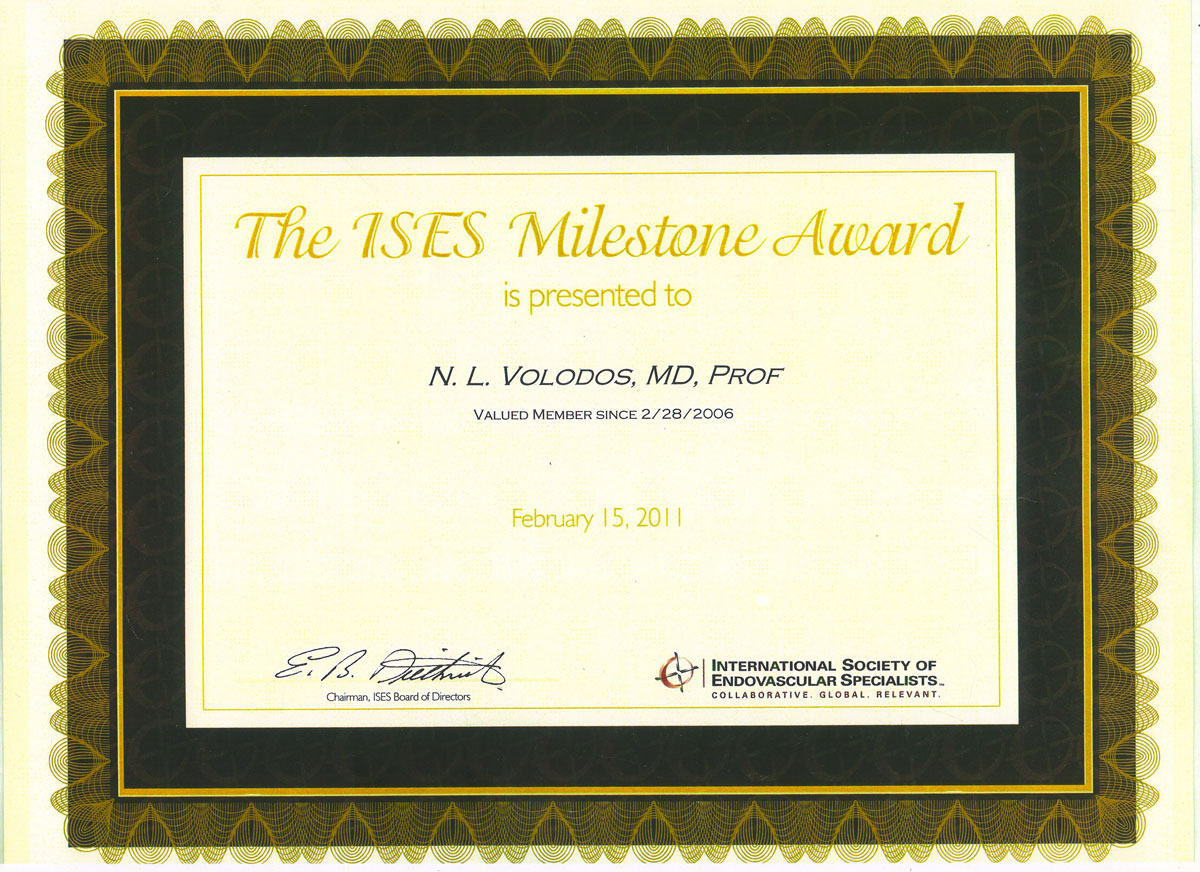
In 2011, was granted "The ISES Milestone Award". Became the ISES member in 2006.
In 2013, was accepted as Honorary Member of The Edward B. Diethrich Vascular Surgical Society.

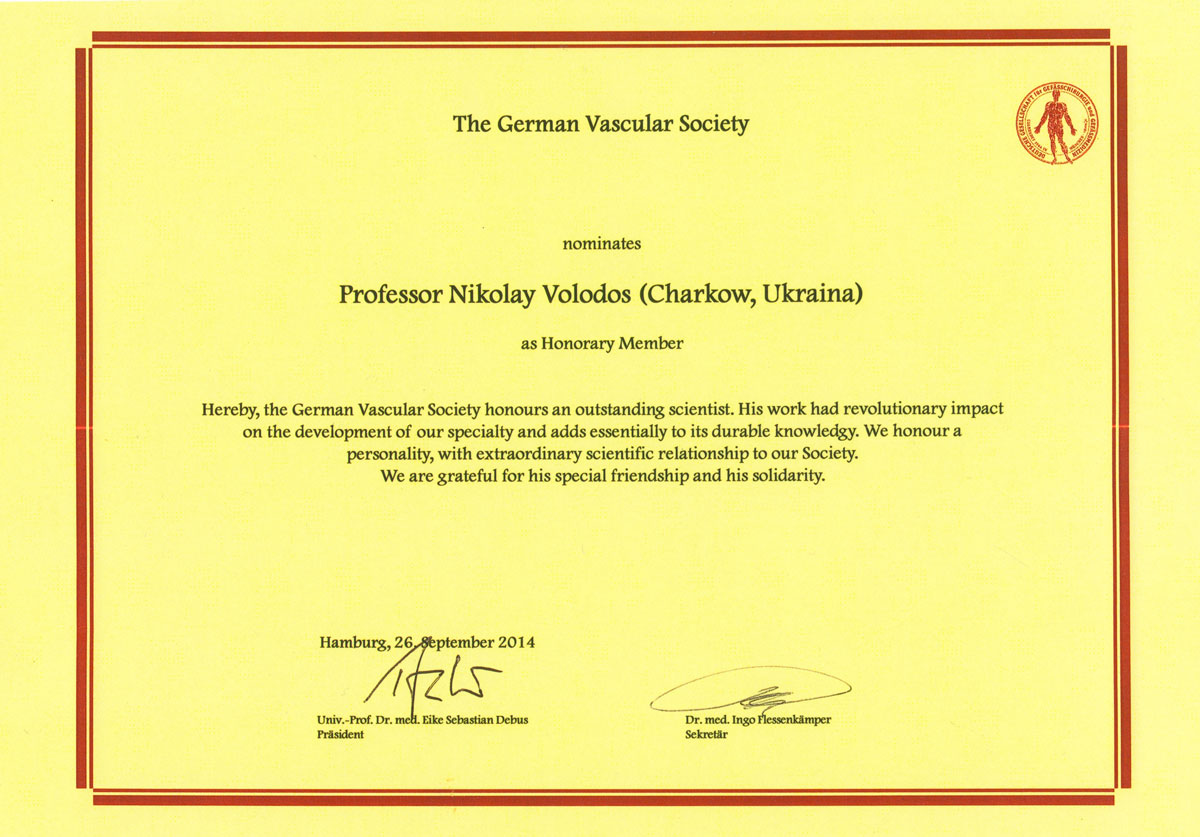
In 2014, was nominated as Honorary Member by The German Vascular Society. At the same time, he was awarded the Jörg Vollmar Medal by the Jörg Vollmar Foundation.[18]
In 2015, was honoured with the International Bakoulev Award «For the first in the World development and clinical use of stent graft for the treatment of thoracic aortic aneurism».

In 2015, was granted the ESVS Honorary Membership.

In 2016, the European Society for Vascular Surgery (ESVS) commissioned a keynote lecture to be delivered at the Society's Annual Scientific Meeting. In honour of his great achievements, ESVS named the lecture after Professor Nicolai Volodos. The inaugural lecture was delivered by Professor Ross Naylor (Leicester, UK) in Copenhagen in 2016 and he was succeeded by Professor Peter Gloviczki (USA) in Lyon in 2017 [2], by Sumaira MacDonald (USA) in Valencia in 2018 and by Professor Krassi Ivancev (Germany) in Hamburg in 2019 [1], by Dr.Claude Mialhe (France) in 2020, by Dr. B. Mitchell (USA) in Rotterdam in 2021, by Professor Gustavo S. Oderich in Rome in 2022.
References
- ^ Ivancev K, Vogelzang R. ESVS 2019 Volodos Honorary Lecture: A 35 Year History of Stent Grafting, and How EVAR Conquered the World. Eur J Vasc Endovasc Surg 2020; 59:685-694.
- ^ Peter Gloviczki. ESVS Volodos Lecture: Innovations and the Hippocratic Oath. Eur J Vasc Endovasc Surg. 2018 May;55(5):605-613.
- ^ Frank J Criado. Nicholay Volodos and the Origins of Endovascular Graft. Vascular Disease Management. Volume 9 - Issue 7 - July 2012.
- ^ Volodos NL, Shalimov AA. [Some issues of coronary insufficiency]. Grudnaya Khirurgiya. 1968;(3):91-5. Russian
- ^ Volodos NL. [Selective coronarography]. Grudnaya Khirurgiya. 1968;(3):146-50. Russian.
- ^ Volodos NL, Goloborodko NK, Mikhailenko VV. [Surgical treatment of traumatic rupture of the thoracic aorta]. Grudnaia khirurgiia. 1981;(6):76-8. Russian. PMID 7333515.
- ^ Volodos NL, Shekhanin VE, Udovenko VF, Karpovich IP, Troian VI. [Radial zigzag spring, self-fixing synthetic prosthesis for remote endoprosthetics of blood vessels]. Kharkiv: FTINT; 1987. 35 p. (Preprint; 1987). Russian.
- ^ a b VI Troian, AV Chinilin, VA Prasol. [History of activity and role of Professor N. L. Volodos in the development of national and world’s cardiovascular surgery. To the 85th anniversary of his birth.]. Medichna gazeta "Zdorovja Ukraini". Veresen 2019. Russian.
- ^ Volodos NL, Shekhanin VE, Karpovich IP, Troian VI, Goncharova LS. [Remote endoprosthetics of the aorta and iliac arteries]. In: [Topical issues in organization of prevention and surgical treatment of the main vessels diseases. Abstracts of the All-Union Conference]; 1985 Mar 20-22; Moscow. Part 2. Moscow; 1985. p. 163. Russian.
- ^ Volodos NL, Shekhanin VE, Karpovich IP, Troian VI. [Remote endoprosthetics of the aorta and iliac arteries with a self-fixing synthetic prosthesis]. In: [Topical issues of surgery. Abstracts of the 5th Scientific Conference of Surgeons of the Latvian, Lithuanian and Estonian SSR]; 1985 Dec 5-6; Tallinn. Tallinn; 1985. p. 217-8. Russian.
- ^ Volodos NL, Shekhanin VE, Karpovich IP, Troian VI, Gurev IuA. [A self- fixing synthetic blood vessel endoprosthesis]. Vestnik khirurgii imeni I. I. Grekova. 1986 Nov;137(11):123-5. Russian. PMID 3824776. PMID 3824776.
- ^ Volodos NL, Karpovich IP, Shekhanin VE, Troian VI, Iakovenko LF, Keremet LS, et al. [A case of distant transfemoral endoprosthesis of the thoracic artery using a self-fixing synthetic prosthesis in traumatic aneurysm]. Grudnaia khirurgiia. 1988 Nov-Dec;(6):84-6. Russian. PMID 3220297.
- ^ Volodos NL. The origin of TEVAR. In: Chiesa R, editor. History of Aortic Surgery in the World. Turin: Edizioni Minerva Medica; 2015. p. 2-10.
- ^ Volodos NL. The 30th Anniversary of the First Clinical Application of Endovascular Stent-grafting. Eur J Vasc Endovasc Surg. 2015 May;49(5):495- 7. doi: 10.1016/j.ejvs.2015.02.012.
- ^ Volodos SN. [New system for the endovascular grafting of aorta. Technique of using two simultaneous approaches.]. Andiologiia i sosudistaia khirurgiia. 1998 Vol.4(3-4):103-9. Russian.
- ^ Volodos NL, Karpovich IP, Troyan VI, Kalashnikova YuV, Shekhanin VE, Volodos SN, et al. Endovascular Stented Grafts for Thoracic, Abdominal Aortic and Iliac Artery Disease: Clinical Experience in the Ukraine from 1985. Semin Intervent Radiol. 1998;15(1):89-95. doi: 10.1055/s-2008-1057062
- ^ "РАДИАЛЬНАЯ ЗИГЗАГООБРАЗНАЯ ПРУЖИНА, САМОФИКСИРУЮЩИЙСЯ СИНТЕТИЧЕСКИЙ ПРОТЕЗ ДЛЯ ДИСТАНЦИОННОГО ЭНДОПРОТЕЗИРОВАНИЯ КРОВЕНОСНЫХ СОСУДОВ" (PDF). Archived from the original (PDF) on 8 September 2021.
- ^ E. S. Debus. Professor Nicolaj Leontyevich Volodos 15.5.1934–3.4.2016. Gefässchirurgie. 2016; 5 Vol. 21; Iss. 3, pp. 201-2. German. DOI 10.1007/s00772-016-0140-z