New Plymouth City Transport
| Parent | New Plymouth Borough/City Council |
|---|---|
| Commenced operation | March 10, 1916 |
| Ceased operation | 1991 |
| Defunct | Yes |
| Headquarters | Transport House 2 Egmont Street |
| Locale | New Plymouth |
| Service type | Bus, Trolley Bus, Tram |
| Routes | 16 |
| Depots | Rangi Street (bus depot) Fitzroy (tram sheds) Liardet Street (electricity depot) |
| Fuel type | Overhead Electric Battery-Electric Petrol Diesel |
New Plymouth City Transport (originally known as New Plymouth Tramways) was a council-owned public transport operator in New Plymouth, New Zealand. It was established in 1916 with the opening of the borough’s electric tramway system and remained in operation for 75 years.
The system went through several transitions: electric trams (1916–1954), trolleybuses (1950–1967), and a succession of battery-electric, petrol and diesel powered buses from the 1920s through to the early 1990s. In 1991, regulatory changes required the council to divest its bus services, and the operation was sold to Gold Star Bus Lines, ending direct municipal involvement in public transport.
Early private services
Before municipal control, public transport in New Plymouth was provided by private operators. Early attempts to start a regular service occurred in the 1890s. In April 1892, W. Courtney announced his intention to run a bus to Fitzroy “within two months,” promoting it as a catalyst for local growth.[1] In March 1894, a public meeting was held to form the New Plymouth and Fitzroy Omnibus Company, which proposed to purchase a Jubilee horse bus similar to those in Auckland at the time.[2]
Neither venture appears to have succeeded, but on 21 May 1894 M. Jones of the Criterion Livery Stables began a new service from Fitzroy to town, using a bus imported from Auckland. The bus could carry ten passengers inside and four outside, and was described as “splendidly finished off” with plush-covered seats, curtained windows, and overhead racks for parcels."[3] Fares were sixpence one way,[4] and the route also extended to the Breakwater on some trips.[5]
As suburban growth created new demand, there was growth in both the number of routes covered and the number of operators, leading in 1902 to a brief period of intense competition.[6] For example, in 1902 a competing Breakwater–New Plymouth service was advertised by H Sparks,[7] while S W Jury started running on the New Plymouth–Westown run [8] Jury took over Sparks Breakwater service in 1903.[9][10]
That same year, another competing service named Cathro’s bus started between Fitzroy and New Plymouth.[11] In 1903 Fitzroy services had all been taken over by operator J. W. West.[12][13] That same year M. Jones started a new service along Carrington Road to Vogeltown.[14]
By the mid-1910s, horse buses were falling out of favour in favour of self-propelled vehicles. In August 1915 West sold his horses[15] and a replacement motor bus service to Fitzroy and the Breakwater was introduced by M Jones.[16][17] By 1916 motorbus services were also running to Vogeltown, Westown and Frankleigh Park.[18] These developments marked the shift away from horse-drawn transport — a transition that would accelerate once the Borough Council took control and introduced electric trams and battery buses.
Council-run services (1916–1991)
Tramways (1916–1954)
By 1910, New Plymouth had begun exploring the introduction of an electric tramway system. A council committee examined the options and reported two possibilities:[19]
- a single line between Fitzroy and the Breakwater
- the same, with branches to Vogeltown and Elliot Road (now Tukapa Street)
The committee recommended building only the main Fitzroy–Breakwater line initially, noting that further extensions would only be viable with significant population growth. Frankleigh Park was deemed entirely unsuitable for tram services.
Before any tramway construction could begin, the council sought to amalgamate the separate Fitzroy and St Aubyn town districts, along with Westown, Vogeltown, and Frankleigh Park (then part of the Hurworth Riding of Taranaki County), into the Borough of New Plymouth. Consolidation under one authority was seen as essential for laying track without protracted negotiations between multiple councils and to avoid the expense of establishing a separate transport board.[20][21][22]
In March 1913, a vote authorised the construction of tramways within the expanded borough. Although “trackless trams” or motor buses were suggested as cheaper alternatives, the council opted to proceed with a conventional electric tramway.[23][24]
The New Plymouth Borough Council launched the tramway on 10 March 1916, initially running from Fitzroy past the railway station to Weymouth Street.[25] The full route to the Breakwater opened on 21 April,[26] and the Morley Road extension on 20 May. The network was officially opened on 1 June 1916.[27]
When the network officially opened, two routes were in operation:[28]
- Fitzroy – New Plymouth – Breakwater
- Eliot Street – New Plymouth – Morley Road
Calls for further expansion soon followed. The first extension was a 1.7 kilometres (1.1 mi) continuation of the Morley Road line to David Street in Westown, accompanied by the purchase of three additional tramcars.[29] This extension opened on 29 November 1923, though it did not reach as far into Westown as many residents had hoped (or as the existing bus service did). Limited electricity generating capacity and the £19,000 cost constrained how far the Borough could extend the line. By comparison, the original 8 kilometres (5.0 mi) system, including six trams, depot, and electrical infrastructure, had cost £56,000 in total.[30]
The short length of the Westown line became a point of contention. It had three fare sections, the same as the longer Fitzroy and Breakwater routes, despite covering only 2.5 kilometres (1.6 mi). By contrast, the Fitzroy line was 3.13 kilometres (1.94 mi) and the Breakwater line about 4 kilometres (2.5 mi).[31] With fares set at 2d for the first section and 1d for each additional stage, Westown residents argued that they were paying disproportionately more for a shorter journey.
The next extension opened in 1924 when track was laid along Liardet Street and Gilbert Street to the Pukekura Park entrance there. A spur further up Liardet street was also laid for football game traffic.[32] The line was widely seen as the beginning of the tram service to Vogeltown.[33] The line also provided a triangle at Devon Street where trams could be turned.[34] From this day, Westown trams were extended to run all the way through to Pukekura Park.
This was to be the last expansion of the tram service. Investigations on which road trams should take to reach Vogeltown, concerns on the narrowness of Carrington Street and the potential cost scuppered any extensions.[35] A 1930 proposal sought to extend the Westown line to Upper Westown (now Hurdon), freeing up the bus for other services, but this did not proceed due to lack of funds.[36]
The Liardet Street service by itself was never a paying proposition, and the line was the first to close in 1937, with the track reclaimed and used for other track modifications in the system.[37] This change also coincided with rugby moving from Pukekura Park to the newly built Rugby Park grounds in Westown.[38] The service was replaced with the through-routing of Avenue Road buses down Liardet Street. The rest of the system was retained as it was considered to have a useful life of around 15 years before the trams needed replacing, and while the cost of running a fully diesel bus system was estimated as slightly lower than trams, the upfront cost of replacing vehicles was considered unaffordable.[39]
The Westown line was the next to close on 6 October 1950, replaced with a lower cost trolley bus service running to Upper Westown. The core route between Fitzroy and The Port remained in service, and in 1950 enquiries were made for the purchase of three former Wanganui trams recently taken out of service when that city's network closed down.[40] Wanganui wanted £450 per tram,[41] which was not accepted, while New Plymouths offer of £100 per tram and £150 for spares was not accepted by Wanganui.[42] This effectively locked in the end of the trams in New Plymouth, which closed for good on 23 July 1954.[43]
Fleet Details
| Vehicle Type | Fleet numbers | Year Introduced | Details |
|---|---|---|---|
| 4-wheel, single-truck single-saloon | 1–4 | 1916 | Built by Boon & Co, Christchurch |
| Double-bogie, double-saloon | 5–6 | 1916 | Built by Boon & Co, Christchurch |
| 4-wheel, single-truck Birney Safety Cars | 7–9 | 1921 | Built by J. G. Brill & Co, USA |
| Double-bogie, double-saloon | 10 | 1925 | Built by Boon & Co, Christchurch |
All trams remained in service until the closure of the system in 1954.[44] By this point they had all been updated to match the Birney trams, including a single saloon inside, fully enclosed, lowered destination blinds and converted for single-man operation.
Battery buses (1919–1931)
Upon the launch of the tramway system, attention soon turned to how best to serve the parts of New Plymouth that did not yet have the population density to justify a tram service. The solution was found in the 1919 purchase by the Borough Council of a Walker battery-electric truck, fitted with a locally built bus body.[45][46]
The bus could travel at 15–20 miles per hour on level ground and about 6 miles per hour on hills. Despite its solid rubber tyres, it was considered comfortable at moderate speeds on well-metalled roads. The vehicle was equipped with leather-upholstered seats, opening windows, and electric lighting, and operating costs were reported at only 4–5 shillings per day.[47] It was somewhat encumbered by the weight of the on-board batteries though.[48]
From 11 March 1919, the bus operated services to both Westown and Vogeltown (the latter service terminating at Doralto Road in Frankleigh Park), as well as to Frankley Road.[49] The Westown route, which had been without buses since the private company running the service stopped in 1916, ran only as far as Omata Road (much to the annoyance of residents further on).[50] Originally operated as a separate service, from 1922 this bus was administered as an extension of the tramway service.
The electric bus proved popular enough that in 1922 a second, larger battery bus was purchased to relieve overcrowding.[51] The body was built in Christchurch at the cost of £360.[52] Around the same time, investigations into tram routes to Westown and Vogeltown also resumed.
By 1922, Westown was judged large enough to support a tram line, and an extension of the Morley Street branch to David Street (along with the acquisition of three new tramcars) was authorised. The bus, meanwhile, continued to serve Vogeltown and Frankleigh Park, as well as new services in 1923-24 to South Road and Upper Westown, running via Vaele’s Estate (now Lynmouth).
The two vehicles were overhauled in 1925-26 (after the first petrol bus was introduced), but the original electric bus was withdrawn from service in 1929.[53] In 1931, the Council authorised replacing the second bus with a Bedford petrol vehicle, as the electric bus was described as “obsolete and worn out.”[54]
Fleet Details
| Vehicle Type | Fleet numbers | Year Introduced | Details |
|---|---|---|---|
| Walker Model L battery-electric bus[55] | 1 | 1919 | First electric bus purchased by the Borough Council; operated to Westown, Vogeltown, and Frankleigh Park. Withdrawn in 1929. |
| Walker Special Model 42 battery-electric bus[55] | 2 | 1922 | Larger replacement vehicle; branded "New Plymouth Municipal Tramways" and numbered 2. Declared obsolete by 1931 and replaced. |
-
Battery-electric number #1
-
Battery-electric number #2
Trolleybuses (1950–1967)
New Plymouth showed interest in trolleybuses (or 'Trackless Trams') from as early as 1920, with it was suggested using trackless trams for both Westown and Vogeltown (instead of trams to Westown only).[56] In 1924, thoughts were given to using trackless trams to expand services to Vogeltown, stating that services could be provided in a loop from Vogeltown to Avenue Road and back for the cost of a single tramline to Vogeltown.[57][58]
During the 1930s, as track renewals loomed and finances tightened, New Plymouth repeatedly revisited the idea of replacing some tram routes with trolleybuses. Early consideration of “trackless trams” dates to 1922, when the council investigated trolleybuses for hilly routes beyond the existing tramway.[59] Proposals resurfaced in July 1935, with reports canvassing trolleybus conversion in lieu of costly relaying, and identifying lines to Westown, Vogeltown and Frankleigh Park as likely candidates; however, no immediate action was taken.[60][61] The closure of the short Pukekura Park branch in 1937 effectively ended the immediate interwar proposals, although the concept returned after the war and led to the Westown trolleybus conversion in 1950.
In 1945, 14 Crossley TSD42/1 trolleybus chassis were ordered by the Passenger Transport Federation of New Zealand, of which the New Plymouth Borough Council was a member.[62] Ten were for Wellington, while the other four were ordered to replace the Westown tram route, which required money to be spent on improvements.[63] Bodies for the buses were constructed in New Plymouth using locally sourced rimu and beech wood from the South Island, to plans supplied by Wellington.[64]
This was intended to be the first route converted to trolley bus operation, with a policy adopted in 1948 to convert all tram and main bus routes to trolley buses.[65] Other suggested routes included up Avenue Road and returning via both Brooklands and Carrington Roads, or up Frankley Road and returning via Westown.[64] Indeed, when the trolley buses were introduced, Vogeltown was included on the destination roll.
However, in 1949 a policy change saw New Plymouth get cold feet after seeing the full cost of improving roads to withstand trolley buses.[66] Its attempt to sell the vehicles was unsuccessful, so the council decided to proceed with the conversion. The trolley bus route opened on 24 October 1950. As the only route to be converted, the system became an anomaly in New Plymouth (especially after the closure of the tram system in 1954) as the only electric vehicles in the fleet. They continued in service for seventeen years until 7 October 1967, when the line was closed. The system was purchased jointly by the Kapiti Coast Electric Tramway and the Ferrymead Tramway in Christchurch, who recovered electrical systems, overhead equipment and the remaining vehicles.[67]
Fleet Details
| Vehicle Type | Fleet numbers | Year Introduced | Details |
|---|---|---|---|
| Crossley TSD42/1 trolleybus | 1–4 | 1950 | Four vehicles ordered in 1945 and bodied locally in rimu and beech. Entered service on the Westown line from 24 October 1950. Withdrawn 1964–67. |
Petrol & Diesel Buses (1925–1991)
New Plymouth introduced its first petrol-powered bus in 1925, a Vulcan purchased to relieve pressure on the two battery-electric vehicles already in service.[68] The Vulcan maintained services alone over Christmas 1925.[69] A second petrol vehicle was purchased in 1926,[70] and a third larger petrol bus followed in 1927, seating 28 (plus nine standing) and fitted with “double balloon tyres” on the rear axle.[71] Its purchase was controversial, as the council chose an American chassis instead of a British one, prompting protests from local residents.[72][73][74] Additional purchases included a Bedford WHB in 1931 to replace the second battery bus.[54] In 1934, the whole fleet was replaced with 3 new Morris Commercial vehicles (though two had recycled bodies from previous vehicles).[75]
The first diesel bus arrived in 1937 - a 25-seat Leyland Cub - followed by two more in 1938.[76] This marked the start of a long association with British-built vehicles that lasted into the 1970s. Over the next decades the council operated a succession of Leyland Lioness, Leyland Tiger, AEC Regal IVs (to replace the trams), and AEC Reliance models (including three that replaced the trolleybuses), as well as Bedford SB and VAM types.
The only break from British supply came in 1945, when post-war shortages led to the purchase of two American vehicles: a Diamond T and a Ford V8 bus.
From the mid-1970s, the fleet shifted mostly towards European models. Among the Leyland Leopards were Mercedes-Benz O305s, followed by Volvo B58s and MAN SL202s. The MANs, delivered in 1986 & 1987, were the final new vehicles acquired before privatisation in 1991.
Fleet details
New Plymouth experimented with manufacturers in its early years, with several English manufacturers participating. These included Vulcan, Thornycroft & Bedford, as well as American manufacturers White. Early vehicles tended to have quite short lives before being replaced, showing the experimental nature of many of these vehicles. The first attempt at standardisation occurred in 1934 with three Morris Commercial chassis, though two of these reused bodywork from earlier vehicles that were only a few years old.
The first truly 'standard' vehicle came in 1937-38 with three identical Leyland Cubs. This was followed by two second-hand Leyland Lionesses from Wellington City Council Tramways (WCCT). This started a trend of New Plymouth vehicles appearing the same as those in other parts of the country. This included a Bedford WTB[77] and the post-war Ford V8,[78] both with bodies built in WCCT by Wellington, and the Leyland Tiger Half-cabs (and Crossley trolley buses) bodied by New Plymouth to plans produced and supplied by WCCT.
From the 1950's New Plymouth began its tradition of “piggybacking” its orders onto those of larger cities. This allowed the borough to purchase higher-specification vehicles at lower cost. Many of its buses were either similar or identical to those running in Auckland, Christchurch, Dunedin and Wellington.[79]
The largest single vehicle type was for ten AEC Regal IVs to replace the trams, identical to those ordered for Christchurch. Other parallels included the Mercedes-Benz O305s (similar to Auckland’s), Hawke Hunter-bodied Leyland Leopards (comparable, though slightly longer, to Wellington’s), and MAN SL202s, also seen in Auckland, Wellington, and Christchurch.
Details of the earliest petrol and diesel buses are sparse, as newspaper coverage often fails to record makes and specifications.[80][81]
| Vehicle Type | Body Style | Fleet numbers | Seating | Year Introduced | Details |
|---|---|---|---|---|---|
| Vulcan | Bate & Bell | 3 | - | 1925 | First petrol-powered bus purchased; operated alongside Edison battery buses. Withdrawn by 1934 |
| Thornycroft | Eden Motor Body | 4 | 19 | 1926 | Withdrawn 1934 and body reused.[55] |
| White Bus | G.J & Williams | 5 | 29 | 1927 | Purchase caused local controversy for not supporting British industry. Withdrawn by 1934 |
| Bedford WHB | Munt, Cottrell, Neilsen & Company | 1 | 17 | 1931 | First vehicle to re-use a fleet number. Withdrawn by 1934 and body reused.[55] |
| Morris Commercial[55] | Eden Motor Body | 2 | 19 | 1934 | Reused body from Thornycroft bus. |
| Morris Commercial[55] | Munt, Cottrell, Neilsen & Company | 3 | 23 | 1934 | - |
| Morris Commercial[55] | Munt, Cottrell, Neilsen & Company | 4 | 17 | 1934 | Reused body from Bedford WHB bus. |
| Leyland Cub KPZO2 | Crawley Ridley & Co | 5 | 25 | 1937 | – |
| Leyland Cub KPZO2 | Crawley Ridley & Co | 6–7 | 25 | 1938 | – |
| Leyland Lioness LTB1 | WCCT | 8–9 | 25 | 1940 | Second-hand vehicles from Wellington City Transport Withdrawn 1955-56. |
| Bedford WTB | WCCT | 10 | - | 1945 | - |
| Ford V8 3G[82] | WCCT | 11 | 34 | 1945 | Withdrawn 1962. |
| Diamond T404 | Crawley Ridley & Co | 12 | - | 1945 | Withdrawn 1955. |
| Leyland Tiger OPS1/1 | NPCT | 13–15 | 37 | 1948 | Half-cab buses. Plans for bodywork supplied by WCCT. Withdrawn 1963-71. |
| AEC Regal IV 9821E | Crossley/Park Royal | 16–17 | 42 | 1952 | Early Regal IVs; additional batches followed in 1954 and 1955. Withdrawn from 1976 |
| AEC Regal IV 9821E | Park Royal | 18–22 | 42 | 1954 | Purchased for tram replacement. Withdrawn from 1976 |
| Bedford SB3 | NZMB | 23 | 35 | 1954 | Withdrawn 1972. |
| AEC Regal IV 9821E | Park Royal | 24–26 | 42 | 1955 | 2 preserved in various capacities Withdrawn 1980-83. |
| AEC Reliance 470 | Park Royal | 8–9 | 42 | 1958 | Withdrawn 1984–85. |
| AEC Reliance 470 | NZMB | 6–7 | 42 | 1962 | Withdrawn 1983. |
| Bedford SB5 | – | 10–11 | 37 | 1962 | Withdrawn 1974. |
| AEC Reliance 590 2U2RA | NZMB | 1–3 | 42 | 1967 | Replaced trolleybuses Bus 2 later converted to mobile library. Withdrawn 1986. |
| Bedford VAM70 | NZMB | 4 | 42 | 1967 | Withdrawn 1983. |
| Bedford VAM70 | NZMB | 15 | 42 | 1970 | Withdrawn 1982. |
| AEC Reliance 691 6U2RE | Hawke Commander | 23 | 50 | 1972 | Withdrawn 1987. |
| AEC Reliance 691 6U2RE | Hawke Commander | 10–11 | 46 | 1974 | Withdrawn 1987. |
| Mercedes-Benz O305 | NZMB/VöV | 16–19 | 46 | 1976 | Added to Auckland order.[83] |
| Leyland Leopard PSU3E/2R | Stratford Motor Bodies | 21, 22 | 46 | 1978 | Only example of Stratford bodywork.[84] |
| Leyland Leopard PSU3E/2R | Hawke Hunter | 5, 20 | 46 | 1978 | Longer version of Wellington vehicles. |
| Leyland Leopard PSU3E/2R | NZMB/Hess | 12, 14 | 45 | 1980 | – |
| Volvo B58 | NZMB/Hess | 24 | 46 | 1980 | Operated as the Hess bodywork demonstrator bus from 1978.[85] |
| Volvo B58 | NZMB/Hess | 4, 15 | 45 | 1982 | – |
| Volvo B58 | NZMB/Hess | 26 | 45 | 1983 | – |
| Mercedes-Benz O305 | Coachwork International/VöV | 7–9 | 45 | 1985 | #8 still operating as a motorhome |
| MAN SL202 | Coachwork International/VöV Stadt 80 | 1–3, 6, 10–11 | 45 | 1986-1987 | Last new vehicles purchased by the council. Ordered with Auckland, Wellington and Christchurch.[86] |
Livery Evolution
While individual vehicles differed, the fleet followed a clear sequence of colour schemes that reflected the changing identity of the system:
- 1920s–1940s: Buses were painted with red lower bodies and cream above, including the roof. On the sides appeared the borough coat of arms alongside the legend NEW PLYMOUTH TRAMWAYS.
- Mid-1940s: The familiar white arrows, already in use on the tram fleet, were added to the bus sides.
- Early 1950s: The wording on the sides was changed to NEW PLYMOUTH CITY TRANSPORT, as seen on the AEC Regal IVs, while the red-and-cream layout was retained.
- 1960s: The presentation was simplified. First the arrows, then the wording were removed, leaving only the city coat of arms; the upper panels were either cream or red depending on the vehicle.
- Early 1970s: The coat of arms was briefly replaced by a small NEW PLYMOUTH CITY TRANSPORT SERVICES script.
- 1976–1991: With the arrival of the first Mercedes-Benz O305 buses, the colour scheme was changed to green lower bodywork with white upper sides and roof. The city council coat of arms also returned, with the exception of the final vehicle delivered, which carried the new district council logo instead. This was the final livery, and it remained in use until the fleet was sold in 1991.
Routes
Bus routes expanded steadily as the borough developed. By 1927, services were operating to Avenue Road, Vogeltown–Frankleigh Park, and Upper Westown via Vaele’s Estate.[87] In 1934, a new service along Devon Street West to South Road (via Lorna and Doone Streets) was also introduced.[88][89] Routes continued to increase, including former Tram and Trolley Bus Routes, and extensions into Spotswood, Mangorei Road/Merrilands and Pembroke Street.
In addition to regular town services, a daily observation bus for tourists ran from the 1930s through to the 1970s.[90][91]
Bus services initially operated from the corner of Brougham and Devon Streets. Congestion led in 1945 to the building of a new bus depot opposite the Railway station in Rangi Street. Initially allowing for buses to lay over between services off-street, it eventually became the main bus depot for the city, allowing buses to be based in town instead of from the tram depot in Fitzroy.[92] The first services started using the new depot in November 1945.[93]
Route numbering was not initially used; buses displayed their destinations on the blinds. Numbers were introduced in the late 1950s or early 1960s as part of a system-wide reorganisation.
| Route | Destination blind | Notes |
|---|---|---|
| 1 | Brooklands | Via Coronation Avenue |
| 2 | Brooklands | Inbound only – returns via Brooklands Road, Victoria Road, and Shortland St to Carrington Road travelling on to City. |
| 3 | Vogeltown | |
| 3A | Rata St | Via Vogeltown (replaced dedicated Rata St route) |
| 4 | Ferndale | Outbound via Frankley Road.
City via Pembroke St, Tavistock St, and Clawton St. |
| 5 | Ferndale | Outbound via Pembroke St, Tavistock St, and Clawton St.
Citybound via Frankley Road |
| 6 | Omata Rd | Via Lynmouth |
| 6A | Omata Rd | Via Lynmouth and Oranga St |
| 7 | Omata Rd | Direct - does not travel via Lynmouth |
| 7A | Omata Rd | Direct - does not travel via Lynmouth.Travels via Oranga St. |
| 8 | Highlands Park | |
| 9 | Not used | |
| 10 | Frankleigh Park | |
| 11 | Spotswood | Outbound via Port |
| 11A | Spotswood | Outbound via Port and then via Whalers Gate (Triverton Cres) |
| 12 | Spotswood | Inbound via Port |
| 12A | Spotswood | Via Whalers Gate (Triverton Cres) |
| 13 | Fitzroy | Via Princes St on selected journeys |
| 13A | Fitzroy | Services Glen Avon as part of the Fitzroy service (replaced dedicated Smart Road route)
Via Princes St on selected journeys |
| 14 | Hurdon | Travels to/from Hospital on specified journeys |
| 15 | Merrilands | Outbound Via Mangorei Road
Inbound Via Mangorei Road and (occasionally) Riversdale Dr |
| 15A | Merrilands | Outbound following R15 then via Awanui St & Cumberland St to Smith Road |
| 16 | Merrilands | Outbound Via Ngaio St, Paynters Avenue, and Rimu St to Mangorei Road terminus at Smith Road
Inbound via Rimu St, Paynters Avenue, and Waiwaka Tce to Northgate and on to City. |
| 16A | Merrilands | Outbound to Smith Road following R16 via Awanui St |
The following table lists known destination signs alongside their route numbers. Not all destinations existed at the same time, and routes were added or altered as the city grew.
| Route | Destination blind | Notes |
|---|---|---|
| 1 | BROOKLANDS | – |
| 1A | HIGHLANDS PK | – |
| 2 | - | unknown |
| 3 | VOGELTOWN / BROOKLANDS | |
| 4 | FRANKLEY ROAD / FERNDALE | – |
| 5 | BROOKLANDS / RATA STREET | – |
| 6 | OMATA RD | – |
| 7 | OMATA RD | excluding Lyn Street |
| 8 | FITZROY / PORT | – |
| 9 | MERRILANDS / MANGOREI RD | Direct |
| 10 | FRANKLEIGH PARK | – |
| 11 | MERRILANDS / MANGOREI RD | via Waiwaka Terrace |
| 12 | PORT / FITZROY | - |
| 13 | PORT / FITZROY | - |
| 14 | WESTOWN & HOSPITAL | – |
| 14 | HURDON | – |
| 14 | WESTOWN or HURDON / OMATA ROAD | combined service |
| 15 | MERRILANDS | via Awanui & Cumberland Street |
| 16 | PEMBROKE | – |
| - | OBSERVATION | New Plymouth sight-seeing service |
| - | PICTURE BUS | Late night service after the cinemas close |
| - | RUGBY PARK | Sports bus |
| - | RACECOURSE | - |
| - | AVENUE ROAD | Now called Coronation Avenue |
| - | SMART ROAD | Unsure of number this was used with[95] |
Post-1991 operations
On 30 July 1991, New Plymouth City Council sold its bus fleet and operations to Gold Star Bus Lines. Gold Star was a Hamilton-based company that offered to run the New Plymouth services as well. The fleet was split between New Plymouth and Hamilton depots. However, the company was placed into liquidation a few months later.[96] Buses were progressively sold off in late 1991 and early 1992 to pay down the company's debt.
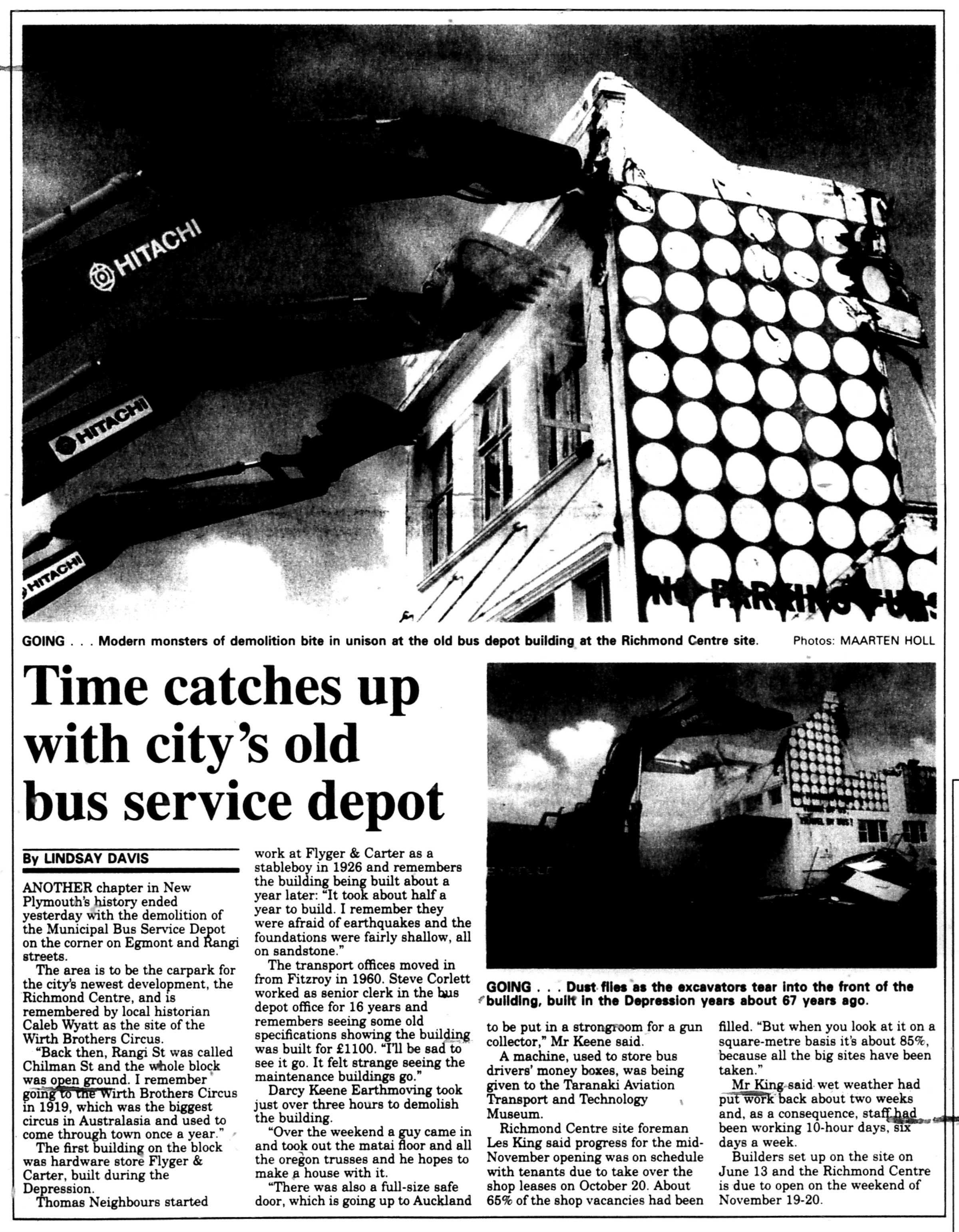
In 1994, the council-owned bus depot at Rangi Street was sold and demolished to make way for the Richmond Centre shopping complex.[97]
Subsequent Services
For the subsequent history of bus operations in New Plymouth after the closure of New Plymouth City Transport and Gold Star Bus Lines see Public transport in New Plymouth.
Preservation
Although most of the New Plymouth City Transport fleet was sold off following withdrawal, a small number of vehicles have made their way into preservation. None of the trams remains complete, but one Birney body is held in storage, alongside two of the four trolleybuses and two Regal IV diesel buses (in various states of completeness). These vehicles are preserved by heritage groups across New Zealand, as listed below:
| Type | Vehicle | Fleet Number | Fate | Location |
|---|---|---|---|---|
| Tram | Birney | 8 | Body in storage | Tramways Whanganui Trust, Whanganui |
| Trolley bus | Crossley | 1 | Preserved / Storage | Kapiti Coast Electric Tramway, Paekākāriki |
| Trolley Bus | Crossley | 3 | Preserved / Operable | Ferrymead Heritage Park, Christchurch |
| Diesel Bus | AEC Regal IV | 24 | Chassis only / Operable | Omnibus Society of New Zealand, Mananui |
| Diesel Bus | AEC Regal IV | 26 | Under restoration / Operable | Omnibus Society of New Zealand, Mananui |
See also
Related Topics
Maps showing bus routes over the years
- 1945 map showing tram and bus routes
- 1949 map showing tram and bus routes
- 1952 map showing tram, bus & trolley bus routes
- 1960 map showing bus, trolley bus and observation bus routes
- 1977 map showing bus routes
- 1987 map showing bus routes
References
- ^ "To All Land Buyers". Taranaki Herald. Vol. XLI, no. 9376. Papers Past. 27 April 1892. p. 3. Retrieved 14 August 2025.
- ^ "New Plymouth and Fitzroy Omnibus Company". Taranaki Herald. Vol. XLIII, no. 9956. Papers Past. 17 March 1894. p. 2. Retrieved 14 August 2025.
- ^ "Mr M Jones' Omnibus". Taranaki Herald. Vol. XLIII, no. 10007. Papers Past. 18 May 1894. p. 2. Retrieved 14 August 2025.
- ^ "Fitzroy Omnibus". Taranaki Herald. Vol. XLIV, no. 10426. Papers Past. 1 October 1895. p. 3. Retrieved 14 August 2025.
- ^ "Fitzroy 'Bus. Notice". Taranaki Herald. Vol. XLIV, no. 10330. Papers Past. 11 June 1895. p. 3. Retrieved 14 August 2025.
- ^ "What the Trams will Do. The Passing of the Omnibus". Taranaki Daily News. Vol. LVII, no. 63. Papers Past. 3 August 1914. p. 2. Retrieved 15 August 2025.
- ^ "Bus Timetable. From New Plymouth to Breakwater". Taranaki Herald. Vol. L, no. 12137. Papers Past. 4 December 1902. p. 8. Retrieved 14 August 2025.
- ^ "'Bus Time-Table from New Plymouth to Westown". Taranaki Herald. Vol. LIV, no. 12803. Papers Past. 9 March 1905. p. 5. Retrieved 14 August 2025.
- ^ "Notice". Taranaki Herald. Vol. L, no. 12325. Papers Past. 6 August 1903. p. 5. Retrieved 14 August 2025.
- ^ "Bus Timetable from New Plymouth to Breakwater". Taranaki Herald. Vol. L, no. 12354. Papers Past. 9 September 1903. p. 8. Retrieved 14 August 2025.
- ^ "Cathro's 'Bus". Taranaki Herald. Vol. L, no. 12014. Papers Past. 9 July 1902. p. 4. Retrieved 14 August 2025.
- ^ "Fitzroy 'Bus". Taranaki Herald. Vol. L, no. 12068. Papers Past. 10 September 1902. p. 4. Retrieved 14 August 2025.
- ^ "Fitzroy Bus Service". Taranaki Daily News. Vol. XXXXV, no. 7. Papers Past. 9 January 1903. p. 2. Retrieved 14 August 2025.
- ^ "Bus Service to Vogeltown". Taranaki Daily News. Vol. XXXXV, no. 118. Papers Past. 20 May 1903. p. 4. Retrieved 14 August 2025.
- ^ "Sales by Auction". Taranaki Herald. Vol. LXIII, no. 144757. Papers Past. 13 August 1915. p. 7. Retrieved 14 August 2025.
- ^ "Untitled". Vol. LXIII, no. 144759. Taranaki Herald. 16 August 1915. p. 2. Retrieved 14 August 2025.
- ^ "Timetable of the New Plymouth and Breakwater Motor Bus". Taranaki Herald. Vol. LXIII, no. 144770. Papers Past. 28 August 1915. p. 2. Retrieved 14 August 2025.
- ^ "Motor Bus Service to Suburbs". Taranaki Herald. Vol. LXIV, no. 145001. Papers Past. 30 May 1916. p. 1. Retrieved 14 August 2025.
- ^ "The Tramway Scheme. A Valuable Report". Taranaki Daily News. Vol. LII, no. 375. Papers Past. 8 April 1910. p. 8. Retrieved 15 August 2025.
- ^ "The Tramway Scheme. The Mayors First Move". Taranaki Daily News. Vol. LII, no. 356. Papers Past. 6 April 1910. p. 8. Retrieved 15 August 2025.
- ^ "Greater New Plymouth". Taranaki Herald. Vol. LIX, no. 143657. Papers Past. 27 November 1911. p. 2. Retrieved 15 August 2025.
- ^ "Greater New Plymouth. Hurworth Riding Amalgamated". Taranaki Herald. Vol. LX, no. 143748. Papers Past. 20 March 1912. p. 2. Retrieved 15 August 2025.
- ^ "Municipal Poll". Timaru Herald. Vol. XCVII, no. 14988. Papers Past. 6 March 1913. p. 7. Retrieved 15 August 2025.
- ^ "The Tramways Question". Taranaki Herald. Vol. LXI, no. 144001. Papers Past. 21 January 1913. p. 2. Retrieved 15 August 2025.
- ^ "New Plymouth Tramway Service". Taranaki Daily News. Papers Past. 13 March 1916. p. 4. Retrieved 15 August 2025.
- ^ "Easter Holidays". Taranaki Daily News. Papers Past. 22 April 1916. p. 3. Retrieved 15 August 2025.
- ^ "New Plymouth Tram Service. Official Opening". Stratford Evening Post. Vol. XXX, no. 50. Papers Past. 2 June 1916. p. 3. Retrieved 15 August 2025.
- ^ "New Tram Timetable". Taranaki Daily News. Papers Past. 14 December 1916. p. 7. Retrieved 15 August 2025.
- ^ "Trams to Westown". Taranaki Daily News. Papers Past. 30 November 1923. p. 4. Retrieved 20 August 2025.
- ^ "Trams to Westown". Taranaki Daily News. No. 25 October 1923. Papers Past. p. 4. Retrieved 20 August 2025.
- ^ "Westown Trams". Taranaki Daily News. Papers Past. 17 November 1923. p. 6. Retrieved 20 August 2025.
- ^ "Trams to Park. Services Begin Today". Taranaki Daily News. Papers Past. 11 July 1924. p. 4. Retrieved 20 August 2025.
- ^ "Trams to the Park. Plans for Extension". Taranaki Daily News. Papers Past. 7 April 1924. p. 4. Retrieved 20 August 2025.
- ^ "Trams to Park. Ready in Ealy June". Taranaki Daily News. Papers Past. 17 April 1924. p. 4. Retrieved 20 August 2025.
- ^ "Tram Extension. Service to Vogeltown". Taranaki Daily News. Papers Past. 9 January 1925. p. 4. Retrieved 20 August 2025.
- ^ "Extension of Tramways. Upper Westown Proposal". Taranaki Daily News. Papers Past. 24 April 1930. p. 7. Retrieved 18 August 2025.
- ^ "To be Retained. New Plymouth Trams". Taranaki Daily News. Papers Past. 21 December 1937. p. 6. Retrieved 20 August 2025.
- ^ "North v South". Auckland Star. Vol. LXVII, no. 204. Papers Past. 28 August 1936. p. 12. Retrieved 21 August 2025.
- ^ "New Plymouth Trams". Taranaki Daily News. Papers Past. 21 December 1937. p. 6. Retrieved 23 August 2025.
- ^ "New Plymouth May Buy Wanganui Trams When Buses Start". Wanganui Chronicle. Papers Past. 4 May 1950. p. 4. Retrieved 21 August 2025.
- ^ "New Plymouth Will Not Pay £450 for Wanganui Trams". Wanganui Chronicle. Papers Past. 22 August 1950. p. 5. Retrieved 21 August 2025.
- ^ "New Plymouth Offer For Three Of Wanganui's Disused Tram Cars". Wanganui Chronicle. Papers Past. 8 November 1950. p. 4. Retrieved 21 August 2025.
- ^ "New Plymouth's Last Trams". Press. Vol. XC, no. 27405. Papers Past. 19 July 1954. p. 11. Retrieved 22 August 2025.
- ^ Parr, Wally (1998). New Plymouth Trams: A Pictorial History. New Plymouth Tramways Historical Society.
- ^ "The Tramways". Taranaki Herald. Papers Past. 17 January 1919. p. 7. Retrieved 27 August 2025.
- ^ "The Electric Bus". Taranaki Daily News. Papers Past. 11 March 1919. p. 6. Retrieved 18 August 2025.
- ^ "Electric 'Bus. Vogeltown and Westown Services". Taranaki Herald. Vol. LXVII, no. 16384. Papers Past. 10 March 1919. p. 3. Retrieved 18 August 2025.
- ^ "Busses for Palmerston". Manawatu Times. Vol. XLIII, no. 1572. 24 May 1920. p. 5. Retrieved 27 August 2025.
- ^ "New Plymouth Borough Council. Westown, Vogeltown and Frankley Road Timetable. Electric 'Bus". Taranaki Daily News. Papers Past. 22 September 1919. p. 6. Retrieved 27 August 2025.
- ^ "Antiquated Proposals". Taranaki Herald. Vol. LXVI, no. 16323. Papers Past. 27 December 1918. p. 7. Retrieved 27 August 2025.
- ^ "Needs of Suburbs. 'Bus or Trams!". Taranaki Daily News. Papers Past. 28 March 1922. p. 5. Retrieved 18 August 2025.
- ^ "untitled". Poverty Bay Herald. Vol. XLVIII, no. 15907. Papers Past. p. 6. Retrieved 27 August 2025.
- ^ "New Plymouth Trams. Loss on Year's Working". Taranaki Daily News. Papers Past. 4 February 1930. p. 13. Retrieved 18 August 2025.
- ^ a b "New Plymouth Borough. Meeting of the Council. Purchase of an Omnibus". Taranaki Daily News. 8 September 1931. p. 3. Retrieved 18 August 2025.
- ^ a b c d e f g Northern City Bus Fleets. Omnibus Society. 1992. pp. 12–13.
- ^ "The Tramway Proposals". Taranaki Herald. Vol. LXVIII, no. 16867. Papers Past. 14 October 1920. p. 2. Retrieved 27 August 2025.
- ^ "Tram Extension. Service to Vogeltown". Taranaki Daily News. Papers Past. 9 January 1925. p. 4. Retrieved 20 August 2025.
- ^ "Transit Facilities". Taranaki Daily News. Papers Past. 7 February 1925. p. 6. Retrieved 20 August 2025.
- ^ "Trackless trams considered for New Plymouth". Taranaki Daily News. Papers Past. 7 February 1922. p. 5. Retrieved 10 August 2025.
- ^ "Proposed trolleybuses for New Plymouth". Timaru Herald. Papers Past. 2 July 1935. p. 7. Retrieved 10 August 2025.
- ^ "Trolley bus proposal for New Plymouth". Hawke's Bay Tribune. Papers Past. 2 July 1935. p. 7. Retrieved 10 August 2025.
- ^ "Trolley Bus Order Placed By Federation". Taranaki Daily News. Papers Past. 13 June 1945. p. 2. Retrieved 21 August 2025.
- ^ "Trolley Buses To Be Ordered For Westown". Taranaki Daily News. Papers Past. 17 April 1945. p. 4. Retrieved 21 August 2025.
- ^ a b "Trolley Buses Scheduled For New Plymouth". Taranaki Daily News. Papers Past. 12 November 1945. p. 4. Retrieved 21 August 2025.
- ^ "Untitled". Hawke's Bay Herald-Tribune. Vol. 91, no. 105. Papers Past. 28 January 1948. p. 4. Retrieved 21 August 2025.
- ^ "Unable to Find Purchasers". Rotorua Morning Post. No. 4042. Papers Past. 21 July 1949. p. 7. Retrieved 21 August 2025.
- ^ Tooke, Craig; Dale, Bruce; Beale, Peter. "Trolleybus Tribulations" (PDF). Council of Tramway Museums of Australasia. Retrieved 25 September 2025.
- ^ "Traansport to Suburbs". Taranaki Daily News. Papers Past. 21 July 1925. p. 9. Retrieved 22 August 2025.
- ^ "New Plymouth Borough Tramways. Xmas Day - Tramway Service Suspended". Taranaki Daily News. Papers Past. 24 December 1925. p. 1. Retrieved 23 August 2025.
- ^ "Trams & 'Buses". Taranaki Daily News. Papers Past. 20 July 1926. p. 9. Retrieved 13 September 2025.
- ^ "New Municipal Bus". Taranaki Daily News. Papers Past. 19 December 1927. p. 14. Retrieved 23 August 2025.
- ^ "British or Foreign?". Taranaki Daily News. Papers Past. 8 November 1927. p. 7. Retrieved 23 August 2025.
- ^ "American or British Bus". Taranaki Daily News. 12 November 1927. p. 13. Retrieved 23 August 2025.
- ^ "Buying Foreign Goods". Auckland Star. Vol. LVIII, no. 265. Papers Past. 9 November 1927. p. 8. Retrieved 23 August 2025.
- ^ "Business of Monthly Meetings. Reports of the Committees". Taranaki Daily News. Papers Past. 20 March 1934. p. 9. Retrieved 13 September 2025.
- ^ "Economical Bus". Taranaki Daily News. Papers Past. 23 June 1937. p. 14. Retrieved 23 August 2025.
- ^ "New Bus Arrives for New Plymouth". Taranaki Daily News. Papers Past. 17 May 1945. p. 6. Retrieved 13 September 2025.
- ^ "News of the Day. New Passenger Bus". Taranaki Daily News. Papers Past. 14 August 1945. p. 4. Retrieved 13 September 2025.
- ^ Jones, David (1992). Northern city transport : municipal buses of Eastbourne, Gisborne, New Plymouth, Palmerston North, Upper Hutt, Waikanae, Wanganui. Wellington, N.Z.: Omnibus Bulletin. ISBN 0908732090.
- ^ "New Plymouth City Transport Fleet List". BusInfo New Zealand. Retrieved 10 August 2025.
- ^ "New Plymouth Omnibus Fleet 1982". Omnibus Society. Retrieved 25 August 2025.
- ^ "Ford V8 buses". Omnibus Society. Retrieved 25 August 2025.
- ^ "Mercedes Benz 0305". Omnibus Society. Retrieved 25 August 2025.
- ^ "Leyland Leopard PSU3 Buses and Coaches". Omnibus Society. Retrieved 25 August 2025.
- ^ "Volvo B58 Buses and Coaches". Omnibus Society. Retrieved 25 August 2025.
- ^ "MAN SL202 Buses". Omnibus Society. Retrieved 25 August 2025.
- ^ "New Plymouth Trams. Working of the System". Taranaki Daily News. Papers Past. 2 August 1927. p. 9. Retrieved 23 August 2025.
- ^ "New Plymouth Tramways. New Bus Service Started". Taranaki Daily News. Papers Past. 18 September 1934. p. 2. Retrieved 13 September 2025.
- ^ "New Council Bus Route Agreed". Taranaki Daily News. Papers Past. 6 August 1934. p. 11. Retrieved 13 September 2025.
- ^ "From a Bus Window". Taranaki Daily News. Papers Past. 23 January 1935. p. 7. Retrieved 13 September 2025.
- ^ "Revenue Increased". Taranaki Daily News. Papers Past. 6 January 1939. p. 12. Retrieved 23 August 2025.
- ^ "Work On Borough Bus Parking Area Begun". Taranaki Daily News. No. 21 March 1945. Papers Past. p. 4. Retrieved 13 September 2025.
- ^ "News of the Day. New Bus Terminal Used". Taranaki Daily News. Papers Past. 14 November 1945. p. 4. Retrieved 13 September 2025.
- ^ "What did New Plymouth's urban bus network look like immediately prior to deregulation?".
{{cite web}}: CS1 maint: url-status (link) - ^ "RUNNING SHEET MARCH, 2010". Omnibus Society. Retrieved 25 August 2025.
- ^ "Gold Star Bus Lines Limited (in liquidation) Notice of Order to Wind Up Company" (PDF). New Zealand Gazette. 4 March 1992. p. 643. Retrieved 24 August 2025.
- ^ "Time Catches Up with City's Old Bus Services Depot". Taranaki Daily News. 12 October 1994. Retrieved 27 September 2025.