Mira Pintar
Mira Pintar | |
|---|---|
Portrait of Mira Pintar from 1913, painted by her aunt Ivana Kobilca | |
| Born | Marija Ana Frančiška Pintar February 5, 1891 |
| Died | June 23, 1980 (aged 89) |
| Occupations | bank clerk, artist, art collector |
| Relatives | Ivana Kobilca (aunt) |
Marija Ana Frančiška Pintar, also known as Mira Pintar, (5 February 1891 – 23 June 1980) was a Slovenian bank clerk, artist, and art collector. Closely associated with her aunt, the painter Ivana Kobilca, she played an important role as the custodian of her aunt's artistic estate after the painter's death.[1][2] Although she rarely exhibited her own work, she was active as an embroiderer and painter, and was an important part of the artistic and intellectual circles of early 20th-century Ljubljana.[1]
Childhood and education
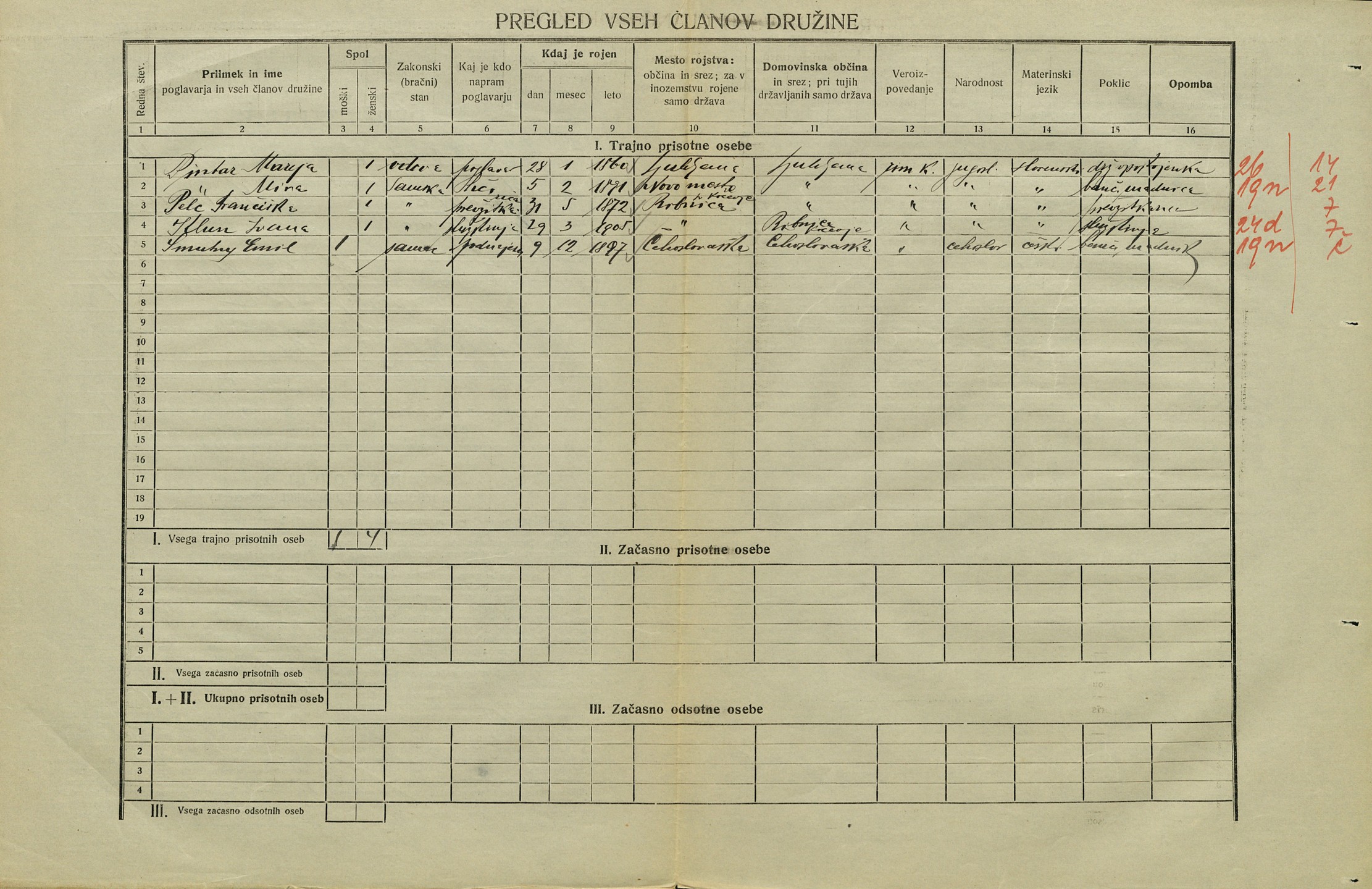
She was born into a Slovenian family on 5 February 1891 in Novo mesto.[1][3][4] Her mother was a private needlework teacher Marija Kobilca (1860–1946), sister of the painter Ivana Kobilca, and her father was the librarian and writer Luka Pintar (1857–1915).[1][5][6][7][4][8] She had an older brother, the physician Ivan Pintar (1888–1963).[6][5][9] Both of her parents, especially her mother, helped Ivana Kobilca sell paintings and manage commissions.[7] In 1898, Mira moved with her parents and brother to Ljubljana.[1][3] From an early age she learned embroidery from her mother.[1] After elementary school she attended a higher city school and also privately studied foreign languages.[1] In the 1906/07 school year, her art teacher there was Ivana Kobilca.[1] That year Mira Pintar also began studying with her aunt in her free time.[2] At the end of 1907 Ivana Kobilca moved to Berlin, but remained in close contact with her niece and taught her painting when they were together.[10][7] They also travelled on holidays together.[1] After finishing the higher civic school, Mira completed the girls' lyceum at Mladika in Ljubljana.[1] She also studied painting at the school of Rihard Jakopič in Ljubljana.[1] After completing the lyceum, she trained in office work at St Christopher's Institute.[1]
Portrait
In the summer of 1913 she visited Ivana Kobilca in Berlin for a holiday.[2] The painter had already been in poor health for several years.[2] The visit cheered her, and she began working more actively and exhibiting again.[2] During this period she painted the portrait of Mira.[10][2] In the painting, the girl wears a white dress and her hair is pinned up. Kobilca had for several years been concerned with whiteness and light, and therefore did not varnish the bright oil painting.[10] The work, aligned with bourgeois modernism, is regarded as one of the artist's finest, and among the best works by Slovenian artists more generally.[2][10] It is held in the permanent collection of the National Gallery of Slovenia.[2][10]
Career
After her education she worked as a bank clerk.[3][1] Alongside her job she was very active in the arts. She produced embroidery, especially hand-embroidered tablecloths, and exhibited them.[1][11] She also painted extensively, mainly still lifes, and drew portraits in charcoal and pencil.[1] Out of self-criticism she did not exhibit her paintings.[1] She socialized with pianist Dana Kobler and writer Vera Kressler Albreht, and visited the salon of Vera's mother.[12] There she met the writer Ivan Cankar, who in 1911 named the second part Mira of his novella triptych Volja in moč after her, as well as the painter Matija Jama, the poet Oton Župančič, the writer Vladimir Levstik, and other notable Slovenian intellectuals.[13][14] She also introduced Ivana Kobilca to the salon and its visitors; Kobilca later portrayed several of them.[13][14] She was an art collector as well, and among the founders of the National Gallery Society (Društvo Narodna galerija), established on 18 September 1918.[1][15]
Ivana Kobilca’s estate
Even after taking up employment she maintained close ties with her aunt. In letters, her aunt gave her detailed instructions on handling paintings, and even entrusted her with restoring her faded signatures.[1] She also helped her aunt with interviews.[16] At the end of 1926 Ivana Kobilca died, and in her will appointed Mira Pintar as custodian of her legacy and heir to most of her unsold paintings.[1][17] After twelve years as a bank clerk, she left her job in the 1930s and devoted herself to caring for her aunt's estate and to her own artistic work.[1][3]
Later life and death
She never married and had no children.[1] She lived in Ljubljana with her mother, who died in 1946.[3] She died in Ljubljana on 23 June 1980.[4][1]
References
- ^ a b c d e f g h i j k l m n o p q r s t u v Mrevlje, Neža (2020-04-19). "Pozabljene Ljubljančanke: Mira Pintar – Skrbnica Kobilčinih del" [Forgotten women of Ljubljana: Mira Pintar—guardian of Kobilca’s works]. www.dnevnik.si (in Slovenian). Retrieved 2025-11-28.
- ^ a b c d e f g h Mohor, Michel (January 2019). "Odstiranja, januar 2019 – Ivana Kobilca: Mira Pintar in mladenke v belem" [Unveiling, January 2019 — Ivana Kobilca: Mira Pintar and young women in white]. www.ng-slo.si (in Slovenian). Narodna galerija Slovenije. Retrieved 2025-11-28.
- ^ a b c d e "Popis prebivalstva Ljubljana 1931" [Ljubljana census 1931]. sistory.si (in Slovenian). Mesto Ljubljana 1931. 1931.
- ^ a b c "Krstna knjiga / Taufbuch - 04090 | Novo mesto - Kapitelj - Nadškofijski arhiv Ljubljana - Slovenia - Matricula Online" [Baptismal Register / Taufbuch – 04090 - Novo mesto - Kapitelj - Archdiocese archive Ljubljana - Slovenia - Matricula Online]. data.matricula-online.eu (in German). Archdiocesan Archives of Ljubljana. 1890–1913. Retrieved 2025-12-02.
- ^ a b "Pintar, Luka (1857–1915) — Slovenska biografija" [Pintar, Luka (1857–1915) — Slovenian Biography]. www.slovenska-biografija.si (in Slovenian). Retrieved 2025-11-28.
- ^ a b "Kobilca, Ivana (1862–1926) — Slovenska biografija" [Kobilca, Ivana (1862–1926) — Slovenian Biography]. www.slovenska-biografija.si (in Slovenian). Retrieved 2025-11-28.
- ^ a b c Šorn, Mojca (September 2022). "Ljubljančanka Ivana Kobilica v prostoru in času" [Ljubljana woman Ivana Kobilca in space and time]. Contributions to Contemporary History (in Slovenian). 2. doi:10.51663/pnz.62.2.03 – via ResearchGate.
- ^ "Poročna knjiga / Trauungsbuch - 01317 - Ljubljana - Črnuče - Nadškofijski arhiv Ljubljana -- Slovenia - Matricula Online" [Marriage Register / Trauungsbuch – 01317 - Ljubljana - Črnuče - Nadškofijski arhiv Ljubljana -- Slovenia - Matricula Online]. data.matricula-online.eu (in German). Archdiocesan Archives of Ljubljana. 1836–1900. Retrieved 2025-12-02.
- ^ "Pintar, Ivan (1888–1963) — Slovenska biografija" [Pintar, Ivan (1888–1963) — Slovenian Biography]. www.slovenska-biografija.si (in Slovenian). Retrieved 2025-11-28.
- ^ a b c d e "Ivana Kobilca — Mira Pintar" [Ivana Kobilca — Mira Pintar]. www.ng-slo.si (in Slovenian). Narodna galerija. 2017. Retrieved 2025-12-14.
- ^ Bojc, Saša (2016-04-19). "The canvas was not cut; it arrived from Vienna folded (Platno ni bilo prerezano, prepognjeno prišlo z Dunaja)". old.delo.si (in Slovenian). Retrieved 2025-12-11.
- ^ Mohor, Michel (September 2017). "Unveiling, September 2017 — Ivana Kobilca and the Kessler salon (Odstiranja, september 2017 – Ivana Kobilca in Kesslerjev salon)". www.ng-slo.si (in Slovenian). Narodna galerija Slovenije. Retrieved 2025-11-29.
- ^ a b Mohor, Michel (September 2017). "Odstiranja, september 2017 – Ivana Kobilca in Kesslerjev salon" [Unveiling, September 2017 — Ivana Kobilca and the Kessler salon]. www.ng-slo.si (in Slovenian). Narodna galerija Slovenije. Retrieved 2025-11-29.
- ^ a b Mahnič, Joža (July 1976). "Cankar, Župančič, Kesslerjeve in Bled" [Cankar, Župančič, the Kesslers, and Bled]. Planinski vestnik (in Slovenian). Vol. 7. pp. 332–321.
- ^ Osmanagić, Danijel (2018-09-18). "18 September 1918 — Formation of the National Gallery Society (Nastanek Društva Narodna galerija)". Zgodovina na dlani (in Slovenian). Retrieved 2026-01-12.
- ^ Vurnik, Stanko (15 May 1927). "Ivanka Kobilca in njena umetnost" [Ivanka Kobilca and her art]. Dom in svet (in Slovenian). 2. Katoliško tiskovno društvo.
- ^ Libnik, Vid (9 August 2019). "Na trgu sta se pojavili "izgubljeni" sliki Ivane Kobilce #foto #video" [“Lost” paintings by Ivana Kobilca appeared on the market #photo #video]. siol.net (in Slovenian). Retrieved 2025-12-02.