List of Palestinians
| Part of a series on |
| Palestinians |
|---|
| Demographics |
| Politics |
|
| Religion / religious sites |
| Culture |
| List of Palestinians |
The following Lists of Palestinians are lists of notable people with either a self-designation (endonym) or a foreign appellation (exonym) as "Palestinian", or who were born in the region of Palestine.
Approximately 12 million people today identify as Palestinians,[1] as defined in the Palestinian National Charter of 1968.[2]
Mandate period and after
The first list "Mandate period and after" consists of people who identify as "Palestinians" since the creation of Mandatory Palestine in 1920. The list does not include those Palestinian Jews or other Israeli citizens[3] who are native to the geographic region of Palestine, unless they self-identify as "Palestinians".[4][5]
| Name | Field | Speciality | Place of birth | Year of birth |
|---|---|---|---|---|
| Farah Baker | Social media | Reporter | Gaza Strip | 1998 |
| Mo Amer | Comedy | Stand up comedian | Kuwait | 1981 |
| Said Durrah[6] | Comedy | Stand up comedian | USA | 1982 |
| Maysoon Zayid | Comedy | Stand up comedian | USA | 1974 |
| Abeer Abu Ghaith | Business | technology entrepreneur, and social activist | Jordan | c. 1985 |
| Khaled Al-Hassan | Politics (Fatah) | political theorist, author, Fatah & PLO leader | Haifa | 1928 |
| Lila Abu Lughod | Academia | professor, anthropology, women and gender studies | USA | 1952 |
| Salman Abu Sitta | Academia | Palestinian studies | Beersheba | 1938 |
| Imad-ad-Dean Ahmad | Academia | academic | USA | 1948 |
| Mai al-Kaila | Politics | health minister, ambassador | Jerusalem | 1955 |
| Plestia Alaqad | Journalism | journalist | Gaza Strip | 2001 |
| Awad Saud Awad | Journalism, Academia | Author on Palestinian folklore, journalist | Jubb Yusuf | 1943 |
| Motaz Azaiza | Journalism | photojournalist | Deir al-Balah | 1999 |
| Fatma Hassona | Journalism | photojournalist | Gaza City | 1999 |
| Bisan Owda | Journalism | Journalist, activist, filmmaker | Beit Hanoun | |
| Rashad al-Shawwa | Politics | Mayor of Gaza City (1971 – 1982) | Gaza City | 1909 |
| Izzat Darwaza | Academia | historian, politician, educator | Nablus | 1888 |
| Samih Farsoun | Academia | sociologist | Haifa | 1937 |
| Ismail al-Faruqi | Academia | philosopher and comparative religions professor | Jaffa | 1921 |
| Leila Farsakh | Academia | Middle East, politics | Jordan | 1967 |
| Sami Hadawi | Academia | land specialist and researcher | Jerusalem | 1904 |
| Nemah Hasan | Music | Singer-songwriter | Toronto | 1994 |
| Ameer Idreis | Literature | Writer, playwright, urbanist | Dubai | 1999 |
| Wasif Jawhariyyeh | Music | Oud composer | Jerusalem | 1897 |
| Rashid Khalidi | Academia | historian | USA | 1948 |
| Walid Khalidi | Academia | historian | Jerusalem | 1925 |
| Salem Hanna Khamis | Academia | economic statistician | Nazareth | 1919 |
| Laila Al-Marayati | Medicine | gynecologist | USA | 1962 |
| Khaled Mardam-Bey | Academia | programmer | Jordan | 1968 |
| Nur Masalha | Academia | academic, historian, editor | Galilee | 1957 |
| Joseph Massad | Academia | academic | Jordan | 1963 |
| Basheer Nafi | Academia | academic | Rafah | 1952 |
| Ali H. Nayfeh | Academia | mathematician, mechanical engineer, physicist | Tulkarm | 1933 |
| Sari Nusseibeh | Academia | philosopher, diplomat | Syria | 1949 |
| Edward Said | Academia | professor of comparative literature, intellectual, and Palestinian Nationalist | Jerusalem | 1935 |
| Nadia Abu El Haj | Academia | professor, anthropologist | USA | 1962 |
| Rosemarie Said Zahlan | Academia | historian | Egypt | 1937 |
| Anis Sayigh | Academia | historian | Tiberias | 1931 |
| Yezid Sayigh | Academia | historian | USA | 1955 |
| Zuhair Al-Karmi | Academia, Natural science | author, scientific programs presenter on TV | Damascus | 1922 |
| Omar M. Yaghi | Chemistry | Nobel prize | Amman | 1965 |
| Hashem El-Serag | Medicine | doctor and medical researcher | Libya | 1966 |
| Reem Kassis | Literature | cookbook author | Jerusalem | 1987 |
| Hisham Sharabi | Academia | historian | Jaffa | 1927 |
| Qustandi Shomali | Academia | professor, historian, critic, researcher | Beit Sahour | 1946 |
| Khalil Suleiman | Medicine | medical doctor | Jenin | 1943 |
| Helga Tawil Souri | Academia | professor, media scholar and researcher, filmmaker | Kuwait | 1969 |
| Ahmad Teebi | Academia | geneticist and dysmorphologist | Beirut | 1949 |
| Aseel Anabtawi | Science | Electrical engineer with NASA | Tulkarem | 1969 |
| Ali Abunimah | Literature | author, journalist | USA | 1971 |
| Said K. Aburish | Literature | author, journalist | Jerusalem | 1935 |
| Susan Abulhawa | Literature | author, journalist | Kuwait | 1970 |
| Mourid Barghouti | Literature | poet | Ramallah | 1944 |
| Khalil Beidas | Literature | author | Nazareth | 1874 |
| Huzama Habayeb | Literature | author | Kuwait | 1965 |
| Jamal Dajani | Literature | author, journalist, producer | Jerusalem | 1957 |
| Mahmoud Darwish | Literature | poet | Al-Birwa | 1941 |
| Khaled Ennasra | poet | journalist | Jenin | 1927 |
| Najwa Kawar Farah | Literature | author | Nazareth | 1923 |
| Rashida Tlaib | Politician | congresswoman | USA | 1976[7] |
| Emile Habibi | Literature | author | Haifa | 1922 |
| Bella Hadid | Fashion | model | USA | 1996[8] |
| Gigi Hadid | Fashion | model | USA | 1995[8] |
| Mohamed Hadid | Business | businessman | Nazareth | 1948 |
| Suheir Hammad | Literature | poet | Jordan | 1973 |
| Nadia Hijab | Literature | author, journalist | Syria | 1950s |
| Jabra Ibrahim Jabra | Literature | poet, novelist, translator and literary critic | Bethlehem | 1919 |
| Emily Jacir | Artist | professor, filmmaker | Bethlehem | 1975 |
| Randa Jarrar | Literature | author, translator | USA | 1978 |
| Sabri Jiryis | Literature | author | Fassuta | 1938 |
| Ghassan Kanafani | Literature | author | Acre | 1938 |
| Hasan Karmi | Literature | linguist and author | Tulkarm | 1905 |
| Ghada Karmi | Literature | author | Jerusalem | 1939 |
| Sayed Kashua | Literature | author and journalist | Tira | 1975 |
| Widad Kawar | Literature | author and collector | Tulkarm | 1932 |
| Sahar Khalifa | Literature | novelist | Nablus | 1942 |
| Daoud Kuttab | Literature | journalist, author | Jerusalem | 1955 |
| Taha Muhammad Ali | Literature | poet | Saffuriyya | 1931 |
| Salman Masalha | Literature | poet, writer, essayist and translator | Maghar | 1953 |
| Kamal Nasser | Literature | poet, activist | Gaza | 1925 |
| Mohammed Omer | Literature | journalist | Rafah | 1984 |
| Samih al-Qasim | Literature | poet | Jordan | 1939 |
| Nahid al-Rayyis | Literature | poet | Gaza | 1937 |
| Abu Salma | Literature | poet | Tulkarm | 1906 |
| Khalil al-Sakakini | Literature | author | Jerusalem | 1878 |
| Naomi Shihab Nye | Literature | poet | USA | 1952 |
| Serene Husseini Shahid | Literature | author, philanthropist, researcher and collector of Palestinian costumes | Jerusalem | 1920 |
| Khaled Abu Toameh | Literature | journalist | Tulkarm | 1963 |
| Fadwa Toukan | Literature | poet | Nablus | 1917 |
| Ibrahim Touqan | Literature | poet, writer of the poem Mawtini, the current national anthem of Iraq | Nablus | 1905 |
| Samir El Youssef | Literature | writer and critic | Lebanon | 1965 |
| May Ziadeh | Literature | author | Nazareth | 1886 |
| Mustafa Abu Ali | Film | film director, founder of Palestinian Revolutionary Cinema, eight films | Malha | 1940 |
| Hany Abu-Assad | Film | film director | Nazareth | 1961 |
| Rashad Abu Sakhila | Film | actor, poet | Jabalia | 2001 |
| Kamel El Basha | Film | actor, film director | Malha | 1962 |
| Mohammad Bakri | Film | film director, actor | Bi'ina | 1953 |
| Cherien Dabis | Film | film director, writer | USA | 1976 |
| Qaher Harhash | Film | actor, model | East Jerusalem | 1998 |
| Annemarie Jacir | Film | film director, writer | Bethlehem | 1974 |
| Michel Khleifi | Film | film director (Wedding in Galilee) | Nazareth | 1950 |
| Lexi Alexander | Film | film director | Mannheim | 1974 |
| Clara Khoury | Film | actress | Haifa | 1976 |
| Makram Khoury | Film | actor, first Arab to win (Israel Prize – 1987) | Jerusalem | 1945 |
| Saja Kilani | Film | actress | Jordan | 1998 |
| Rashid Masharawi | Film | film director | Gaza | 1962 |
| Mai Masri | Film | film director | Beirut | 1959 |
| Elia Suleiman | Film | film director (Divine Intervention) | Nazareth | 1960 |
| Hiam Abbass | Film | actress | Nazareth | 1960 |
| Anwar Jibawi | Film | comedian | USA | 1991 |
| Waleed Zuaiter | Film | actor, producer | USA | |
| Nasri Tony Atweh | Music | lead singer of the band MAGIC! & singer/songwriter/record producer | Toronto | 1981 |
| Ramzi Aburedwan | Music | composer, viola player | Bethlehem | 1979 |
| Charlie Bisharat | Music | Grammy-winning violinist | USA | 1963[9] |
| Yacoub Shaheen | Music | Winner of the fourth season of Arab Idol | Bethlehem | 1994[10] |
| Mohammed Assaf | Music | Winner of the second season of Arab Idol | Gaza | 1989[11] |
| Belly | Music | rapper | Jenin | 1984 |
| Rim Banna | Music | singer/songwriter | Nazareth | 1966 |
| Ammar Hasan | Music | singer | Salfit | 1976 |
| Wissam Joubran | Music | composer and Oud player | Nazareth | 1983 |
| Reem Kelani | Music | singer/composer/musicologist | UK | 1963 |
| Shadia Mansour | Music | rapper/singer | UK | 1980s |
| Amal Murkus | Music | singer | Galilee | 1970s |
| Nemahsis | Music | singer | Canada | |
| Mohsen Subhi | Music | composer, arranger, oud and buzuq player | Ramallah | 1963 |
| DJ Khaled | Music | hip-hop producer, radio personality, and DJ | USA | 1975 |
| Simon Shaheen | Music | oud and violin virtuoso, composer | Galilee | 1955 |
| Massiv | Music | rapper | Germany | 1982 |
| Tära | Music | singer-songwriter | Italy | 2003 |
| Habib Hassan Touma | Music | composer | Nazareth | 1934 |
| Fred Wreck | Music | hip-hop producer | USA | 1972 |
| Tamer Nafar | Music | rapper of DAM fame | Lod | 1979 |
| Bashar Murad | Music | singer, songwriter, visual artist | Jerusalen | 1993 |
| Sameh Zakout | Music | rapper | Ramle | 1980s |
| Laila Bagge Wahlgren | Music | manager and songwriter | Sweden | 1972 |
| Tarééc | Music | German singer | Germany | 1978 |
| Dalal Abu Amneh | Music | singer and producer | Nazareth | 1983 |
| DAM (band) | Music | Palestinian rap group | Lod | 1970s |
| Fouad Awad | Art | theater director | Nazareth | 1956 |
| Alaa Minawi | Art | multidisciplinary artist, lecturer | Beirut | 1982 |
| Naji al-Ali | Art | cartoonist | al-Shajara | 1938 |
| Iman Al Sayed | Art | artist | Sharjah | 1984 |
| Nasr Abdel Aziz Eleyan | Art | artist | Jericho | 1941 |
| Mustafa Al-Hallaj | Art | artist | Jaffa | 1938 |
| Mona Hatoum | Art | sculptor | Beirut | 1952 |
| Nabil Anani | Art | artist | Halhoul | 1943 |
| Hasan Hourani | Art | painter | Hebron | 1974 |
| Emily Jacir | Art | painter and photographer, artist | Bethlehem | 1970 |
| Hanna Jubran | Art | sculptor | Galilee | 1952 |
| Sliman Mansour | Art | painter | Birzeit | 1947 |
| Sama Raena Alshaibi | Art | photographer, artist | Iraq | 1973 |
| Ahlam Shibli | Art | photographer | Galilee | 1970 |
| Jafar Tukan | Art | architect | Jerusalem | 1938 |
| Hisham Zreiq | Art | artist and film director (The Sons of Eialboun) | Nazareth | 1968 |
| Rami Kashou | Fashion | fashion designer | Ramallah | 1977 |
| Jaffa Phonix (band) | Music | band | Kuwait | 1980s |
| Yousef Beidas | Business | Intra Bank | Jerusalem | 1912 |
| Munib al-Masri | Business | PADICO[12] | Nablus | 1934 |
| Hasib Sabbagh | Business | Consolidated Contractors International Company | Tiberias | 1920 |
| Naim Attallah | Business | Asprey, Quartet Publishing | Haifa | 1931 |
| Talal Abu-Ghazaleh | Business | Jaffa | 1938 | |
| Sam Bahour | Business | West bank businessman | USA | 1964 |
| Yasser Elshantaf | Business | CEO of PhoenixBird Diversity Management GmbH | Gaza | 1983 |
| Tarab Abdul Hadi | Politics | activist | Jenin | 1910 |
| Fu'ad Nassar | Politics (PCP) | co-founded National Liberation League in Palestine | Nazareth | 1914 |
| Nabil Amr | Politics (Fatah) | presidential aide and negotiator | 1947 | |
| Yasser Arafat | Politics (Fatah) | first President of the PNA | Cairo | 1929 |
| Hakam Balawi | Politics (Fatah) | former ambassador of PLO to Tunisia and Algeria | Tulkarm | 1939 |
| Marwan Barghouti | Politics (Fatah) | founder of Tanzim and senior Fatah opposition figure | Kobar | 1959 |
| Mohammed Dahlan | Politics (Fatah) | Head of Preventive Security Service in Gaza | Gaza | 1961 |
| Saeb Erekat | Politics (Fatah) | presidential aide and senior negotiator | Jerusalem | 1955 |
| Qadura Fares | Politics (Fatah) | PNA minister and aide of Barghouti | ||
| Rawhi Fattuh | Politics (Fatah) | former interim President of the PNA | Barqa | 1949 |
| Faisal Husseini | Politics (Fatah) | former head of Jerusalem affairs | Baghdad | 1940 |
| Farouk Kaddoumi | Politics (Fatah) | former head of Fatah | Jinsafut | 1931 |
| Salah Khalaf | Politics (Fatah) | former top aide of Arafat | Jaffa | 1933 |
| Ahmed Qurei | Politics (Fatah) | former Prime Minister of the Palestinian National Authority | Jerusalem | 1937 |
| Ali Hassan Salameh | Politics (PLO) | Qula | 1940 | |
| Nabil Shaath | Politics (Fatah) | former Foreign Affairs Minister | Safed | 1938 |
| Khalil al-Wazir | Politics (PLO) | former PLO military leader and top aide | Ramleh | 1934 |
| Mohammad Shtayyeh | Politics/Fatah | economist/academic/minister | Nablus | 1958 |
| Muhammad Abu Tir | Politics (Hamas) | Political leader and militant | Umm Tuba | 1951 |
| Mohammad Barghouti | Politics (Hamas) | |||
| Mohammed Deif | Politics (Hamas) | Former leader of Qassam Brigades, Hamas' military wing | Khan Younis | 1965 |
| Ismail Haniyeh | Politics (Hamas) | Gaza | 1963 | |
| Mousa Abu Marzook | Politics (Hamas) | Fundraiser for terrorist activities | Rafah | 1951 |
| Ahmed al-Ja'abari | Politics (Hamas) | Gaza | 1960 | |
| Wasfi Kabha | Politics (Hamas) | Prisoners' Affairs Minister | ||
| Khaled Meshaal | Politics (Hamas) | Secretary-General of Hamas | Silwad | 1956 |
| Abdel Aziz al-Rantissi | Politics (Hamas) | founder and former Secretary-General of Hamas | Yibna | 1947 |
| Ahmed Yassin | Politics (Hamas) | founder and spiritual leader | Al-Jura | 1937 |
| Mahmoud al-Zahar | Politics (Hamas) | former Foreign Affairs Minister of the Palestinian National Authority, Hamas foreign minister | Jerusalem | 1945 |
| Salah Shehade | Politics (Hamas) | leader of military wing of the Hamas organization | Gaza | 1953 |
| Yahya Ayyash | Politics (Hamas) | chief bomb maker planner of the Hadera bus station suicide bombing | Jerusalem | 1966 |
| Bassam Abu Sharif | Politics (PFLP) | former spokesperson of PFLP and PLO | 1946 | |
| George Habash | Politics (PFLP) | founder and former Secretary-General of PFLP | Lod | 1926 |
| Abu Ali Mustafa | Politics (PFLP) | former Secretary-General of PFLP | Jenin | 1938 |
| Leila Khaled | Politics (PFLP) | former PFLP militant and activist | Haifa | 1944 |
| Ahmed Saadat | Politics (PFLP) | current Secretary-General of PFLP | al-Bireh | 1953 |
| Nader Sadaqa | Politics (Popular Front for the Liberation of Palestine|PFLP | exiled militant and activist | Mount Gerizim | 1977 |
| Riyad al-Malki | Politics (PFLP) | current Foreign Affairs Minister of PNA | 1955 | |
| Wadie Haddad | Politics (PFLP) | former PFLP militant and founder | Safed | 1927 |
| Abu Qatada | Politics | al-Qaeda Muslim religious preacher and militant | Bethlehem | 1959 |
| Abu Muthana | Politics | spokesman for the Palestinian Army of Islam | ||
| Awni Abd al-Hadi | Politics | Palestinian political figure | Nablus | 1889 |
| Haidar Abdel-Shafi | Politics | independent, head of Palestinian delegation to Madrid Peace Conference of 1991 | Gaza | 1919 |
| Salah Abdel-Shafi | Politics | independent, economist, Palestinian Ambassador to Sweden, Germany, Austria, and UNOV | Gaza | 1962 |
| Muhammad Zaidan | Politics | PLF | Syria | 1948 |
| Musa Alami | Politics | Jerusalem | 1897 | |
| Hanan Ashrawi | Politics | Third Way | Nablus | 1946 |
| Mustafa Barghouti | Politics | doctor and leader of the Palestinian National Initiative | Jerusalem | 1954 |
| Nayef Hawatmeh | Politics | DFLP | Jordan | 1935 |
| Ahmed Jibril | Politics | PFLP-GC | Jaffa | 1938 |
| Karimeh Abbud | Art | photographer | Shefa 'Amr | 1896 |
| Nimr al-Khatib | Politics | political leader, Haifa | Haifa | 1918 |
| Jabra Nicola | Politics | Trotskyist leader | Haifa | 1912 |
| Abu Nidal | Politics | Abu Nidal Organization | Jaffa | 1937 |
| Nahid al-Rayyis | Politics | Justice Minister of the Palestinian National Authority | Gaza | 1937 |
| Afif Safieh | Politics | Palestine's Ambassador to the Russian Federation | jerusalem | 1950 |
| Hasan Tahboub | Politics | former Head of the Supreme Islamic Council | Hebron | 1923 |
| Ruhi al-Khatib | Politics (local) | mayor of East Jerusalem from 1957 to 1994; titular | Jerusalem | 1914 |
| Fahmi al-Abboushi | Politics (local) | appointed mayor of Jenin in 1935 | Jenin | 1895 |
| Hussein Al-Araj | Politics (local) | former mayor of Nablus | ||
| Ramiz Jaraisy | Politics (local) | mayor of Nazareth | 1951 | |
| Omar Hammayil | Politics (local) | mayor of al-Bireh | 1976 | |
| Mohammed Milhim | Politics (local) | former mayor of Halhul | 1929 | |
| Hadem Rida | Politics (local) | mayor of Jenin | ||
| Bassam Shaka | Politics (local) | former mayor of Nablus | 1930 | |
| Ghassan Shakaa | Politics (local) | former mayor of Nablus | 1943 | |
| Adly Yaish | Politics (local) | mayor of Nablus | ||
| Adel Zawati | Politics (local) | former mayor of Jenin, Nablus, Hebron, Ruler of Yafa, Ramleh | Nablus | 1920 |
| Ahmad Tibi | Politics (Israel) | member of Israeli Knesset from the Ta'al party, former political advisor to Palestinian Authority President Yasser Arafat | Tayibe | 1958 |
| Azmi Bishara | Politics (Israel) | former member of Israeli Knesset, from the Balad party | Nazareth | 1956 |
| Jamal Zahalka | Politics (Israel) | member of Israeli Knesset, from the Balad party | Kafr Qara | 1955 |
| Hana Sweid | Politics (Israel) | member of Israeli Knesset with Hadash and mayor of Eilabun | Eilabun | 1955 |
| Tawfiq Ziad | Politics (PCP) | a poet, a former mayor of Nazareth and a former Hadash member of Israeli Knesset | Nazareth | 1929 |
| Ibrahim Sarsur | Politics (Israel) | Knesset member Israel from the United Arab List party | Kafr Qara | 1959 |
| Taleb el-Sana | Politics (Israel) | Knesset member Israel from the United Arab List party | Tel Arad | 1960 |
| Mohammad Barakeh | Politics (Israel) | member of Israeli Knesset, from Hadash party | Shefa-'Amr | 1955 |
| Haneen Zoabi | Politics (Israel) | first Arab woman elected to the Knesset on an Arab party | Nazareth | 1969 |
| Rania of Jordan | Politics (Foreign) | Queen of Jordan, wife of King Abdullah II | Kuwait | 1970 |
| Alia al Hussein | Politics (Foreign) | late Queen of Jordan, 3rd wife of King Hussein | Cairo | 1948 |
| Antonio Saca | Politics (Foreign) | former president of El Salvador | El Salvador | 1965 |
| Shafik Handal | Politics (Foreign) | El Salvador politician | El Salvador | 1930 |
| Nayib Bukele | Politics (Foreign) | president of El Salvador | El Salvador | 1981 |
| Carlos Flores Facussé | Politics (Foreign) | former president of Honduras | Honduras | 1950 |
| Said Musa | Politics (Foreign) | former Prime Minister of Belize | Belize | 1944 |
| Pierre de Bané | Politics (Foreign) | Canadian | Haifa | 1938 |
| Naser Khader | Politics (Foreign) | member of the Parliament of Denmark | Syria | 1963 |
| Joe Hockey | Politics (Foreign) | Australian cabinet minister | Australia | 1965 |
| John H. Sununu | Politics (Foreign) | former Chief of Staff Pres. George H. Bush Administration | Cuba | 1939 |
| John E. Sununu | Politics (Foreign) | Senator from New Hampshire | USA | 1964 |
| Huwaida Arraf | Politics | co-founder of ISM | USA | 1976 |
| Mubarak Awad | Politics | advocate of nonviolent resistance | Jerusalem | 1943 |
| Abdullah Yusuf Azzam | Religion (Islam) | Islamist scholar and activist | Jenin | 1941 |
| Bulus Farah | Politics | trade unionist | Haifa | 1910 |
| Abd al-Qadir al-Husayni | Politics | nationalist leader | Jerusalem | 1907 |
| Archbishop Theodosios (Hanna) of Sebastia | Religion (Christianity) | current archbishop of Sebastia for the Greek Orthodox Patriarchate of Jerusalem | Galilee | 1965 |
| Riah Abu Assal | Religion (Christianity) | current Anglican Bishop of Jerusalem | Nazareth | 1937 |
| Naim Ateek | Religion (Christianity) | founder of Sabeel | Beit She'an | 1937 |
| Elias Chacour | Religion (Christianity) | Archbishop of Galilee, of the Melkite Greek Catholic Church | Galilee | 1939 |
| Michel Sabah | Religion (Christianity) | current Latin Patriarch of Jerusalem | Nazareth | 1933 |
| Munib Younan | Religion (Christianity) | Lutheran bishop | Jerusalem | 1950 |
| Rifat Odeh Kassis | Politics | human rights and community activist | Beit Sahour | |
| Mitri Raheb | Religion (Christianity) | Lutheran minister and author | Bethlehem | 1962 |
| Benny Hinn | Religion (Christianity) | evangelical preacher | Jaffa | 1952 |
| Anis Shorrosh | Religion (Christianity) | evangelical preacher and debater | Nazareth | 1930s |
| Amin al-Husayni | Politics | former Mufti of Jerusalem | Jerusalem | 1895 |
| Ekrima Sa'id Sabri | Religion (Islam) | former Mufti of Jerusalem | ||
| Ahmad Abu Laban | Religion (Islam) | Imam in Denmark | Jaffa | 1946 |
| Raed Salah | Religion (Islam) | leader of the Northern branch of the Islamic Movement | 1958 | |
| Sheikh Taissir Tamimi | Religion (Islam) | Head of Islamic court in Palestinian territories | Hebron | |
| Omar Sheika | Sport | Professional Boxer | USA | 1977 |
| Salim Tuama | Sport | soccer player | Lod | 1979 |
| Ramsey Nijem | Sport | MMA fighter, The Ultimate Fighter: Team Lesnar vs. Team dos Santos runner up | USA | 1988 |
| Walid Badir | Sport | soccer player, Israeli team, Captain of Hapoel Tel Aviv | Kafr Qasim | 1974 |
| Muhammad al-Durrah | Other | 12-year-old boy shot under disputed circumstances | Gaza | 1988 |
| Faris Odeh | Other | teenage boy shot while throwing stones | Gaza | 1985 |
| Rana Raslan | Other | 1999 Miss Israel contest winner | Haifa | 1977 |
| Mahmoud Abbas | Politics (Fatah) | President of the PNA | Safed | 1935 |
| Tawfiq Canaan | Academia | doctor and academic | Beit Jala | 1881 |
| Ahmad Shukeiri | Politics (PLO) | first chairman of the PLO | Lebanon | 1908 |
| Omar Barghouti | Politics | political activist and analyst PACBI | Qatar | 1964 |
| Asma Agbarieh | Politics, journalism | journalist, leader of Organization for Democratic Action | Jaffa | 1974 |
| Muin Bseiso | Literature | Poet | Gaza | 1926 |
| Eyad al-Sarraj | Medicine | psychiatrist and human rights activist | Beersheba | 1944 |
| Fadi Elsalameen | Politics | political commentator and analyst | USA | 1983 |
| Layla Moran | Politics | British Liberal Democrat Member of Parliament for Oxford West and Abingdon | UK | 1982 |
| Michael Malarkey | Film | actor and musician | Beirut | 1983 |
| May Calamawy | Film | actress | Bahrain | 1986[13][14] |
| Mayssoun Azzam | Media | TV anchor, news presenter, media instructor, and activist[15] | 1972 |
Pre-Mandate
The second list, titled "Pre-Mandate", consists of people with roots in the region of Palestine prior to the modern identity politics resulting from the creation of Mandatory Palestine and the Israeli–Palestinian conflict. As well as native Palestinian Muslims and Christians, the list includes those Jews, Samaritans, Druze, and Dom who were native to the geographic region of Palestine. The list also include some famous names and titles as exonyms, prior to nationalism and national identity becoming commonplace in the modern era.
Chronologically or by floruit and regnal succession:
| Name | Field | Speciality | Place of birth | Year of Birth |
|---|---|---|---|---|
| Antiochus of Ascalon[16] | Academia | Philosophy | Ascalon | c.125 BCE |
| Meleager of Gadara[16] | Literature | Poet | Gadara | c.120 BCE |
| Jesus[17] | Religion (Judaism) | Founder of Christianity | Bethlehem | c.4 BCE |
| Mary, mother of Jesus[18] | Religion (Judaism) | Mother of Jesus of Nazareth | Sepphoris | c.18 BCE |
| James, brother of Jesus[19] | Religion (Judaism) | Brother of Jesus, first bishop of Jerusalem | early 1st century | |
| Saint Peter[19] | Religion (Judaism) | Apostle of Jesus, primus inter pares among the Twelve Apostles | 1st century BCE | |
| Titus Flavius Boethus[20] | Politics | Roman Senator and Governor | Ptolemais (Akka) | d. 168 |
| Rabbi Jochanan | Religion (Judaism) | Talmudic rabbi | Sepphoris | c.220[21] |
| Eusebius[22] | Academia and Religion (Christianity) | "Father of Church History" | Caesarea Palestinae | c.263 |
| Alphaeus and Zacchaeus[23] | Religion (Christianity) | Martyrs | Caesarea Maritima | d. 303/304 |
| Rabbi Assi | Religion (Judaism) | Talmudic rabbi | Babylonia | c.270 |
| Saint Agapius of Palestine[24] | Religion (Christianity) | Martyr | Gaza | c.270 |
| Procopius of Scythopolis[25] | Religion (Christianity) | Martyr | Jerusalem | c.270 |
| Romanus of Caesarea[23] | Religion (Christianity) | Martyr | Caesarea Palestinae | c.270 |
| Hilarion[26] | Religion (Christianity) | Monk | Gaza | c.291 |
| Saint George[27] | Religion (Christianity) | Christian martyr | Lydda | c.300 |
| Epiphanius of Salamis[28] | Religion (Christianity) | Church Father | Eleutheropolis | c.310 |
| Sozomen[29] | Academia | Historian | Gaza | c.400 |
| Marinus of Neapolis[16] | Academia | Mathematician, astronomer, poet | Flavia Neapolis (Nablus) | c. 440 |
| Aeneas of Gaza[28] | Academia | Philosophy | Gaza | c.460 |
| Procopius of Gaza[16] | Academia | Philosophy | Gaza | c.465 |
| Eutocius of Ascalon[16] | Academia | Mathematics | Ascalon | c.480 |
| Procopius of Caesarea[16] | Academia | Historian | Caesarea Palaestina | c.500 |
| John of Gaza (Iohannes)[28] | Academia | Grammarian and poet | Gaza | early 6th century |
| Cyril of Scythopolis[30] | Religion (Christianity) | Monk, hagiographer | Scythopolis (Beisan) | |
| Sulayman al-Ghazzi[31] | Religion (Christianity) | Bishop and poet | Gaza | c.940 |
| al-Muqaddasi[32] | Academia | medieval geographer | Jerusalem | c.946 |
| Ibn Qudamah[33] | Religion (Islam) | Hanbali jurist, theologian, ascetic | Jamma'in, Nablus district | c.1147 |
| Ibn Muflih[34] | Religion (Islam) | Jurisconsult | Qaqun | 1310-1362 |
| Ibn Raslan[35] | Religion (Islam) | Shafa'i jurist and poet | Ramla | 1371-1440 |
| Mujir al-Din al-'Ulaymi[36] | History of Palestine | historian | Jerusalem | c.1456 |
| Mar'i al-Karmi[37] | Religion (Islam) | Hanbali scholar | Tulkarem | 1580-1624 |
| Khayr al-Din al-Ramli[36] | Religion (Islam) | Hanbali jurist | c.1585 | |
| Daher al-Umar[38] | Politics | 18th century ruler of the Galilee | Arraba | c.1690 |
| Marie-Alphonsine Danil Ghattas[39] | Religion (Christian) | Nun and saint | Jerusalem | 1843 |
| Mariam Baouardy[40] | Religion (Christianity) | Modern saint / miracle | I'billin | 1846 |
References
- ^ According to Rashid Khalidi, the modern Palestinian identity encompasses the heritage of all ages from biblical times up to the Ottoman period. (Rashid Khalidi, Palestinian identity: the construction of modern national consciousness, Columbia University Press, 2009 p.18.) According to Palestinian author Walid Khalidi: "the Palestinians considered themselves to be descended not only from Arab conquerors of the seventh century but also from indigenous peoples who had lived in the country since time immemorial." ("(With reference to Palestinians in Ottoman times) Although proud of their Arab heritage and ancestry, the Palestinians considered themselves to be descended not only from Arab conquerors of the seventh century but also from indigenous peoples who had lived in the country since time immemorial, including the ancient Hebrews and the Canaanites before them. Acutely aware of the distinctiveness of Palestinian history, the Palestinians saw themselves as the heirs of its rich associations.") and according to Palestinian anthropologist Ali Qleibo: "in their customs and manners, fossils of these ancient civilizations survived until modernity—albeit modernity camouflaged under the veneer of Islam and Arabic culture." ("Throughout history a great diversity of peoples has moved into the region and made Palestine their homeland: Canaanites, Jebusites, Philistines from Crete, Anatolian and Lydian Greeks, Hebrews, Amorites, Edomites, Nabateans, Arameans, Romans, Arabs, and European crusaders, to name a few. Each of them appropriated different regions that overlapped in time and competed for sovereignty and land. Others, such as Ancient Egyptians, Hittites, Persians, Babylonians, and Mongols, were historical 'events' whose successive occupations were as ravaging as the effects of major earthquakes ... Like shooting stars, the various cultures shine for a brief moment before they fade out of official historical and cultural records of Palestine. The people, however, survive. In their customs and manners, fossils of these ancient civilizations survived until modernity—albeit modernity camouflaged under the veneer of Islam and Arabic culture."
Genetic analysis suggests that a majority of the Muslims of Palestine, inclusive of Arab citizens of Israel, are descendants of Christians, Jews and other earlier inhabitants of the southern Levant whose core may reach back to prehistoric times.(Gibbons, Ann (October 30, 2000). "Jews and Arabs Share Recent Ancestry". ScienceNOW. American Academy for the Advancement of Science.. Studies cited are: M. F. Hammer, et al. (2000). "Jewish and Middle Eastern non-Jewish populations share a common pool of Y-chromosome biallelic haplotypes" (PDF). Proceedings of the National Academy of Sciences of the United States of America. 97 (12): 6769–6774. Bibcode:2000PNAS...97.6769H. doi:10.1073/pnas.100115997. PMC 18733. PMID 10801975. and Almut Nebel, et al. (2000). "High-resolution Y chromosome haplotypes of Israeli and Palestinian Arabs reveal geographic substructure and substantial overlap with haplotypes of Jews". Human Genetics. 107 (6): 630–641. doi:10.1007/s004390000426. PMID 11153918. S2CID 8136092. Another study says; "Our recent study of high-resolution microsatellite haplotypes demonstrated that a substantial portion of Y chromosomes of Jews (70%) and of Palestinian Muslim Arabs (82%) belonged to the same chromosome pool." Nebel, Almut; Filon, Dvora; Brinkmann, Bernd; Majumder, Partha P.; Faerman, Marina; Oppenheim, Ariella (2001). "The y Chromosome Pool of Jews as Part of the Genetic Landscape of the Middle East". The American Journal of Human Genetics. 69 (5): 1095–1112. doi:10.1086/324070. PMC 1274378. PMID 11573163..) - ^ "those Arab nationals who, until 1947, normally resided in Palestine regardless of whether they were evicted from it or stayed there. Anyone born, after that date, of a Palestinian father—whether in Palestine or outside it—is also a Palestinian (..) the Jews who had normally resided in Palestine until the beginning of the creation of Israel in 1948 are considered Palestinians." "The Palestinian National Charter". Permanent Observer Mission of Palestine to the United Nations. Archived from the original on 9 September 2010. Retrieved 9 September 2010.
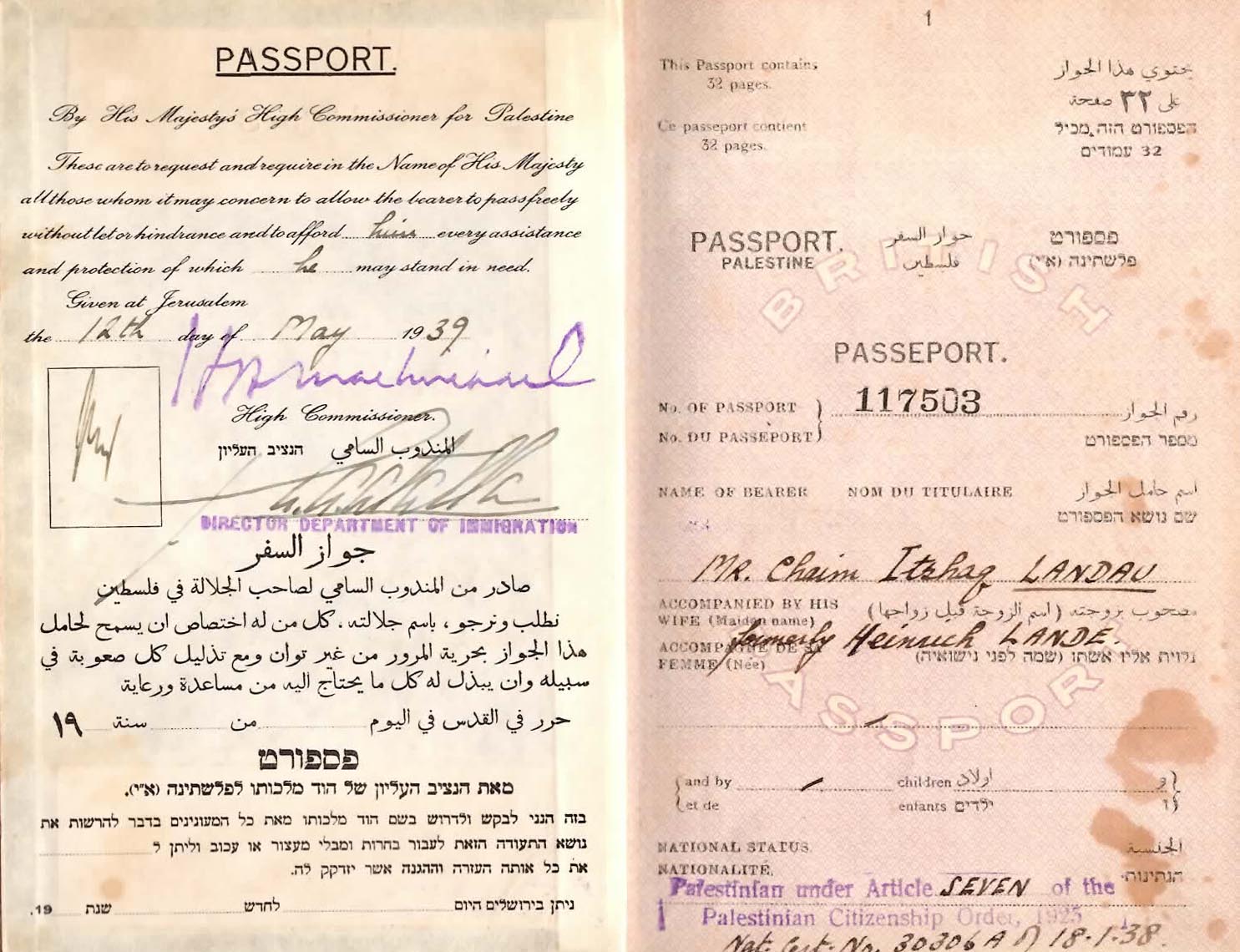
- ^ "Image of a passport of a Palestinian Jew (1939)".
- ^ After crushing the Bar Kokhba revolt, Roman Emperor Hadrian applied the name Syria Palæstina to the region, including the area known as Kingdom of Israel, thus reviving and expanding the ancient name of the Pentapolis Philistia, in an attempt to suppress Jewish connection to the land. (H.H. Ben-Sasson: A History of the Jewish People, Harvard University Press, 1976, ISBN 0-674-39731-2, page 334: "In an effort to wipe out all memory of the bond between the Jews and the land, Hadrian changed the name of the province from Iudaea to Syria-Palestina, a name that became common in non-Jewish literature." - Ariel Lewin: The archaeology of Ancient Judea and Palestine. Getty Publications, 2005, ISBN 0-89236-800-4, p. 33. "It seems clear that by choosing a seemingly neutral name - one juxtaposing that of a neighboring province with the revived name of an ancient geographical entity (Palestine), already known from the writings of Herodotus - Hadrian was intending to suppress any connection between the Jewish people and that land." - 'The Bar Kokhba War Reconsidered', by Peter Schäfer, ISBN 3-16-148076-7)
- ^ Some scholars describe the Roman persecution of the Jews in Syria Palæstina after the Bar Kokhba revolt (135 CE) as a genocide (Totten, S.: Teaching about genocide: issues, approaches and resources. . p24) for it resulted in an extensive depopulation of Jewish communities, more so than the First Jewish–Roman War of 70 CE (Taylor, J. E. (2012-11-15). The Essenes, the Scrolls, and the Dead Sea. Oxford University Press. ISBN 9780199554485.
Up until this date the Bar Kokhba documents indicate that towns, villages and ports where Jews lived were busy with industry and activity. Afterwards there is an eerie silence, and the archaeological record testifies to little Jewish presence until the Byzantine era, in En Gedi. This picture coheres with what we have already determined in Part I of this study, that the crucial date for what can only be described as genocide, and the devastation of Jews and Judaism within central Judea, was 135 CE and not, as usually assumed, 70 CE, despite the siege of Jerusalem and the Temple's destruction
) - ^ "Finding Palestine Through Humor". Institute for Palestine Studies. Palestine-Studies.org. 30 July 2013. Retrieved 24 February 2026.
- ^ "Thanks to Rashida Tlaib, Palestinians finally have a voice". www.thenation.com. Retrieved August 15, 2019.
- ^ a b "Palestinian and Proud: 6 times the Hadid's embraced their roots". www.stepfeed.com. Retrieved August 15, 2019.
- ^ "IMEU: Links: Charlie Bisharat: Violinist and recording artist". Archived from the original on 2013-04-10. Retrieved 2013-02-10.
- ^ "Palestinian Christian from Bethlehem wins wildly popular 'Arab Idol' song contest". Washington Post.
- ^ Palestinian public hails local hero of Arab Idol Archived 2014-11-03 at the Wayback Machine. Ma'an News Agency. 2 June 2013.
- ^ "BBC World Service | Programmes | Outlook | Visiting a Palace in the West Bank".
- ^ "May El Calamawy". Time Out Dubai. September 14, 2011. Archived from the original on April 3, 2022. Retrieved April 6, 2022.
- ^ Calamawy, May (June 11, 2020). "Sharing My Alopecia Helped Me Set New Expectations for Myself". Glamour. Archived from the original on June 5, 2021. Retrieved June 5, 2021.
- ^ "Up Close and Personal with Mayssoun Azzam". Al Bawaba. 9 August 2005. Retrieved 21 September 2011.
- ^ a b c d e f Geiger, Joseph. Hellenism in the East: Studies on Greek Intellectuals in Palestine. p. 9. ISBN 9783515106177.
All this said it is of course clear, that the Palestinian provenance of some important Greek poets, writers and philosophers did not go unnoticed by classical scholars. From the Cynic Menippus, the poet Meleager and the poet and philosopher Philodemus, all of Gadara in the Hellenistic Age, to Marinus of Neapolis, the last Head but two of the Neoplatonic School in Athens and Procopius of Caesarea, the historian of the Age of Justinian and the last to uphold the tradition of classical historiography, the place of their birth, and in some of the cases the place of their activity, were duly noticed. Among intellectuals from Ascalon only the philosopher Antiochus, and to a lesser degree the mathematician Eutocius (and to an even lesser degree, the poet Euenus and the architect Julian) have received special attention. Nevertheless, with the sole exception of the so-called School of Gaza in the fifth and sixth centuries it has never been attempted to position a group of Greek intellectuals in their Palestinian surroundings, or of analysing the contribution to Greek cultural life of the inhabitants of one city in that country; Part II of this book will attempt to rise to this challenge.
- ^ *(1) 'today most active Jesus scholars are convinced that Jesus was a real historical being, who existed as a Palestinian-Jewish person in the beginning of the first century CE.' Per Bilde, The Originality of Jesus: A Critical Discussion and a Comparative Attempt, Vandenhoeck & Ruprecht, 2013 p.60
- (2) 'The recovery of Jesus' identity as a first-century Palestinian Jew, begun with Klausner's Jesus of Nazareth and reiterated forcefully by such recent authors as Vermes and Sanders, does important conceptual work.' John S.Kloppenberg, ‘Sources, Method and Discursive Locations in the Quest for the Historical Jesus,’ in Tom Holmén, Stanley E. Porter (eds.) Handbook for the Study of the Historical Jesus, (4 Vols) BRILL Vol.1, 2011 pp.241-289 p.247
- (3) Those events and that teaching would have meant much to the dozens of Palestinian Jews we call the early apostles. . . .Could any of those who were not familiar with Jesus in his native Palestine have been totally incurious about his public life and teaching, what manner of man he was that some had thought him intimately related to God and others wanted him dead.?’ Gerard S. Sloyan, Jesus: Word made flesh, Liturgical Press, 2008 p.40
- (4) Jesus’ rejection of divorce outright would have offended practically everyone of His day. Further, Jesus’ view that the single state was a legitimate and not abnormal calling for those to whom it was given, went against prevailing views in various parts of the Roman Empire about a man's duty to marry and procreate, but nowhere more so than in His native Palestine.’ Ben Witherington 111, Women in the Ministry of Jesus: A Study of Jesus' Attitudes to Women and Their Roles As Reflected in His Earthly Life, Cambridge University Press 1987 p.125
- (5) The earliest church was not entirely homogeneous culturally. Acts 6 indicates that almost from the beginning two groups existed.: the Hebrews and the Hellenists. Most scholars conclude that the Hebrews were primarily Aramaic-speaking Jews and native Palestinian in dress. The Hellenists were on the other hand Jews that had .. adopted Greek as their language as well as Greek dress and customs David A. Fiensy, New Testament Introduction, College Press p.167
- (6) 'Jesus, a Jew of First-Century Palestine.' Frederick James Murphy, The religious world of Jesus: an introduction to Second Temple Palestinian Judaism, Abingdon Press1991 p.311
- (7) 'As I examined these scenes again, I could find none where Jesus directly challenged the forces occupying his native Palestine.' Virginia Stem Owens, Looking for Jesus, Westminster John Knox Press 1999 p.250
- (8) 'Jesus, and the message that he preached to the people of his native Palestine, was truly prophetic,' Joseph Stoutzenberger, Celebrating sacraments, St Mary’s Press, 2000 p.286
- (9) As a man, he (Jesus) traveled throughout his native Palestine teaching the word of God (see Sermon on the Mount), healing the sick, and performing miracles.' Eric Donald Hirsch, Joseph F. Kett, James S. Trefil, The new dictionary of cultural literacy, Houghton Mifflin 2002 p.12
- (10) 'The Bultmann era of New Testament scholarship did not encourage research into the Palestinian background of either Jesus or his movement' (citing Freyne) Morten H. Jensen, The Literary and Archaeological Sources on the Reign of Herod Antipas and its Socio-Economic Impact on Galilee, Mohr Siebeck 2010 p.5
- (11) 'The "influence" of Sal terrae and Lux Mundi seems to have originated, as ideas, with the Palestinian Jesus.' Eric Francis Fox Bishop, Jesus of Palestine: the local background to the Gospel documents, Lutterworth Press 1955 p.73
- (12) But of all the traditions to which Jesus and his Palestinian disciples would have been exposed, the most influential would naturally have been the Jewish.' John Davidson, The gospel of Jesus: in search of his original teachings, 2005 p.177.
- (13) 'We can say that Jesus was a Palestinian Jew who lived during the reign of Emperor Tiberius.' Christopher Gilbert, A Complete Introduction to the Bible, Paulist Press 2009 p.187
- (14) 'Jesus was a Palestinian Jew; Paul was a Jew of the diaspora.' William Baird, History of New Testament Research, Fortress Press, 2002 p.260
- (15a)‘Jesus was a first-century Palestinian Jew. .His faith in God was nurtured within the context of a Jewish home and family, within the context of first-century Palestinian Judaism.’ p.30
- (15b)'Catholic sacraments have their foundation in the preaching and teaching ministry of Jesus of Nazareth a first-century Palestinian Jew.' Gregory L. Klein, Robert A. Wolfe, Pastoral foundations of the Sacraments: a Catholic perspective, 1998 p.32
- (16) 'Born in Bethlehem, Jesus was a Palestinian Jew,' George Kaniarakath, Jesus Christ: a Meditative Introduction, Society of St Paul, Bombay 2008
- (17) 'Jesus, like many Palestinian Jews,..' Chuck Colson, Norm Geisler, Ted Cabal, The Apologetics Study Bible, 2007 p.1481 on Mark 7:35
- (18) 'The title Kurios applied to Jesus by the Palestinian disciples', David B. Capes, Old Testament Yahweh texts in Paul's christology, Mohr Siebeck, Tuebingen 1992 p.13
- (19) 'The reader also will notice the new beatitude generated by Palestinian Jesus culture—'Blessed is whoever is not scandalized by me' (Matt. 11.4/Luke 7.22).' Vernon Kay Robbins, The tapestry of early Christian discourse, 1996 p.140
- (20) 'How did Jesus relate to Palestinian Judaism and how was he different from other Palestinian Jews?' Mark Allan Powell, Jesus as a figure in history, Westerminster John Knox Press, 1998 p.170
- (21) 'Christianity was at first essentially a sect of Palestinian Jews who believed Jesus was the Messiah.' Kathryn Muller Lopez, Glenn Jonas, Donald N. Penny, (eds.)Christianity: A Biblical, Historical, and Theological Guide, Mercer University Press, 2010
- (22)'It also appears that the Nomos tradition is limited to Patristic authors with strong Palestinian ties. Justin was a native of Shechem, while Clement, who came to Alexandria from Athens, identified his greatest teacher as a Palestinian thinker “of Hebrew origins”.’Azzan Yadin Scripture as logos: Rabbi Ishmael and the origins of midrash, University of Pennsylvania Press, 2004 p.175.
- (22) 'There was another type of allegory that was familiar to the Palestinian thinkers.' Willis Allen Shotwell, The Biblical Exegesis of Justin Martyr, S.P.C.K., 1965 p.41(referring to Palestinians, Jews, pagans or others of the period of the 1st-2nd century CE)
- (23) 'Jesus, we may assume, was by all means a Jewish patriot, but rousing his Palestinian people to throw off the Roman yoke was no part of his message. Neither had it been that of John the Baptist.'Gerard S. Sloyan, Jesus: Word Made Flesh, Liturgical Press 2009 p.23
- (24) 'Given the fact that Jesus was a Jew, what were the religious concepts he learned, accepted, and perhaps adapted, as a first-century Palestinian Jew?’ David Ray Bourquin First Century Palestinian Judaism: An Annotated Guide to Works in English, Wildside Press LLC (1990) 2007 p.9
- (25) 'The recovery of Jesus' identity as a first-century Palestinian Jew, begun with Klausner's Jesus of Nazareth and reiterated forcefully by such recent authors as Vermes and Sanders, does important conceptual work.'John S.Kloppenberg, ‘Sources, Method and Discursive Locations in the Quest for the Historical Jesus,’ in Tom Holmén, Stanley E. Porter (eds.) Handbook for the Study of the Historical Jesus (4 Vols) BRILL Vol.1, 2011 pp.241-189 p.247
- (26) (of Paul) 'his preaching was addressed largely to diaspora Jews, not the Palestinian Jews among whom Jesus circulated.'Robert Chazan The Jews of Medieval Western Christendom: 1000-1500, Cambridge University Press 2006 p.31
- (27) 'He was a Palestinian Jew, born of a woman named Mary married to a carpenter, Joseph.' Joseph A. Fitzmyer, A Christological Catechism: New Testament Answers, Paulist Press 1991 p.16.p.16
- (28) 'The historical setting of Jesus' life and teaching — that he was a first-century Palestinian Jew-may awaken Christian theology to its Judaic origins’Katherine Sonderegger, That Jesus Christ Was Born a Jew: Karl Barth's Doctrine of Israel, Pennsylvania University Press 2010 p.10.
- (29) 'Jesus, we may assume, was by all means a Jewish patriot, but rousing his Palestinian people to throw off the Roman yoke was no part of his message. Neither had it been that of John the Baptist.' Gerard S. Sloyan, Jesus: Word Made Flesh, Liturgical Press 2009 p.23
- (30) ‘Given the fact that Jesus was a Jew, what were the religious concepts he learned, accepted, and perhaps adapted, as a first-century Palestinian Jew?’ David Ray Bourquin, First Century Palestinian Judaism: An Annotated Guide to Works in English, Wildside Press, Studies in Judaica and the Holocaust', 6, 2007 p.9.
- ^ Bauckham, Richard. "The Relatives of Jesus". Themelios. 21 (2).
- ^ a b Lee, Sang-Il (2012). Jesus and Gospel Traditions in Bilingual Context: A Study in the Interdirectionality of Language. pp. 318, 380.
- ^ Geiger, Joseph. Hellenism in the East: Studies on Greek Intellectuals in Palestine. p. 18. ISBN 9783515106177.
Flavius Boethus From Ptolemais, interested in Peripatetic philosophy and medicine, known only from Galen and the inscription quoted below, according to which he may have been consul in 161 or 162 and governor not before 164 or 165: he is the only person from Palestine in the Early Empire to become governor of the province. It may be conjectured that Galen's visit to Palestine (see GLAJJ II, nos. 382, 384, 385, 390) was connected with their relationship: Galen restored to health Boethus' wife and one of his sons, and was handsomely rewarded and introduced to Mark Aurel; Galen eventually dedicated to him not less than nine of his works.
- ^ Jeffrey L. Rubenstein (27 June 2002). Rabbinic stories. Paulist Press. p. 109. ISBN 978-0-8091-4024-4. Retrieved 2 August 2011.
- ^ Bonar, Chance (May 20, 2025). "The Father of Church History was Palestinian". Everyday Orientalism.
Eusebius viewed himself as a Palestinian and sought through some of his writings, especially On the Martyrs of Palestine, to craft, narrate, and disseminate his understanding of Palestinian Christian identity and the importance of Palestine to Christian history to his readers.
- ^ a b Taylor, Joan E. (1993). Christians and the Holy Places: The Myth of Jewish-Christian Origins. pp. 56–63.
- ^ Eusebius. "Martyrs of Palestine, short recension, III". Retrieved 17 April 2013.
- ^ Barnes, Timothy David (2010). Early Christian Hagiography and Roman History. Mohr Siebeck. p. 121.
Although he died in Antioch, he was a Palestinian, and Eusebius counted him as one of the martyrs of his province.
- ^ Binns, John (2019). The T&T Clark History of Monasticism: The Eastern Tradition. Bloomsbury Publishing.
Another early Palestinian monk was Hilarion, whose life was written by Jerome. Hilarion (291-371) was, according to Jerome, the first monk in Gaza, and together with Anthony of Egypt, he established monastic life.
- ^ Johanyak, Debra; Lim, W. (2010). The English Renaissance, Orientalism, and the Idea of Asia. Palgrave MacMillan. p. 52.
Born in Cappadocia, to a mother who was Christian Palestinian ...
- ^ a b c Geiger, Joseph. Hellenism in the East: Studies on Greek Intellectuals in Palestine. p. 13. ISBN 9783515106177.
Aeneas 1 was born about 430, studied in Alexandria with Hierocles in about 450, and is attested in 488; the fact that Zacharias 1 referred to him in 514 without a formula confirming his death should not be taken as proof. He visited Constantinople and had connections in Antioch and other cities. Among his Palestinian correspondents were Iohannes 3 (not sure, see s. v.), Zonaeus, Diodorus, Zosimus 2, Epiphanius 2, the iatrosphist Gessius of Petra, and Julianus 1, as well as the sophist Diogenes of Antioch, who corresponded also with Hierius and with Eutocius 1. The absence of any correspondence between him and Procopius 1 must be due to both of them residing in the same city and should not be construed even as an argumentum e silen tio against their acquaintance.
- ^ Bitton-Ashkelony, Brouria; Kofsky, Aryeh (2006). The Monastic School of Gaza. Brill. p. 14.
There is no doubt that Sozomen's Palestinian origins and his particularly close acquaintance with the south of the country and with Palestinian local traditions contributed to his desire to include these matters in his composition, even when not required by the narrative.
- ^ McCray, Austin (2024). "THE PRACTICE OF LENTEN SOLITUDE IN THE LIVES OF CYRIL OF SCYTHOPOLIS" (PDF). Journal for Late Antique Religion and Culture. 18. Cardiff University Press: 33–50.
In this excerpt, Cyril of Scythopolis, a Palestinian monk writing in the mid-sixth century, described an annual practice in which a small number of monks left their monasteries for a period of solitude during the season of Lent.
- ^ Noble, Samuel; Treiger, Alexander (2014). The Orthodox Church in the Arab World, 700–1700: An Anthology of Sources. p. 160.
As the author of thr first collection of Christian religious poetry in Arabic, the early eleventh-century Palestinian bishop sulayman al-Ghazzi (or Solomon of Gaza) holds a unique place in the history of Arab Christian literature.
- ^ Al-Maqdisi (1906). M. J. Goeje (ed.). The Best Divisions for Knowledge of the Regions (Arabic) (2 ed.). Brill. p. 440.
في البناء فقال لي الاستاذ انت مصري ؟. قلت لا بل فلسطيني . قال سمعت ان عندكم تخرم الاحجار كما يخرم الخشب. قلت اجل (And I told them of the architecture in Palestine, and asked them questions in the art of architecture. He {a Stone cutter} asked me 'Are you Egyptian ?' I said 'No, I am Palestinian'. He said : 'I heard you drill stone as you would drill wood ?'. I said 'Yes'.)
- ^ Jalajel, David Solomon (2016). Women and Leadership in Islamic Law: A Critical Analysis of Classical Legal Texts. Taylor & Francis. p. 190.
Written by the Palestinian-Syrian scholar al-Qudāmah, al-Mughnī is the first major, comprehensive encyclopedic work on Hanbali school of law.
- ^ The Encyclopedia of Islam Three (PDF). E.ܿܿJ. Brill. 2017. p. 139.
He was born in the Palestinian village of Qāqūn in 710/1310 ...
- ^ Al-Hassani, Salim (2025-07-18). "Ibn al-Ha'im, A Scholar and Mathematician from Jerusalem: Some of his Manuscripts in Near Eastern libraries". Muslim Heritage.
- ^ a b Gerber, H. (2008). Remembering and Imagining Palestine:Identity and Nationalism from the Crusades to the Present. pp. 49–51.
Mujir al-Din is our baseline for all aspects of Palestinian identity in Ottoman times: He was clearly conscious of his Palestinian-ness; he was clearly conscious as well of living in a Holy Land, and he was fully aware of the Crusades, their likely recurrence, ans the probably implications of this for the people of the country. [...] Khayr al-Din al-Ramli calls the country he was living in Palestine, and unquestionably assumes that his readers do likewise. What is even more remarkable is his use of the term "the country" and even "our country" (biladuna) possibly meaning that he had in mind some sort of a loose community focused around that term.
- ^ "Farid al-Salim, Landed Property and Elite Conflict in Ottoman Tulkarm, P75" (PDF). Institute for Palestine Studies. Archived (PDF) from the original on 22 July 2020. Retrieved 12 January 2021.
- ^ Doumani, Beshara (1995). "Cotton, Textiles and the Politics of Trade". Merchants and Peasants in Jabal Nablus, 1700-1900. UNIVERSITY OF CALIFORNIA PRESS.
It is significant that we meet Zahir al-Umar (1690–1775) in this context, because he, more than any other Palestinian leader during the Ottoman period, was closely associated with the growing trade in cotton.[5] His imposition of a monopoly on the export of cotton changed the politics of trade in northern Palestine and put him on a collision course with the leaders of Jabal Nablus.
- ^ "Christians Celebrate Beatification of Palestinian Nun". Holy Land Christian Ecumenical Foundation. 27 November 2009. Archived from the original on 24 March 2018. Retrieved 23 March 2018.
- ^ Melvin, Don; Liebermann, Oren; Latza Nadeau, Barbie (17 May 2025). "In religious and political gesture, Pope confers sainthood on two Palestinians". CNN. Retrieved 28 July 2025.