In Kaluza–Klein theory, a unification of general relativity and electromagnetism, the five-fimensional Kaluza–Klein–Christoffel symbol is the generalization of the four-dimensional Christoffel symbol. They directly appear in the geodesic equations of Kaluza–Klein theory and indirectly through the Kaluza–Klein–Riemann curvature tensor also appear in the Kaluza–Klein–Einstein field equations.
The Kaluza–Klein–Christoffel symbols are named after Theodor Kaluza, Oskar Klein and Elwin Bruno Christoffel.
Definition
Let  be the Kaluza–Klein metric. The Kaluza–Klein–Christoffel symbols are given by:[1]

Properties
- For non-compactified spacetime indices, the Kaluza–Klein–Christoffel symbols don't reduce to the ordinary Christoffel symbols. Instead one has:

- For compactified spacetime indices, the Kaluza–Klein–Christoffel symbols simplify with the cylinder condition:


- Analogous to the ordinary Christoffel symbol, but additionally using the relation
 ,[2] one has:

Kaluza–Klein geodesic equation
The Kaluza–Klein Christoffel symbols are of particular importance in the Kaluza–Klein geodesic equation, which is the geodesic equation based on the Kaluza–Klein metric. These can be separated with respect to non-compactified and compactified spacetime indices with the respective simplifcations of the Kaluza–Klein Christoffel symbols above entering:


The first equation now contains the ordinary geodesic equation  with additional terms all coming from the additional dimension. The second equation is fully based on it.
A special case, which strongly simplifies both equations, is when there is no movement in any non-compactified dimension, meaning  . In this case, there is only movement in the compactified dimension. The first equation then simplifies to
  , which means that (using
  , otherwise the Kaluza–Klein metric would become singular) the condition
  is required for this to stay the case. The second equation then simplifies to
  and the front term
  is in fact a constant along the geodesic using
  and the cylinder condition. For
  a solution with additional constants of integration
  (which can be determined from the initial values
  and
and  ) is given by:
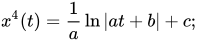
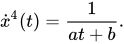
This describes an asymptotic stop using  .
.
Literature
References
- ^ Overduin & Wesson 1997, Equation (4)
- ^ Pope, Equation (1.14)