Jose Estella
Jose Estella | |
|---|---|
Jose Estella in a 1924 book | |
| Born | May 2, 1870 Manila, Philippines |
| Died | 6 April 1943 (aged 72) Manila, Philippines |
| Occupation | Composer |
| Years active | 1890–1900 |
| Children | Ramon Estella |
Don José Anastasio Estella y Barredo (2 May 1870 – 6 April 1943) was a Filipino composer and conductor. Besides composing waltzes, he also became one of the major contributors of Philippine zarzuelas from the 1890s to 1900s.[1] He was sometimes referred to as the "Philippine Waltz King".[2][3]
Biography
Jose Estella was born in Escolta, Manila on 2 May 1870[4][5] to Spaniard Don José María Agustín Ricardo Estella y Cazorla from Andalusia, Spain and Doña María del Socorro Josefa Antonia Barredo y González from Quiapo, Manila.[6] He was baptized at the Binondo Church.[5] A virtuoso pianist by age 10, he had performed before King Alfonso XII of Spain and entered the Royal Conservatory of Brussels, Belgium.[5] After studying and graduating from the Madrid Conservatory, he returned to the Philippines and pursued a career in music. In Manila and Cebu, he conducted several orchestras. In Manila, he had a teaching career as a piano instructor and spent his time studying history, visiting different Filipino provinces and exploring the local folk music. In Cebu, he was director of the Municipal Band where he started to gain recognition.[4] Estella also became the first director of the Rizal Orchestra, founded by Martin Ocampo in 1898.[7][3][8]
Philippine Revolution
He received patronage from Francisco Roxas, one of the wealthiest men in the Philippines and would frequently provide music at Roxas' social events. In January 1897, Roxas was executed by Spanish authorities. On the night of his patron's arrest, Estella accompanied him in the carriage which brought him to prison. The arrest occurred following Jose Rizal's martyrdom in December 1896.[9]: 127–128
American occupation
Estella was one of the Filipino composers inspired from the songs published by the Tin Pan Alley. During the American occupation, he made his ragtime and dance compositions such as the California March (1899), Germinales (1908), Manila Carnival Rag (1914), and the Visayan Moon (1922).[10] He was also the first Filipino to compose a complete symphonic poem, Mi Ultimo Adios.[5] According to music historian Antonio J. Molina, Estella wrote a violin concerto but was not performed publicly.[11]
Estella became involved with a plagiarism case in 1939 with Francisco Santiago over which he complains that Santiago copied his Campanadas de Gloria. In the end of the investigation, it was revealed that they both get inspiration from the same folk song named "Leron Leron Sinta".[12][13] The controversy between the two composers became a sensation throughout the Philippines.[13]
Death
He died on 6 April 1943 in Manila,[5] and throughout his lifetime, he composed more than 100 waltzes hence he is given the title, "the Philippine Waltz King".[2][3] In terms of his personal life, he was married to Doña Matilde Tronqued and had three sons: Jose Blas, Antonio, and Ramon Estella. [5] His son, Ramon Estella, was a film director.[14]
Notable works
Ang Maya
Composed in 1905, it was a piece from Estella's zarzuela, "Filipinas para los Filipinos" with Severino Reyes as librettist.[10] Estella's "Filipinas para los Filipinos" was a satire made by the composer as a reaction to an American Congress bill banning American women from marrying Filipino men.[8] Maria Carpena, one of the first recording artist in the Philippines, sung "Ang Maya" under the American label Victor Records issued around 1908 and 1909.[10]
La Tagala
Originally composed in 1898,[15] the waltz is a collection of Filipino folk songs such as Balitaw, Hele hele, Kundiman, Kumintang, etc. It was dedicated to the Tobacco Company Germinal. One of its notable performance was on a concert night of November 1899.[16] His La Tagala, along with his other works, were preserved in the United States' Library of Congress.[17]
Filipinas Symphony (1928)
Jose Estella's Filipinas Symphony is the first Filipino Symphony by modern scholarly consensus.[3] It was composed in 1928 prior to Francisco Santiago's Taga-ilog Symphony.[18] Some parts of the symphony were lost during World War II.[18]
Other works
Source:[19]
- California March (Ragtime)
- El Diablo Mundo - First performed at the inauguration of the Teatro Zorrila on October 25, 1893, this zarzuela was described to have a dark and gloomy atmosphere.[20] Emilio and Rafael del Val wrote the prose and verse of this zarzuela.[21][15]
- Los Pajaros[22]
- Katubusan (Fox-Trot)
- My Dreamed Waltz
- Veni, Vidi, Vici – a Tagalog opera with Severino Reyes as librettist[23][24][25]
- Ang Opera Italiana - in collaboration with Severino Reyes, presented 1908[23][26]
- La Venta de Filipinas al Japon – in collaboration with Severino Reyes, presented 1905[23][26]
References
Citations
- ^ Canave-Dioquino, Corazon. "Music in the Philippines since 1898". National Commission for Culture and the Arts.
- ^ a b Santos, Ramon Pagayon. "Nationalism and Indiginization in Philippine Contemporary Music; An Accultured Response To Westernization" (PDF). University of the Philippines.
- ^ a b c d Philippines, Cultural Center of the (1994). CCP Encyclopedia of Philippine Art: Philippine music. Cultural Center of the Philippines. ISBN 978-971-8546-40-6.
He [Jose Estella] became known as the "Waltz King" of the Philippines, having written more than 100 waltzes, most popular of which was "Ang Maya"...
- ^ a b Bañas 1924, p. 114.
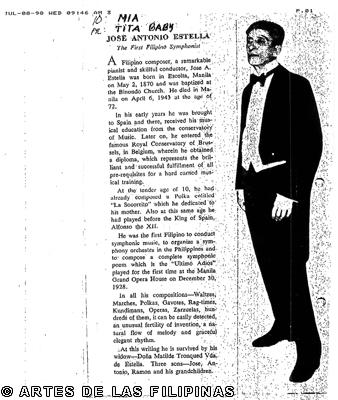
- ^ a b c d e f "Jose Antonio Estella: The First Filipino Symphonist". Artes De Las Filipinas. 8 March 2012. Archived from the original on 24 February 2026. Retrieved 17 September 2025.
Jose A. Estella was born in Escolta, Manila on May 2, 1870 and was baptized at Binondo Church. He died in Manila on April 6, 1843 at the age of 72.
- ^ "Jose A. Estella". www.geni.com. Retrieved 25 February 2026.
- ^ Bañas 1924, p. 19.
- ^ a b Miller, Terry E.; Williams, Sean (25 September 2017). The Garland Encyclopedia of World Music: Volume 4: Southeast Asia. Routledge. ISBN 978-1-351-54420-7.
- ^ Tan, Arwin Quiñones (18 December 2019). "Patronage and Capitalism in the Musical Associations of Late Nineteenth-Century Colonial Manila". Malaysian Journal of Music. 8: 122–135. doi:10.37134/mjm.vol8.8.2019. ISSN 2600-9331.
- ^ a b c Murray, Jeremy A.; Nadeau, Kathleen (15 August 2016). Pop Culture in Asia and Oceania. Bloomsbury Publishing USA. ISBN 978-1-4408-3991-7.
- ^ Philippines, Cultural Center of the (1998). The National Artists of the Philippines. Cultural Center of the Philippines. ISBN 978-971-27-0782-7.
- ^ Castro, Christi-Anne (28 March 2011). "Composing for an Incipient Nation". Musical Renderings of the Philippine Nation. pp. 23–58. doi:10.1093/acprof:oso/9780199746408.003.0002. ISBN 978-0-19-974640-8.
- ^ a b Hila, Antonio C. (2004). Music in History, History in Music. University of Santo Tomas Publishing House. ISBN 978-971-506-302-9.
In 1939, when [Francisco] Santiago was accused of his fellow composer Jose Estella, the case became sensational as it "shocked not only Metropolitan Manila but the nation as well."
- ^ Pareja, Lynn (23 September 2011). "Love and army life fascinated Ramon Estella". INQUIRER.net. Retrieved 3 October 2022.
- ^ a b Castillo, Raymundo Bañas y (1975). Pilipino Music and Theater. Manlapaz Publishing Company.
- ^ Bañas 1924, p. 115.
- ^ Filipinos in History. National Historical Institute. 1989. ISBN 978-971-538-093-5.
- ^ a b Sturman, Janet (26 February 2019). The SAGE International Encyclopedia of Music and Culture. SAGE Publications. ISBN 978-1-4833-1774-8.
- ^ "Category:Estella, José - IMSLP: Free Sheet Music PDF Download". imslp.org. Retrieved 1 October 2022.
- ^ Hernandez, Tomas Capatan (1975). "The Emergence of Modern Drama in the Philippines and its Social, Political, Cultural, Dramatic, and Theatrical Background" (PDF). University of Hawaii.
- ^ Sinardet, Emmanuelle; Gómez, Ana María Ramírez (9 November 2024). Literary and Cultural Connections in the Spanish-Speaking World. Springer Nature. ISBN 978-3-031-69126-3.
- ^ Bañas 1924, p. 15.
- ^ a b c Miguel Cornejo (1939). Cornejo's Commonwealth Directory Of The Philippines.
- ^ Deocampo, Nick (22 November 2017). Cine: Spanish Influences on Early Cinema in the Philippines. Anvil Publishing, Inc. ISBN 978-621-420-178-5.
- ^ Buenconsejo, José Semblante, ed. (2017). Philippine Modernities: Music, Performing Arts, and Language, 1880 to 1941. Diliman, Quezon City: University of the Philippines Press. ISBN 978-971-542-849-1.
- ^ a b Samson, Helen F. (2016). Music in the Zarzuelas of Severino Reyes ("Lola Basyang"). University of the Philippines Press. ISBN 978-971-542-800-2.

Books
- Bañas, Raymundo C. (1924). The Music and theater of the Filipino people. Manila: Oriental Printing.