Hymenoxys helenioides
| Hymenoxys helenioides | |
|---|---|
| Scientific classification | |
| Kingdom: | Plantae |
| Clade: | Tracheophytes |
| Clade: | Angiosperms |
| Clade: | Eudicots |
| Clade: | Asterids |
| Order: | Asterales |
| Family: | Asteraceae |
| Genus: | Hymenoxys |
| Species: | H. helenioides
|
| Binomial name | |
| Hymenoxys helenioides | |
| Synonyms[2] | |
| |
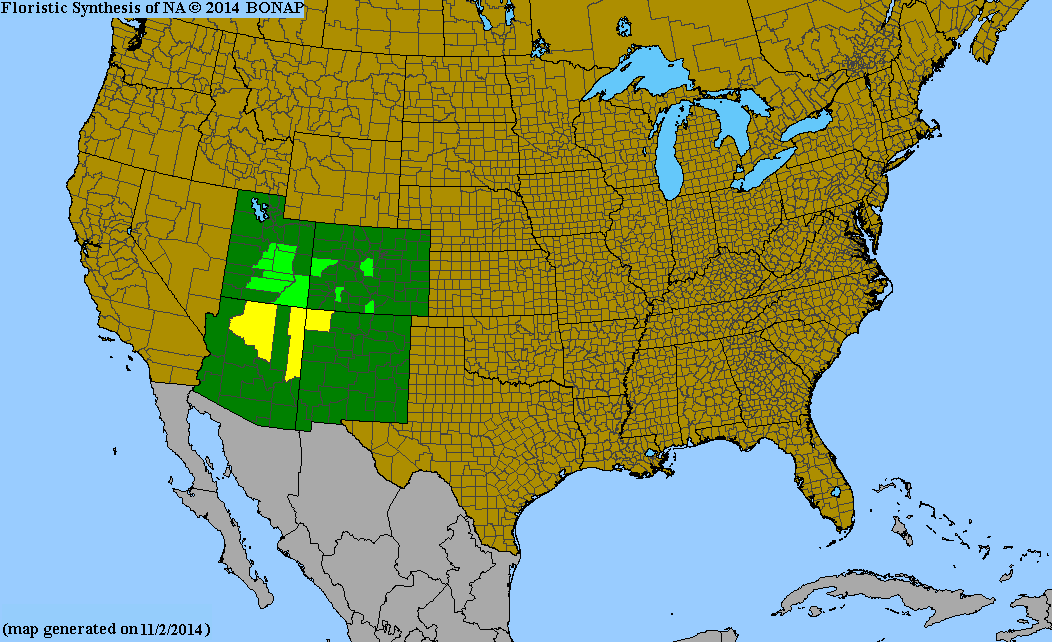
Hymenoxys helenioides is a North American species of flowering plant in the daisy family known by the common name intermountain rubberweed. It is native to Arizona, Utah, Colorado, and New Mexico in the western United States.[3]
Hymenoxys helenioides is a perennial herb up to 50 cm (20 in) tall. One plant generally produces as many as 50 flower heads. Each head has 10–16 ray flowers and 50–150 disc flowers.[4]
Taxonomy
In 1904 Hymenoxys helenioides was scientifically described and named by Theodore D. A. Cockerell. It is classified in the genus Hymenoxys within the family Asteraceae. It has no subspecies and has three heterotypic synonyms.[2]
| Name | Year |
|---|---|
| Actinea helenioides S.F.Blake | 1931 |
| Dugaldia helenioides A.Nelson | 1909 |
| Picradenia helenioides Rydb. | 1901 |
Range
According to Plants of the World Online, intermountain rubberweed is native to just three western states; Colorado, Utah, and Arizona.[2] However, according to the Natural Resources Conservation Service it also grows in San Juan County, New Mexico and Clark County, Nevada, though nowhere else in these states. The NRCS also records it in just Apache County, Arizona.[5]
References
- ^ NatureServe (5 November 2025). "Hymenoxys helenioides". NatureServe Explorer. Arlington, Virginia. Retrieved 27 December 2025.
- ^ a b c POWO (2025). "Hymenoxys helenioides Cockerell". Plants of the World Online. Royal Botanic Gardens, Kew. Retrieved 27 December 2025.
- ^ Biota of North America Program 2014 distribution map
- ^ Flora of North America, Hymenoxys helenioides (Rydberg) Cockerell, 1904. Intermountain rubberweed
- ^ NRCS (27 December 2025), "Hymenoxys helenioides", PLANTS Database, United States Department of Agriculture (USDA)