Hwasong-16B
| Hwasong-16B | |
|---|---|
| Type | Intermediate-range ballistic missile |
| Place of origin | North Korea |
| Service history | |
| In service | 2024–present |
| Used by | Korean People's Army Strategic Force |
| Production history | |
| Designed | 2024 |
| Manufacturer | North Korea |
| Specifications | |
| Length | 21 m (69 ft) (estimated) |
| Diameter | 2.1 m (6.9 ft) (estimated) |
| Warhead | Hypersonic glide vehicle Nuclear or conventional unitary warhead |
| Propellant | solid-fueled |
Operational range | 3,000–5,500 km (1,900–3,400 mi) (estimated) |
| Maximum speed | Mach 15 – Mach 18 (18,400–22,100 km/h) (estimated) Mach 12 (14,700 km/h) (tested) |
Launch platform | 7-axle transporter erector launcher (TEL) |
The Hwasong-16B[a] (Korean: 《화성포-16나》형; lit. 'Mars Artillery Type 16B') is a North Korean intermediate-range ballistic missile (IRBM). First test-fired on 2 April 2024, Hwasong-16B is the third North Korean ballistic missile capable of carrying hypersonic glide vehicle (HGV) after Hwasong-8 and Hwasong-12B, as well as the first solid-fueled IRBM of North Korea.
Description
| Images of the Hwasong-16B | |
|---|---|
| 7-axle TEL | |
| Launch of the missile |
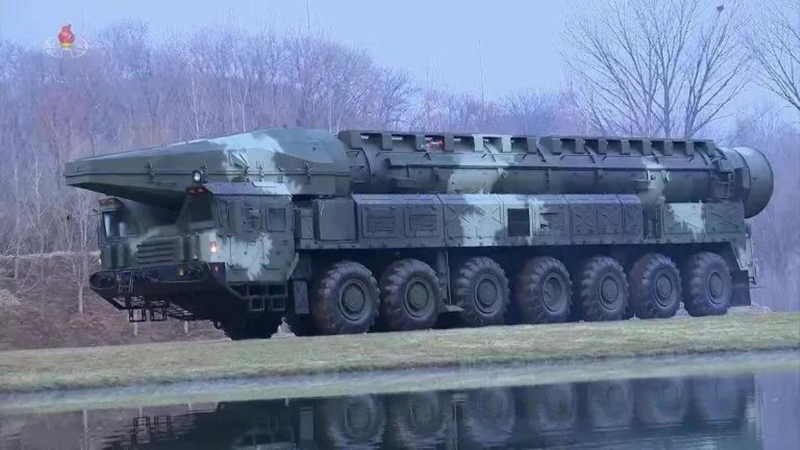
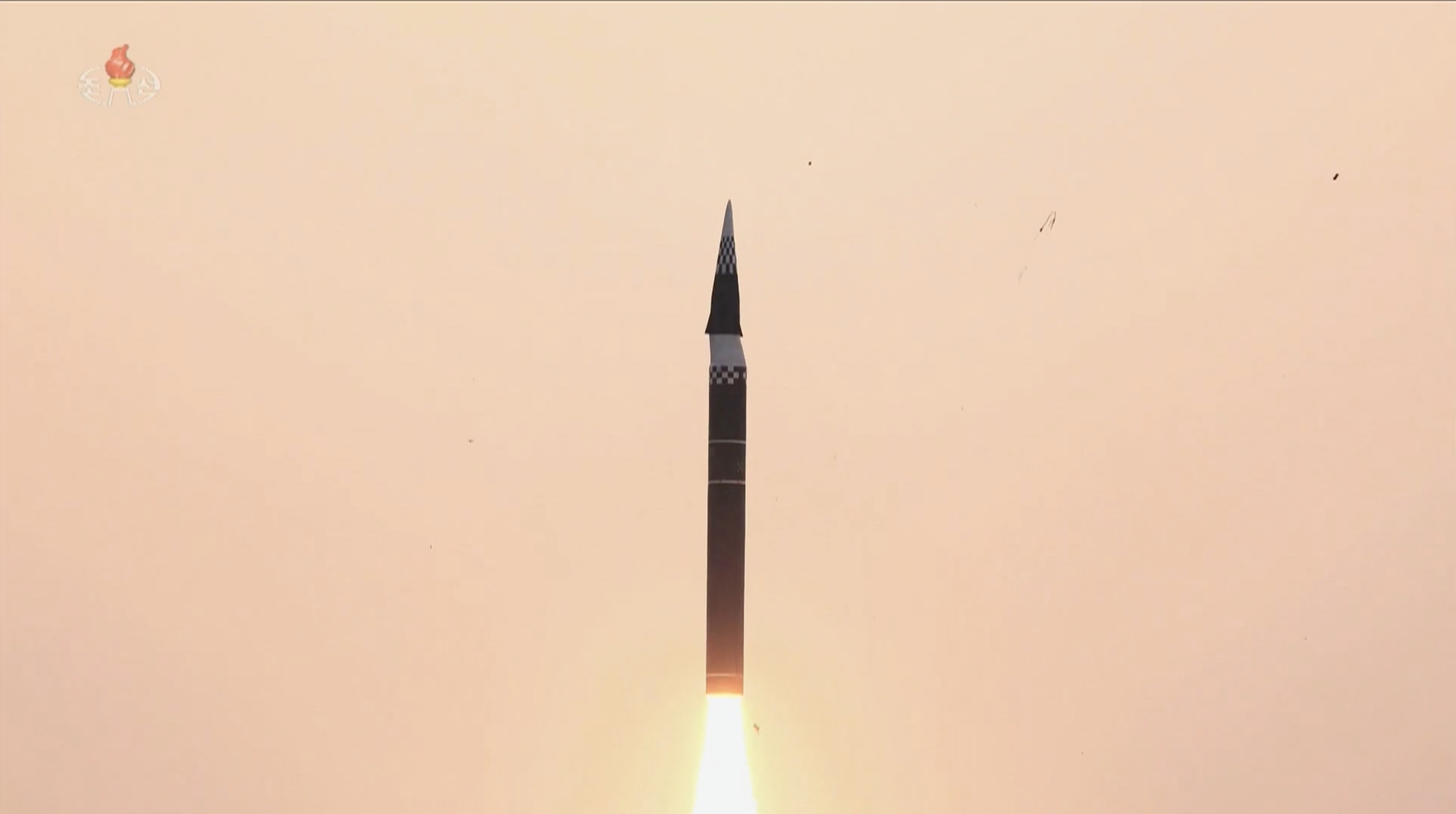
Hwasong-16B is a two-stage, solid-fueled missile. It is estimated to be 21 m (69 ft) long and 2.1 m (6.9 ft) wide. The length of the first and second stage boosters are also judged to be 10.6 m (35 ft) and 5.6 m (18 ft), respectively.[4] The HGV payload is also claimed to have a length of 4.8 m (16 ft).[5] It is launched from a seven-axle wheeled transporter erector launcher (TEL). The open-front canister, which in its stored state, has a two-part clam-shell cover on each side. The missile is cold-launched with a gas generator at the end of the launch tube, popping the missile up prior to ignition.[6]
Based on information released after the January 2025 test, it was determined that the Hwasong-16B's engine body used a new composite carbon fiber material.[7] Its estimated range is about 3,000–5,500 km (1,900–3,400 mi);[5] however, if North Korea increases the Hwasong-16B's range to 6,000 km (3,700 mi), it can even attack US military bases in Alaska. Using Hwasong-16B platform, if North Korea reduces the missile structural weight and uses high-energy solid propellant, Hwasong-16B can achieve 8,000 km (5,000 mi) range and become an intercontinental ballistic missile (ICBM).[8]
Data from test-fires showed that Hwasong-16B reached a maximum speed of Mach 12 (14,700 km/h).[7] However, the estimated maximum speed of the missile is Mach 15 – Mach 18 (18,400–22,100 km/h).[9] According to North Korea, Hwasong-16B have the capablility of evading missile defenses, while its performance is considered "cannot be ignored worldwide".[7][10]
The missile can also be armed with a nuclear or conventional unitary warhead.[4]
History
A military parade on 10 October 2020 unveiled the existence of an intercontinental ballistic missile (ICBM), larger than the Hwasong-15 and mounted on 11-axle launchers.[11][12] It was unofficially dubbed the "Hwasong-16" as part of the Hwasong missile series,[13] though subsequent analysis of footage indicated that it was officially called Hwasong-17.[14]
In November 2023, North Korea announced static ground tests of rocket motors for a solid-fueled IRBM.[15]
On 14 January 2024, North Korea test-fired a solid-fueled hypersonic IRBM, but the missile used for the test was Hwasong-16A, and it was not counted as an official test of Hwasong-16B.[4] After this test, on 19 March 2024, Kim Jong Un oversaw an initial solid-fuel engine test in preparation for another launch.[16] Hwasong-16B officially made its public debut on 2 April 2024, with a flight test. This launch was made with a HGV payload akin to the one mounted on the Hwasong-8.[6]
North Korea conducted another test-fire of Hwasong-16B on 6 January 2025.[17] North Korean state media called the missile as "new-type intermediate-range hypersonic ballistic missile" without mentioning official name.[7] The missile seen in the January 2025 test is identical to the Hwasong-16B missile tested in April 2024.[18]
List of tests
| Attempt | Date | Location | Pre-launch announcement | Outcome | Additional notes | References |
|---|---|---|---|---|---|---|
| 1 | 2 April 2024, 6:53 am Pyongyang Standard Time | Outskirts of Pyongyang | None | Success | First test where the missile was named as Hwasong-16B. The Korean Central News Agency (KCNA) claimed the missile traveled 1,000 km (620 mi) and reached a maximum altitude of 101.1 km (62.8 mi), and subsequently engaged in a pull-up maneuver reaching an altitude of 72.3 km (44.9 mi). South Korean military assessments said it flew 600 km (370 mi), while Japan's Ministry of Defense estimated a range of 650 km (400 mi), suggesting the HGV test was not successful. The maximum speed was Mach 5 (6,100 km/h).
Kim Jong Un supervised the launch, with senior officials attending. The launch coincided with a joint US/Japan/South Korea trilateral flight exercise. |
[6][19][20][21] |
| 2 | 6 January 2025, around 12:00 pm Pyongyang Standard Time | Outskirts of Pyongyang | None | Success | Japanese and South Korean data showed the missile flew approximately 1,100 km (680 mi). Japan also stated that the missile's apogee was around 100 km (62 mi). North Korean data showed the missile flew 1,500 km (930 mi), with a first apogee of 99.8 km (62.0 mi) and a secondary apogee of 42.5 km (26.4 mi). The maximum speed was Mach 12 (14,700 km/h). However, according to South Korean military, the KCNA's report was most likely exaggerated, as South Korea did not detect a secondary apogee and the detected range was around 1,100 km (680 mi).
The launch was supervised by Kim Jong Un and his daughter. |
[7][17] |
Responses after Hwasong-16B's maiden flight
Carnegie Endowment for International Peace researcher Ankit Panda, described the transition to solid-fuel rockets as a heavily favored play by Kim, noting that "There are obvious strategic advantages to an all-solid-fuel force for them in the form of greater promptness, responsiveness, and survivability,"[20]
The launch was condemned by the United Kingdom as a breach of United Nations Security Council resolutions.[20]
Japan's Prime Minister Fumio Kishida condemned the launch as "damaging for regional and international peace and stability".[21]
South Korea's Ministry of Foreign Affairs confirmed a joint investigation ongoing with the U.S., and subsequently on 3 April 2024 it seized a ship off the coast of South Korea in violation of North Korean sanctions.[20]
Variants
MaRV variant
Prior to the April 2024 test of Hwasong-16B with hypersonic glide vehicle (HGV), in January 2024, a variant of Hwasong-16B with maneuverable reentry vehicle (MaRV) was tested. The official name of this variant may be Hwasong-16A, but it remains unconfirmed.[22][23]
MIRV test vehicle
The two-stage solid-propellant booster, which was used for the tests of Hwasong-16A and Hwasong-16B, was unofficially called as Hwasong-16. It is based on the Hwasong-18 solid-fueled ICBM.[18] This booster is believed to be an unconfirmed road-moblie, solid-fueled IRBM with possible MIRV-capable.[24]
On 26 June 2024, North Korea test-fired a missile using the first stage of Hwasong-16 to test multiple independently-targeted reentry vehicles (MIRVs). The missile that had the first stage to be used in this test was not officially named, instead, North Korean state media depicting it as an "intermediate-range solid-fuel ballistic missile" and claimed the test was a success,[25] with the three warheads being guided to their targets. South Korean military detected the launch around 5:30 a.m. and claimed that North Korea possibly launched a hypersonic missile.[26] According to South Korea and Japan, the missile flew 250 km (160 mi) with an apogee of 100 km (62 mi), failed to release any warhead and exploded in midair before falling into Sea of Japan.[27][28]
The nose cone of the MIRV test vehicle resembles that of Hwasong-17.[28]
In popular culture
After the first successful test, on 27 July 2024, the Korea Stamp Corporation unveiled postage stamps featuring Hwasong-16B.[29]
See also
Related development
Comparable missiles
Notes
References
- ^ Tianran Xu (12 April 2024). "HGV Unproven at IRBM Ranges: Analysis of the April 2 Hwasong-16Na Hypersonic Missile Test". 38 North. Retrieved 5 January 2025.
- ^ "DPRK Missile Administration Succeeds in Test-fire of New-type Intermediate-range Hypersonic Missile". Korean Central News Agency. 3 April 2024. Retrieved 5 January 2025.
- ^ "DPRK Missile Administration Succeeds in Test-fire of New-type Intermediate-range Hypersonic Missile". Minju Joson. 3 April 2024. Retrieved 19 June 2025.
- ^ a b c "Hwasong-16B". Missile Threat. Center for Strategic and International Studies. 17 December 2025. Retrieved 5 January 2026.
- ^ a b Kapil Kajal; Rahul Udoshi (4 April 2024). "Update: North Korea test-fires Hwaseong-16Na intermediate-range hypersonic missile". Janes Information Services. Retrieved 8 August 2025. For detail, see this image
- ^ a b c Vann H. Van Diepen (5 April 2024). "Second Flight of North Korea's Solid IRBM Also Second Flight of HGV". 38 North. Retrieved 31 January 2025.
- ^ a b c d e "DPRK Missile Administration Succeeds in Test-fire of New-type Intermediate-range Hypersonic Ballistic Missile". Korean Central News Agency. 7 January 2025. Retrieved 7 January 2025.
- ^ Thu Thủy (8 January 2025). "Khám phá tên lửa tầm trung siêu thanh Hwasong-16B Triều Tiên vừa phóng thử nghiệm" [Discovering the Hwasong-16B hypersonic intermediate-range ballistic missile that North Korea has just tested]. VietTimes (in Vietnamese). Retrieved 31 January 2025.
- ^ Min Dae-ho (3 April 2024). "北, 절대 요격 어려운 극초음속미사일 성공"…美 방처체계 '구멍' ["North Korea succeeds in launching hypersonic missile that is absolutely difficult to intercept"... 'Holes' in US defense system]. Korea Report (in Korean). Retrieved 5 February 2025.
- ^ "Triều Tiên thử tên lửa siêu vượt âm có thể "xuyên thủng mọi lớp phòng thủ"" [North Korea tests hypersonic missile capable of "penetrating any defense"]. Langson Radio & Television (in Vietnamese). 7 January 2025. Retrieved 7 February 2026.
- ^ Smith, Hyonhee; Shin, Josh (11 October 2020). "North Korea unveils 'monster' new intercontinental ballistic missile at parade". Reuters. Retrieved 14 February 2026.
- ^ "Triều Tiên trình làng tên lửa đạn đạo mới" [North Korea unveiled new ballistic missile]. Quảng Ngãi TV (in Vietnamese). Quang Ngai Newspaper and Radio, Television. 11 October 2020. Retrieved 14 February 2026.
- ^ Nguyễn Tiến (13 October 2020). "Uy lực hai 'siêu tên lửa' Triều Tiên khoe trong duyệt binh" [The power of two North Korean 'super missiles' shown in parade]. VnExpress (in Vietnamese). Retrieved 8 August 2025.
Giới chuyên gia gọi mẫu tên lửa mới là Hwasong-16, song chưa rõ nó có tầm bắn xa hơn, hiện đại hơn các mẫu trước đây hay có thể mang các đầu đạn hồi quyền độc lập (MIRV) hay không. (Experts call the new missile the Hwasong-16, but it is unclear whether it has a longer range, is more advanced than previous models, or can carry multiple independently targetable reentry vehicles.)
- ^ Tianran Xu (20 October 2021). "Brief on the Defence Development Exhibition of the Democratic People's Republic of Korea" (PDF). Open Nuclear Network. p. 11. Retrieved 8 August 2025.
- ^ "North Korea tests 'new type, high thrust' solid-fuel engines for IRBMs". Al Jazeera. 15 November 2023. Retrieved 8 August 2025.
- ^ "Respected Comrade Kim Jong Un Guides Test of Solid-fueled Engine for New-type Intermediate-range Hypersonic Missile". Korean Central News Agency. 20 March 2024. Retrieved 5 January 2026.
- ^ a b Sources mentioning Hwasong-16B's second test flight:
- "Triều Tiên thử thành công tên lửa đạn đạo tầm trung mang đầu đạn siêu thanh" [North Korea confirmed the test of intermediate-range ballistic missile with hypersonic warhead]. Gia Lai TV (in Vietnamese). Gia Lai Newspaper and Radio, Television. 7 January 2025. Retrieved 5 January 2026.
- Hyonhee, Shin (7 January 2025). "North Korea successfully tests new intermediate-range missile, state media says". Reuters. Retrieved 7 January 2025.
- 北朝鮮のミサイル等関連情報 [North Korean missiles and other related information]. Japanese Ministry of Defense (in Japanese). 6 January 2025. Retrieved 7 January 2025.
- Zwirko, Colin (6 January 2025). "North Korea fires intermediate-range missile in first launch in two months: ROK". NK News. Retrieved 7 January 2025.
- Thanh Bình (7 January 2025). "Triều Tiên công bố ảnh tên lửa siêu vượt âm mới, có thể 'chặn các đối thủ ở Thái Bình Dương'" [North Korea releases photos of new hypersonic missile, capable of 'contain any rivals in the Pacific']. Tuổi Trẻ (in Vietnamese). Retrieved 6 April 2025.
- ^ a b Vann H. Van Diepen (9 January 2025). "Half A Loaf: Third Hwasong-16 Solid IRBM Test Shows Booster is Ready but HGV Payload Needs Work". 38 North. Retrieved 10 January 2025.
- ^ Sources mentioning Hwasong-16B's first test flight:
- Mahadzir, Dzirhan (3 April 2024). "North Korea Tests Hypersonic Weapon Following U.S. Navy Ballistic Missile Intercept Test". USNI. Retrieved 4 April 2024.
- Kim Tong-Hyung; Hyung-Jin Kim (1 April 2024). "North Korea fires an intermediate-range missile into its eastern waters, South Korea says". Associated Press. Retrieved 4 April 2024.
- Kim Tong-Hyung (2 April 2024). "North Korea says it tested a new hypersonic intermediate-range missile that's easier to hide". Associated Press. Retrieved 4 April 2024.
- ^ a b c d "North Korea aims to adopt solid-fuel missiles for faster launches". The Japan Times. 3 April 2024. Retrieved 4 April 2024.
- ^ a b Park, Ju-min (2 April 2024). "North Korea fires suspected intermediate-range ballistic missile". Reuters. Retrieved 4 April 2024.
- ^ JSF (3 April 2024). 北朝鮮が中距離級の極超音速滑空ミサイル「火星16ナ(火星16B)」の発射試験に成功 [North Korea successfully test-fires medium-range hypersonic glide missile Hwasong-16Na (Hwasong-16B)]. Yahoo News Japan (in Japanese). Retrieved 5 January 2025.
- ^ "North Korean nuclear weapons, 2024" (PDF). Bulletin of the Atomic Scientists. Retrieved 5 January 2025.
- ^ Dale F. Reding (27 March 2025). Air & Missile Defence Ballistic, Hypersonic & Advanced Cruise Missile Threats to North America (PDF). Defence Research and Development Canada (Report). ResearchGate. pp. 173, 176. Retrieved 7 February 2026.
- ^ "DPRK Missile Administration Conducts Test of New Important Technology". Korean Central News Agency. 27 June 2024. Archived from the original on 29 July 2024. Retrieved 26 December 2024.
- ^ "Triều Tiên phóng tên lửa đạn đạo mới ra biển" [North Korea launches new ballistic missile toward sea]. Bắc Ninh TV (in Vietnamese). Bac Ninh Newspaper and Radio – Television. 26 June 2024. Retrieved 7 February 2026.
- ^ Vann H. Van Diepen (2 July 2024). "North Korea Reveals a Multiple-warhead Payload in Probable Failed Test". 38 North. Retrieved 7 February 2025.
- ^ a b Colin Zwirko (27 June 2024). "North Korea says it successfully tested multiple warhead missile system". NK News. Retrieved 15 January 2025.
- ^ "First Test Fire of Hwasongpho-16-Na, a New-type Intermediate-range Solid-fueled Ballistic Missile". Korea Stamp Corporation. 27 July 2024. Retrieved 17 June 2025.
