Geography of the Gambia
The Gambia is a very small and narrow African country with the border based on the Gambia River. The country is less than 48 kilometres (30 mi) wide at its greatest width. The country's present boundaries were defined in 1889 after an agreement between the United Kingdom and France. It is often claimed by Gambians that the distance of the borders from the Gambia River corresponds to the area that British naval cannon of the time could reach from the river's channel. However, there is no historical evidence to support the story, and the border was actually delineated using careful surveying methods by the Franco-British boundary commission.[1][2] The Gambia is almost an enclave of Senegal and is the smallest country on mainland Africa.
Terrain
The grassy flood plain of the Gambia river contains Guinean mangroves near the coast, and becomes West Sudanian savanna upriver inland.
Statistics
Location: Western Africa, bordering the North Atlantic Ocean and Senegal
Geographic coordinates: 13°28′N 16°34′W / 13.467°N 16.567°W
Area:
total: 11,295 km2
land: 10,000 km2
water: 1,295 km2
Land boundaries:
total: 749 km
border countries: Senegal 749 km
Coastline: 80 km
Maritime claims:
- territorial sea: 12 nmi (22.2 km; 13.8 mi)
- contiguous zone: 18 nmi (33.3 km; 20.7 mi)
- exclusive fishing zone: 200 nmi (370.4 km; 230.2 mi)
- continental shelf: extent not specified
Climate: tropical; hot, rainy season (June to November); cooler, dry season (November to May)
Terrain: floodplain of the Gambia River, flanked by low hills
Elevation extremes:
- lowest point: Atlantic Ocean 0 m
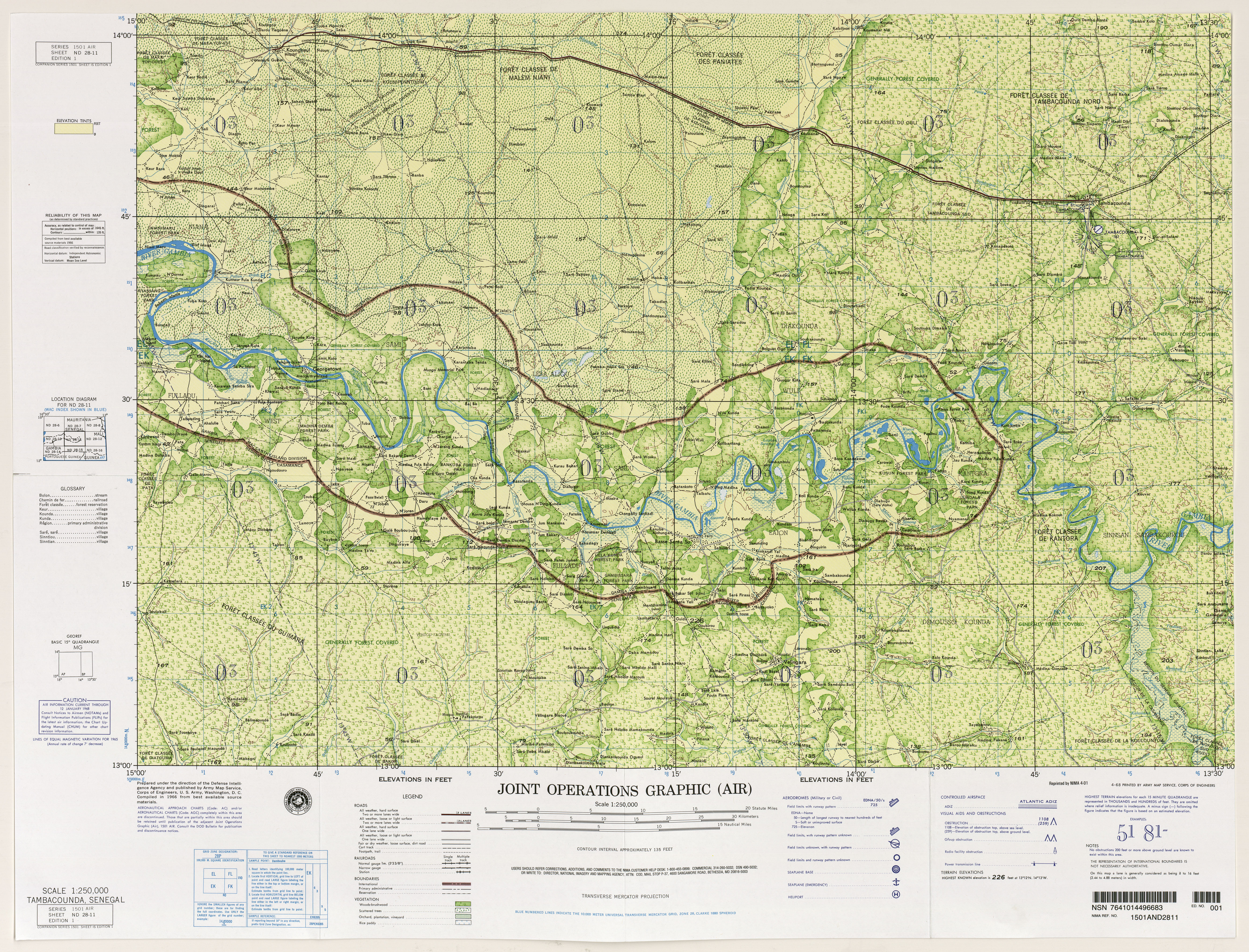
- highest point: at least 53 m according to The World Factbook and a 1966 map by U.S. National Imagery and Mapping Agency,[3][4][5] 64 m based on SRTM data calculated by peakbagger.com between Sabi and the Senegalese village Vélingara (13°13′18″N 14°09′35″W / 13.22159°N 14.15974°W),[6] located in a sandstone plateau at the border with Senegal[7]
Natural resources: fish, clay, silica sand, titanium (rutile and ilmenite), tin, zircon
Land use:
arable land: 43.48%
permanent crops: 0.49%
other: 56.03% (2011)
- Irrigated land: 50 km2 (2011)
- Total renewable water resources: 8 km3 (2011)
- Freshwater withdrawal (domestic/industrial/agricultural):
total: 0.09 km3/yr (41%/21%/39%)
per capita: 65.77 m3/yr (2005)
Current issues: deforestation, desertification, prevalence of water-borne diseases, drought (rainfall has dropped by 30% in the last 30 years)
Environment - party to international agreements on:
- biodiversity, climate change, Kyoto Protocol, desertification, endangered species, hazardous wastes, law of the sea, ozone layer protection, ship pollution, wetland, whaling
Extreme points
This is a list of the extreme points of the Gambia, the points that are farther north, south, east or west than any other location.
- Northernmost point – unnamed location on the border with Senegal immediately south of the Senegalese village of Keur Mali Makham, Central River Division
- Easternmost point – unnamed point on the border with Senegal near the village of Sembagne, Upper River Division
- Southernmost point – the point at which the border with Senegal enters the Atlantic Ocean at the mouth of the Allahein River, Western Division
- Westernmost point - Bijol Islands, Western Division
- Westernmost point (mainland) - Solifor Point, Western Division
Forests
Tree cover extent and loss
Global Forest Watch publishes annual estimates of tree cover loss and 2000 tree cover extent derived from time-series analysis of Landsat satellite imagery in the Global Forest Change dataset.[8][9][10][11] In this framework, tree cover refers to vegetation taller than 5 m (including natural forests and tree plantations), and tree cover loss is defined as the complete removal of tree cover canopy for a given year, regardless of cause.[12]
For the Gambia, country statistics report cumulative tree cover loss of 733 ha (7.33 km2) from 2001 to 2024 (about 16.1% of its 2000 tree cover area).[8] For tree cover density greater than 30%, country statistics report a 2000 tree cover extent of 4,563 ha (45.63 km2).[8] The charts and table below display this data. In simple terms, the annual loss number is the area where tree cover disappeared in that year, and the extent number shows what remains of the 2000 tree cover baseline after subtracting cumulative loss. Forest regrowth is not included in the dataset.[8][12]
Annual tree cover loss in the Gambia, 2001–2024.[8] View chart definition.
Tree cover extent in 2000 minus cumulative tree cover loss in the Gambia, 2001–2024 (loss-only residual; does not account for gain).[8] View chart definition.
| Year | Tree cover extent (km2)[a] | Annual tree cover loss (km2) |
|---|---|---|
| 2001 | 45.60 | 0.03 |
| 2002 | 45.19 | 0.41 |
| 2003 | 45.08 | 0.11 |
| 2004 | 44.45 | 0.63 |
| 2005 | 44.40 | 0.05 |
| 2006 | 44.33 | 0.07 |
| 2007 | 43.84 | 0.49 |
| 2008 | 40.86 | 2.98 |
| 2009 | 40.77 | 0.09 |
| 2010 | 40.53 | 0.24 |
| 2011 | 40.23 | 0.30 |
| 2012 | 39.82 | 0.41 |
| 2013 | 39.70 | 0.12 |
| 2014 | 39.53 | 0.17 |
| 2015 | 39.43 | 0.10 |
| 2016 | 39.38 | 0.05 |
| 2017 | 39.30 | 0.08 |
| 2018 | 39.24 | 0.06 |
| 2019 | 39.03 | 0.21 |
| 2020 | 38.93 | 0.10 |
| 2021 | 38.75 | 0.18 |
| 2022 | 38.58 | 0.17 |
| 2023 | 38.46 | 0.12 |
| 2024 | 38.30 | 0.16 |
Gallery
-
Fishing boats in Bakau, Gambia
-
Children swimming near Lamin Lodge.
-
The river.
-
River bird
-
A market.
-
The Spotted hyena is part of the Gambian fauna.
-
Wild hippopotamus in the Gambia River.
See also
Notes
- ^ This residual measure does not include forest regrowth.
References
This article incorporates public domain material from The World Factbook (2025 ed.). CIA.
- ^ Donald R. Wright (2004). The World and a Very Small Place: A History of Globalization in Niumi, The Gambia (New York: M.E. Sharp) p. 151–152.
- ^ Craig Emms and Linda Barnett (2001). Bradt Travel Guide for The Gambia (Chalford, UK: Bradt Travel Guides).
- ^ Global Environment Facility, United Nations Environment Programme (eds.): The Gambia’s Second National Communication under the United Nations Framework Convention on Climate Change. Banjul, November 2012, p. 32.
- ^ The World Factbook: The Gambia. Chapter Geography and map.
- ^ On a 1966 map, two points close to Jah Kunda and Nyamanari are indicated with 174 feet, thus 53 m. Source: West Africa, Joint Operations Graphic 1:250,000: map ND 28-11 Tambacounda, Senegal (11MB). U.S. National Imagery and Mapping Agency. Map data from 1966.
- ^ "Gambia High Point". peakbagger.com..
- ^ Malanding S. Jaiteh, Baboucarr Sarr: Climate Change and Development in the Gambia: Challenges to Ecosystem Goods and Services, p. 1–3. Map based on: The Gambia 50,000 database 2003 topographic data. Department of Local Government and Lands.
- ^ a b c d e f g "Gambia Deforestation Rates & Statistics". Global Forest Watch.
- ^ Hansen, Matthew C.; Potapov, Peter V.; Moore, Rebecca; et al. (2013). "High-Resolution Global Maps of 21st-Century Forest Cover Change". Science. 342 (6160): 850–853. doi:10.1126/science.1244693.
- ^ "Tree cover loss". Global Forest Watch Open Data Portal.
- ^ "Tree cover (2000)". Global Forest Watch Open Data Portal.
- ^ a b "How much forest was lost in 2023?". Global Forest Review.