C/2024 E1 (Wierzchoś)
Comet Wierzchoś with a split tail as it exits the inner solar system on 13 March 2026 | |
| Discovery[1] | |
|---|---|
| Discovered by | Kacper W. Wierzchoś |
| Discovery site | Mount Lemmon Obs. |
| Discovery date | 3 March 2024 |
| Designations | |
| CK24E010[2] | |
| Orbital characteristics[4][6] | |
| Epoch | 12 May 2025 (JD 2460807.5) |
| Observation arc | 763 days (2.09 years) |
| Earliest precovery date | 15 February 2024[3] |
| Number of observations | 3,540[c] |
| Aphelion | ≈43000 AU (inbound)[4] |
| Perihelion | 0.5661 AU (85 million km)[5] |
| Semi-major axis | ≈22000 AU (inbound) |
| Eccentricity | 0.99997 (inbound) 1.000004 (outbound)[4] |
| Orbital period | ≈3 million years (inbound) ejection (outbound)[a] |
| Max. orbital speed | 56 km/s[5][b] |
| Inclination | 75.239° |
| 108.08° | |
| Argument of periapsis | 243.64° |
| Mean anomaly | -0.00025° |
| Last perihelion | 20 January 2026[5] |
| TJupiter | 0.238 |
| Earth MOID | 0.1990 AU |
| Jupiter MOID | 1.90 AU |
| Physical characteristics[6] | |
Mean radius | 2–10 km (1.2–6.2 mi)[7] |
| Comet total magnitude (M1) | 11.7±0.7 |
| Comet nuclear magnitude (M2) | 11.9±0.3 |
| 12 (18 March 2026)[8] | |
C/2024 E1 (Wierzchoś) is a hyperbolic Oort cloud comet, discovered on 3 March 2024 by Polish astronomer Kacper Wierzchoś. It reached perihelion on 20 January 2026, with apparent magnitude of around +6.5, visible in larger binoculars. It has a highly eccentric orbit, with an inbound orbital period of millions of years and an outbound ejection trajectory.[4][a] Cometary emission activity for C/2024 E1 has been driven by carbon dioxide (CO2).
Observational history
Discovery
During a routine Mt. Lemmon survey (G96) search on 3 March 2024, one of the scientists participating in the project, Kacper Wierzchoś, spotted a moving object in four 30-second–exposure images taken using an f/1.6 1.5 m (59 in) Cassegrain telescope, equipped with a 111.5 megapixel (10,560 x 10,560 pixel) CCD. It appeared as a 20th-magnitude object in the constellation Draco,[d] about 2 degrees north of the star ν Dra.[9] After the discovery announcement, the Zwicky Transient Facility reported that they obtained precovery images of the comet between 15 and 29 February 2024.[3] The comet was reported to have a condensed coma about 4 arcseconds in diameter and a tail about 6 arcseconds long.[1][2] It is the fifth comet discovered by Kacper Wierzchoś.[e]
Follow-up observations
C/2024 E1 (Wierzchoś) was observed by the James Webb Space Telescope at a distance of 7.0 AU (1.05 billion km) from the Sun in early 2025, measuring its spectra and dust production rates in infrared light.[11] There were no emission features for carbon monoxide (CO) as the comet may have lost its near-surface CO early in its evolution before being ejected to the Oort Cloud. The activity was driven by carbon dioxide (CO2).
When first discovered the comet was expected to brighten to apparent magnitude 5, near the naked-eye limit, but later calculations predicted the brightest apparent magnitude to reach only 8.5, 25 times fainter than original expectations.[12] By 25 August 2025, the comet was 2.64 AU (395 million km) from both the Sun and Earth. It crossed the celestial equator on 17 November 2025.[13] The comet passed about 2.3 degrees southwest near the globular cluster Messier 14 as seen from the night sky by 26 November 2025.[14]
Around perihelion
The comet came to perihelion on 20 January 2026 around 18:27 UT at 0.566 AU (85 million km) from the Sun.[5][8] It was about 22 degrees from the Sun and was visible from the Southern Hemisphere. Peak brightness was estimated to be around 8.5 magnitude,[8][12] meaning it could be visible through larger binoculars or a modest telescope. It was about 1.352 AU (202.3 million km; 125.7 million mi) from Earth during perihelion.[12]
It passed 0.191 AU (29 million km; 18 million mi) from Venus on 1 January 2026[15] and passed 1.0 AU from Earth on 17 February 2026.[12] After its perihelion and solar conjunction, the comet was observed on 23 January 2026 having an estimated apparent magnitude of 6.8. On January 26, its coma had an estimated diameter of 3 arcminutes and its tail was one degree long.[8] In mid February the comet featured a thin ion tail 3 degrees long and three distinct dust tails spaning near 90 degrees.[16]
Possible disintegration
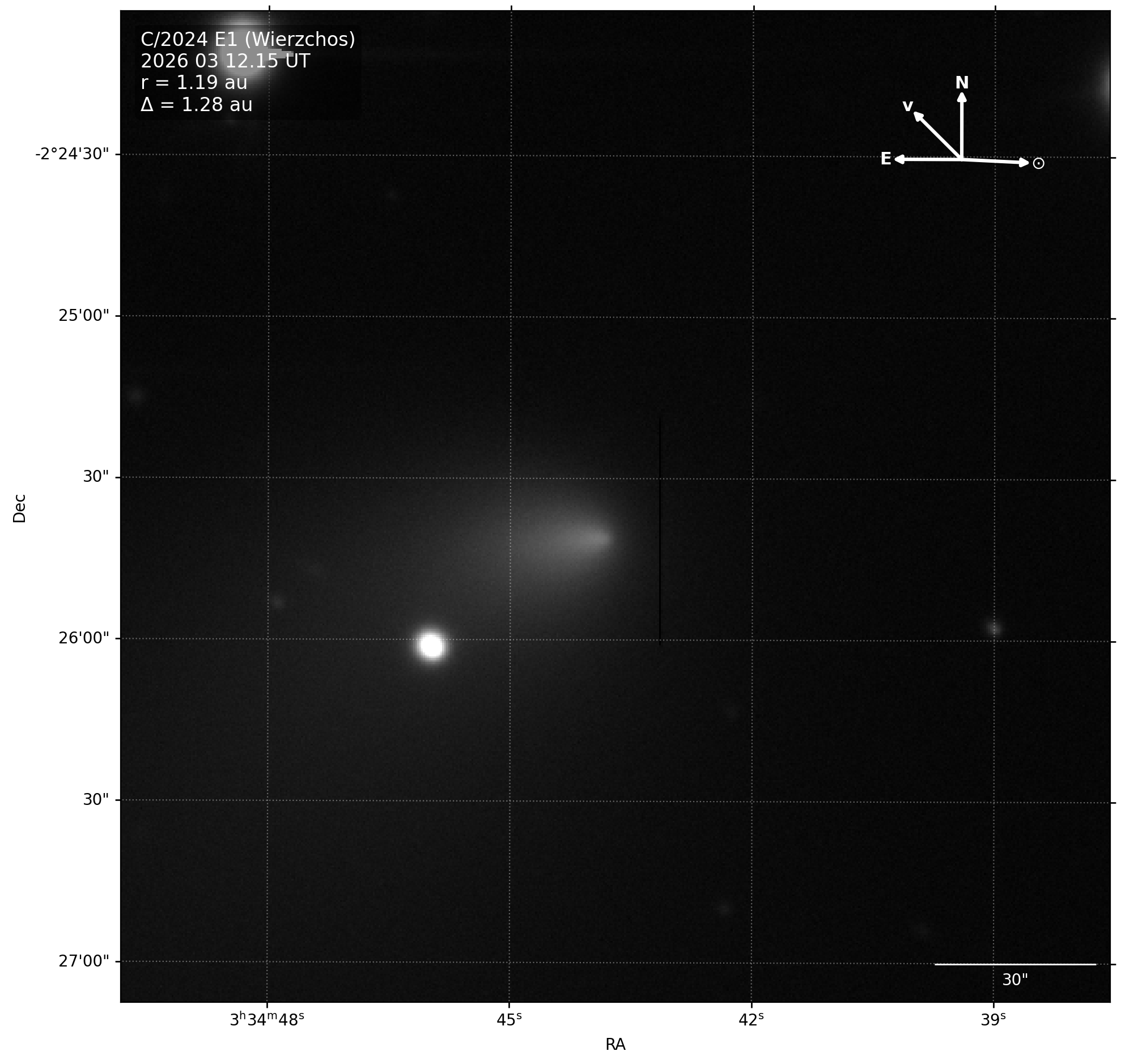
The comet brightened slightly between February 28 and March 6 and afterwards its magnitude declined quickly, by 0.2 to 0.3 magnitudes per day, and in images obtained on March 12 by Lowell Discovery Telescope it lacked a central condensation when 1.2 AU (180 million km) from the Sun.[16]
The orbital eccentricity is slightly greater than 1 at the JPL SBDB epoch 2025 solution[6] as the comet is inside of the planetary region of the Solar System and subject to ongoing planetary perturbations.[17] With a future orbital eccentricity of 1.000004, the comet may have just enough energy to leave Solar System.[4]
Physical characteristics
Initial estimates of the radius of its nucleus in September 2025 determined an upper limit of approximately 13.7 km (8.5 mi).[11] Follow-up studies in October 2025 based on its CO2 production rate revised the estimate to around 2–10 km (1.2–6.2 mi), most likely indicating that it is much smaller than previously thought.[7]
Notes
- ^ a b There is a very small difference in energy between a near-parabolic orbit of 200000 years and an ejection trajectory. At the epoch of 2200, the comet will be weakly hyperbolic with an eccentricity of 1.000004.[4]
- ^ Mercury has an orbital speed of 48 km/s.
- ^ For the orbital calculations of this comet, only 2,198 observations were used
- ^ Reported initial position upon discovery was: α = 17h 19m 12.26s, δ = 55° 07′ 02.0″[1]
- ^ As of 2025, Wierzchoś discovered six other comets. These were; C/2020 H3, P/2021 R4, P/2021 U1, P/2022 B1, C/2024 G1 and C/2024 J2.[10]
References
- ^ a b c K. W. Wierzchoś; W. Ryan; S. Nakano (7 March 2024). D. W. Green (ed.). "Comet C/2024 E1 (Wierzchoś)". Central Bureau for Astronomical Telegrams. 5364: 1. Bibcode:2024CBET.5364....1W.
- ^ a b K. W. Wierzchoś; J. Hogan; B. Ryan; P. Breitenstein; et al. (6 March 2024). "Comet C/2024 E1 (Wierzchoś)". Minor Planet Electronic Circular. 2024-E102.
- ^ a b J. Shanklin (21 December 2024). "BAA Comet Section: New Comets Discovered in 2024". University of Cambridge. Retrieved 22 December 2024.
- ^ a b c d e f Horizons output. "Barycentric Osculating Orbital Elements for Comet Wierzchos (C/2024 E1)". Archived from the original on 28 February 2026. Retrieved 23 March 2026. (Solution using the Solar System's barycenter (Sun+Jupiter). Select Ephemeris Type:Elements and Center:@0)
Inbound period (PR) = 1.15E+09 / 365.25 days = 3.1 million years
Outbound period (PR) = E+99 (ejection) - ^ a b c d "Perihelion on 20 January 2026". JPL Horizons. Retrieved 14 February 2026. (when rdot = 0)
- ^ a b c "C/2024 E1 (Wierzchoś) – JPL Small-Body Database Lookup". ssd.jpl.nasa.gov. Jet Propulsion Laboratory. Retrieved 23 March 2026.
{{cite web}}: CS1 maint: deprecated archival service (link) - ^ a b A. Parhi; D. Prialnik (2025). "Combined Orbital and Thermal Evolution of Oort Cloud Comets". arXiv:2510.26549 [astro-ph.EP].
- ^ a b c d "Observation list for C/2024 E1". COBS – Comet OBServation database. Retrieved 15 February 2026.
- ^ "Facilities". Catalina Sky Survey. University of Arizona. Retrieved 22 December 2024.
- ^ "Objects name: Wierzchos". ssd.jpl.nasa.gov. Jet Propulsion Laboratory. Retrieved 23 February 2026.
- ^ a b C. Snodgrass; C. E. Holt; M. S. P. Kelley; C. Opitom; A. Guilbert-Lepoutre; et al. (2025). "First JWST spectrum of distant activity in Long Period Comet C/2024 E1 (Wierzchos)". Monthly Notices of the Royal Astronomical Society: Letters. 541 (1): 8–13. arXiv:2503.14071. Bibcode:2025MNRAS.541L...8S. doi:10.1093/mnrasl/slaf046.
- ^ a b c d G. van Buitenen. "C/2024 E1 (Wierzchoś)". astro.vanbuitenen.nl. Retrieved 8 September 2025.
- ^ "Crossing the celestial equator at declination 0". JPL Horizons. Retrieved 12 September 2025.
- ^ P. Lawrence (5 November 2025). "How to see comets 24P/Schaumasse and C/2024 E1 Wierzchoś". BBC Sky at Night Magazine. Retrieved 13 November 2025.
- ^ "C/2024 E1 + Venus on 1 Jan 2026". Jet Propulsion Laboratory. Retrieved 15 March 2026.
- ^ a b Green, Daniel W. E. (17 March 2026). "COMET C/2024 E1 (WIERZCHOS)". Central Bureau for Astronomical Telegrams. 5669. Retrieved 19 March 2026. (12 March Photo)
- ^ D. Heggie; M. Phillips; I. Smith; B. Lutkenhoner; A. Arquiola (10 February 2026). "Comet C/2024 E1 (Wierzchoś)". Minor Planet Electronic Circular. 2026-C68. Bibcode:2026MPEC..100...68H. doi:10.48377/MPEC/2026-C68.
External links
- C/2024 E1 at the JPL Small-Body Database
- C/2024 E1 at Seiichi Yoshida's website
- NASA Astronomy Picture of the Day: Tails of Comet Wierzchoś (17 February 2026)