Battle for Height 958
| Battle of Makivka | |||||||
|---|---|---|---|---|---|---|---|
| Part of the Eastern Front of the World War I | |||||||
Ukrainian Sich Riflemen at Makivka in April 1915 | |||||||
| |||||||
| Belligerents | |||||||
|
Austria-Hungary Germany | Russian Empire | ||||||
| Commanders and leaders | |||||||
| Major general Ignaz Fleischmann | Vladimir Alftan | ||||||
| Units involved | |||||||
|
55th Austrian Infantry Division
| 78th Infantry Division | ||||||
| Strength | |||||||
| Unknown | Unknown | ||||||
| Casualties and losses | |||||||
|
Ukrainian sources: 47 killed 76 wounded Many captured Russian sources: 2,000 (on 22 April alone) 3,006 captured[2] 8 flamethrowers[3] | 3,170 casualties | ||||||
Battle for Height 958, known in Ukrainian sources as the Battle of Makivka (Ukrainian: Бої за Маківку)[4] was a relatively small Russian operation to gain control over a height in the Beskids region of the Carpathian mountains. Usually overlooked in German and Austrian sources, the battle received significant coverage in Ukrainian literature because the bulk of Austrian troops in the battle were Ukrainians. The battle ended with the capture of the height, but the Russians could not develop a major offensive to the rear of the Austro-Hungarian forces.
Location
Makivka (Ukrainian: Маківка) is a mountain in the Carpathian mountains, located in the area of Skole Beskids, 8 kilometers north of the town of Slavsko, and reaching the height of 958 meters above sea level.[5][6]
Battle
After capturing Galicia in September 1914, a Russian army commanded by Nikolai Ivanov started an offensive across the Carpathians with the aim of invading Hungary. The height of Makivka was held by the Legion of Ukrainian Sich Riflemen, whose units, consisting of 7 sotnias, formed part of the 129th and 130th brigades of the Austrian army.[5][6]
In the night of 28 to 29th April, numerically superior Russian troops begain storming the positions held by Ukrainian Sich Riflemen. After five days of fierce fighting, in which 47 riflemen lost their lives, 76 were wounded and many captured, Russian troops were repelled across the river Holovchanka. After the arrival of reserve troops, Russians started a new advance, which ended with the taking of Makivka on 4 May. However, as a result of heavy losses, Russian troops were unable to continue their advance, and retreated from the area following the arrival of Austrian troops one week later.[5]
Legacy
Commemoration
Among Ukrainians the battle of Makivka has been widely interpreted as a victory and became a source of national pride. It was the first major battle of the Ukrainian Sich Riflemen and contributed to a rise in the morale of the Ukrainian people.[7][6] The battle is celebrated in museum displays, monuments, patriotic songs and a movie.[8] The 47 Sich Riflemen fallen at Makivka were buried on the southern lopes of the mountain, where a memorial to fallen Ukrainians was created, and annual memorial services were organized at the location.[5][6]
In music
A patriotic march dedicated to the battle has since become a popular Ukrainian folk song. Several varieties of the song's text are known, with some of them mentioning events of the Ukrainian-Soviet War along with the fights on Makivka. In January 1990 a modernized version of the song was performed by participants of the human chain honouring the 71st anniversary of the Unification Act between the Ukrainian People's Republic and West Ukrainian People's Republic. In modern times the song is being performed by various Ukrainian collectives, including the choir of the Armed Forces of Ukraine.[9]
A version of the song recorded in 1992 in Isakiv, Pokuttia (Ivano-Frankivsk Oblast):[5]
| Ukrainian original[10] | English translation[11] |
|---|---|
|
Там на горі, на Маківці, Приспів: Йдуть до бою — і співають, Приспів Наша сотня вже готова — Приспів А в Кийові злота брама, Приспів |
There, on the mountain, on Makivka Chorus: Our boys are fighting well, Chorus: Our company is ready, Chorus There is a Golden Gate in Kyiv, Chorus |
Notable participants
| External image | |
|---|---|
| Map of the battle (Russian troops in green, Austro-Hungarian forces in orange) |
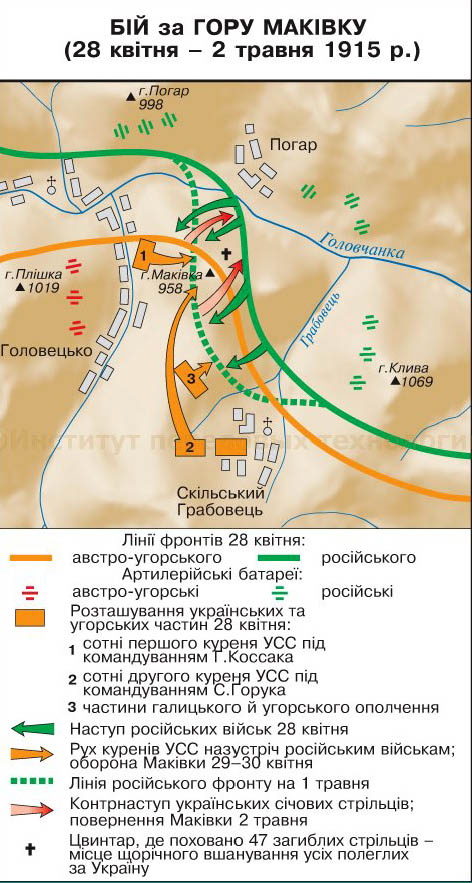
- Sofia Halechko (1891-1918), Ukrainian cadet and political activist.[12]
- Yevhen Konovalets (1891-1938), Ukrainian officer and leader of the Organization of Ukrainian Nationalists.[1]
- Hryhoriy Kossak (1882-1939), Ukrainian teacher and officer; awarded Military Merit Cross 3rd Class for his actions during the battle; later commanded the Ukrainian Galician Army during the Battle of Lviv.[13]
- Olena Stepaniv (1892-1963), Ukrainian soldier and economist, first woman of Ukrainian ethnicity to reach an officer's rank.
- Roman Sushko (1894-1944), Ukrainian officer and member of the Organization of Ukrainian Nationalists.
See also
References
- ^ a b "ДНК полковника Євгена Коновальця". 2021-05-21. Retrieved 2026-01-20.
- ^ Kashirin 2010.
- ^ Oleynikov 2023, p. 105.
- ^ Бої за Маківку
- ^ a b c d e "Цього дня 1915 року закінчилися бої між Легіоном Українських Січових Стрільців і російськими військами за гору Маківка". 2020-04-04. Retrieved 2026-01-20.
- ^ a b c d Енциклопедія українознавства. Словникова частина (ЕУ-II). Vol. 4. 1994. p. 1432-1439.
- ^ Internet Encyclopedia of Ukraine. Makivka
- ^ The New York Times. THE GREAT WAR: A Battle in Ukraine Echoes Through the Decades
- ^ "Там на горі, на Маківці". Retrieved 2026-02-04.
- ^ Оксана Кузьменко, ed. (2005). Стрілецькі пісні. Львів. p. 158.
- ^ "There, on the mountain, on Makivka". Retrieved 2026-02-04.
- ^ "Країна Роксоланія: українки в Першій світовій війні". 2022-01-03. Retrieved 2026-01-20.
- ^ "Трагедія вчителя у військовому однострої. Історія Гриця Коссака". 2026-01-28. Retrieved 2026-02-05.
Bibliography
- Kashirin, Vasili (2010). Взятие горы Маковка [Capture of Makivka Hill] (in Russian).
- Oleynikov, Alexei (2023). Германский натиск на Восток 1915 [The German push to the East 1915] (in Russian). ISBN 978-5-4484-4327-5.