Arthur Edwards (architect)
Arthur Edwards | |
|---|---|
| Born | 18 March 1863 Birmingham, Warwickshire |
| Died | 6 July 1927 (aged 64) Handsworth, Staffordshire |
Resting place | Handsworth Old Church |
| Occupation | Architect |
| Years active | 1874–1927 |
| Awards | Member of Birmingham Architectural Association |
| Buildings |
|
| Signature | |
Arthur Edwards (18 March 1863 – 6 July 1927) was an architect based in Birmingham, Warwickshire. He designed at least four listed buildings, including the Craven Arms public house, Birmingham, the Samson and Lion public house Bordesley Green, the Aston Cross Clock Tower and the Aston Cross Lamp Standard. He also designed the Birmingham Municipal Technical School which was a foundational building of Aston University, the Royal Albert Hall, Aston, various mills and factories, and numerous local residences.
Background
The immediate family of Edwards and his wife were Birmingham artisans and manufacturers. His paternal grandfather was John Edwards of Birmingham, a boot and shoe maker who was born in London,[nb 1][1][2] and his paternal grandmother was Sarah Edwards.[nb 2][1][2] Edwards' father was William Edwards of Birmingham,[nb 3][3][4] originally a boot and shoe maker, then a gunmaker and gun finisher. His mother was Emma née Ford.[nb 4][3][4] Arthur Edwards was born in Birmingham.[nb 5][5] He had an elder brother, William Edwards junior.[nb 6][3]
In West Bromwich in 1888, Edwards married Rose Heaton.[nb 7][6] Her ancestors were "well known in Birmingham, with family members involved with the Birmingham Mint".[7] Her paternal grandfather was John Heaton, an iron founder of Aston, Birmingham.[nb 8][8] Her father was Reuben George Heaton,[nb 9][8] who in 1857 founded the Reuben Heaton company, which manufactures angling equipment.[7] Edwards and his wife Rose had three children:[6] Mary Eveline Edwards,[nb 10][4][9] Arthur Stanley Edwards,[nb 11][4] and Grace Marjorie Edwards.[nb 12][6]
Edwards died, aged 65, at his last address in 4 Park Avenue, Handsworth.[10] His funeral was held at Handsworth Old Church on 9 July, 1927.[6] He left £5,326 (equivalent to £289,285.61 in 2025).[10][11]
Career
Edwards was an architect and surveyor.[10] He was articled to the architect William Jenkins at 34 Bennett's Hill, Birmingham, in 1878 when he was fifteen years old. He completed his articles and then remained in Jenkins's firm until 1891. Thereafter, he set up his own practice as an architect and quantity surveyor at 9 Bennett's Hill.[6][5] Beside major projects such as the Royal Albert Hall, Aston, and the Birmingham Municipal Technical School, he designed town and country houses, warehouses, factories, breweries, bicycle works and large rubber mills.[5]
Building designs
Aston Cross Clock Tower, 1891
The Aston Cross Clock Tower is a listed building, designed by Edwards. Historic England describes it as: "Iron. Square in plan. High plinth, the panelled shaft with Corinthianesque colonnettes with ring shafts at the corners and then the 4 clock faces surmounted by pediments with elaborate open cresting. Finial".[12]
Aston Cross Lamp Standard, 1891
The Aston Cross Lamp Standard is a listed building, designed by Edwards. It is described by Historic England as: "Iron. Ionic style column carrying scrolly arms for lamps now missing and ball finial".[13]
-
The Aston Clock Tower and Lamp Standard originally formed a group
-
Aston Cross Clock Tower (detail)
-
Aston Cross Clock Tower with Lamp Standard behind, before 1914
-
Aston Cross Lamp Standard (detail)
Birmingham Municipal Technical School, 1894
This building in Suffolk Street, Birmingham, was designed by Edwards as the Aston Technical Schools,[5][6] and cost around £12,000 (equivalent to £1,348,528.64 in 2025).[11] It was opened on 11 July 1894 by the barrister and politician John Stratford Dugdale, Q.C., who was at that time chairman of Warwickshire County Council. The occasion involved a two-hour light refreshment break for a "large number" of guests in a large classroom, followed by a speeches session in another large classroom. Dugdale was presented with a gold key decorated with "an embossed view of the school ... together with the arms of Aston and Mr Dugdale in enamel".[14]
The three storeys of the building performed three functions: the basement held engineering shops using power, the middle storey held lecture rooms, and the top floor held laboratories. The lower storey was a semi-basement, holding heavy equipment such as a modelling room with casting facilities, an engineering classroom with engine house, a battery storage room which lit the building, a metallurgical laboratory and more.[15] The term, "engine house" implies a steam engine, as it was normal at that time to use a horizontal-cylinder steam engine and hydraulics to power an engineering workshop,[16] when the first functional diesel engine prototype was not built until 1897,[17] and electric motors would power individual machines without the need for an engine house.[18] However the engine house could have contained an additional Crossley gas engine for some purposes.[19]
The ground or middle floor contained a lecture room, art rooms, classrooms and facilities for teachers and technical workers. On the top floor was a chemical laboratory, a lecture room and more art rooms, besides other facilities. The carpenter's shop was situated behind the building. The structure had electric light, lavatories and piped hot water heating. The building's exterior was decorated with terracotta, ornamental iron palisades, and wrought iron gates. Edwards was very much a project architect, being present to superintend the construction.[15] It was a foundational building of Aston University, and was demolished in the 1960s.[20]
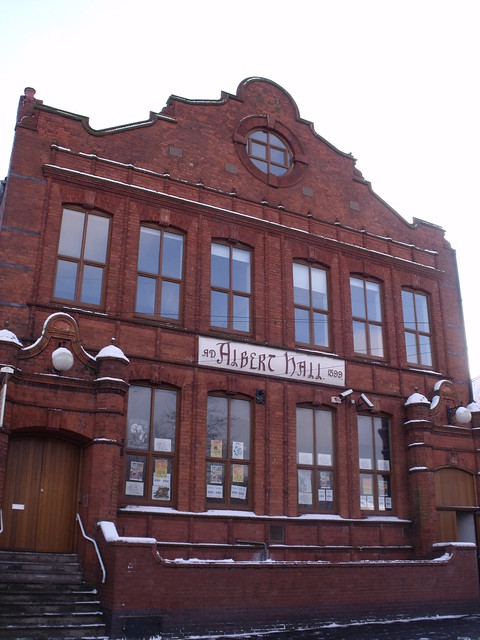
Royal Albert Hall, Aston, 1899
This Royal Albert Hall, Witton Road, Aston, was designed by Edwards in 1899.[nb 13][5]
Bandstand, Aston Park, Aston
Before Aston became part of Birmingham, the people of Aston had no local bandstand, and bands performing in Aston had to work outdoors, unprotected, in all weathers. Ultimately, Aston District Council paid for a bandstand, which was designed by Edwards at a cost of £360 (equivalent to £39,996.13 in 2025), and opened on 28 May 1899, on the site of Aston Hall's former tennis court in the grounds of Aston Park.[11][21] The Birmingham Mail described it thus:[21]
This erection ... which occupies the south end of what was originally the tennis lawn, is octagonal in shape and is 22 feet in diameter. The base is of King's red bricks, with York stone coping ... It has cast iron columns, with ornamental circular cast iron spandrels, supporting overhanging pyramid roof, 30ft in diameter. The roof is covered in zinc, surmounted by an artistic iron finial. The sides are filled in with ornamental cast iron railing and oak handrail, and each bay of the railing has a shield, two of which have the Birmingham coat of arms, two the Aston coat of arms, and two with inscription as follows: Presented to the City of Birmingham by Frederick Smith Esquire, J.P., chairman of the Aston Manor Urban District Council, May, 1899. The ceiling is boarded, so as to form a sounding board, and the structure is painted pale blue picked out with gold. It has been attempted as far as possible to make the design harmonious with the hall and its surroundings.[21]
Harborne Industrial School, 1900–1902
Edwards designed a building for Harborne Industrial School,[6] replacing a former building which had become unusable. The pupils moved in, in 1902. Edwards' building was later demolished, and Aston University now stands on the site.[22]
Samson and Lion pub, Yardley Green Road, 1913–1915
The former Samson and Lion public house, 42 Yardley Green Road, Bordesley Green, Birmingham, is a listed building, designed by Edwards. Historic England says: "No longer in use as a pub. It was converted to The Clock Café, which is now closed. Currently in use by the Association of Islamic Charitable Projects".[23] The building can be glimpsed behind the street lamp in the photograph (right). This is a decorative structure as described by Historic England. It is a bay-windowed, red brick building with diapering and terracotta details. The doors have "round-arched canopies with dentil ornament", and there is a large, bracketed clock projecting above the entrance. When registered by Historic England, the interior retained many original features, including a mirrored bar with etched glass panels, stained glass windows and original fire surrounds. Historic England describes the building as, "Well-detailed and little altered early C20 public house which illustrates the shift of emphasis from lavish decoration and opulence to greater restraint, simplicity and decency in the design of early C20 premises".[23]
Alterations and renovations
Components Tube Company, Birmingham, 1896
Edwards prepared plans for alterations at the Components Tube Company (which made bicycle tyres) in Birmingham. The works were later carried out at the mills.[24]
St George's Church, Edgbaston, 1899
St George's Church, Edgbaston is a listed building, designed by Joseph John Scoles, Charles Edge and J. A. Chatwin.[25] Edwards "carried out extensive alternations and restorations in the interior of the church in 1899".[5]
Craven Arms, Birmingham, 1906–1910
The Craven Arms public house in Birmingham is a listed building, decoratively remodelled inside and out by Edwards. Historic England describes the building thus:[26]
A C19 public house, remodelled between 1906 and 1910, with the addition of an ornate ceramic façade, attributed to local architect Arthur Edwards for Holders Brewery ... [designated] for its bold exterior which incorporates an exemplary scheme of architectural ceramics, featuring ornate capitals and textured tilework, along with high-quality etched and stained glass windows; [and] for the remarkable survival of the elegant Holders Brewery signage moulded into the friezes and cartouches, which speaks to the brewery’s pride and ambition for their tied premises.[nb 14][26]
Associations
Edwards was elected a member of the Birmingham Architectural Association in 1892.[5] He became a Worshipful Master of the Holte Lodge of Freemasons in 1907.[6] He was a manager of voluntary schools, a superintendent of the Working Men's School, and had membership of the Handsworth Golf Club, the local Conservative Club and the Conservative Association. He was a churchwarden for St George's Church, Edgbaston, and an active church member and worker.[5]
Notes
- ^ John Edwards (born London c.1803).
- ^ Sarah Edwards (born Staffordshire c.1803).
- ^ William Edwards (born Birmingham c.1825).
- ^ Emma Edwards née Ford (born Birmingham c.1834). GRO index: Marriages Mar 1850 Ford Emma and Edwards William Aston 16 272.
- ^ Arthur Edwards (Birmingham 18 March 1863 – Handsworth 6 July 1927). GRO index: Births Jun 1863 Edwards Arthur Birmingham 6d 173.
- ^ William Edwards junior (born Birmingham c. 1858) GRO index: Births Dec 1858 Edwards William Birmingham 6d 143.
- ^ Rose Edwards née Heaton (born Aston c.1865). GRO index: Marriages Sep 1888 Edwards Arthur and Heaton Rose W.Bromwich 6b 954.
- ^ John Heaton (Birmingham c.1811 – Birmingham 1883).
- ^ Reuben George Heaton (Birmingham 1 August 1839 – Erdington 3 November 1923).
- ^ Mary Eveline (or Evaline) Edwards (born Aston 1890). GRO index: .
- ^ Arthur Stanley Edwards (born Aston 1896). GRo index: Births Sep 1896 Edwards Arthur Stanley Aston 6d 403.
- ^ Grace Marjorie Edwards (born Handsworth 1903). Births Jun 1903 Edwards Grace Marjorie W Bromwich 6b 833.
- ^ A picture of the Royal Hall, Witton Road, Aston (now known as the Royal Albert Hall) can be seen on Flickr
- ^ Historic England is correct that the Craven Arms was run by Holders Brewery, Birmingham, not Holdens Brewery which was also a Midlands company.
References
- ^ a b "1841 England census, Craken/Croker Lane, Birmingham, St Philip's parish. HO 107/1146/1. Page 38/38". ancestry.co.uk. H.M. Government. Retrieved 10 June 2026 – via Ancestry.
- ^ a b "1851 England census John and Sarah Edwards. 7 Coach Yard, St Peter's parish, Birmingham. HO 107/2057. Page 9. Schedule 26". ancestry.co.uk. H.M. Government. 1851. Retrieved 10 June 2026 – via Ancestry.
- ^ a b c "1871 England Census, 79 Tower Street, Birmingham. RG10/3121. page 22/3. Schedule 13". ancestry.co.uk. H.M. Government. 1871. Retrieved 9 June 2026 – via Ancestry.
Head, William Edwards, age illegible, born Birmingham, gun finisher. Wife Emma Edwards age 37, born Birmingham. Son William, age (13?), clerk, born Birmingham. Son Arthur, age 8, scholar, born Birmingham.
- ^ a b c d "1901 England Census 26 Vicarage Road, Handsworth. RG13/2709. Page 33/79. Schedule 180". ancestry.co.uk. H.M. Government. 31 March 1901. Retrieved 9 June 2026 – via Ancestry.
Arthur Edwards, 38, architect/building surveyor. Wife Rose Edwards 36. Children Mary E. age 11 and Arhur S. age 4. Edwards' parents: William Edwards age 76 retired gunmaker and Emma Edwards age 67. All born in Birmingham except Rose Edwards (born Aston)
- ^ a b c d e f g h Pike, W. T. (1900). Pike, W. T. (ed.). Vol. 3. Birmingham at the Opening of the Twentieth Century. Brighton, Sussex: W. T. Pike & Co. p. 156.
- ^ a b c d e f g h "Death of architect". Birmingham Daily Gazette. 8 July 1927. p. 6 col.2. Retrieved 9 June 2026 – via British Newspaper Archive.
- ^ a b "Reuben Heaton has its roots firmly set in the angling industry and was founded in 1857 by its namesake Reuben George Heaton". reubenheaton.com/. Reuben Heaton. Retrieved 9 June 2026.
- ^ a b "1841 England Census St James Street, Aston. John Heaton. HO 107/1149/9. Page 2/43". ancestry.co.uk. H.M. Government. Retrieved 9 June 2026 – via Ancestry.
- ^ "1891 England census. 7 Buckfield Road, Aston Manor, Warwickshire. RG12/2432. Page 31/130. Schedule 193". ancestry.co.uk. H.M. Government. 1891. Retrieved 9 June 2026 – via Ancestry.
Arthur Edwards, architect, wife Rose Edwards, child May Evaline Edwards age 1 year, one servant Charlotte S. Steadman.
- ^ a b c "Midland Wills". Birmingham Daily Gazette. 1 October 1927. p. 7 col.6. Retrieved 9 June 2026 – via British Newspaper Archive.
- ^ a b c UK Consumer Price Index inflation figures from 1209–2024 based on data from "Inflation calculator". Bank of England. London. 18 February 2026. Retrieved 1 April 2026.
- ^ Historic England. "Aston Cross Clock Tower at the Junction With Park Road (1076288)". National Heritage List for England. Retrieved 30 December 2022.
- ^ Historic England. "Birmingham. Aston Cross Lamp Standard at the Junction With Park Road (1076289)". National Heritage List for England. Retrieved 30 December 2022.
- ^ "Aston Manor Technical School. Opening by Mr J. S. Dugdale QC". Birmingham & Aston Chronicle. 14 July 1894. p. 4 cols 4,5. Retrieved 11 June 2026 – via British Newspaper Archive.
- ^ a b "New technical schools at Aston". Birmingham Daily Post. 22 June 1894. p. 5 col.8. Retrieved 10 June 2026 – via British Newspaper Archive.
- ^ Buchanan, Robert Angus. "The Industrial Revolution (1750–1900)". britannica.com. Britannica. Retrieved 11 June 2026.
- ^ Gilani, Hafsah (1 December 2024). "Short History of the Diesel Engine: First Diesel Engine Prototype (1897)". britishdiesel.co.uk. British Diesel Systems. Retrieved 11 June 2026.
- ^ Devine, Warren D. Jnr (June 1983). "From Shafts to Wires: Historical Perspective on Electrification". The Journal of Economic History. 43 (2): 347–372. doi:10.1017/S0022050700029673. Retrieved 11 June 2026.
- ^ "The Industrial Revolution was not all about giant coal-fired steam engines and huge mills. By the late 19th century, thousands of little engines fuelled by gas were at work too, powering machinery in all sorts of small businesses". scienceandindustrymuseum.org.uk. Science and Industry Museum. 13 October 2023. Retrieved 14 June 2026.
- ^ "1860s-1890s. Foundations in Technical Education". aston.ac.uk. Aston University. Retrieved 10 June 2026.
- ^ a b c "Improvements at Aston Park". Birmingham Mail. 28 May 1899. p. 3 col.5. Retrieved 11 June 2026 – via British Newspaper Archive.
- ^ Higginbotham, Peter. "Birmingham free Industrial School for Boys, Birmingham, Warwickshire". childrenshomes.org.uk. Children's Homes. Retrieved 9 June 2026.
- ^ a b Historic England. "Samson and Lion public house (1387742)". National Heritage List for England. Retrieved 30 December 2022. Photographs here
- ^ "Law intelligence, Saturday. Components Tubes". Freeman's Journal. 6 July 1899. p. 2, cols 4,5. Retrieved 9 June 2026 – via British Newspaper Archive.
- ^ Historic England. "Anglican Church of St George (1211414)". National Heritage List for England. Retrieved 30 December 2022.
- ^ a b Historic England. "The Carven Arms (1489204)". National Heritage List for England. Retrieved 30 December 2022.
External links
Media related to Arthur Edwards (architect) at Wikimedia Commons