Ali Abdullah Jaber
Ali Abdullah Jaber | |
|---|---|
علي بن عبد الله جابر | |
| Imam of Masjid Al Haram | |
| In office 1981–1983 (Official Imam) | |
| In office 1986–1989 (Ramadan guest imam) | |
| Title | King's Imam |
| Personal life | |
| Born | August 1954 |
| Died | 14 December 2005 (aged 51) |
| Resting place | Al Sharayea cemetery Makkah |
| Known for | His unique recitation of the Qur'ān |
| Occupation | Imam at Masjid al Haram, Professor |
| Religious life | |
| Religion | Islam |
| Denomination | Sunni |
| Jurisprudence | Hanbali |
| Teachers | Khalil Al-Qari |
| Creed | Athari |
| Muslim leader | |
Students | |
| Arabic name | |
| Personal (Ism) | ʻAlī عَلِي |
| Patronymic (Nasab) | ibn Abdullāh ibn Ṣāliḥ ibn Abdullāh ibn Nāṣir ibn Jābir ibn ʻAlī Jābir بْنُ عَبْدِ اللَّهِ بْنِ صَالِحِ بْنِ عَبْدِ اللَّهِ بْنِ نَاصِرِ بْنِ جَابِرِ بْنِ عَلِيِّ جَابِرٍ |
| Epithet (Laqab) | King's Imam امام الملك |
| Toponymic (Nisba) | al-Saʻīdī al-Muwasṭī al-Yāfiʻī al-Ḥimyarī al-Qaḥṭānī السَّعِيدِيُّ الْمُوَسْطِيُّ الْيَافِعِيُّ الْحِمْيَرِيُّ الْقَحْطَانِيُّ [2] |
| Website | https://alijaber.net/ (Arabic) |
Ali Abdullah Saleh Ali Jaber Al-Saeedi[a] (August 1954 – 14 December 2005) was a Saudi Arabian Quran reciter, imam and an Islamic scholar. He served as an Imam of the Masjid al-Haram in Mecca, Saudi Arabia[3] and as a lecturer in comparative jurisprudence in the department of Islamic studies at King Abdulaziz University, Jeddah.[4][5] He was recognised for his distinctive and melodic Quran recitation.[6]
Personal life
Birth and early life
Ali Jaber was born in August 1954[b] in Jeddah, Saudi Arabia, along with his twin brother Salem. At the age of 5, he and his family moved from Jeddah to Medina, where he began learning the Quran. His father, Abdullah ibn Saleh, died in Medina when Ali Jaber was 11 years old.[7][4]
Education
Early education
Ali Jaber began his Quran studies under the supervision of Rahmatullah Qari in Princess Munira bint Abdul Rahman Mosque. He was later nominated to memorize the entire Quran under the guidance of Sheikh Khalil Al-Qari, at the Charitable Society for the Memorization of the Holy Quran in Medina, where he learned Tajwid (Quranic phonetics). During this period, he became acquainted with Muhammad Ayyub, who would later become an imam of the Prophet's Mosque.[8]
Postgraduate education
After obtaining his first university degree, Ali Jaber pursued postgraduate studies at the Higher Institute of the Judiciary, in Riyadh, affiliated with Imam Muhammad bin Saud Islamic University, he enrolled in the Master's program in the academic year 1396-1397 AH.
He completed his master's degree with distinction, presenting a thesis the Department of Comparative Jurisprudence titled:[4][9]
(Arabic: فقه عبد الله بن عمر ما وأثره في مدرسة المدينة, lit. 'The Jurisprudence of Abdullah bin Omar and its Impact on the School of Medina') in the Comparative Jurisprudence Department.
He later earned his doctorate in 1987, with a thesis titled:[10][11][12]
(Arabic: فقه القاسم بن محمد بن أبي بكر الصديق موازناً بفقه أشهر المجتهدين, lit. 'The jurisprudence of Al-Qasim bin Muhammad bin Abi Bakr Al-Siddiq compared to the jurisprudence of the most famous mujtahids').
Career as a lecturer
After completing his master's degree at the Higher Institute of Judiciary, Ali Jaber was offered a judgeship at the Maysan Court in Taif, which he declined for personal reasons. Although the Ministry of Justice exempted him from judicial duties, it initially required him to serve in an administrative role. He refused an appointment as an administrative inspector in Mecca, but the Ministry persisted in its assignment. Eventually, King Khalid intervened, releasing Ali Jaber from the obligation to the Ministry of Justice and appointing him as a lecturer at the College of Education, King Abdulaziz University in Medina.[13]
Travels
Throughout his life, Ali Jaber travelled to several countries, including Canada, Pakistan, Japan where he visited Islamic center in Tokyo.
Visit to Canada
in 1983, Ali Jaber travelled to Ottawa, the capital of Canada, for a scientific trip and remained there for 8 months. Despite suffering from health issues, he recorded the entire Quran in his voice in a voice at a recording studio in Canada, at the request of the Saudi Cultural Attaché at the time. The original copy of that registration was delivered to King Saud University in Riyadh.[2]
Imamate
At the request of his Sheikh, Rahmatullah Qari, Ali Jaber began his career as an Imam in 1974 (1394 AH), at the age of 21, at Mosque of Al-Ghamama in Medina.[14] He led the worshippers to prayers there for two years.[4]
Afterwards, he served as an imam at several Mosques before being appointed Imam of a private Mosque in palace of King Khalid.
When King Khalid arrived at Mecca on the 20th night of Ramadan 1401 AH (1981), he recalled Ali Jaber's recitation, having heard him lead the tarawih prayers during the first 20 nights of Ramadan at the Khalidiya Palace Mosque in Taif. As a result, Ali Jaber was ordered to lead prayers at the Masjid al-Haram from the 23rd night of Ramadan until the end of the month. His recitation was well received by the worshippers, and he then was officially appointed as an Imam of Masjid al-Haram, at the age of 27.[2]
Student and Legacy
One of Ali Jaber's notable students was Salah Ba'uthman, who later served as a guest imam at the Masjid al-Haram in 2016. His recitation style has often been described as closely resembling that of his teacher, and some listeners regard Ba'uthman’s delivery as a continuation of Ali Jaber’s distinctive approach.[16]
King Khalid's recognition
Rahmatullah Qari, accompanied by Ali Jaber, often visited Taif to meet Prince Saud and Prince Saad, sons of Prince Muhammad bin Abdulaziz. During these visits, the princes would request Ali Jaber to recite verses from the Quran. On one occasion, he was invited to lead the Maghrib prayer at the Khalidiya Palace Mosque in Taif. King Khalid was reportedly pleased with Jaber's recitation and later invited him to the palace, where he honoured the visitors.[4]
A year later, Ali Jaber was summoned to Riyadh by the Royal Court, where he delivered the Friday sermon and led King Khalid and his companions in the prayer. His sermon was well received, and the King's companions, who praised his knowledge, oratory, and the influence of Saudi university education.[4]
In 1981 (1401 AH), Ali Jaber was appointed personal imam of the private mosque at King Khalid's palace in Taif. he led the King in daily prayers, including Tarawih during Ramadan, and accounts describe a respectful relationship between the two.
Later that year, King Khalid instructed Ali Jaber to lead Tarawih at the Masjid al-Haram during the last 10 nights of Ramadan. Following this, Ali Jaber became popularly known as the "King's Imam".[2][17]
Death
Ali Jaber died after an illness at Bugshan Hospital in Jeddah on 14 December 2005.[c][5][18] His funeral prayer was held at the Masjid al-Haram in Mecca on 15 December after the Asr prayer, led by Saleh al-Talib. A second funeral prayer was led by Muhammad Ayyub.
He was buried the same day in the Al-Sharayea cemetery in Makkah.[19]
Footnotes
- ^ Arabic: علي عبد الله صالح علي جابر السعيدي
- ^ Corresponding to Dhu al-Hijjah 1373 AH
- ^ Corresponding to 12 Dhu al-Qi'dah 1426 AH
References
- ^ Dogan, Mohammed (2021-09-04). "علي جابر وبا عثمان في رمضان". alyaum. Retrieved 2025-09-13.
- ^ a b c d "سيرة الشيخ علي جابر " إمام المسجد الحرام " رحمه الله Ali Jaber". alijaber.net. Retrieved 2024-09-12.
- ^ "Names of Former Imams 1345–1435 Ah". Archived from the original on 18 May 2018. Retrieved 3 May 2018.
- ^ a b c d e f "سيرة الشيخ علي جابر " إمام المسجد الحرام " رحمه الله Ali Jaber". alijaber.net (in Arabic). Archived from the original on 2025-09-29. Retrieved 2024-09-09.
- ^ a b "Sheikh Jaber Remembered for Melodious Recitation". Arab News. 2005-12-17. Archived from the original on 2019-03-24. Retrieved 2024-09-29.
- ^ اليمني, المشهد (2024-01-17). "على طريقة امام الحرم المكي السابق "علي جابر " ..شاب يبهر الجميع بتلاوة رائعة (فيديو) | المشهد اليمني". www.almashhad-alyemeni.com (in Arabic). Retrieved 2024-09-29.
- ^ "Abdullah Ali Jabir". Archived from the original on 2024-09-14.
- ^ Taj, Ejaz (2018-09-06). "Shaykh Khalīl ʿAbdul-Raḥmān al-Qāriʾ: A Qurʾānic Legacy". Keep The Voice of Muslims Alive. Archived from the original on 2025-06-17. Retrieved 2024-09-12.
- ^ "صحيفة عكاظ - إمام المسجد الحرام علي جابر صاحب الصوت الندي والترتيل المميز". 2016-03-05. Archived from the original on 2016-03-05. Retrieved 2024-09-09.
- ^ وطن (2021-01-21). "علي جابر يتصدر ترند السعودية بتلاوات نادرة ومميزة .. ماذا تعرف عن إمام الحرم الراحل؟!". وطن. يغرد خارج السرب (in Arabic). Retrieved 2024-09-29.
- ^ البجالي, عبدالرزاق (2020-05-18). ""إمارة مكة" تبثُّ فيديو للتعريف بالشيخ "علي جابر" إمام المسجد الحرام". صحيفة سبق الالكترونية (in Arabic). Retrieved 2024-09-29.
- ^ العصيمي, هادي (2020-05-06). "أحبه الملايين وتميز بعذوبة صوته في ترتيل القرآن.. تعرف على "الشيخ علي جابر"؟". صحيفة سبق الالكترونية (in Arabic). Retrieved 2024-09-29.
- ^ "سيرة الشيخ الدكتور علي جابر إمام الحرم المكي (2) - موقع الشيخ علي جابر إمام المسجد الحرام رحمه الله ali_db Jaber". سيرة الشيخ الدكتور علي جابر إمام الحرم المكي (2). Retrieved 2024-09-29.
- ^ SultanBinBandar@, سلطان بن بندر (جدة) (2018-05-24). "أستاذ الفقه المقارن علي جابر.. أمّ الحرم واعتذر عن القضاء". Okaz (in Arabic). Archived from the original on 2024-12-18. Retrieved 2024-09-29.
- ^ "موقع الشيخ علي جابر إمام المسجد الحرام رحمه الله ali_db Jaber". www.alijaber.net. Retrieved 2024-09-29.
- ^ Dogan, Mohammed (2021-09-04). "علي جابر وبا عثمان في رمضان". alyaum (in Arabic). Retrieved 2025-09-13.
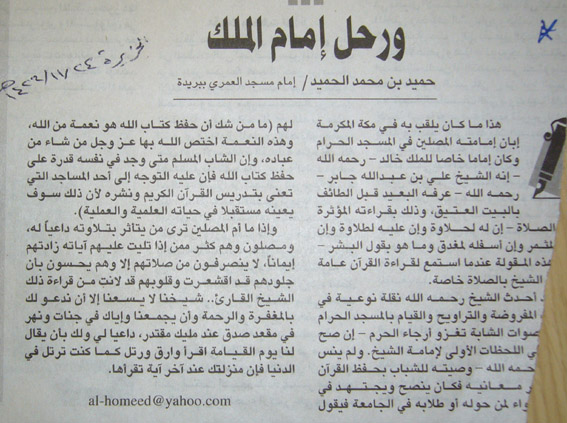
- ^ Arabic: جريدة الجزيرة : ورحل إمام الملك ! - العدد 12142 يوم الإثنين 24/11/1426, lit. 'Al-Jazirah Newspaper: The King’s Imam has departed! - Issue No. 12142, Monday 11/24/1426' "The king's imam has passed away". alijaber.net. 1 July 2008. Retrieved 29 September 2014.
- ^ "ومات صاحب الصوت الشجي". جريدة الرياض (in Arabic). Archived from the original on 2022-11-27. Retrieved 2025-09-13.
- ^ "Passing of Sheikh Ali Abdullah Jaber". www.facebook.com. Retrieved 2024-09-14.