1958 East German general election
16 November 1958
| ||||||||||||||||||||||
400 out of 466 seats in the Volkskammer | ||||||||||||||||||||||
|---|---|---|---|---|---|---|---|---|---|---|---|---|---|---|---|---|---|---|---|---|---|---|
| Turnout | 98.90% (0.49pp) | |||||||||||||||||||||
| ||||||||||||||||||||||
| ||||||||||||||||||||||
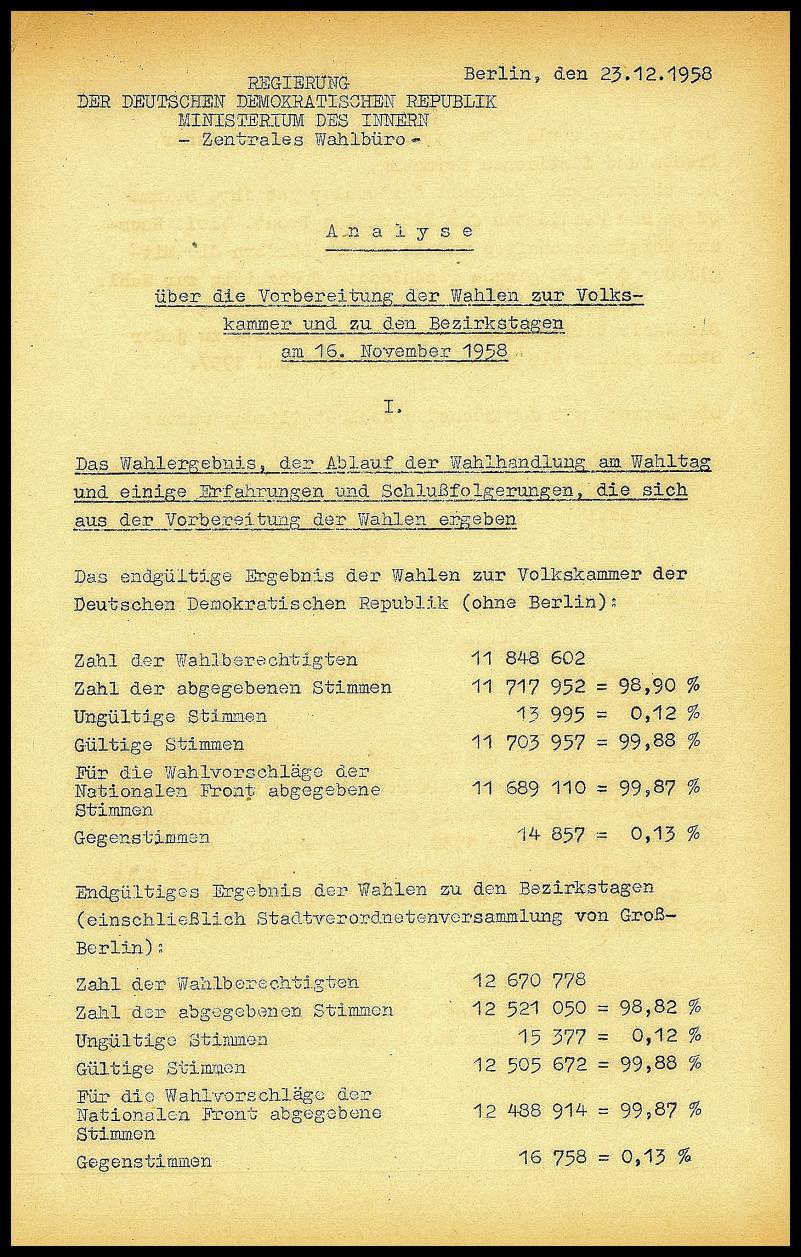
General elections were held in East Germany on 16 November 1958. There were 466 deputies in the Volkskammer, including 66 from East Berlin who were not directly elected but appointed by the Magistrate of East Berlin. All were candidates of the single-list National Front, dominated by the Socialist Unity Party of Germany. The list received the approval of 99.9% of voters, with turnout reported to be 98.9%.[1]
Like all East German elections before the Peaceful Revolution, this election was neither free nor fair. Voters were only presented with a closed list of candidates (pre-approved by the SED Central Committee Secretariat) put forward by the National Front. The list predetermined an outcome whereby the SED had both the largest faction in the Volkskammer and a majority of its members, as almost all of the Volkskammer members elected for one of the mass organizations were also members of the SED. While voters could reject the list, they would have to use the polling booth, the use of which was documented by Stasi informants located at every polling site, and had to cross out every name, as "Yes" and "No" boxes were removed after the 1950 election. Abstaining from voting was also seen as oppositional and punished. While legally permissible according to East German election laws, widespread election monitoring was not done out of fear for repression until the 1989 local elections.[2][3][4]
Results
| Party or alliance | Votes | % | Seats | +/– | |||
|---|---|---|---|---|---|---|---|
| National Front | Socialist Unity Party of Germany | 11,689,110 | 99.87 | 117 | 0 | ||
| Free German Trade Union Federation | 53 | 0 | |||||
| Christian Democratic Union | 52 | 0 | |||||
| Liberal Democratic Party of Germany | 52 | 0 | |||||
| National Democratic Party of Germany | 52 | 0 | |||||
| Democratic Farmers' Party of Germany | 52 | 0 | |||||
| Democratic Women's League of Germany | 29 | 0 | |||||
| Free German Youth | 29 | 0 | |||||
| Cultural Association of the GDR | 18 | 0 | |||||
| Peasants Mutual Aid Association | 12 | 0 | |||||
| Against | 14,857 | 0.13 | – | – | |||
| Total | 11,703,967 | 100.00 | 466 | 0 | |||
| Valid votes | 11,703,967 | 99.88 | |||||
| Invalid/blank votes | 13,995 | 0.12 | |||||
| Total votes | 11,717,962 | 100.00 | |||||
| Registered voters/turnout | 11,848,602 | 98.90 | |||||
| Source: German Federal Archives, Nohlen & Stöver[5] | |||||||
References
- ^ Analyse üver due Vorbereitung der Wahlen zue Volkskammer und zu den Bezirkstagen am 16. November 1958 Ministry of the Interior
- ^ Wahlen in der DDR (PDF) (in German). Federal Foundation for the Reappraisal of the SED Dictatorship. Retrieved 2025-12-04.
- ^ Bundesstiftung Aufarbeitung Brand (2022-08-08). MitBeStimmen: Wahlen in der DDR: So unterschiedlich sind Demokratie und Diktatur. Retrieved 2025-12-04 – via YouTube.
- ^ MDR Investigativ (2019-05-21). Wahlfälschung bei der DDR-Kommunalwahl 1989 - Der Anfang vom Ende | FAKT. Retrieved 2025-12-04 – via YouTube.
- ^ Dieter Nohlen & Philip Stöver (2010) Elections in Europe: A data handbook, p792 ISBN 978-3-8329-5609-7
